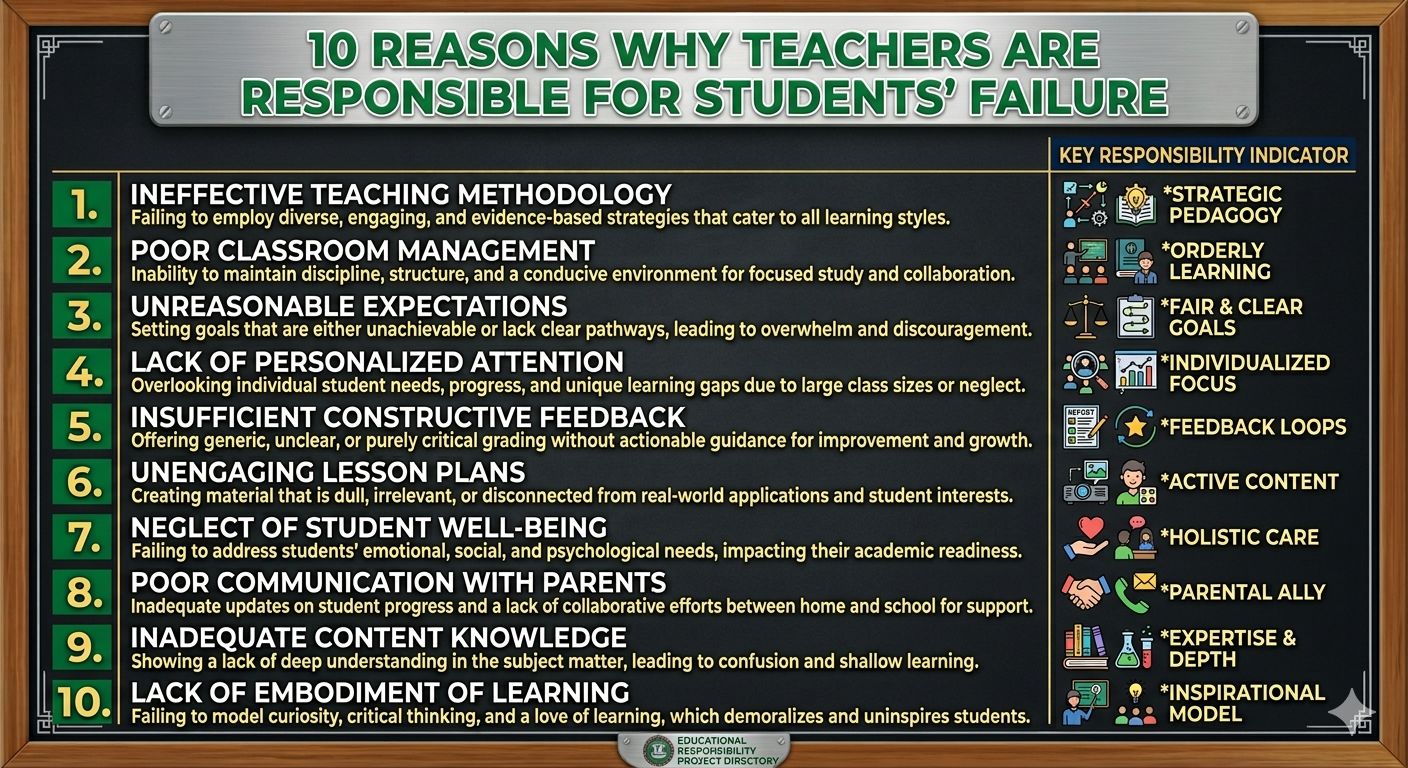
This post explains 10 reasons why teachers are responsible for students’ failure….
When students fail, the blame often falls entirely on them. But is that the full story?
The truth is more complex.
While students must take responsibility for their learning, teachers also play a critical role in shaping academic outcomes. In many cases, teaching methods, classroom environment, and support systems can significantly influence whether a student succeeds or struggles.
In this article, we explore 10 powerful reasons why teachers can contribute to students’ failure—not to blame, but to understand and improve the system.
10 reasons why teachers are responsible for students’ failure
1. Ineffective Teaching Methods
Not all teaching methods work for every student.
When teachers rely on outdated or one-size-fits-all approaches, students who learn differently may fall behind.
For example:
- Over-reliance on lectures
- Lack of visual or practical learning
- No interactive engagement
Result: Students lose interest and fail to grasp key concepts.
2. Poor Communication Skills
A teacher may know the subject—but struggle to explain it clearly.
Read now: JAMB 2026 Novel Summary: The Lekki Headmaster by Kabir Alabi Garba (Complete Guide)
When explanations are:
- Confusing
- Too fast
- Too complex
Students are left guessing instead of understanding.
Clarity is everything in teaching.
3. Lack of Passion or Motivation
Students can sense when a teacher is disengaged.
A teacher who:
- Shows no enthusiasm
- Rushes through lessons
- Avoids student interaction
…can create a dull learning environment.
Result: Students become unmotivated and disconnected.
4. Failure to Identify Struggling Students
Every classroom has students who need extra help.
When teachers fail to:
- Notice weak students
- Offer additional support
- Provide feedback
Those students quietly fall behind.
Early intervention can prevent failure.
See also: Farmer vs Doctor: 10 Compelling Reasons Why the Doctor Is More Important
5. Unfair Assessment and Grading
Sometimes, students fail not because they don’t understand—but because of:
- Poorly structured tests
- Biased grading
- Lack of clear marking schemes
Result: Students feel discouraged and misunderstood.
6. Lack of Classroom Management
A chaotic classroom is a barrier to learning.
If a teacher cannot:
- Control distractions
- Maintain discipline
- Create a focused environment
Students who want to learn may still fail.
7. Ignoring Different Learning Styles
Students learn in different ways:
- Visual learners
- Auditory learners
- Kinesthetic learners
When teaching doesn’t adapt to these differences, some students are left behind.
Flexibility in teaching is key.
8. Negative Attitude Toward Students
Words and attitude matter.
Teachers who:
- Label students as “weak”
- Show favoritism
- Discourage questions
…can damage a student’s confidence.
Result: Students stop trying—and performance drops.
Read now: How to Create Flashcards for Quick Revision: The Ultimate Guide for Nigerian Students
9. Lack of Feedback and Guidance
Students need direction to improve.
When teachers fail to:
- Provide constructive feedback
- Explain mistakes
- Guide improvement
Students repeat errors and continue failing.
10. Failure to Update Knowledge and Skills
Education is constantly evolving.
Teachers who don’t:
- Update teaching methods
- Learn new technologies
- Adapt to modern education trends
…risk becoming ineffective.
Continuous learning is essential for teachers too.
Important Note: It’s Not Only the Teacher
While teachers play a major role, student failure is usually a combination of factors:
- Student effort and discipline
- Home environment
- School resources
- Peer influence
Blaming only teachers is unfair—but ignoring their impact is also a mistake.
How This Problem Can Be Solved
To reduce student failure, schools should focus on:
- Teacher training and development
- Smaller class sizes
- Better teaching tools and resources
- Regular performance evaluations
- Encouraging student-teacher interaction
People Also Ask
Are teachers responsible for students’ success or failure?
Teachers play a major role, but success or failure is shared between students, teachers, and the learning environment.
Can a bad teacher cause students to fail?
Yes. Poor teaching methods, lack of support, and negative attitudes can significantly impact student performance.
Read more: Farmer vs Doctor: 10 Compelling Reasons Why the Doctor Is More Important
How can teachers help struggling students?
By offering:
- Extra support
- Clear explanations
- Encouragement
- Personalized teaching methods
Final Thoughts
Teachers are not the only reason students fail—but they are one of the most influential factors.
A great teacher can:
- Inspire
- Motivate
- Transform lives
While a poor teaching approach can:
- Discourage
- Confuse
- Limit potential
The goal isn’t to assign blame—but to improve the education system for better outcomes.