Struggling to remember what you study? You’re not alone. Many students spend hours reading but still forget key information when it matters most. The truth is—studying harder isn’t the answer. Studying smarter is.
In this guide, you’ll discover 7 powerful (and often overlooked) study methods that can help you learn faster, retain more, and perform better in exams.
Why Most Study Methods Don’t Work
Most students rely on:
Re-reading notes
Highlighting textbooks
Cramming before exams
These feel productive—but they’re not effective for long-term memory.
To truly improve, you need active, brain-based techniques that force your mind to engage, recall, and apply knowledge.
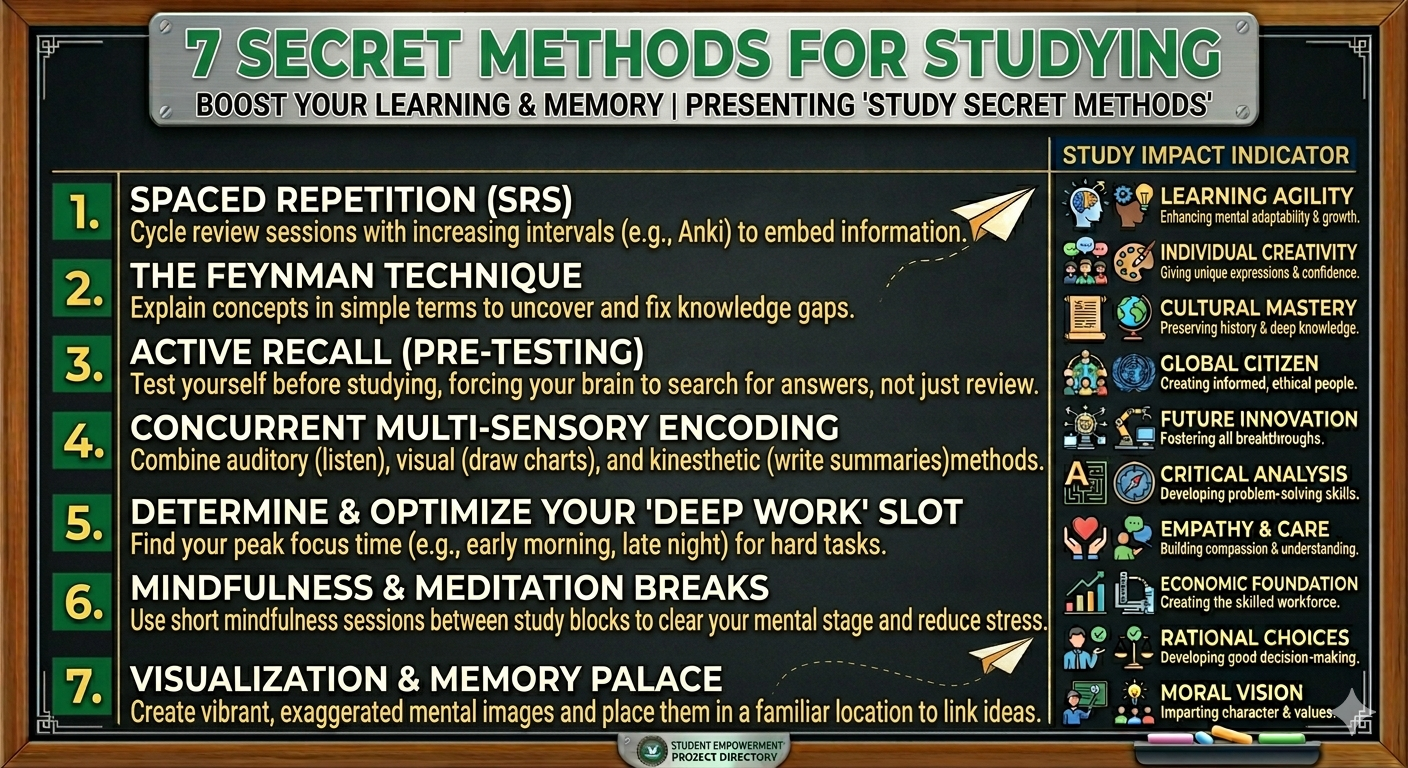
7 Secret Methods for Studying Effectively
1. Active Recall (The Memory Hack Top Students Use)
Instead of re-reading your notes, test yourself repeatedly.
How to use it:
Close your book
Write down everything you remember
Check what you missed
This strengthens memory far better than passive reading.
Read now: How to Use the Cornell Method to Take Better Lecture Notes (A Guide for Nigerian Students)
2. Spaced Repetition (Stop Cramming Forever)
Study information over time, not all at once.
Example:
Day 1: Learn topic
Day 2: Review
Day 4: Review again
Day 7: Final review
This method helps move information into long-term memory.
3. The Feynman Technique (Learn by Teaching)
If you can explain it simply, you truly understand it.
Inspired by Richard Feynman, this method is simple:
Steps:
Pick a topic
Explain it like you’re teaching a child
Identify gaps
Simplify and repeat
This exposes weak areas instantly.
4. Blurting Method (Brain Dump Technique)
This is a powerful exam prep trick.
How it works:
Study a topic
Close your notes
Write everything you remember (no looking)
Then compare with your notes and fill gaps.
This method improves:
✔ Memory
✔ Speed
✔ Confidence
5. Interleaving (Mix Your Subjects)
Instead of studying one subject for hours, switch between topics.
Example:
1 hour Math
1 hour Biology
1 hour English
This improves problem-solving and prevents boredom.
Read also: The Importance of Girl Child Education in Nigeria Debate: Why It Matters More Than Ever
6. Study with the Right Environment
Your environment affects your focus more than you think.
Tips:
Use instrumental music or white noise
Keep your desk clean
Turn off notifications
Study in short, focused sessions
A focused environment = better retention.
7. The 2-Hour Deep Focus Rule
Instead of studying all day, aim for 2–4 hours of deep, distraction-free study.
How:
Use a timer (50 min study, 10 min break)
Avoid multitasking
Focus on one task at a time
Quality beats quantity every time.
Bonus Tips to Study Smarter
✔ Use flashcards for quick revision
✔ Sleep well—your brain processes memory during sleep
✔ Stay hydrated and eat brain-friendly foods
✔ Practice past questions regularly
Read more: How to Handle Panic Attacks in the Exam Hall: A Survival Guide for Nigerian Students
Common Study Mistakes to Avoid
Cramming the night before exams
Studying without testing yourself
Multitasking (phone + books)
Skipping breaks
Relying only on highlighting
People Also Ask
What is the most effective study method?
Active recall combined with spaced repetition is considered the most effective method.
How can I study faster and remember more?
Use techniques like blurting, teaching others, and reviewing information over time.
How many hours should I study daily?
2–4 hours of focused study is often more effective than long, unfocused sessions.
Final Thoughts
You don’t need to study longer—you need to study smarter.
These 7 secret study methods can completely transform how you learn, helping you:
✔ Remember more
✔ Understand faster
✔ Perform better in exams
Start with just one or two methods today, and you’ll quickly notice the difference.
Your Next Step
Pick one method—like active recall or blurting—and try it in your next study session.
Consistency is what turns these techniques into results.