7 Winning Points: Religious Studies Should Be Made Compulsory for All Students
Good day, fellow students and debaters! Are you preparing to take the stage and defend the need for God in our curriculum? You have come to the right place.
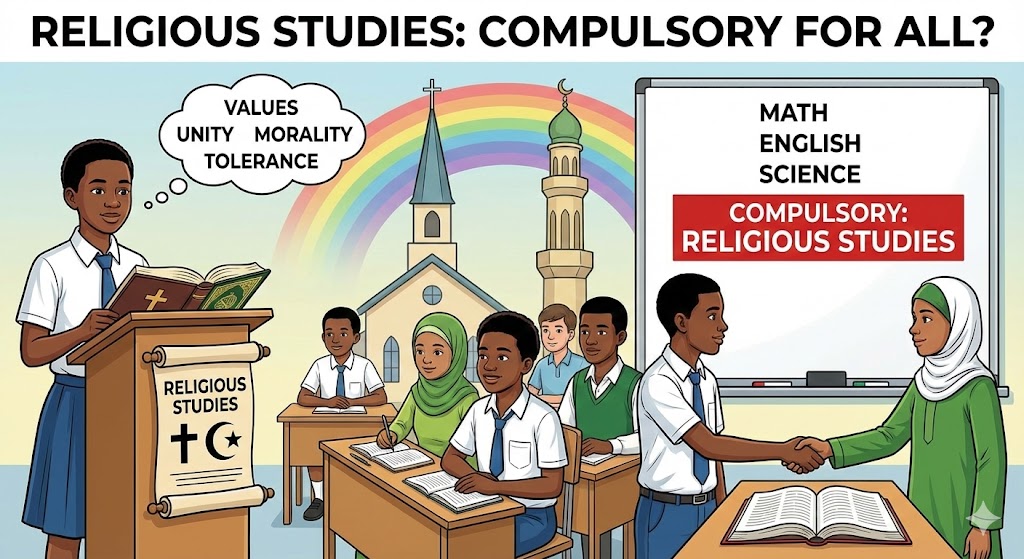
If you are supporting the motion that Religious Studies Should Be Made Compulsory for All Students, you are fighting for the soul of our education system. In a world—and a country—facing moral challenges, this subject is not just about prayers; it is about building better human beings.
This article provides debate points supporting one side of the motion for educational purposes. We respect all beliefs and understand that education policy is a complex topic. These arguments are crafted to help you win your specific debate round.
Winning Debate Points on Why Religious Studies Should Be Made Compulsory for All Students
Here are the arguments that will help you convince the judges and the audience. Pick the ones that resonate best with you and deliver them with confidence.
1. It Curbs Moral Decadence in Schools
My first point addresses a problem we all see every day: bad behavior. Bullying, stealing, disrespecting teachers—these issues are rising in our secondary schools. Why? Because students are losing their moral compass.
Religious studies—whether CRS or IRS—teaches us the difference between right and wrong. It instills the fear of God and the love for our neighbors. When a student understands that their actions have spiritual consequences, they think twice before doing something bad. Just like we discussed in our list of debate topics for Nigerian schools, moral topics are always relevant because they touch the heart of society. Making this subject compulsory is the first step to fixing our behavior.
2. Promoting Religious Tolerance and Unity
Let’s face reality. In Nigeria, we have people of different faiths living side by side. Most conflicts happen because of ignorance. We fight what we don’t understand.
If Religious Studies is compulsory, a Christian student learns about the values of Islam, and a Muslim student learns about the teachings of Christianity. Knowledge kills fear. By studying these texts in a classroom setting, we learn that both religions preach peace, love, and charity. This promotes unity. According to a UNESCO report on Intercultural Dialogue, education is the most powerful tool to prevent conflict and build peace between different groups. We need this unity now more than ever.
3. Strengthening Mental and Emotional Health
School can be stressful. We worry about exams, we worry about the future, and we face peer pressure. Where do students find hope?
Religious studies provide spiritual stability. It teaches us that we are not alone and that there is a higher purpose for our lives. This belief system is a strong anchor for mental health. When a student is depressed or anxious, the lessons learned in religious classes—lessons about patience, prayer, and faith—can be a lifeline. It is not just about passing an exam; it is about surviving life’s challenges.
4. Preserving Our Cultural Values
Our religion is often tied deeply to our culture and our identity as Africans. We are a people who respect elders, value community, and cherish the family unit.
By making Religious Studies Should Be Made Compulsory for All Students, schools ensure that these traditional values are not lost to western influence or social media trends. It keeps us grounded. If you remove religion from the curriculum, you are slowly erasing a huge part of who we are.
5. Combatting Extremism with True Knowledge
This might sound surprising, but the best way to fight religious extremism is through more religious education, not less. Extremists prey on people who are ignorant about their own holy books.
When schools teach religious studies using a standardized, government-approved syllabus, students learn the true meaning of their texts—which is usually peace and submission to God. They become immune to the lies of radicals who try to twist religion for violence. The classroom is the safest place to learn about God.
6. Building Future Leaders with Integrity
We always say that “youths are the leaders of tomorrow.” But what kind of leaders are we raising? Are we raising smart thieves? Or intelligent leaders with a conscience?
A leader without the fear of God is a dangerous leader. By making this subject compulsory, we are planting seeds of integrity in the future governors, presidents, and CEOs of this country. This is as important as developing effective study habits; academic brilliance without character is a disaster waiting to happen. We need leaders who answer to a higher power.
7. It Provides a Complete Education
Finally, let’s look at the definition of education. Education is supposed to develop the “whole child”—mentally, physically, and spiritually.
If we teach Mathematics for the brain and Physical Education for the body, but we ignore the spirit, the education is incomplete. To produce a balanced citizen, the school system must address the spiritual side of the student. Much like the protocols in our guide on how to start a debate greeting in school, there is a structure to education that must be respected. Leaving out religion creates a vacuum that will be filled with the wrong things.
Frequently Asked Questions (FAQs)
Q: Won’t this force religion on students who don’t believe? A: Not necessarily. The academic study of religion is about learning the history, moral codes, and impact of faith. It doesn’t force conversion; it forces understanding.
Q: How do I handle opponents who say religion causes division? A: Acknowledge that misunderstood religion causes division. Argue that the solution to misunderstanding is education. That is exactly why it should be taught in schools—to correct those misunderstandings before they become conflicts.
Q: Can I use quotes from Holy Books? A: Yes! Using a verse from the Bible or Quran to support a point on morality is very effective. Just keep it brief and relevant to the argument.
Conclusion / Summary
In conclusion, the motion that Religious Studies Should Be Made Compulsory for All Students is not just about religion; it is about saving our society. It is about building character, fostering unity, and ensuring that the next generation has a strong moral foundation.
We cannot rely on Mathematics to teach us mercy, or Physics to teach us forgiveness. Those lessons come from Religious Studies.
As noted by the outcome of many educational summits, a value-based curriculum is essential for national development. Let us support a system that trains the heart as well as the head.
What is your take on this? Do you think religion has a place in every classroom? Drop your comment below and share this script with your debate team!