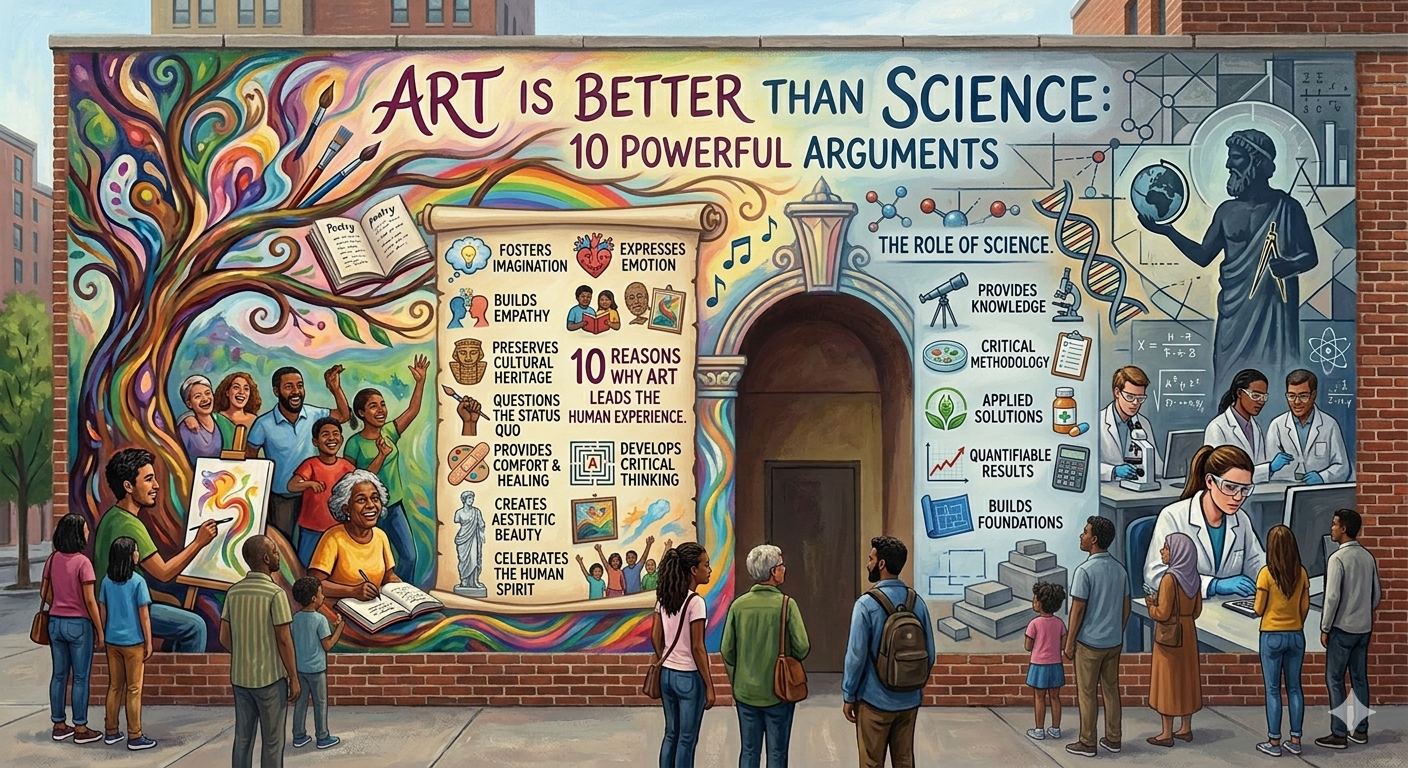
Art Is Better Than Science: 10 Powerful Arguments
A full debate guide covering both sides — for Nigerian school students and debaters
Debate Topic: Art Is Better Than Science | Proposition & Opposition | Nigerian Schools | Both Sides
Introduction: The Debate That Science Always Thinks It Has Already Won
Here is how this debate usually begins. The science class walks in with supreme confidence. They have been told, every year, that they are the smart ones — that their subjects are the harder ones, that their career options are the more prestigious ones, that their contribution to society is the more essential one.
They have been told that medicine, engineering, and technology are the future. That the arts class is for students who could not make the cut for science. That in a country like Nigeria, struggling to industrialise and digitalise, the arts are a luxury that the nation can barely afford.
They are wrong. And this blog post explains exactly why.
The debate topic ‘Art is better than science’ is one of the most stimulating and most personally invested topics in Nigerian secondary school competition debating.
It is stimulating because it requires students to look beyond the obvious social prestige of science careers and engage seriously with the genuine, documented, and often underappreciated contributions that the arts make to human society. It is personally invested because every student in the debate hall belongs to one of these classes and has built part of their identity around that belonging.
This guide covers both sides in full — ten strong, fully developed arguments for why art is better than science, and five powerful counterarguments from the science side with the responses that defeat them.
You will also find a complete sample speech for the art side, a rebuttal toolkit, eight performance tips, and a FAQ section. Whether you are arguing the proposition, preparing to defeat the opposition, or simply exploring this rich debate topic, everything you need is here.
One note on terminology: throughout this guide, ‘art’ and ‘arts’ refer broadly to the humanities, social sciences, creative disciplines, and language studies — Literature, History, Government, Economics, Languages, Philosophy, Music, Visual Art, Drama, and allied fields. ‘Science’ refers to the natural sciences, mathematics, and applied technical fields — Physics, Chemistry, Biology, Mathematics, Computer Science, Engineering, and Medicine. Both are understood as genuinely valuable — the argument here is about which is better, not about which is worthless.
Read now: 6 Winning Points: Social Media Has Done More Harm Than Good to Nigerian Teenagers
SEO NOTE: This article is optimised for searches including ‘art is better than science debate points’, ‘why arts is better than science Nigeria’, ‘art vs science debate secondary school’, and ‘arguments for art over science’. Share with classmates preparing for the same topic.
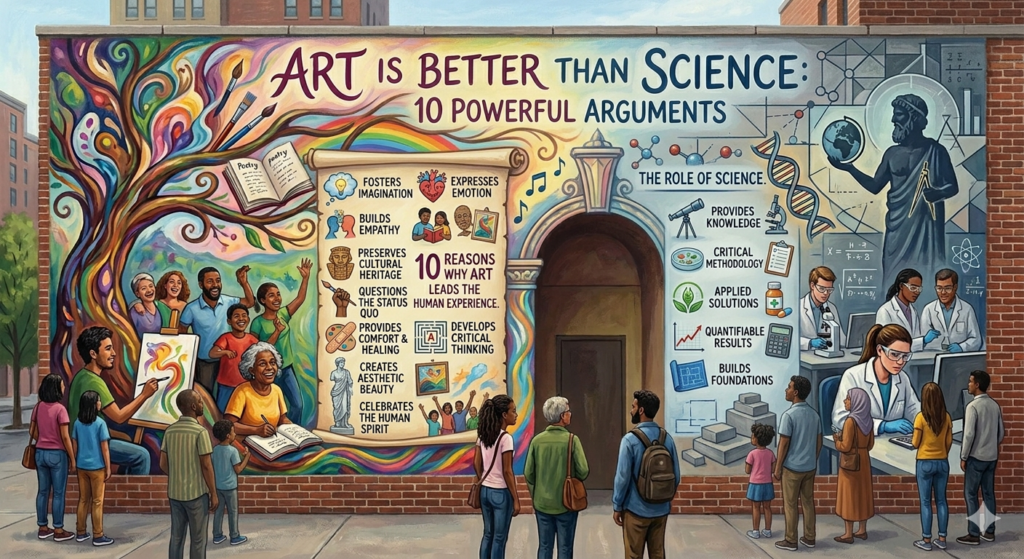
Art vs Science: A Quick Snapshot
| Dimension | Art (Humanities & Social Sciences) | Science (Natural Sciences & STEM) |
| Core strength | Understanding, interpreting, and communicating human experience | Explaining, predicting, and manipulating the physical world |
| Develops primarily | Empathy, communication, critical reading, ethical reasoning | Quantitative reasoning, logical precision, experimental method |
| Nigerian career examples | Law, journalism, governance, teaching, writing, diplomacy | Medicine, engineering, pharmacy, technology, architecture |
| Cultural contributions | Literature, Nollywood, Afrobeats, journalism, governance | Medical advances, infrastructure, technology platforms |
| Questions addressed | What should we do? What does this mean? Who are we? | How does it work? What causes this? How can we measure it? |
| Greatest Nigerian names | Achebe, Soyinka, Fela, Adichie, Saro-Wiwa, Azikiwe | Philip Emeagwali, Okonjo-Iweala (economics crossover) |
| What fails without it | Justice, democracy, culture, meaning, identity | Medicine, infrastructure, technology, food security |
| Argument for being better | Addresses the why and the who — the purpose of all human activity | Addresses the how — enables many human activities |
Ten Reasons Why Art Is Better Than Science
The following ten arguments make the full case for why art — broadly understood as the humanities, social sciences, and creative disciplines — is better than science. Each is written for a Nigerian audience with specific Nigerian examples and ends with a debate-ready line you can use in competition.
Reason 1 [Art Is Better]: Art Answers the Questions That Actually Drive Human Life
Science is extraordinarily good at answering questions that begin with ‘how’: how does the heart pump blood, how does gravity work, how does a computer process information, how can we design a bridge that does not collapse. These are important questions. But they are not the questions that drive the deepest decisions of human life.
The questions that actually drive human life begin with ‘why’ and ‘what’: why are we here, what makes a life worth living, what do we owe to each other, what makes something beautiful, what makes an action just, and what does it mean to be Nigerian, to be Yoruba, to be a woman, to be alive in this specific time and place.
These questions — the ones that philosophy, literature, history, religious studies, and the arts address — are not secondary to the questions science asks. They are prior to them. Before you can decide which scientific projects are worth pursuing, you need values that tell you what is worth pursuing. Before you can apply medical knowledge ethically, you need a moral framework that science itself cannot provide.
Before you can use engineering to build infrastructure, you need a vision of what kind of society you are building that infrastructure for. Art and the humanities provide this foundational layer of human understanding — the why that gives all the how its direction and purpose.
Chinua Achebe did not write Things Fall Apart to describe Igbo biochemistry or to explain the physics of the Niger Delta’s climate. He wrote it to answer a far more important question: who are we, what did we lose, and what does it mean for a people to have their story told only by those who conquered them? That question — and Achebe’s answer — changed how Africa was understood globally in a way that no scientific discovery has ever done. The question was an arts question. The answer was an arts achievement.
DEBATE LINE: “Science tells you how the world works. Art tells you what the world is for. You need to know what the world is for before you can decide how to use how it works. The why always comes before the how. Art asks the why. That makes art more fundamental, more necessary, and more genuinely important than science.”
Reason 2 [Art Is Better]: Nigeria’s Most Globally Recognised Achievements Are Arts Achievements
When the world thinks of Nigeria, what comes to mind? The oil fields? The refineries? The engineering projects? These things exist, but they are not what has given Nigeria its cultural footprint in the global imagination. What has given Nigeria its global cultural footprint is art.
Chinua Achebe’s Things Fall Apart — translated into more than sixty languages and taught in universities on six continents — is Nigeria’s single most internationally recognised cultural product. Wole Soyinka’s Nobel Prize in Literature made Nigeria the first African country to win this award. Nollywood’s emergence as the world’s second-largest film industry by volume has made Nigerian storytelling a global phenomenon.
Check out: The Lekki Headmaster: Themes and Symbolism (Complete Literature Guide)
Afrobeats — the musical genre pioneered by Fela Kuti and carried into the twenty-first century by Burna Boy, Wizkid, Davido, and dozens of other Nigerian artists — is now played in clubs, on playlists, and at parties from Lagos to London to Los Angeles.
Nigerian fashion designers, Nigerian visual artists, and Nigerian writers are achieving international recognition at a rate that no other sector of Nigerian society is matching. The soft power that Nigeria exercises in global culture — the ability to shape how the world thinks, feels, and identifies with Nigerian experience — is entirely an arts achievement.
Science has produced important technical outputs in Nigeria — the computer scientist Philip Emeagwali’s work on parallel processing, the contributions of Nigerian medical researchers to understanding tropical diseases.
These are genuine and important. But they do not compare, in terms of global cultural impact, to the arts achievements that have made Nigeria one of the most culturally influential countries on the African continent. If we measure better by which discipline has most powerfully put Nigeria on the global map, art wins decisively and comprehensively.
DEBATE LINE: “Ask anyone outside Africa what they know about Nigeria. The answer is Achebe’s novel, Soyinka’s poetry, Nollywood films, Afrobeats music. These are arts achievements. Nigeria’s global reputation — the cultural soft power that draws investment, tourism, and international respect — was built by artists, writers, and musicians, not by engineers and chemists. Art put Nigeria on the world map. Science has not matched it.”
Reason 3 [Art Is Better]: Art Builds Empathy — the Foundation of Every Functioning Society
A society is not a collection of technical systems — power grids, road networks, hospital buildings. A society is a community of people who must find ways to live together, cooperate despite differences, resolve conflicts without violence, and maintain the minimum of mutual understanding and trust that makes collective life possible.
The capacity that makes this possible is empathy — the ability to understand another person’s experience, perspective, and interests from the inside. And empathy is not built by science. It is built by art.
When a Nigerian student reads Things Fall Apart and inhabits the inner life of Okonkwo, or reads Purple Hibiscus and understands the psychology of domestic violence from the perspective of a child who loves and fears her father simultaneously, or reads Death and the King’s Horseman and grapples with the genuine dignity and the genuine tragedy of a cultural tradition that colonialism refuses to understand — that student is developing a capacity for human understanding that no chemistry practical, no physics calculation, and no programming exercise can develop. The empathetic imagination that literature cultivates is one of the most practically important human capacities there is.
The failures of Nigerian governance, the persistence of corruption, the ethnic and religious tensions that periodically fracture the country’s social fabric — these are not failures of technical knowledge. They are failures of empathy, of the capacity to see other people’s humanity, to understand other communities’ legitimate interests, and to find common ground across difference.
Art — specifically literature, drama, music, and the social sciences — is the educational medium through which this empathetic capacity is most effectively developed. Nigeria’s social problems require art’s solutions.
DEBATE LINE: “The doctor understands the human body. The artist understands the human being who inhabits it. Empathy — the capacity that holds communities together, that makes governance humane, that prevents the conflicts that destroy everything science builds — is developed through art. A Nigeria of technically brilliant but empathetically impoverished people is a Nigeria whose science achievements will ultimately be consumed by its social failures. Art prevents those failures. That is a better contribution.”
Reason 4 [Art Is Better]: Art Preserves and Transmits Culture — Science Cannot
Nigeria’s cultural heritage — its languages, its oral traditions, its stories, its music, its visual arts, its philosophical and spiritual traditions, its accumulated wisdom about how to live well and die well and raise children and resolve conflict and govern a community — is among the most diverse and richest on the African continent.
This heritage is carried, transmitted, and preserved by artists, writers, musicians, historians, and storytellers. Remove them and the heritage is lost. Once lost, it cannot be recovered by any scientific method.
The Yoruba language, with its tonal complexity, its proverb-rich literary tradition, its extensive oral literary heritage, and its living role as one of the world’s most widely spoken indigenous African languages, is maintained and developed by linguists, poets, novelists, dramatists, and musicians who work within that language.
The Igbo tradition of oral narrative, the Hausa tradition of epic poetry, the Efik theatrical tradition, the Ijaw water spirit masquerade — all of these cultural forms that make Nigeria’s internal diversity so extraordinarily rich depend on arts practitioners for their survival.
When a people loses its language, its stories, and its cultural memory, it loses something that science cannot restore. You cannot discover a lost language by running an experiment. You cannot reconstruct a vanished oral tradition from a chemical analysis.
The UNESCO estimate that a language dies every two weeks globally — and that most of the languages dying are indigenous languages — is a cultural catastrophe that science cannot address and that only arts-based cultural preservation work can slow. In Nigeria, where scores of indigenous languages are endangered, the work of arts scholars, writers, and cultural practitioners is genuinely preservation of irreplaceable human heritage.
DEBATE LINE: “When a culture is lost, it is gone forever — no laboratory can recover it. Nigeria has over 500 languages and millennia of oral tradition, story, music, and wisdom. Art preserves this heritage. Art transmits it to the next generation. Art keeps Nigerian identity alive. Science cannot do any of this. The preservation of who we are — as Nigerians, as Yoruba, as Igbo, as Hausa — is an arts function. That work is more important than any physical infrastructure, because without it, there is no people to build the infrastructure for.”
Reason 5 [Art Is Better]: Art Provides the Ethical Framework That Science Desperately Needs
The history of the twentieth century demonstrates, with terrifying clarity, that scientific knowledge without ethical guidance is not a force for human flourishing but a force for human destruction.
The scientific knowledge that produced penicillin also produced mustard gas. The physics that enabled nuclear power also enabled the atomic bomb. The chemistry that enables agricultural pesticides also enabled nerve agents. The biology that enables medical treatment also enabled the concentration camp experiments that are among history’s most horrific crimes. Science produces power. Power without ethics is catastrophe.
Every major debate about the application of scientific knowledge — should we use this technology, should we conduct this research, who should benefit from this discovery, who should pay for this risk, what limits should govern this application — is an ethical debate that science itself cannot resolve.
The ethics of gene editing, the privacy implications of surveillance technology, the justice of who has access to life-saving medicines, the environmental responsibility of industrial development — these are arts questions. They are questions that require the philosophical training, the historical perspective, the legal reasoning, and the ethical analysis that arts education develops.
In Nigeria, the ethics of the relationship between multinational oil companies and Niger Delta communities — the question of who owns the resources beneath the land, who bears the cost of environmental damage, what justice requires in the aftermath of decades of extraction — is an arts question of the highest urgency.
The science of oil extraction is clear. The ethics of it is contested, complex, and urgently in need of the kind of rigorous, historically-grounded, philosophically-informed analysis that arts education produces. Science cannot govern itself. Art provides the governance that science needs.
DEBATE LINE: “Nuclear weapons were built by scientists. The decision about whether to use them — the most consequential decision in human history — required ethics, law, philosophy, and political theory. Every time science produces a new power, art must decide whether and how it should be used. The ethical framework that governs what science does with its power was built by art. Without art, science is a powerful engine with no steering wheel.”
Reason 6 [Art Is Better]: Communication and Language Are Art’s Domain — and Communication Drives Everything
Consider the chain of events that leads from a scientific discovery to a genuine improvement in human life. A researcher makes a discovery in the laboratory. They write a paper, published in a journal, that requires clear, precise, and persuasive scientific writing — an arts skill. The paper must be evaluated by peer reviewers who assess not only its scientific validity but the quality of its reasoning and presentation — arts skills.
If the discovery is important enough to attract public attention, a science journalist must translate it from technical language into terms that policymakers, funding bodies, and the general public can understand — an arts skill. Policymakers must then be persuaded that this discovery should inform a change in practice or policy — requiring advocacy, argumentation, and political communication — arts skills.
See now: The Lekki Headmaster: Themes and Symbolism (Complete Literature Guide)
Without the arts skills of writing, communication, advocacy, and translation between technical and public discourse, the scientific discovery never reaches the people it is supposed to benefit. The vaccine sits in a laboratory notebook. The engineering innovation never gets funded. The medical insight never changes clinical practice. The entire pathway from scientific knowledge to human benefit is paved with arts skills — and when those arts skills are absent, the pathway is broken.
In Nigeria, the communication gap between scientific knowledge and public understanding is a genuine public health problem. The vaccine hesitancy that has periodically undermined immunisation campaigns is not a failure of vaccine science — it is a failure of health communication, which is an arts function.
The public mistrust of scientific institutions that allows pseudoscientific health advice to spread more widely than evidence-based guidance is a communication failure that arts-trained health communicators, journalists, and educators must address. Science without communication is science that never changes the world. Art provides the communication.
DEBATE LINE: “The scientific discovery that never gets communicated never changes the world. The cure that never gets explained is never used. The technology that nobody understands is never adopted. Communication — the arts skill of translating knowledge into language that moves people to action — is what bridges scientific discovery and human benefit. Art does not merely describe science. Art delivers it to the people it is supposed to serve.”
Reason 7 [Art Is Better]: Art Drives the Creative Economy — Nigeria’s Most Promising Growth Sector
Nigeria’s economic future cannot rest on oil. Every serious economist who has studied the Nigerian economy agrees: diversification away from petroleum dependence is not optional — it is existential. Among the alternative economic engines that have the greatest potential to generate widespread, sustainable employment and foreign exchange, the creative economy stands out as Nigeria’s most distinctive competitive advantage.
Nollywood already generates over one billion dollars in annual revenue and employs over a million people directly and indirectly. Nigerian music — Afrobeats, Afropop, Afro R&B — generates hundreds of millions of dollars annually in streaming revenue, live performance income, and brand partnership deals, with artists like Burna Boy, Wizkid, and Davido achieving global superstar status that brings international attention and tourism interest to Nigeria.
Nigerian fashion designers, visual artists, craft producers, and digital content creators are building export-oriented businesses that are, in many cases, more internationally competitive than anything the formal industrial sector produces.
This creative economy is entirely an arts economy. It is built by people who studied literature and discovered they could write. Who studied visual art and discovered they could direct. Who studied drama and discovered they could act, produce, and build entertainment businesses. Who studied music and discovered they could compose the rhythms that the world wanted to dance to.
The arts student who seems to be studying something useless in the classroom is often the student who will build the most valuable, most globally competitive, and most distinctively Nigerian businesses of the next generation. The creative economy is the arts student’s economy. And it is Nigeria’s future.
DEBATE LINE: “Nollywood employs a million Nigerians and earns over a billion dollars a year. Afrobeats fills stadiums in London, New York, and Paris. Nigerian fashion is on international runways. This is the creative economy — Nigeria’s most globally competitive economic sector — and it was built entirely by arts students. The diversified, non-oil Nigerian economy of the future will be built substantially on creative industries that art makes possible. Art is not studying for unemployment. Art is building the economy that science alone cannot.”
Reason 8 [Art Is Better]: Art Humanises the World That Science Builds
Science builds things: medicines, machines, systems, structures. These things are enormously useful. But usefulness is not the same as meaning, and the world that science builds, without the humanising contribution of art, is a world of impressive functionality with an absence of the meaning, the beauty, and the emotional depth that make human life genuinely worth living.
Think about the built environment of any Nigerian city. The functional roads, the concrete block buildings, the industrial warehouses, the electricity pylons — these are science and engineering products. They work. They function. And they would be a profoundly impoverished place to live if they were all there was. The murals that transform bare concrete walls into community art.
The music that fills the streets of Lagos with a joyful, rhythmically complex soundtrack. The architecture that takes the functions of shelter and space and transforms them into beauty — as the Portuguese-influenced architecture of Lagos Island does, as the traditional Hausa mud architecture of Kano does, as the mud-relief art of Benin’s palace walls does. These are art’s contributions to the built world that science constructs.
The Nigerian who sits in their hospital waiting room — a space built and equipped by science — benefits from better mental health and lower anxiety if that space has been thoughtfully designed with colour, natural light, comfortable seating, and visual art on the walls. The recovery rate of patients in hospitals has been shown in medical research to improve when the environment includes natural elements, beauty, and art. Science builds the hospital. Art makes it heal. This collaboration is not optional — it is the condition for the fullest human benefit of everything that science makes possible.
DEBATE LINE: “Science builds the world. Art makes it worth living in. The hospital built by science heals the body. The music that fills the ward heals the spirit. The painting in the corridor reduces anxiety and speeds recovery. Art does not merely decorate the world that science builds — art completes it, humanises it, and makes it a place where human beings can not only survive but flourish. Without art, science’s greatest achievements produce only functional machines for human habitation. With art, they produce home.”
Reason 9 [Art Is Better]: Art Is the Language of Justice — and Justice Is Society’s Highest Purpose
Every society’s most fundamental obligation to its members is justice — ensuring that rights are protected, that power is accountable, that the vulnerable are defended, and that the resources of the community are distributed in accordance with principles that reasonable people can endorse. The pursuit of justice is not a scientific project. It is a philosophical, legal, literary, and political project — it is an arts project.
See also: Farmer vs Doctor: 10 Compelling Reasons Why the Doctor Is More Important
The Nigerian legal system — the entire apparatus of courts, lawyers, judges, constitutional scholars, and legal academics that adjudicates disputes, protects rights, and holds state power to account — is an arts institution built and staffed by arts graduates.
The Nigerian journalism that has most powerfully exposed corruption, challenged impunity, and given voice to communities without power — from the investigative journalism of Tell Magazine and Newswatch in the 1980s and 1990s to the digital advocacy journalism of today — was and is done by arts graduates.
The civil society organisations that advocate for the rights of marginalised communities, the gender equality advocates, the environmental justice campaigners who fight for Niger Delta communities — these are led by people whose educational formation was in the humanities and social sciences.
Ken Saro-Wiwa, executed by the Abacha regime in 1995 for his advocacy on behalf of the Ogoni people’s environmental and human rights, was a writer — an arts graduate who understood that the most powerful weapon available to a community without military or financial power is the word: the ability to document, to witness, to name injustice, and to make it visible to the world in terms that the world cannot ignore. His pen was mightier than the sword that killed him. That pen — the pen of art — is the instrument of justice. And justice is what every other human achievement, including science, ultimately exists to serve.
DEBATE LINE: “The courts that protect your rights were built by lawyers — arts graduates. The journalism that exposed the corruption that diverted your school’s budget was written by journalists — arts graduates. The advocate who fought for your community’s land rights was trained in law and philosophy — arts disciplines. Justice — society’s highest purpose — is an arts project. And the discipline that serves society’s highest purpose is the discipline that is best.”
Reason 10 [Art Is Better]: The Greatest Human Beings Were Formed by the Arts — Not by Science
If we ask which discipline has produced the human beings whose lives and work we most admire, most draw inspiration from, and most wish to emulate — the people whose names we invoke when we want to describe what human greatness looks like — the answer is overwhelmingly the arts. Nelson Mandela was trained as a lawyer.
Mahatma Gandhi was a lawyer who became a philosopher of non-violent resistance. Martin Luther King Jr. was a theologian and a preacher — a student of religion, rhetoric, and the African American literary tradition.
Nnamdi Azikiwe, Nigeria’s first President, was a journalist and a political thinker. Obafemi Awolowo was a lawyer who became one of Nigeria’s most visionary political minds. Aminu Kano was a teacher and a political activist.
These are not coincidences. They reflect something real about the relationship between arts education and the formation of the kind of human being who uses their life in the service of justice, human dignity, and social transformation.
The arts disciplines — philosophy, literature, history, law, theology, rhetoric — are the disciplines that most directly engage with the questions that great leadership requires: what is right, what is just, what do human beings owe to each other, and what does it mean to live a life that matters? These questions are the arts’ domain. The people who wrestle most seriously with them produce the leaders who change the world for the better.
Science has produced great people too — Marie Curie, Nikola Tesla, Albert Einstein. These are genuine heroes of human intellectual history. But the greatness they embody is the greatness of discovery — of adding to human knowledge.
The greatness of the arts figures cited above is a different and, in the context of human social life, more directly impactful greatness: the greatness of transformation — of changing how human beings treat each other and how societies are organised. Both forms of greatness matter. But the form that most directly determines whether human life is lived in dignity or in oppression is the arts form. And that makes it better.
DEBATE LINE: “Mandela was a lawyer. Gandhi was a philosopher. Azikiwe was a journalist. Awolowo was a legal and political thinker. The human beings who most changed the world for the better — who dismantled apartheid, who won independence, who built democratic institutions where there were none — were formed by the arts. They studied the questions that matter most: what is just, what do we owe each other, what does dignity require? The discipline that forms the greatest human beings is the better discipline. That discipline is art.”
Check out: 10 Powerful Points: Why a Doctor Is More Important Than a Teacher
Defeating the Opposition: Science’s Best Arguments and How to Answer Them
In any debate on this topic, the science side will use several standard arguments. Here is how to defeat each one.
Science Responds: ‘Science saves lives — medicine and engineering are indispensable’
This is the science side’s strongest argument, and it deserves a careful, honest response rather than a dismissive one. The response has three parts. First: acknowledge it genuinely. Yes, doctors save lives. Yes, engineers build bridges. Yes, pharmaceutical scientists develop the medicines that treat disease. We honour these contributions completely.
Second: point out the ethical and communication dimensions of medicine that belong to art. The doctor who saves a life uses medical knowledge produced by science — but uses it through the doctor-patient relationship, the communication of diagnosis and treatment, the ethical framework of informed consent and patient dignity, and the empathetic engagement with the frightened person in the bed, all of which are arts-derived capacities.
The health policy that determines which medicines are available to which Nigerian communities, at what price, with what insurance support, is a policy question — a political and ethical question — not a scientific one.
Third: reframe the comparison. The question is not whether science contributions are important — they are. The question is which discipline is better. ‘Better’ is not exclusively determined by ‘saves lives in medical emergencies.’
By the standard of contributing to the fullness of human life — its meaning, its justice, its beauty, its cultural richness, its social cohesion — art makes contributions that are not less important than those science makes. They are differently important, and the arts’ contributions to the dimensions of human life that make it most worth living are genuinely superior.
REBUTTAL LINE: “The doctor saves the life. The artist makes that life worth living. The engineer builds the hospital. The lawyer ensures that the hospital treats every patient with dignity regardless of wealth. Both the life-saving and the meaning-making are necessary. But the meaning-making — the arts contribution — addresses the question of what all the life-saving is for. That question is prior to and more fundamental than the technical questions science answers.”
Science Responds: ‘Science is more rigorous and intellectually demanding’
This argument claims that solving a physics problem is harder than writing a literary essay, and that the greater difficulty proves the greater quality of science students and the superior value of their discipline. There are two responses.
First: challenge the premise. The arts have their own forms of rigour that are no less demanding than those of science, though they operate in different domains. The historian who must evaluate conflicting primary sources and construct a coherent narrative from fragmentary evidence, while acknowledging the limits of what the evidence allows them to say, is engaged in a genuinely demanding intellectual exercise.
The literary scholar who must construct a close-reading argument that is responsive to the evidence of the text, defensible against alternative interpretations, and situated in appropriate historical and critical context is engaged in a genuinely rigorous discipline.
The legal advocate who must construct an argument that holds together logically, that addresses the relevant precedents, and that persuades a sceptical judge is practising a demanding intellectual craft.
Read also: 10 Powerful Points: Why a Doctor Is More Important Than a Teacher
Second: challenge the inference. Even if science subjects were harder (which is contestable), difficulty does not determine value. Running a marathon is harder than writing a poem. This does not make marathon runners more valuable than poets. The measure of a discipline’s value is not the difficulty of mastering it but the importance of what it produces for human life. Art produces meaning, justice, cultural identity, ethical guidance, and human connection. These are important regardless of whether arts subjects are easy or hard.
REBUTTAL LINE: “Tell me that constructing a legally airtight argument before the Nigerian Supreme Court is less demanding than solving a chemistry equation. Tell me that writing a novel that captures the full complexity of human experience requires less intellectual engagement than completing a physics practical. Different disciplines demand different intellectual capacities at equally high levels. The arts’ rigour is different from science’s rigour — it is not less. And the products of arts rigour — justice, culture, meaning — are not less important than the products of scientific rigour.”
Science Responds: ‘Science careers are more lucrative in Nigeria’
The economic argument for science — that doctors, engineers, and tech professionals earn more — is partly accurate at the average level but misleading as a general principle. The most economically successful individuals in Nigeria include many arts graduates: the senior lawyers at elite Lagos law firms, the senior diplomats and civil servants, the political leaders and their advisers, the successful journalists who have built media empires, and above all the entertainers, musicians, and Nollywood producers whose creative businesses generate enormous wealth.
More importantly, economic reward is not the only or even the primary measure of a discipline’s value. Teaching — an arts career — generates modest economic rewards in Nigeria while generating enormous societal value. Journalism operates under significant economic pressure in the Nigerian media environment while providing irreplaceable democratic accountability functions.
The artists and writers who build Nigerian cultural heritage rarely earn what their contribution to national life would warrant if it were properly valued economically. The fact that arts careers are often undervalued economically is not evidence that they are less valuable — it is evidence that the Nigerian economy has not adequately recognised and rewarded some of its most important contributions.
REBUTTAL LINE: “The Nigerian economy pays doctors more than teachers. This does not mean doctors contribute more than teachers — it means the market undervalues teaching. Burna Boy earns more than most engineers. Chinua Achebe’s literary contribution to Nigeria’s global reputation is worth more than any single engineering project. Economic reward is a poor proxy for social value. Art’s economic undervaluation is a market failure, not evidence of art’s inferiority.”
Science Responds: ‘Nigeria needs STEM for development — arts is a luxury’
This is the most politically resonant argument for science in the Nigerian context, and it requires the most careful and complete response. The argument is that a developing country like Nigeria, facing urgent challenges of industrialisation, electrification, healthcare access, and food security, cannot afford the luxury of investing heavily in humanities and arts education when STEM is what development requires.
The response begins with a challenge to the premise. The development failures that most hold Nigeria back are not primarily technical failures. Nigeria’s electricity crisis is not primarily an engineering problem — there are engineers who know how to build power stations. It is a governance problem: the corruption, the mismanagement, the policy failures, the regulatory dysfunction that have prevented competent engineering from being deployed effectively.
The governance capacity to address these failures is an arts product: it requires political scientists who understand institutional reform, lawyers who can design regulatory frameworks, public administrators who can manage complex organisations, economists who can design incentive structures, and journalists who can hold the entire system accountable. Nigeria needs arts to make its science work.
Furthermore, the premise that arts is a luxury in developing contexts misunderstands what development means. Development is not merely the accumulation of technical capability — it is the transformation of societies in ways that improve the actual quality of human life. Human life is not improved only by better medicine and better infrastructure.
It is improved by better governance, better justice, richer culture, stronger communities, and more meaningful individual lives. Art contributes to all of these. A development strategy that invests only in STEM and neglects humanities, law, and social sciences is a strategy that builds technical capability while failing to build the institutional, cultural, and social capacity that makes technical capability productive.
REBUTTAL LINE: “Nigeria’s development problem is not a shortage of engineers who know how to build power stations. It is a shortage of governance capacity — the legal, political, and administrative ability to create the conditions in which engineering knowledge can be effectively deployed. Arts graduates build governance capacity. Without arts, Nigerian science and engineering remain technically capable but institutionally frustrated. You cannot develop with engineering alone. You need the governance that arts provides.”
Science Responds: ‘Technology and the internet are making arts less relevant’
This argument claims that as artificial intelligence, automation, and digital technology take over more human cognitive tasks, the skills that technology cannot replicate — quantitative analysis, programming, scientific reasoning — will become more valuable while the skills that arts develops — reading, writing, human understanding — will be replaced by machines. This is a misreading of what technology actually does and what arts skills actually are.
Artificial intelligence is becoming very good at the most clearly defined, most algorithmic cognitive tasks — exactly the tasks that science and technology education prepares people for. AI can already solve differential equations, analyse laboratory data, and generate code.
The cognitive tasks that AI is worst at — and that many researchers believe AI will remain worst at — are the most humanistic ones: genuine understanding of context and nuance, ethical reasoning, creative imagination, emotional intelligence, and the kind of interpretive insight that allows a human to read a complex situation and identify what it means for the people involved. These are arts skills.
In a world increasingly populated by AI that can do technical tasks, the comparative advantage of human beings lies increasingly in the humanistic capabilities that arts education develops. The professional who can do what a machine cannot — who brings genuine empathy, creative judgment, ethical reasoning, and deep human understanding to their work — will be more valuable in the AI economy, not less.
Technology does not make arts irrelevant. Technology makes arts more important by doing the technical tasks that free human beings to do the distinctively human things that only people can do well.
REBUTTAL LINE: “Artificial intelligence can already write code and analyse data. It cannot yet write a novel that moves people to tears, advocate passionately for justice in a courtroom, inspire a community through music, or construct the kind of ethical argument that determines whether a new technology should be used at all. In the AI economy, the comparative advantage of human beings is humanity itself — the empathy, creativity, and ethical intelligence that arts education develops. Technology makes arts more valuable, not less.”
Check out: How to Create Flashcards for Quick Revision: The Ultimate Guide for Nigerian Students
Sample Debate Speech: Art Is Better Than Science
“Distinguished judges, respected opponents, teachers, and students — I want to begin with a question that I invite you all to sit with for a moment before I answer it.
What is science for?
Not how does science work, or what has science discovered. But what is it for? What is the purpose — the human purpose — of knowing how matter behaves, of understanding how disease spreads, of engineering the physical world into new configurations? What is it all ultimately in the service of?
The answer is: it is in the service of human flourishing. Of a world in which people live longer, healthier, more comfortable, more connected lives. But notice what that answer contains: lives. Human lives, with their need for meaning, for justice, for beauty, for belonging, for the stories that make sense of suffering and the music that makes joy feel shared. Science builds the conditions for human flourishing. Art is the flourishing itself.
Today the proposition will demonstrate why art is better. Not because science is unimportant — it is enormously important. But because art does what science cannot. Art answers the questions that precede science: what should we build, for whom, at whose cost, to what end? Art preserves what science cannot create: culture, identity, the living memory of who we are. Art governs what science cannot govern: its own application, through the ethics and law and political philosophy that art produces.
Chinua Achebe did more for Nigeria’s place in the world than any scientist this country has produced. Wole Soyinka’s Nobel Prize puts Nigeria on the global intellectual map in a way that no engineering award has matched. Nollywood and Afrobeats generate more foreign exchange from cultural exports than most of our manufacturing sectors. The lawyers and judges who have fought for Nigerian constitutional democracy have done more to determine whether Nigeria is a country worth living in than any technical professional.
Science tells you how. Art tells you why. The why is always more important than the how — because without the why, the how has no direction, no purpose, and no guarantee that it serves the human beings it is supposed to serve.
Vote for the proposition. Vote for art. Not against science — but for the discipline that gives all of science its meaning, its direction, and its human soul. I thank you.”
See more: How to Avoid Daydreaming/Zoning Out in the Library: A Student’s Guide to Staying Focused
Eight Tips for Arguing This Topic Successfully
- Open with the ‘why’ question. The most powerful opening for this debate is the philosophical challenge: ‘What is science for?’ This question immediately establishes art’s argument on its strongest ground — the argument that art addresses the foundational questions that give all scientific activity its purpose. Starting here puts the science side on the defensive from your first sentence.
- Name specific Nigerian arts achievements. Achebe, Soyinka, Fela, Adichie, Nollywood, Afrobeats — use these specific names and industries with confidence. They are your most powerful evidence because they demonstrate art’s impact in terms that every Nigerian in the room recognises and respects. The science side cannot match the cultural impact of Things Fall Apart with any equivalent scientific achievement in terms of global recognition.
- Acknowledge science’s value genuinely before arguing art’s superiority. The most credible and most persuasive debaters do not pretend the other side has nothing to offer. Say clearly: ‘We recognise and honour the doctor who saves lives, the engineer who builds infrastructure, the scientist who develops vaccines.’ Then pivot: ‘But we argue that art provides the foundation, the ethical guidance, and the humanising contribution that makes all of science’s achievements genuinely valuable to human beings.’ This acknowledgement makes your subsequent argument more credible.
- Use the ethics argument prominently. The argument that science without ethical guidance produces weapons, exploitation, and catastrophe — and that the ethical guidance science needs comes from art — is one of your most powerful structural arguments. Develop it with specific examples: nuclear weapons, pharmaceutical exploitation, environmental destruction. The science side cannot easily refute this because the examples are historical facts.
- Make the governance argument for Nigeria. In the specifically Nigerian context, the argument that Nigeria’s development failures are governance failures — not engineering failures — and that arts graduates provide governance capacity, is extremely effective. It turns the ‘Nigeria needs STEM’ argument against the science side by showing that STEM without governance is already failing in Nigeria, and that the missing ingredient is arts-trained institutional capacity.
- The creative economy argument is your economic evidence. When the science side argues that science careers are more lucrative, your most powerful economic counterargument is Nollywood and Afrobeats — industries that are genuinely globally competitive, that generate enormous revenue and employment, and that are entirely arts products. Use specific figures if you can: Nollywood’s billion-dollar revenue, the global streaming figures for Afrobeats artists.
- Know the science side’s arguments before they make them. The science side will use four main arguments: saves lives (medicine), rigour (science is harder), careers (science pays more), and development (Nigeria needs STEM). Know each of these arguments before you enter the hall and have a specific, evidenced response to each. The debater who responds to the opposition’s best arguments from a position of genuine preparation is the debater judges trust.
- End with a memorable moral image. The sample speech ends with: ‘Science tells you how. Art tells you why. The why is always more important than the how.’ Your closing line should crystallise the entire argument in a phrase that judges remember after the debate is over. Plan it carefully. The closing line is the last thing judges hear and the first thing they remember when they deliberate.
Read now: Science Students Are Better Than Art Students: 7 Winning Debate Points
Frequently Asked Questions
Is ‘art’ in this debate the same as drawing and painting?
No. In this debate context, ‘art’ refers broadly to the arts and humanities — Literature, History, Government/Politics, Economics, Philosophy, Languages, Religious Studies, Music, Drama, and the social sciences including Sociology, Anthropology, and Psychology. While visual art and fine art are included, they are a small part of the broader arts category that is being compared to science in this debate. When you argue that art is better, you are arguing for the entire field of humanistic, social, and creative disciplines, not merely visual art.
Which side is harder to argue in Nigerian competitions?
In the Nigerian school context, where science subjects carry significant cultural prestige and where many students aspire to careers in medicine, engineering, and technology, the arts side is generally considered the harder side to argue — because it requires convincing an audience that may have been trained to think of arts as the easier option for students who could not manage science.
However, when the arts side is argued well — with specific Nigerian cultural examples, the ethics argument, the governance argument, and the creative economy argument — it regularly defeats the science side. The harder-to-argue side, when won convincingly, always creates a stronger impression on judges.
Can I argue that art and science are equally important rather than art being better?
In a formal competition on the stated motion, you must argue the full motion — that art is better than science. You cannot argue for equality in response to a superiority claim. However, in essays, class discussions, and the reflective section of a debate response, the honest intellectual position — that both disciplines are necessary and that their relative importance depends on what dimension of human life you are evaluating — is a sophisticated and defensible view.
The best preparation for this debate is to argue your assigned side with full commitment while privately maintaining the nuanced understanding that both sides have genuine merit.
What is the single most powerful argument for the arts side?
The single most powerful argument is the philosophical one: art addresses the questions that are prior to and more fundamental than the questions science answers.
The ‘why’ questions — what is this for, what should we value, what does justice require, what makes a life meaningful — are questions that must be answered before science can be meaningfully applied. They are the questions that determine what science is used for, who benefits, and whether its application serves human dignity.
A discipline that addresses more fundamental questions than science does is, in that specific and important sense, better than science. This argument is also the hardest for the science side to defeat without conceding significant ground.
Read more: Pen is mightier than the sword debate points for secondary school
Conclusion: Art Is Not the Alternative to Science — It Is Its Foundation
The argument that art is better than science is not an argument against science. It is an argument about the relationship between two types of human knowledge and activity — a relationship that is not one of competition but one of foundation and superstructure.
Art provides the foundation: the values, the ethical framework, the cultural identity, the humanistic understanding, and the answers to the ‘why’ questions that give all scientific activity its direction and its human meaning.
Science builds on this foundation: the technical knowledge, the experimental method, and the physical capability to transform the world in accordance with the purposes that art has defined.
In Nigeria, the most urgent educational challenge is not a choice between producing more scientists or more artists. It is the challenge of producing both, in the right proportions, with the genuine quality that each requires.
A Nigeria that produces excellent engineers but corrupt politicians will fail. A Nigeria that produces excellent writers but no doctors will suffer.
The ideal is a Nigeria that invests in both, that values both, and that builds the cross-disciplinary fluency that the most effective professionals — the doctor who communicates well, the engineer who designs for justice, the lawyer who understands technology — embody.
But in a debate that requires you to argue one side, argue the arts side with the confidence it deserves. The arguments are strong, the evidence is rich, and the values being defended — human meaning, cultural identity, justice, empathy, and the ethical guidance that science needs — are among the most important values that any educational system can cultivate. Art is not the easier option. It is the more fundamental one. And fundamental is better.
Art answers why. Science answers how. The why comes first. Art is better.
Debate: Art Is Better Than Science | 10 Arguments + Counterarguments + Speech | Nigerian Schools