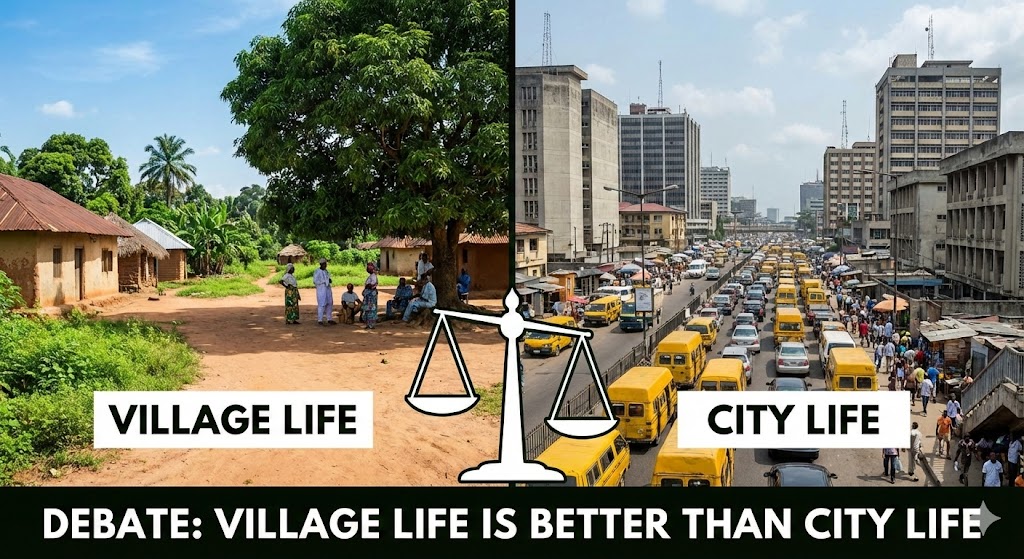
Debate: Village Life is Better Than City Life (7 Winning Points)
Good day, students! Looking for the winning points for your next debate? You’ve come to the right place.
Today, we are tackling a classic topic that always heats up the debate hall: Village Life is Better Than City Life. If you have been chosen to support this motion, you have a huge advantage because the points are practical, emotional, and very easy to defend.
In this context, “village life” refers to a rural setting with a close-knit community, fresh air, and a connection to nature. “City life,” on the other hand, is the urban lifestyle characterized by high population density, traffic, and industrial activity.
This article provides arguments solely for the purpose of an educational debate. We understand that both city and village life have their unique advantages and disadvantages. Our goal here is to help you win your specific side of the argument.
Let’s dive into it

Winning Debate Points on Why Village Life is Better Than City Life
Here are the strong arguments you can copy, adapt, and use to silence your opponents. Remember to speak with confidence!
1. Health is Wealth: Fresh Air vs. Pollution
Mr. Chairman, Panel of Judges, and my fellow debaters. My first and most important point is about our health. We all know the saying, “Health is Wealth.”
In the city, what do we breathe every day? Smoke from cars, dust from construction sites, and fumes from factories. It is choking us. But in the village, the story is different. The air is pure, clean, and fresh because of the abundance of trees and lack of heavy industry.
When you live in the village, you are breathing in life, not poison. This is a major reason why village life is better than city life; it literally keeps you healthier and strengthens your lungs compared to the suffocating pollution of the urban areas.
2. Access to Fresh, Organic Food
Let’s talk about food. In the city, most of what people eat is processed, frozen, or filled with preservatives. You buy vegetables that were harvested a week ago and stored in a fridge.
But come to the village. Here, we eat what we grow. The food is fresh, organic, and straight from the farm to the pot. There are no chemicals to preserve it because we don’t need them.
This access to fresh organic food boosts the immune system and increases life expectancy. Why would anyone prefer expensive, stale city food when the village offers nature’s best for a fraction of the price?
3. The Low Cost of Living
This is a point that touches everyone’s pocket. The cost of surviving in the city is skyrocketing. Rent in places like Lagos or Abuja is enough to build a whole house in the village!
In the village, the cost of living is significantly lower. You don’t need to spend a fortune on transport, rent, or basic foodstuffs. With a small amount of money, a family can feed well and live comfortably.
The financial pressure in the city causes high blood pressure and anxiety. In the village, that financial stress is almost non-existent. It is simple economics: your money has more value here.
4. Peace of Mind and Lack of Stress
Have you ever tried to sleep in a busy city? The generators are making noise, the cars are honking, and the neighbors are playing loud music. Noise pollution is a silent killer in the city.
In contrast, the village offers a serene environment. It is quiet. It is peaceful. You can actually hear the birds singing and the wind blowing.
After a long day of work, you are guaranteed a good night’s rest. You don’t have to wake up at 4:00 AM just to beat traffic congestion. This peace of mind is priceless, and it is something the city simply cannot offer.
5. Strong Communal Lifestyle
In the city, it is very possible to live in a house for five years and not know the name of your next-door neighbor. Everyone is locked behind high gates, living in isolation. It’s lonely.
But in the village, we practice a true communal lifestyle. Everyone is their brother’s keeper. If a child does something wrong, the neighbor corrects them. If a family is in need, the community rallies around to help.
This social support system is vital for mental health. You are never alone in the village. This sense of belonging proves that village life is better than city life because it values human connection over isolation.
6. Safety and Low Crime Rate
Let’s be honest about security. The hustle and desperation in the city often lead to a high crime rate. Armed robbery, kidnapping, and petty theft are daily news stories in urban centers.
While no place is 100% perfect, the village is generally safer. Because everyone knows everyone, it is very hard for a criminal to hide. Strangers are easily identified. You can walk on the road without the constant fear of being mugged. The security that comes from a close-knit community is superior to the high fences and electric wires we see in the city.
7. Connection to Culture and Tradition
Finally, the city is a melting pot where our culture often gets lost or diluted by western influence. We are forgetting our languages, our festivals, and our history.
The village is the custodian of our heritage. Living there keeps you connected to your roots. You learn respect, you understand your language deeply, and you participate in festivals that define who you are.
For a student growing up, this cultural grounding is essential. It gives you an identity that the “modern” city life tries to strip away.
Frequently Asked Questions (FAQs)
What is the strongest argument for the opposing side? Usually, the opposition will talk about the lack of amenities like electricity, good hospitals, or internet in the village. Your counter-argument should be that amenities can be brought to the village (and are being brought), but the peace and nature of the village cannot be manufactured in the city.
How do I start my debate speech? Start with a strong greeting to the Chairman, Panel of Judges, Timekeeper, and audience. Then, state your motion clearly. For example: “I am here to convince you that the peace and health found in the village make it far superior to the chaos of the city.”
Can I use these points for a primary school debate? Yes! These points are simple enough for primary school but strong enough for secondary school. Just adjust the vocabulary to fit your level.
Conclusion / Summary
To wrap up, while the city offers bright lights and fast cars, it also brings pollution, high costs, crime, and stress. The village offers health, peace, community, and safety.
When you weigh the pros and cons, it becomes clear that for a high quality of life, village life is better than city life. The arguments for health and peace of mind naturally outweigh the arguments for mere technological convenience.
Disclaimer: Once again, this article is for educational purposes to help students prepare for academic debates. Both urban and rural settings play vital roles in the development of our nation.
What do you think? Do you prefer the hustle of the city or the quiet of the village? Drop your opinions in the comments section below… Also, feel free to share this post with your coursemates or those in your team!