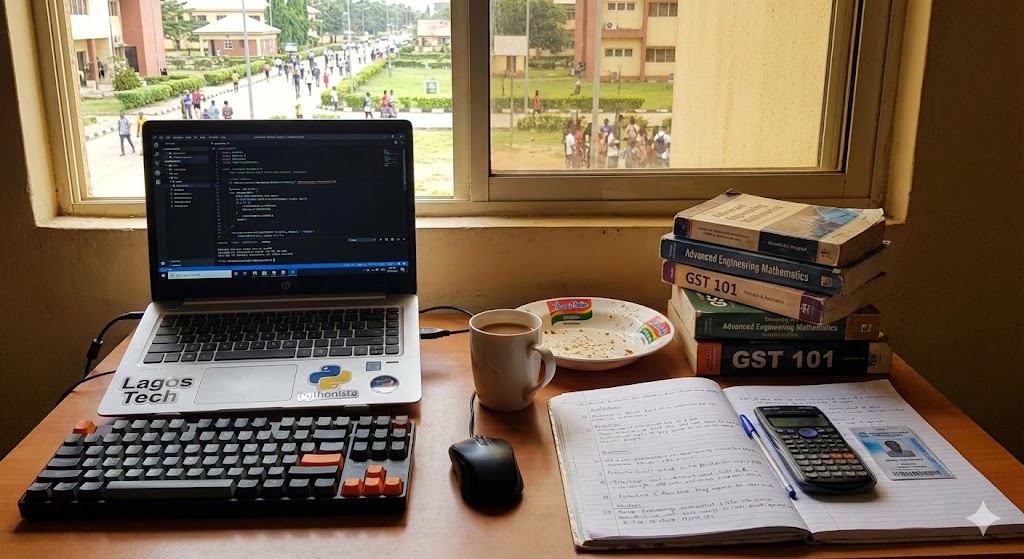
How to Balance Coding/Tech Skills With Your Academic Studies (Without Failing)
Let’s be honest. The pressure is real. You open Twitter (X) and see a 19-year-old posting about their new remote job paying in dollars. Then, you look at your table and see your CHM 101 textbook staring back at you. It’s confusing. You want to learn Python or UI/UX design because you know that is where the money is. But you also have strict parents and lecturers who don’t care about your GitHub repository.
The big question is: How to balance coding/tech skills with your academic studies without crashing your GP?
It is not easy, but plenty of Nigerian students have done it. I have seen students build apps while maintaining a 4.0 CGPA, and I have seen others drop out because they couldn’t handle the heat. The difference isn’t intelligence; it’s strategy.
Here is the truth: You cannot give 100% to both at the same time. You have to be smart about it.
The “80/20” Rule of Survival
Imagine this: It’s exam week. You have a Data Structures exam on Tuesday and a General Studies (GST) exam on Thursday. Is this the time to start a new React course on YouTube? Absolutely not.
Many students make the mistake of trying to code for 4 hours every day, regardless of what is happening in school. That is a recipe for disaster.
During the semester, your ratio should shift. Give your academics 80% of your energy and tech 20%. Why? Because a bad semester can ruin your CGPA forever, but your coding tutorials will still be there next month. As we discussed in our guide on 10 effective study habits every student should develop, knowing when to pause is just as important as knowing when to study.
Strategy 1: Treat Your Degree as the Safety Net
I know the popular saying: “School is a scam.” But let’s be realistic. In Nigeria, that certificate is still a major safety net. It is your Plan B if the tech startup doesn’t work out immediately.
Don’t be the student who fails exams because they were debugging code all night. When you are in class, be in class. When you are studying for a test, close VS Code.
If you are struggling to cover your syllabus because you’ve been distracted by tech, you need to buckle up. You might need to use the techniques we shared on how to prepare for an exam in a short time to catch up. Don’t let your “side hustle” become the reason you have an extra year in school.
Strategy 2: The “Holiday Sprint” Method
This is the secret weapon of successful student developers.
The semester is for maintenance. The holiday is for growth.
During the semester, just try to code for 30 minutes to 1 hour a day. Just enough so you don’t forget the syntax. But when the holiday comes? That is when you go beast mode. You have weeks of free time. No lectures, no assignments.
Instead of sleeping all day, use that break to build projects. I recently wrote about how students reflect on their breaks in an essay on how I spent my last holiday. Make sure your own “holiday story” includes building a portfolio website or mastering a new framework.
This method stops you from burning out during school days.
Strategy 3: Stop “Tutorial Hell” During Semesters
One major trap students fall into is watching endless tutorials without building anything. It feels like learning, but it’s passive.
During the school term, focus on building small, tiny projects rather than starting a 40-hour Bootcamp course.
-
Bad idea: Starting a “Master Full Stack Development” course two weeks before exams.
-
Good idea: Spending 20 minutes a day fixing a bug on a small project.
This keeps your brain active without overwhelming you. According to FreeCodeCamp, consistency with small daily habits beats intense, irregular sessions.
Strategy 4: Join a Community (Don’t Be a Lone Wolf)
Coding can be lonely. Studying can be boring. Combine them.
Find a circle of friends who are also interested in tech. In many Nigerian universities (like OAU, UNILAG, or FUTA), there are tech communities. Join them.
They will understand when you say, “I can’t code tonight, I have a test.” They won’t pressure you. Plus, having friends who are smart helps you with school work too. It’s easier to pass when you study with serious people.
Also, be careful of health. Staring at a laptop for coding and then staring at books for reading is hard on your eyes and back. As we always say, health is better than wealth. If you break down, you can’t code or study.
Final Thoughts: It’s a Marathon, Not a Sprint
You don’t need to be a senior engineer by the time you graduate. You just need to be good enough to get an internship or a junior role.
Don’t let the pressure of social media rush you. If you fail your exams, the stress will make it even harder to learn how to code. Master the balance.
Pass your exams. Learn your skills. Graduate with a good grade and a strong portfolio. That is the ultimate flex.
If you are looking for more ways to optimize your student life or debating whether to focus on skills vs. degrees, check out some of the educational resources and debates available online to broaden your perspective.
What’s your biggest struggle with combining tech and school? Let me know in the comments.