You know that feeling. You’ve read your textbook from cover to cover. You’ve memorized the definitions in Government. You feel ready. But the moment you sit in the exam hall and open the question paper, your mind goes blank.
It’s painful.
Why does this happen? It’s simple: you practiced reading, but you didn’t practice answering. There is a big difference between recognizing an answer in your notebook and pulling it out of your brain under pressure.
To fix this, you need to simulate the pressure before the real day. You need to know how to create a “Mock Exam” for yourself at home.
I used to struggle with exam anxiety until I started doing this. It changed everything. It’s not just about testing your knowledge; it’s about training your nerves.
Here is the exact step-by-step method to set up a mock exam that actually works.

Step 1: Gather Your “Weapons” (Materials)
Don’t just open a textbook and pick random questions. That’s cheating.
You need standard past questions. Whether you are preparing for WAEC, NECO, or JAMB, you need a full year’s paper. For example, pick “JAMB Physics 2019” or “WAEC Economics 2021.”
Print it out if you can. If you are using a phone app or a “Past Q” book, that’s fine, but ensure you have the complete set of questions for that year.
You also need answer sheets. Don’t write in a jotter. Get a plain sheet of paper and number it 1-50 (or whatever the format is). This mimics the shading or selecting process you’ll face in the hall.
For those trying to cover a lot of ground quickly, this method is a core part of how to prepare for an exam in a short time.
Step 2: Create the “Exam Hall” Atmosphere
This is where most students mess up. You can’t take a mock exam while lying on your bed, eating gala, and replying to WhatsApp messages.
You have to respect the process.
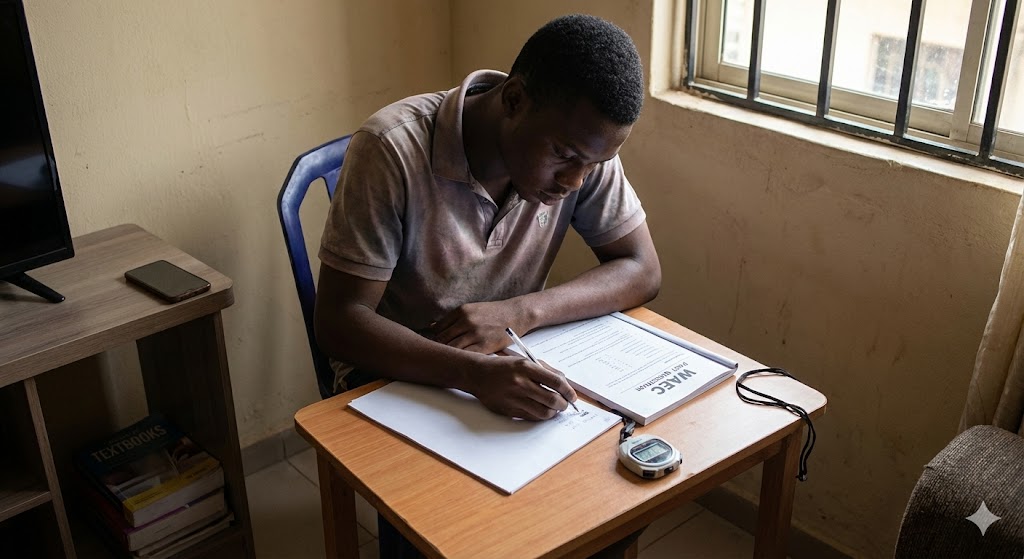
Find a table and a chair. If your house is noisy (which is normal in Nigeria), try to find a quiet corner or wait until late at night. Clear the table. No textbooks, no notebooks, no “expo.” Just you, your pen, your calculation sheet, and the questions.
Turn off your data. Better yet, throw your phone on the bed behind you. If you get a notification mid-exam, you’ve broken the spell. You need to train your brain to focus for long stretches without dopamine hits from social media.
Step 3: Timing is Everything (The Stop-Watch Rule)
In the real exam, your biggest enemy isn’t the question; it’s the clock.
If JAMB gives you 2 hours for 180 questions, you should set your mock exam for 1 hour 45 minutes. Why? Because in the real hall, things happen. The biometric machine might delay you, or you might get nervous.
Train hard so the fight is easy.
Set a timer. Place it where you can see it. When the timer starts, you start. When the timer stops, drop your pen immediately. Even if you are on the last question, stop.
This brutality helps you realize how slow you actually are. It forces you to learn speed, a skill that is critical for passing computer-based tests (CBT). For more on managing your study schedule effectively, check out our guide on 10 effective study habits every student should develop.
Step 4: The “Wicked Teacher” Grading Method
Once the exam is over, take a break. Walk around, drink water. Then come back to mark it.
When you are marking your script, be wicked.
-
If you shaded “A” but the answer is “B,” mark it wrong.
-
If you “almost” got the answer but missed the unit (like forgetting ‘cm’ or ‘kg’), mark it wrong.
-
If you guessed and got it right, mark it right, but circle it so you know it was luck.
Don’t dash yourself marks. “I meant to write B” is not a valid excuse. The OMR sheet doesn’t care about your intentions.
Use the official marking schemes where possible. The West African Examinations Council (WAEC) often releases Chief Examiner reports that show exactly where students lose marks. Read them.
Step 5: The Post-Mortem (Reviewing Your Mistakes)
This is the most important part of learning how to create a “Mock Exam” for yourself at home.
If you scored 40/60, don’t celebrate yet. You need to look at the 20 you failed. Why did you fail them?
-
Did you run out of time? Then you need to work on speed.
-
Did you misread the question? Then you need to work on patience.
-
Did you simply not know the topic? Then you need to go back to your textbook.
Research by educational psychologists suggests that “active recall” (testing yourself) is far more effective than “passive review” (re-reading). You can read more about efficient learning techniques on platforms like Khan Academy (the principles apply to JAMB too).
Conclusion
Creating a mock exam at home isn’t fun. It’s stressful and tiring. But would you rather stress now in your room, or stress later in the exam hall when it matters?
By simulating the environment, the timing, and the grading, you build confidence. When the real day comes, it won’t feel like a scary new experience. It will just feel like another Tuesday at your study table.
Try this out this weekend. Pick a year, set a timer, and see how you score.
Have you ever tried simulating an exam condition at home? How did it go? Tell me about your experience in the comments below.