How to Create a Personal Reading Timetable That Works (Stop Failing Exams!)
Let’s be honest for a second. We have all done it. You get motivated after a bad test score, you grab a ruler and a piece of paper, and you draw up the “perfect” schedule.
4:00 PM to 6:00 PM: Mathematics. 6:00 PM to 8:00 PM: Chemistry. 8:00 PM to 10:00 PM: Physics.
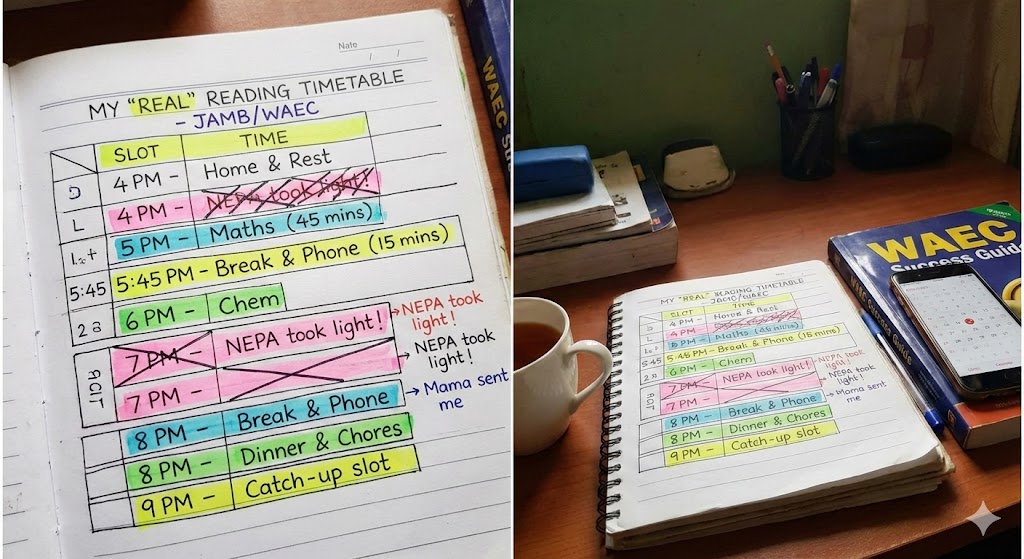
It looks beautiful on paper. But three days later? You’ve abandoned it. Maybe NEPA took the light, or your mum sent you on an errand that lasted two hours, or you simply got tired. The problem isn’t that you are lazy. The problem is that you are trying to act like a robot. If you want to smash WAEC, NECO, or JAMB this year, you need to learn how to create a personal reading timetable that works for your specific life, not a fantasy life.
Here is the thing: copying your brilliant friend’s timetable won’t help you. You need a strategy that fits you.
Why Your Previous Timetables Failed (The Truth)
Most students fail to stick to a plan because they are too ambitious. You cannot study for 8 hours straight without a break. It’s impossible. When you try to do that, you crash.
Also, you probably didn’t account for distractions. We’ve discussed this before—whether it’s social media or television, distractions are everywhere. As I wrote in a previous debate guide, some people argue that watching TV is a waste of time, and when it comes to exam prep, they might be right. If your timetable doesn’t include specific time for “rest” or “pressing phone,” you will end up doing it during your reading time anyway.
So, how do we fix this? Follow these steps.
Step 1: The “Real Life” Audit (Be Honest)
Before you write “Mathematics” on Monday, look at your Monday.
What time do you actually get home from school or lessons? If you get home at 5 PM, don’t set your reading time for 5:15 PM. You are not a machine. You need to bathe, eat, and rest.
Write down your fixed activities:
-
School hours.
-
Lesson hours.
-
House chores (very important).
-
Sleep.
The time left over? That is your actual study window. It might only be two hours. That is fine. Two hours of focused work is better than five hours of dozing off.
Step 2: Find Your “Brain Prime Time”
Are you an early bird or a night owl?
I have seen students force themselves to wake up at 4 AM simply because their teachers said “early morning reading is the best.” But if you wake up at 4 AM and spend the next hour nodding off and wiping drool from your textbook, you are wasting time.
If your brain works better at night (TDB), schedule your hardest subjects then. If you are sharpest in the morning, sleep early and wake up early. Understanding your body clock is one of those effective study habits that separates the high flyers from the average students.
Step 3: The Sandwich Method (Hard-Easy-Hard)
Don’t pile all the heavy subjects on one day. I see science students putting Physics, Further Maths, and Chemistry on the same Tuesday night. That is a recipe for a headache.
Mix it up. Use the “Sandwich Method.”
-
Start with a tough subject (e.g., Physics) when your energy is high.
-
Follow it with a lighter subject (e.g., Civic Education, Literature, or Biology).
-
Finish with a revision task.
This keeps your brain engaged without burning out. It’s a strategy often recommended by experts at Khan Academy for maintaining long-term focus.
Step 4: Use the 45-15 Rule (Stop Burning Out)
This is where many Nigerian students get it wrong. You think sitting in one spot for four hours means you are serious.
Here is a fact: Your brain’s concentration span drops after about 45 to 50 minutes.
If you sit there for three hours, the last two hours are likely wasted. Instead, structure your timetable in blocks.
-
Read for 45 minutes. Intense focus. No phone. No talking.
-
Rest for 15 minutes. Stand up. Walk around. Drink water. Check your WhatsApp.
-
Repeat.
This keeps your mind fresh. It turns a boring study session into manageable chunks.
Step 5: Factor in the “Nigerian Reality”
We live in Nigeria. Things happen.
The generator might spoil. Your younger sibling might start crying. You might fall sick. A rigid timetable breaks when these things happen. A flexible one survives.
How to create a personal reading timetable that works involves leaving “blank spaces.” Don’t fill every single hour of the week. Leave Saturday evening or Sunday afternoon free. These are your “catch-up” slots.
If you miss Tuesday’s reading because of a family emergency, don’t panic. Just move that topic to your free slot on Sunday. This prevents you from feeling guilty and giving up entirely.
Also, ensure you are studying the right things. Always cross-reference your reading plan with the official syllabus from the West African Examinations Council (WAEC). Studying topics that aren’t in the syllabus is just hard work with no reward.
Final Words: It’s About Consistency, Not Perfection
Your timetable is not a prison sentence. It is a map. If you miss a day, don’t tear the paper. Just pick it up the next day.
The goal isn’t to be perfect; the goal is to be better than you were yesterday. If you are currently struggling with cramming or feeling overwhelmed, you might want to check out our guide on preparing for an exam in a short time. It breaks down how to handle pressure when time is running out.
Start small. Be realistic. And please, get enough sleep. You can’t pour from an empty cup.