How to Create Flashcards for Quick Revision: The Ultimate Guide for Nigerian Students
Imagine this scenario: You are sitting in the exam hall for your Post-UTME. You see a question about “Cell Division” or “The 1963 Constitution.” You know you read it. In fact, you remember highlighting it in your textbook.
But can you remember the answer? No. It’s gone.
It is the most frustrating feeling in the world. The problem usually isn’t that you didn’t read; the problem is how you read. Most of us were taught to just read our notes over and over again. Let me be honest with you—that is the slowest, most boring way to study.
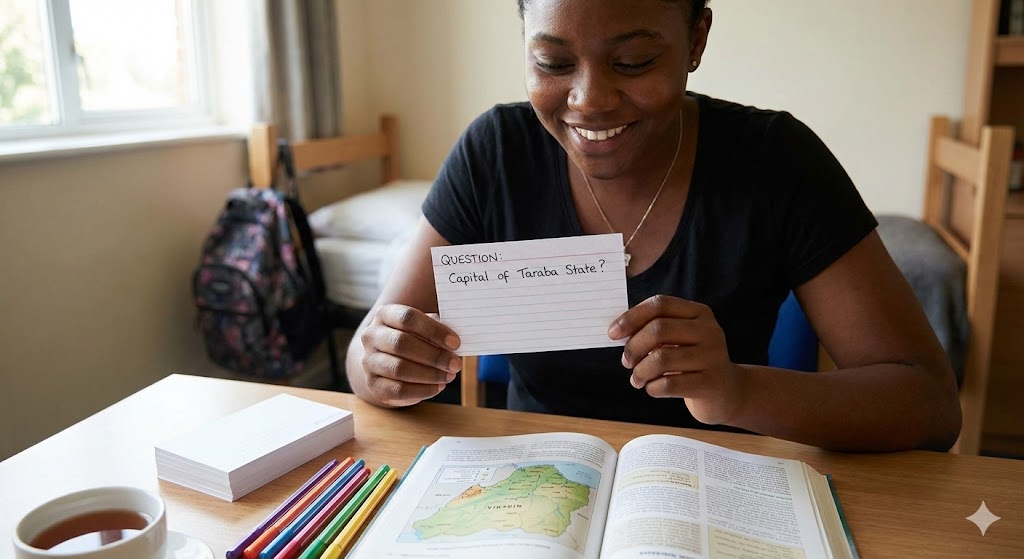
If you want to remember facts without stress, you need a better strategy. That’s where flashcards come in. In this guide, I will show you how to create Flashcards for quick revision so you can crush that next JAMB, WAEC, or semester exam.

Why Most Students Get It Wrong
Before we jump into the “how-to,” let’s talk about why your current method might be failing.
When you just read a textbook, your brain is being passive. It recognizes the words, so you feel like you know them. But recognizing isn’t the same as remembering. Flashcards force you to use “Active Recall.” You have to pull the information out of your brain before you flip the card. It’s like doing push-ups for your memory.
But here is the catch: there is a right way and a wrong way to do it. If you do it wrong, you are just wasting card paper.
Step 1: The “One Card, One Fact” Rule
This is the golden rule. When students first learn how to create Flashcards for quick revision, they often try to write an entire textbook chapter on one small card.
Don’t do that.
If your card looks like a mini-handout, it’s useless. Your brain cannot memorize a paragraph at a glance.
Bad Example:
-
Front: The Nigerian Civil War.
-
Back: Started in 1967, ended in 1970, fought between Nigeria and Biafra, Yakubu Gowon was Head of State, Ojukwu led Biafra… (and 10 other lines).
Good Example:
-
Front: When did the Nigerian Civil War start?
-
Back: 6 July 1967.
See the difference? The second one is instant. You either know it or you don’t. This speed is crucial when you are trying to figure out how to prepare for an exam in a short time.
Step 2: Use Your Own “Broken” English
Okay, maybe not actual Pidgin (unless that helps you!), but use your own words.
Textbook definitions are often long and full of “big grammar.” If you just copy and paste them onto a card, you aren’t learning; you are just memorizing noise.
Read the definition, look away, and ask yourself: “How would I explain this to my younger brother?” Write that on the card. If you can explain a complex concept simply, you truly understand it. This builds a deeper connection in your brain than just “cramming.”
Step 3: Mix Pictures with Words
You don’t need to be an artist. Stick figures are fine.
If you are a science student studying Biology or Chemistry, drawing a rough sketch of a cell or a chemical bond makes the card twice as effective. Our brains are wired to remember images better than text.
Research from sources like 3Star Learning often highlights “Dual Coding”—the idea that combining text and images boosts learning. So, draw that ugly map of Nigeria. It will help you remember the states better than a list.
Digital vs. Paper: Which is Better?
This is a big debate. Since we are in Nigeria, we have to consider factors like NEPA (power supply) and data.
The Case for Paper Cards:
-
Pros: They never run out of battery. The act of writing helps you learn. You can carry them in your pocket anywhere.
-
Cons: You can lose them. They take time to cut and write.
The Case for Apps (Like Anki or Quizlet):
-
Pros: They use algorithms to show you hard cards more often (Spaced Repetition). You can have thousands of cards on your phone.
-
Cons: Distractions. You pick up your phone to study, and suddenly you are on TikTok.
If you are disciplined, I recommend an app like Anki. It automates the process of how to create Flashcards for quick revision. But if you know phone notifications are your weakness, stick to paper.
The “Traffic Light” Review Method
You have made the cards. Now, how do you use them? You don’t just flip through them randomly. You need a system.
I call this the Traffic Light method (a simplified version of the Leitner System):
-
Red Pile (Hard): Cards you got wrong. You must review these every day.
-
Yellow Pile (Medium): Cards you hesitated on but got right. Review these every 3 days.
-
Green Pile (Easy): Cards you knew instantly. Review these once a week.
This ensures you stop wasting time on what you already know and focus on your weak points. This kind of targeted revision is one of the 10 effective study habits every student should develop.
Common Mistakes to Avoid
Even smart students mess this up. Here are a few traps:
-
The “I Knew It” Lie: You flip the card, see the answer, and say, “Oh yeah, I knew that.” If you didn’t say it before flipping, count it as a fail. Be honest with yourself.
-
Making Too Many Cards: Do not make cards for things you already know by heart. You don’t need a flashcard for “What is the capital of Lagos?” (I hope!).
-
Only Using Them Before Exams: Flashcards work best when you use them consistently throughout the semester, not just during the “fire brigade” approach of exam week.
Conclusion
Creating flashcards might feel like extra work at first. You might think, “Why not just read my note?”
But trust me, the time you spend making them saves you hours of stress later. Instead of rereading a 50-page notebook, you can breeze through 30 cards in 10 minutes.
Start small. Pick one difficult subject—maybe Physics or Literature—and try making 10 cards today. By the time the exam timetable comes out, you won’t be panicking; you’ll be ready.
For more resources on exam syllabuses to help you build your questions, you can always check the official JAMB website or the WAEC e-learning portal.
Have you ever used flashcards before? Did you find them helpful or stressful? Let me know in the comments below!