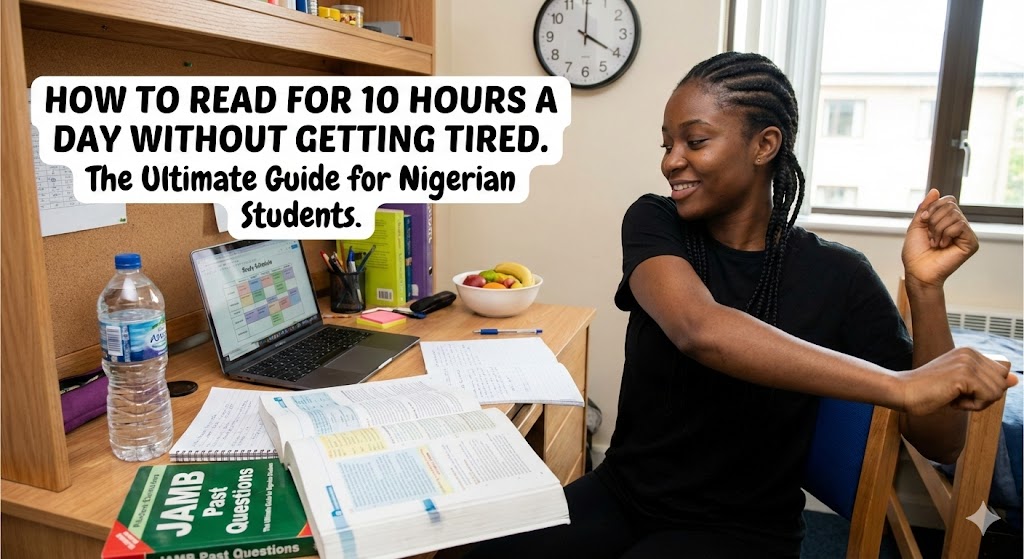
How to Read for 10 Hours a Day Without Getting Tired: The Ultimate Guide for Nigerian Students
The exam timetable is out. You have WAEC, NECO, or JAMB in a few weeks, and the syllabus is looking at you like a giant you haven’t even touched. You know you need to put in serious work.
But here is the problem.
You sit down to read, and after two hours, your back hurts, your eyes are heavy, and you are reading the same line over and over again without understanding a word. Does this sound familiar?
Many students think the secret to success is suffering. They believe they have to lock themselves in a room and suffer until the information sticks. That’s a lie. You don’t need to suffer; you need a strategy.
If you are wondering how to read for 10 hours a day without getting tired, you have come to the right place. I’ve been there, and I’m going to show you exactly how to do it without burning out.
1. The “Chunking” Strategy (Don’t Be a Hero)
Let’s be honest. Trying to sit in one spot for 10 hours straight is a mission impossible. Even a machine needs to cool down, talk less of a human being.
If you try to read for 5 hours at a stretch, by the 3rd hour, you are just looking at the book; you aren’t actually reading.
The Solution? Use the Pomodoro technique, but tweak it for the Nigerian reality.
-
Read intensively for 50 minutes.
-
Take a strictly timed 10-minute break.
-
Repeat this four times, then take a longer break (maybe 1 hour).
During that 10-minute break, stand up. Stretch. Walk outside. Do not—I repeat, do not—open TikTok or Instagram. Once you start scrolling, that 10 minutes will turn into 2 hours, and your study vibe will die.
As we discussed in our guide on 10 effective study habits every student should develop, managing your breaks is just as important as the reading itself.
2. Switch It Up (Subject Rotation)
Imagine eating only rice morning, afternoon, and night for a week. You will get tired of it, right?
Your brain works the same way. If you decide to study Physics for 10 hours straight, your brain will get bored and shut down. This is one of the main reasons students get tired—boredom, not just fatigue.
Here is how to fix it:
Mix your “hard” subjects with your “soft” subjects. If you start the day with Mathematics or Chemistry (calculation heavy), switch to English or Government (reading heavy) after a few hours.
Changing the subject wakes up a different part of your brain. It keeps things fresh.
3. Active Engagement (Stop Just Staring)
A lot of students just read their textbook over and over. Let me be blunt: that is a waste of time.
Passive reading (just moving your eyes over words) is the fastest way to fall asleep. To learn how to read for 10 hours a day without getting tired, you must be active.
Try these instead:
-
Teach an imaginary class: Stand up and explain what you just read to an empty room or your younger sibling.
-
Jot things down: Don’t just highlight. Close the book and try to write down what you remember.
-
Answer past questions: Don’t just read the topic; solve questions related to it immediately.
This keeps your blood flowing and your mind sharp. It’s a similar principle to preparing for a debate; you have to articulate your points to remember them. You can check out some tips on structuring arguments in our article on how to start a debate.
4. Fuel Your Brain, Don’t Sedate It
This is where many Nigerian students mess up.
You cannot whack a mountain of Eba and Egusi soup or a heavy plate of pounded yam and expect to stay awake for the next 5 hours. Heavy carbohydrate meals are “sleeping tablets” in disguise.
When your stomach is fighting to digest heavy food, your brain gets less oxygen. That is why you start dozing off.
The Strategy:
-
Eat light meals during the day. Think noodles, bread and tea, or fruits.
-
Save the heavy swallow for dinner when you are done with your 10-hour goal.
-
Drink Water: Sometimes you aren’t tired; you are just dehydrated. Keep a bottle of water on your table.
Remember, your physical state dictates your mental state. We emphasized this heavily in our post on why health is better than wealth. If your body is weak or overfed, your brain won’t work.
5. Prioritize Sleep (The Irony)
You might think, “I want to read for 10 hours, so I shouldn’t sleep.” That’s a quick way to crash.
To sustain a 10-hour reading schedule, you need at least 6–7 hours of quality sleep at night. If you manage 10 hours of reading but only sleep for 3 hours, you will forget 80% of what you read.
The National Sleep Foundation emphasizes that teenagers and young adults need significant rest to consolidate memory. Without it, your brain can’t store what you’ve learned.
6. Change Your Environment
Are you reading on your bed? That’s a trap.
Your brain associates your bed with sleep. The moment you lie down “just to relax your back,” it’s game over.
Sit at a table. If your room is too hot or your roommates are making noise (shout out to hostel life), go to the school library or find a quiet empty classroom.
Official exam bodies like JAMB often advise candidates to study in environments that mimic the exam hall conditions to build focus.
Final Thoughts
Learning how to read for 10 hours a day without getting tired is not about magic. It is about discipline and knowing how your body works.
Don’t beat yourself up if you can only do 4 hours today. Start there. Build it up to 6, then 8, and finally 10. Consistency beats intensity every single time.
Which of these tips do you find hardest to follow? The food discipline or the phone distractions? Let me know in the comments section!