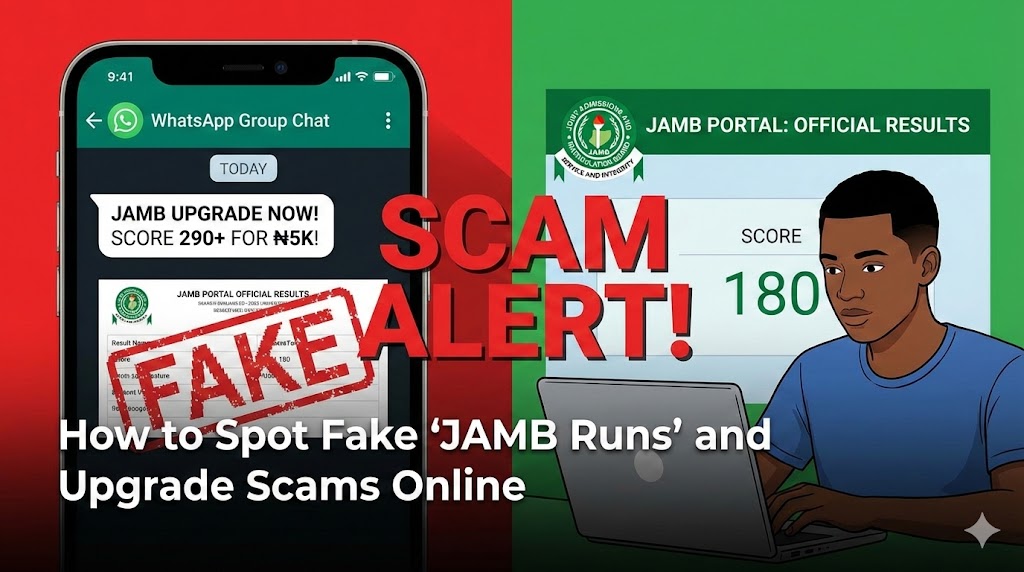
How to Spot Fake “JAMB Runs” and Upgrade Scams Online: A Student’s Guide to Staying Safe
We all know the pressure. The exam date is getting closer, your parents are expecting a miracle, and you’re hearing whispers in your hostel or WhatsApp groups about a “sure way” to score 300+.
It’s tempting, right?
But here is the hard truth: Most of those promises are traps designed to eat your school fees. Knowing how to spot fake “JAMB runs” and upgrade scams online isn’t just about saving money; it’s about saving your admission. Every year, thousands of Nigerian students lose their hard-earned cash to faceless “admins” on Telegram who promise heaven and earth but deliver absolutely nothing.
Let’s be real for a minute. If these guys actually had the power to change scores on the JAMB server, would they be begging for N5,000 recharge cards on Facebook?
Here is how you can identify these “formats” before you become a victim.

1. The “Result Upgrade” Myth
This is the most common lie, and honestly, it breaks my heart to see how many students fall for it. You write the exam, the results come out, and maybe you scored 170. Then, someone contacts you saying they can “upgrade” it to 250 for a fee.
Here is the technical reality: JAMB results are hosted on a secure central server. A scammer might use Photoshop to change the number on a screenshot or a printed slip to show you “proof,” but they cannot touch the database.
When you go for your university clearance or try to print your official admission letter, the original score will pop up. Imagine the embarrassment of being walked out of the screening office because your documents are fake. It’s not worth it.
If your score isn’t what you hoped for, don’t panic. There are still options. As we discussed in our guide on universities that accept 140 cut-off marks, a lower score doesn’t mean the end of your academic journey.
2. The “JAMB Insider” Story
“I work at the JAMB office in Abuja.” “My uncle is the IT director.”
Sound familiar?
This is a classic confidence trick. These scammers build a persona. They might even show you fake ID cards or pictures of themselves standing in front of a government building.
But think about it practically. The officials who handle these databases are monitored strictly. They aren’t risking their careers and pensions to help a random student on WhatsApp get a high score for peanuts.
According to several reports by The Guardian Nigeria, the exam body regularly arrests these impostors. Don’t let your desperation make you their next payday.
3. The “CBT Answers” Format
Years ago, during the paper-and-pencil era, “runs” were easier because papers could leak physically. But with the Computer Based Test (CBT), the game has changed entirely.
JAMB randomizes questions.
This means if you are sitting next to your best friend in the exam hall, your Question 1 is likely their Question 45. The options are also scrambled. So, when a scammer sends you a text saying: 1. A 2. C 3. B
They are just guessing. They have no idea which set of questions the computer will generate for you. Relying on these fake “keys” is the fastest way to fail.
Instead of looking for shortcuts, the energy is better spent on actual preparation. We broke this down in our article on how to prepare for an exam in a short time, which is far more effective than trusting a random vendor.
4. The “Testimonial” Group Trap
Have you ever been added to a WhatsApp or Telegram group where you see screenshots of people thanking the “Admin” for their high scores?
“Thank you Sir! I saw my result, I scored 290!”
It looks convincing, doesn’t it?
Here is the trick: Those people giving testimonies? They are part of the gang. They use multiple phone numbers to talk to themselves to create a “fear of missing out” (FOMO). They want you to feel like the only one not paying.
Once you pay, one of two things happens:
-
They block you immediately.
-
They send you fake answers to keep you quiet until the exam is over.
5. The “after payment” pressure
Real businesses don’t pressure you. Scammers do.
If you are chatting with someone about exam help and they start saying things like:
-
“Pay now or the slot will close.”
-
“Upload closes in 1 hour.”
-
“If you don’t pay, I will delete your name.”
That urgency is a massive red flag. They want you to act on fear before your brain has time to process that it’s a scam.
What should you do instead?
I know the pressure to succeed is heavy. Nigerian parents don’t joke with education. But there are no shortcuts to success. The only “run” that works is the one you do with your brain.
Focus on these proven steps:
-
Use the Syllabus: JAMB’s official website has the syllabus for every subject. Stick to it.
-
Practice Past Questions: JAMB repeats concepts, not necessarily exact questions. If you understand the concept from 2018, you can answer the twist in 2025.
-
Build a Routine: Consistency beats intensity. You don’t need to read for 12 hours a day; you just need to be consistent. Check out our 10 effective study habits every student should develop to build a routine that actually sticks.
The Bottom Line
Learning how to spot fake “JAMB runs” and upgrade scams online is the first step to protecting your future. These scammers prey on your fear of failure. Don’t give them that power.
You are smarter than you think, and you are capable of passing this exam on your own merit. Put in the work, ignore the noise in the WhatsApp groups, and trust your preparation.
Over to you: Have you ever been added to one of these “Runs” groups? What was your experience? Share in the comments below—you might save another student from falling victim!