Starting a debate can feel intimidating—especially if you’re unsure how to grab attention, present your ideas clearly, or set the tone for a strong argument. Whether you’re in school, preparing for a competition, or simply engaging in a meaningful discussion, knowing how to start a debate effectively gives you a powerful advantage.
In this guide, you’ll learn how to start a debate step by step, with examples, tips, and proven techniques to help you sound confident, persuasive, and well-prepared.
What Is a Debate?
A debate is a structured discussion where two or more sides present arguments on a specific topic. The goal is to persuade the audience or judges by using logic, evidence, and clear communication.
Read now: 10 Reasons Why Teachers Are Responsible for Students’ Failure (A Balanced, Honest Look)
Why the Opening of a Debate Matters
The first 30–60 seconds of your debate can determine:
- How seriously your audience takes you
- Whether your argument feels strong or weak
- The overall tone of the discussion
A strong opening builds confidence, captures attention, and sets the stage for everything that follows.
Step-by-Step Guide on How to Start a Debate
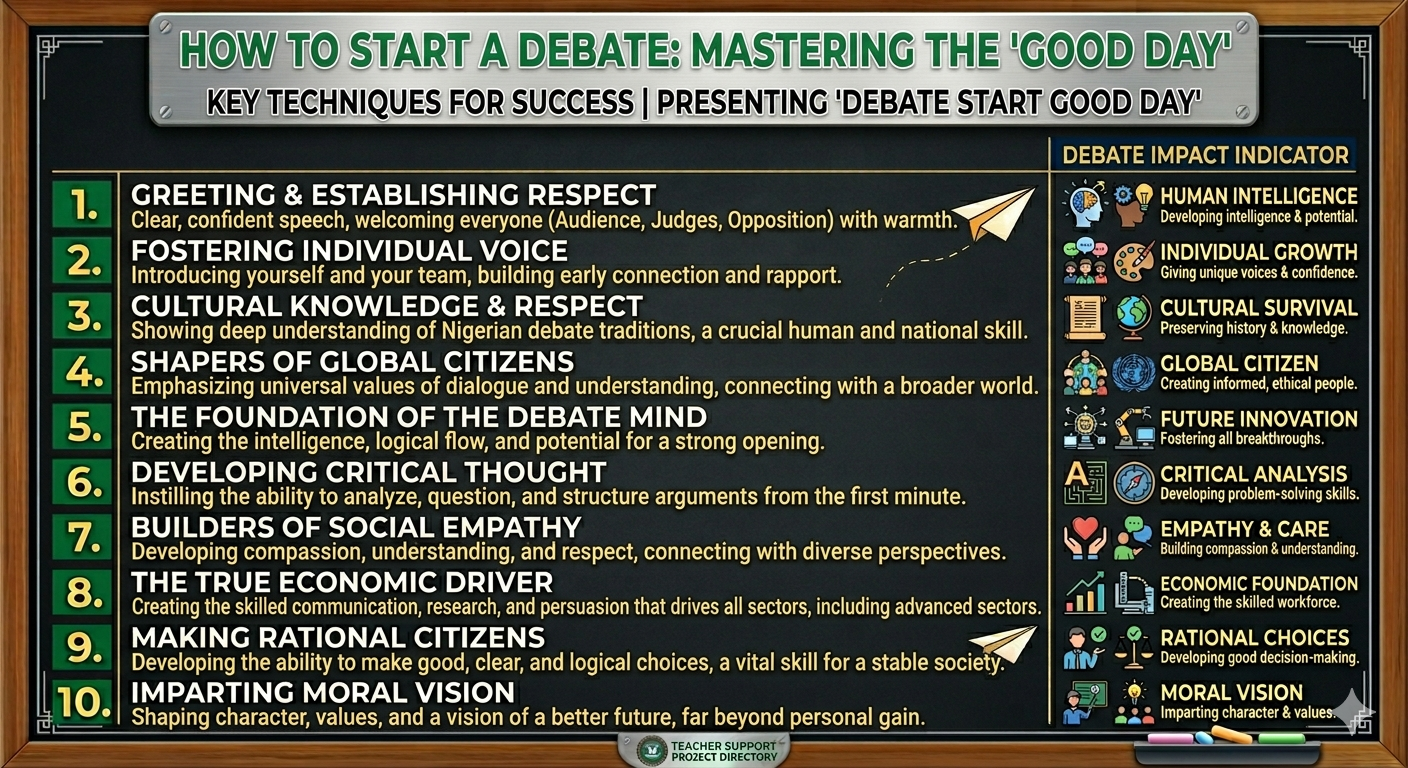
1. Greet and Acknowledge Your Audience
Start with a polite and confident greeting.
Example:
“Good morning respected judges, teachers, and my fellow debaters.”
This shows respect and professionalism.
2. Clearly State the Debate Topic
Make sure everyone understands what the debate is about.
Example:
“Today, we are here to discuss the topic: ‘Should students wear school uniforms?’”
3. State Your Position (For or Against)
Be direct about your stance.
Example:
“I stand firmly in support of this motion.”
or
“I strongly oppose this motion.”
Avoid being vague—clarity is key.
4. Start With a Hook (Grab Attention)
Read now: The Importance of Girl Child Education in Nigeria Debate: Why It Matters More Than Ever
This is where you make your opening memorable.
You can use:
- A surprising fact
- A question
- A short story
- A bold statement
Examples:
- “Did you know that over 60% of students feel more confident when they dress freely?”
- “Imagine a school where every student looks exactly the same—does that promote creativity?”
5. Define Key Terms (Optional but Powerful)
If your topic includes important terms, define them clearly.
Example:
“By ‘school uniforms,’ we mean a standardized dress code required by schools.”
6. Briefly Outline Your Main Points
Give a quick preview of your arguments.
Example:
“In this debate, I will present three key reasons: freedom of expression, comfort, and cost-effectiveness.”
This makes your speech organized and easy to follow.
7. Transition Into Your First Argument
End your introduction smoothly and move into your main point.
Example:
“Let’s begin with the first point—freedom of expression.”
Sample Debate Opening (Full Example)
“Good morning respected judges, teachers, and my fellow debaters. Today, we are here to discuss the topic: ‘Should students wear school uniforms?’ I stand strongly against this motion.
Imagine a world where individuality is suppressed and creativity is limited—this is exactly what strict uniform policies can do. By ‘school uniforms,’ we mean a standardized dress code enforced by schools.
In this debate, I will present three key arguments: the importance of self-expression, the issue of comfort, and the financial burden on families. Let’s begin with my first point.”
Tips to Start a Debate Confidently
Read more: How to Use the Cornell Method to Take Better Lecture Notes (And Stop Cramming)
Speak Clearly and Slowly
Avoid rushing—confidence shows in your voice.
Maintain Eye Contact
Engage your audience, not just your notes.
Use Simple, Strong Words
Clarity beats complexity.
Practice Beforehand
Rehearse your opening multiple times.
Common Mistakes to Avoid
Starting without greeting the audience
Being unclear about your position
Speaking too fast or too softly
Using complicated language unnecessarily
Forgetting to introduce the topic
How to Start a Debate for Students (Quick Format)
Use this simple structure:
- Greeting
- Topic introduction
- Your position
- Hook
- Key points preview
Follow this every time, and you’ll never get stuck.
Pro Tips to Stand Out in a Debate
- Start with a powerful quote or statistic
- Use confident body language
- Keep your tone engaging, not robotic
- Be passionate—but stay respectful
- Practice with friends or in front of a mirror
Check out: Farmer vs Doctor: 10 Compelling Reasons Why the Doctor Is More Important
People Also Ask
How do you begin a debate introduction?
Start with a greeting, introduce the topic, state your position, and use a strong hook to capture attention.
What is a good opening line for a debate?
A good opening line could be a question, fact, or bold statement that makes the audience think.
How long should a debate introduction be?
Usually 30–60 seconds—long enough to set the tone but not too long.
Final Thoughts
Learning how to start a debate is a skill that improves with practice. The more you refine your opening, the more confident and persuasive you’ll become.
Remember:
👉 Be clear
👉 Be confident
👉 Be engaging
Master these, and you’ll not only start debates—you’ll own the room.
Now It’s Your Turn
Try writing your own debate introduction using the steps above—and practice delivering it out loud.
With time, you’ll go from nervous beginner to confident speaker in no time.