The Importance of Art Subjects in Secondary School
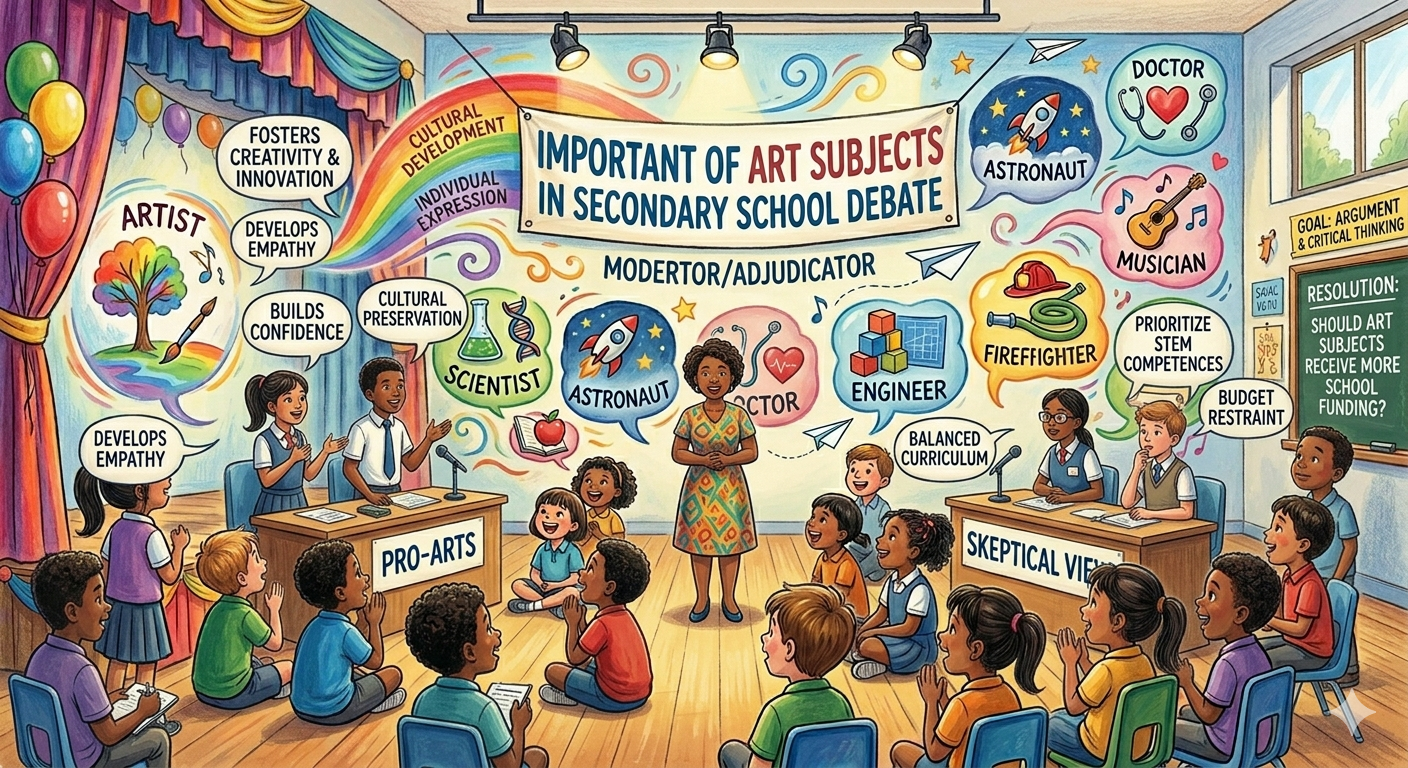
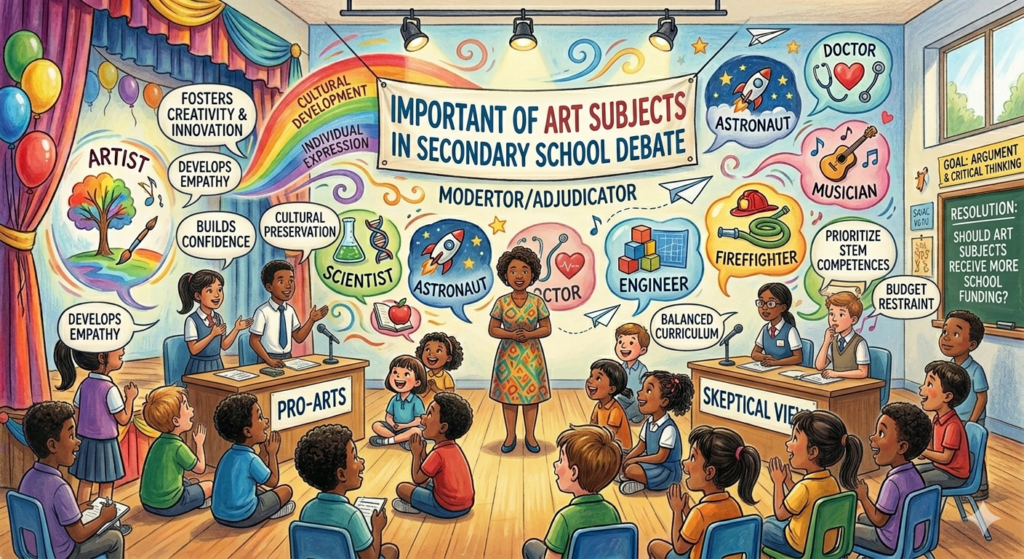
A complete debate guide for Nigerian students on Importance of art subjects in secondary school debate with both sides fully covered
Debate Topic | Art Subjects in Secondary School | Nigerian Schools | 10 Arguments + Counterarguments + Speeches
Introduction: The Undervalued Half of the Curriculum
Every year in Nigerian secondary schools, a predictable pattern plays out. When a student scores high marks in Junior Secondary School examinations and must choose their class for senior secondary, there is an unspoken hierarchy that guides many families’ decisions. Science first. Then commercial. Then arts. The science class is for the brilliant ones who will become doctors and engineers. The arts class is for students who either could not manage science or who simply do not care enough about their future to take the harder path.
This hierarchy is deeply embedded in Nigerian educational culture, and it is deeply wrong. The dismissal of art subjects — English Literature, History, Government, Fine Art, Music, Drama, Economics, Religious and Moral Education, and the full range of humanities and social science disciplines — as secondary, lesser, or supplementary to the ‘real’ subjects of science and mathematics reflects a profound misunderstanding of what education is for and what society actually requires from its educated members.
This blog post makes the full case for the importance of art subjects in secondary school education. It is written primarily for Nigerian secondary school students preparing for debate competitions on this topic, but it is equally useful for teachers, parents, policy makers, and anyone who wants to think seriously about what a complete secondary education should include.
Ten fully developed arguments for the importance of art subjects are presented, followed by the strongest counterarguments and how to defeat them, two complete sample speeches, a rebuttal guide, performance tips, and a FAQ section.
One note before we begin: arguing for the importance of art subjects is not arguing against science. Both are necessary. Both contribute indispensably to individual development and national progress. The argument here is that art subjects are genuinely important — as important as any other component of a well-designed secondary school curriculum — and that their chronic undervaluation in the Nigerian educational context is a mistake with serious consequences for individual students and for the country.
Importance of art subjects in secondary school debate
FOR DEBATE STUDENTS: This guide covers the proposition side (art subjects are important) in full with 10 arguments, plus the opposition’s strongest counterarguments and complete responses. Read everything regardless of which side you are assigned.
What Are Art Subjects? A Quick Overview
When we speak of ‘art subjects’ in the Nigerian secondary school context, we mean the broad cluster of disciplines grouped under the arts and humanities stream.
These are distinct from science subjects (Physics, Chemistry, Biology, Further Mathematics) and from commercial subjects (Accounting, Commerce, Economics as a business subject). Art subjects include:
| Art Subject | What It Develops |
| English Language | Reading, writing, communication, argument, analysis |
| Literature in English | Critical thinking, empathy, cultural understanding, interpretation |
| History | Historical analysis, research skills, contextual thinking, civic awareness |
| Government / Civics | Political understanding, rights awareness, civic engagement |
| Fine Art | Visual creativity, aesthetic judgment, design thinking, craftsmanship |
| Music | Listening, performance, creative expression, cultural literacy |
| Christian/Islamic Religious Studies | Moral reasoning, ethical framework, spiritual development |
| Yoruba / Igbo / Hausa (Language) | Mother tongue literacy, cultural identity, linguistic diversity |
| Drama / Theatre Arts | Oral communication, confidence, teamwork, emotional intelligence |
| French / Other Languages | Cross-cultural communication, global perspective, language acquisition |
Each of these subjects develops a specific and important set of human capabilities. Together, they form the humanistic foundation of a complete education. The following ten arguments explain why this foundation is essential.
Read also: Day School vs Boarding School: Why day school is better than boarding school debate
Ten Arguments for the Importance of Art Subjects in Secondary School
The following ten arguments build the complete case for why art subjects belong at the heart of secondary school education — not at its margins. Each is developed with Nigerian context and ends with a debate-ready line.
Point 1 [For Art Subjects]: Art Subjects Develop Communication Skills That Every Profession Requires
Of all the skills that secondary school education can develop, communication — the ability to read with comprehension, to write with clarity and precision, to speak with persuasion and confidence, and to listen with active understanding — is the one that every professional in every field will use every single day of their working life.
The doctor who cannot explain a diagnosis. The engineer whose project report is incomprehensible. The scientist whose research findings cannot be communicated to policymakers. The business leader who cannot inspire their team. Each of these professionals is limited by the communication deficit in ways that technical knowledge alone cannot compensate.
Art subjects — particularly English Language, Literature, and Drama — are the primary vehicles through which secondary school students develop this essential communication capacity. The Literature class that requires close reading of complex texts, careful interpretation of meaning, and written defence of a critical argument builds the analytical reading and structured writing skills that professional life demands.
See more: The Importance of Girl Child Education in Nigeria Debate: Why It Matters More Than Ever
The Drama class that requires students to perform before an audience, to project their voice, to inhabit a character’s perspective, and to collaborate with peers builds the oral communication and presentational confidence that interviews, meetings, presentations, and negotiations require.
In Nigeria, where English is the official language of education, government, business, and inter-ethnic communication, the quality of a student’s English language proficiency — built through sustained engagement with literature, composition, and language analysis in secondary school — is often the most important single determinant of their professional opportunities. The student who reads and writes English with genuine fluency and rhetorical skill has a professional advantage that technical knowledge alone cannot substitute for.
DEBATE LINE: “Every professional in Nigeria communicates in English — every doctor, every engineer, every lawyer, every business leader. The ability to read, write, and speak with clarity, precision, and confidence is not an arts skill. It is the foundational professional skill. Art subjects build this capacity more systematically and more thoroughly than any other component of the secondary school curriculum. Remove art subjects and you remove the foundation on which every other professional skill must be built.”
Point 2 [For Art Subjects]: History and Government Give Students the Civic Intelligence to Participate in Democracy
Nigeria is a democracy — imperfect, contested, and sometimes fragile, but a democracy nonetheless, with elections, constitutions, courts, and a civic structure that requires engaged, informed citizens to function. The quality of Nigerian democracy depends, at the most fundamental level, on whether Nigerian citizens understand how their political system works, know their rights and the mechanisms through which those rights are protected, can evaluate the claims of politicians critically, and feel both entitled and obligated to participate in the governance of their country.
History and Government are the subjects that build this civic intelligence. History teaches students how Nigeria came to be the country it is — the pre-colonial civilisations, the colonial encounter, the independence movement, the civil war, the cycles of military and civilian governance — and how the present grows from the past in ways that can only be understood historically. Government teaches students how the Nigerian political system is structured, how laws are made and enforced, what the constitution says, what rights it protects, and how citizens can engage with the political process.
A secondary school system that produces graduates who have never studied History or Government produces graduates who are politically illiterate — vulnerable to manipulation by politicians who exploit their ignorance, unable to recognise when their rights are being violated, and disengaged from the civic processes that determine the quality of governance they receive. The poor quality of Nigerian governance is not only a failure of those who govern — it is also a failure of the citizenry’s civic education. History and Government are the subjects that address this failure at the most fundamental level.
DEBATE LINE: “Nigeria’s democracy is as strong as its citizens’ understanding of it. A voter who does not know what the constitution says cannot defend it. A citizen who does not understand history cannot see when patterns of the past are repeating in the present. History and Government are not optional extras in the secondary school curriculum — they are the foundation of informed citizenship. A democracy without civically educated citizens is not a democracy at all.”
Point 3 [For Art Subjects]: Literature Develops Empathy — the Skill That Makes All Other Skills Humane
Empathy — the capacity to understand another person’s experience, perspective, and emotional reality from the inside — is not a soft or supplementary skill. It is the foundation of every form of professional and interpersonal effectiveness that involves working with and for other human beings.
The doctor whose clinical judgment is accurate but whose manner is cold and dismissive provides worse care than the doctor whose clinical judgment is equally accurate and whose manner is warm and empathetic. The teacher whose subject knowledge is encyclopaedic but who cannot understand why a particular student is struggling provides worse education than the teacher whose subject knowledge is equally strong and who genuinely understands each student’s learning experience.
Literature is the educational medium through which empathy is most directly and most systematically developed. When a Nigerian secondary school student reads Things Fall Apart and inhabits the inner life of Okonkwo — understanding from the inside how his world felt, why his choices made sense within the logic of that world, and what was lost when that world was disrupted by colonialism — they are developing a capacity for human understanding that no laboratory practical or mathematics problem set can develop.
Check out: Parents Are NOT Solely to Blame for the Misconduct of Their Children
When they read Purple Hibiscus and understand the psychology of a child navigating domestic violence, or Weep Not Child and understand the experience of colonialism on a specific Kenyan family, they are building the kind of complex, contextualised human understanding that makes professionals genuinely effective at working with people rather than merely at managing processes.
In Nigeria, where ethnic, religious, and regional differences are real and consequential, the empathetic intelligence that literature cultivates — the ability to understand experiences very different from your own, to inhabit unfamiliar perspectives, to recognise the humanity in people whose world view and life experience differ significantly from yours — is not merely personally enriching.
It is socially essential. A secondary education that neglects literature is a secondary education that neglects the development of the capacity for cross-cultural understanding on which Nigeria’s social cohesion depends.
DEBATE LINE: “Literature is not entertainment — it is empathy training. When a student reads how colonialism felt from the inside of a colonised family, they develop a form of human understanding that no science subject can provide. In a country as diverse as Nigeria — with 250 ethnic groups, two major religions, and a history of profound social division — the empathy that literature builds is not a luxury. It is the social infrastructure of national unity.”
Point 4 [For Art Subjects]: Art Subjects Develop the Critical Thinking That Distinguishes Leaders From Followers
Critical thinking is often claimed as the exclusive product of science education — as if the discipline of solving physics problems and conducting chemistry experiments is the only pathway to rigorous analytical thought. This claim is mistaken. The humanities and social sciences develop rigorous forms of critical thinking that are different from scientific reasoning but no less demanding, and that are more directly applicable to the social, political, and ethical dimensions of professional life and civic engagement.
The History student who must evaluate a primary source — who must assess the author’s identity, their position in society, their potential biases, the context in which the document was produced, and the relationship between what it says and what it might be concealing — is engaged in a genuinely demanding form of critical analysis.
The Government student who must evaluate competing theories of political legitimacy and construct a reasoned argument for a specific position is practising the kind of structured analytical reasoning that legal advocacy, policy analysis, and organisational leadership require.
The Literature student who must construct a close-reading argument — identifying specific textual evidence, interpreting its significance, anticipating alternative interpretations, and explaining why their reading is more persuasive than the alternatives — is practising the kind of evidence-based argumentation that debate, journalism, and research require.
These are genuine intellectual disciplines. They develop what educational researchers call ‘higher-order thinking skills’ — analysis, evaluation, synthesis, and application — that the most effective professionals exercise daily and that no memorisation-based approach to any subject, science or arts, can develop adequately. Art subjects, taught well, are among the most rigorous intellectual training available in the secondary school curriculum.
DEBATE LINE: “Critical thinking is not a monopoly of science. The student who evaluates primary sources in History, constructs arguments in Government, and interprets evidence in Literature is practising forms of analytical rigour that are as demanding as any physics calculation. The difference is the domain — not the quality of the thinking. Art subjects develop the critical intelligence that leaders and professionals exercise in the social, political, and ethical dimensions of their work. No curriculum that neglects this is preparing students for the full demands of professional life.”
Point 5 [For Art Subjects]: Fine Art and Music Develop Creativity That Drives Economic Innovation
The global economy is undergoing a transformation that is making creative capability — the ability to generate original ideas, to design compelling experiences, to craft products and communications that connect emotionally with audiences — one of the most economically valuable skill sets available.
The creative industries — including entertainment, media, design, fashion, advertising, gaming, and the full range of digital content industries — are among the fastest-growing economic sectors globally. And Nigeria, with its extraordinary creative talent in music, film, fashion, and visual art, is positioned to benefit enormously from this global creative economy — but only if its education system nurtures rather than suppresses creative capability.
Fine Art and Music, often dismissed as impractical or frivolous in the Nigerian secondary school context, are in fact the subjects that develop the creative thinking, the aesthetic judgment, the design sensibility, and the artistic craftsmanship that the creative economy requires. Nollywood — Nigeria’s billion-dollar film industry — was built by people who knew how to tell stories visually, who understood cinematography, costume design, set design, and the full range of visual and dramatic arts. Afrobeats — Nigeria’s globally recognised musical export — was developed by people with deep musical education and creative musical intelligence.
Beyond the creative industries, creativity as a cognitive capacity is increasingly valued across all professional fields. The engineer who designs an elegant solution to a complex problem rather than a brute-force one is exercising creative intelligence. The business leader who conceives a genuinely novel market approach is exercising creative intelligence.
The researcher who formulates a fundamentally new research question is exercising creative intelligence. Fine Art and Music, by developing the habit of creative thinking — of generating multiple approaches to a problem, of evaluating aesthetic quality, of iterating toward an excellent rather than merely adequate outcome — build a form of cognitive flexibility that has value far beyond the art room and the music hall.
DEBATE LINE: “Nollywood earns over one billion dollars annually. Afrobeats fills stadiums from Lagos to London. These industries — Nigeria’s most globally competitive economic sectors — were built on the creative skills that Fine Art and Music develop. The student who studies Fine Art and Music is not preparing for an impractical career — they are preparing for the creative economy that is the future of Nigeria’s non-oil growth. Creativity is not a luxury. In the twenty-first century, it is an economic engine.”
Check out: How to Use the Pomodoro Technique to Crush WAEC and JAMB (Without Burning Out)
Point 6 [For Art Subjects]: Religious and Moral Education Builds the Ethical Framework that Society Depends On
Every society — including Nigeria — depends on a certain minimum level of shared moral commitment among its members: a commitment to honesty, to fairness, to respect for others’ rights, to the recognition that other people’s interests matter and not only your own.
When this moral foundation erodes — when corruption becomes normalised, when the rule of law is flouted with impunity, when public officials steal from the people they are supposed to serve — the consequences are not merely moral. They are practical, economic, and developmental.
Religious and Moral Education (RME) — whether delivered through the lens of Christianity, Islam, or African traditional values — is one of the primary secondary school vehicles for moral formation: the development of the ethical commitments, the habits of honest reflection, and the sense of personal accountability that a functional society requires of its members.
RME teaches students to think seriously about right and wrong, to examine the basis of moral claims, to understand how religious traditions have shaped the ethical cultures of different communities, and to develop the personal moral compass that guides behaviour when external enforcement is absent.
The governance failures that are among Nigeria’s most serious development obstacles — corruption, impunity, institutional dishonesty — are not primarily failures of technical knowledge. They are failures of moral formation. The official who embezzles public funds is not poorly trained technically. They are poorly formed morally.
The secondary school that takes Religious and Moral Education seriously — that treats ethical reasoning as a genuine intellectual discipline rather than a rote-learning exercise — is contributing to the formation of the honest, responsible citizens and professionals that Nigeria’s development requires.
DEBATE LINE: “Nigeria’s most devastating development problem is not a shortage of technical knowledge — it is a shortage of moral integrity. Corruption costs Nigeria billions of naira every year. The antidote to corruption is not more engineering education — it is more serious, more rigorous, more personally demanding moral education. Religious and Moral Education, taken seriously, builds the ethical foundation that makes every other form of professional knowledge trustworthy and socially useful.”
Point 7 [For Art Subjects]: Nigerian Languages Preserve Cultural Identity and National Heritage
Nigeria is home to over 500 living languages — one of the most linguistically diverse countries on earth. This linguistic diversity is not merely a historical curiosity. It is a living heritage of extraordinary cultural wealth: each language carries within it a worldview, a set of concepts, a collection of stories, proverbs, ceremonies, and ways of understanding human experience that are unique to the culture that speaks it.
When a language dies, this entire intellectual and cultural inheritance — accumulated over centuries — is lost. Permanently. And it cannot be recovered by any scientific method.
The teaching of Yoruba, Igbo, and Hausa in Nigerian secondary schools — and ideally of other Nigerian languages in the regions where they are spoken — is one of the most important forms of cultural preservation available to the Nigerian educational system.
A Yoruba student who studies Yoruba Language in secondary school is not simply learning to communicate with their grandparents. They are acquiring access to one of the richest literary and philosophical traditions in West Africa — the Yoruba proverb tradition, the Ifa divination corpus, the oral poetry of the griots, the theatrical tradition of the masquerades. These traditions carry wisdom that has no equivalent in any textbook.
Beyond cultural preservation, mother tongue literacy has been consistently shown by educational research to improve learning outcomes across all subjects. Students who are literate in their mother tongue before transitioning to instruction in a second language (English) develop stronger cognitive foundations for all subsequent learning. The Nigerian Languages subjects in secondary school are not additions to the curriculum that detract from core learning — they are investments in the cognitive foundations that support all other learning.
DEBATE LINE: “Nigeria has over five hundred languages. When a language dies, a worldview dies with it — a set of stories, a collection of wisdom, a way of understanding human experience that took centuries to accumulate and that no laboratory can recreate. The teaching of Nigerian languages in secondary school is not a concession to sentiment — it is an act of civilisational preservation. A Nigeria that stops teaching its own languages to its own children is a Nigeria that has declared its own heritage worthless. That declaration is a catastrophic mistake.”
Point 8 [For Art Subjects]: Art Subjects Support Mental Health and Emotional Development
Secondary school is one of the most emotionally challenging periods of human development. The adolescent years — roughly ages twelve to eighteen — are marked by profound physical, psychological, and social change: the development of adult identity, the navigation of peer relationships and social hierarchies, the management of academic pressure, the beginning of romantic relationships, the questioning of childhood beliefs and values, and the beginning of the formation of the adult self that will persist throughout life. These are demanding developmental tasks, and they are tasks that art subjects support in ways that no other curriculum component can.
Creative expression — through Fine Art, Music, Drama, and creative writing — is one of the most evidence-supported tools for managing emotional stress and supporting psychological health. Students who have an artistic outlet for their emotional experience — who can paint what they cannot say, sing what they cannot write, perform what they cannot confess — have a resource for managing difficult emotions that students without artistic outlets do not have.
Read also: How to Use the Cornell Method to Take Better Lecture Notes (A Guide for Nigerian Students)
Research in educational psychology consistently finds that students who engage in creative arts activities report lower levels of stress, higher levels of emotional self-awareness, and better overall psychological wellbeing.
Drama and performing arts develop emotional regulation and social skills in particularly direct ways. The Drama student who must inhabit a character’s emotional experience, who must make that emotional reality visible to an audience through performance, and who must coordinate their performance with the performances of other students, is developing their emotional intelligence and their social collaboration skills in the most experiential and most effective way possible. These capacities — emotional regulation, social collaboration, and the ability to understand and express emotional experience — are among the most important predictors of adult psychological health and professional effectiveness.
DEBATE LINE: “Secondary school is one of the most emotionally demanding periods of human life. Art subjects give students the creative outlets, the emotional language, and the self-expression tools that support their psychological development during this challenging time. A curriculum that is all science and no art is a curriculum that addresses the intellectual development of adolescents while neglecting their emotional development — and emotional development is the foundation on which intellectual development must rest.”
Point 9 [For Art Subjects]: Art Subjects Prepare Students for the Most Socially Consequential Careers
When we think about which careers have the most direct and most consequential impact on the quality of Nigerian social, political, and civic life, the list is dominated by professions that require arts-based educational foundations. Lawyers who argue before Nigerian courts and draft the legislation that governs Nigerian life.
Judges who interpret the constitution and determine the rights of Nigerian citizens. Journalists who investigate corruption, hold power accountable, and provide citizens with the information they need for democratic participation. Teachers who educate every subsequent generation of Nigerians. Diplomats who represent Nigeria’s interests in international negotiations. Civil servants who implement policy and manage the machinery of government. Social workers and counsellors who support vulnerable community members.
Each of these professions draws primarily on the knowledge, skills, and values that art subjects develop. The lawyer who argues before the Supreme Court depends on History for contextual understanding of the legal tradition, on Government for constitutional knowledge, on Literature for the reading and argumentation skills that legal reasoning demands, and on English Language for the written and oral communication excellence that effective legal advocacy requires.
The journalist who conducts an award-winning investigation depends on research skills built in History, analytical capacity built in Government and Literature, and writing excellence built through English Language study.
In Nigeria, where governance quality, judicial integrity, and the accountability functions of journalism and civil society are among the most urgent determinants of national development, the quality of these arts-based professions is as important to the country’s future as the quality of its medical and engineering professions.
A secondary school system that produces excellent scientists but neglects the formation of excellent lawyers, teachers, journalists, and public servants is a system that addresses only part of what Nigeria needs.
DEBATE LINE: “The lawyer who protects your rights studied History and Literature and Government. The teacher who shaped your mind studied education built on arts foundations. The journalist who exposed the corruption that stole from your community studied English and mass communication. The civil servant who designed the policy that improved your community’s healthcare studied government and economics. Art subjects prepare the professionals who make every other form of professional excellence possible and socially beneficial.”
Point 10 [For Art Subjects]: A Complete Education Requires Both Art and Science — Neglecting Either Produces an Incomplete Human Being
The most fundamental argument for the importance of art subjects in secondary school is also the most universal: a complete human being is not merely a technical specialist. A complete human being is a person who can think rigorously about the physical world and about the human world, who can communicate effectively in both domains, who brings both analytical precision and empathetic imagination to the problems they encounter, and who understands both the how of the world’s functioning and the why of human values and purposes.
Secondary education is not merely professional training — it is the formation of complete human beings. And the formation of complete human beings requires both the systematic study of the natural world that science provides and the systematic engagement with human experience, values, and social organisation that arts subjects provide.
A student who studies only science and neglects the humanities graduates with one half of the educational formation that a complete person needs. A student who studies only arts and neglects science graduates with the other half. Neither half produces a complete education.
The most distinguished and most effective professionals in any field are typically people whose education and self-development has crossed the boundaries between scientific and humanistic disciplines — the doctor who reads literature widely and understands the cultural contexts of their patients’ illnesses, the engineer who brings aesthetic judgment to the design of buildings and systems that people must inhabit, the lawyer who understands the scientific evidence base for medical and environmental claims, the scientist who can communicate their findings to the public with the clarity and narrative power that good writing provides. These are the most capable people in their respective fields — and they are capable precisely because they are not limited to one half of the human intellectual inheritance.
DEBATE LINE: “Education is not job training. Education is the formation of complete human beings — people who can think, communicate, create, judge, empathise, and act with integrity across all the dimensions of human life. Art subjects and science subjects are both necessary for this formation. A secondary school curriculum that marginalises art subjects does not produce scientists — it produces technically capable but humanistically incomplete people who lack the communication, the empathy, the ethical reasoning, and the civic engagement that make technical capability genuinely valuable to society.”
Read more: Career Day Speech for Primary School: Complete sample speeches, tips, and a full guide
Addressing the Opposition: Counterarguments and How to Defeat Them
In debates on the importance of art subjects, the opposition typically makes four main arguments. Here is each argument and the most effective response to it.
Point 1 [Counterargument]: ‘Science Subjects Are More Important for Nigeria’s Development’
This counterargument claims that Nigeria’s development challenges — infrastructure, healthcare, food security, industrial development — require scientific and technical expertise, and that investment in art subjects therefore takes resources away from the subjects that really matter for national development.
The response has three parts. First: acknowledge the genuine importance of science for development — we are not arguing against science education. Second: point out that development is not purely a technical challenge. Nigeria’s most serious development failures — corruption, institutional dysfunction, poor governance, inadequate civic engagement — are not failures of technical knowledge.
Read also: Art Is Better Than Science: 15 Powerful Reasons Creativity Shapes the World
They are failures of the legal, political, and moral infrastructure that art subjects build. No amount of engineering education addresses corruption. No scientific training produces honest governance. The governance capacity that development requires is an arts product.
Third: point out that science without arts is crippled. The engineer who cannot communicate their design proposal persuasively cannot get it approved. The researcher whose findings cannot be translated into policy language never influences policy. The medical professional who lacks the empathy and communication skills for effective patient care provides worse healthcare than their technical knowledge could support. Art subjects do not compete with science — they complete it.
REBUTTAL LINE: “Nigeria does not lack engineers who know how to build power stations. It lacks the governance capacity to create conditions in which engineering knowledge can be effectively deployed — free from corruption, managed with competence, regulated with integrity. Governance capacity is an arts product. Science without arts governance is technically capable but institutionally frustrated. Build both, not one at the expense of the other.”
Point 2 [Counterargument]: ‘Art Subjects Lead to Less Lucrative Careers’
This counterargument claims that arts-based careers — teaching, journalism, civil service, law at the junior levels — generate lower incomes than science-based careers like medicine and engineering, and that the secondary school curriculum should therefore prioritise the subjects that lead to better economic outcomes.
There are three responses. First: the career earnings argument is empirically overstated. Senior Nigerian lawyers earn more than many doctors. Senior civil servants and diplomats are well compensated. Successful journalists, writers, and media entrepreneurs can build very significant incomes. Nollywood producers and Afrobeats artists earn incomes that rival or exceed those of most STEM professionals. The earnings gap between arts and science careers is real at the average level but dramatically smaller at the top of each profession.
Second: the argument confuses personal economic gain with societal value. Teaching generates modest economic reward in Nigeria while generating enormous societal value — every other professional was formed by a teacher. Journalism generates variable economic reward while providing irreplaceable democratic accountability. These professions’ societal importance does not diminish because the market undervalues them — the market undervaluation is a market failure, not a measure of societal worth.
Third: the argument about career outcomes is relevant to career counselling but not to curriculum design. The secondary school curriculum should develop the full range of human capabilities, not only those that produce the highest average salaries. Education has broader purposes than income maximisation — and a curriculum designed purely around income maximisation would be a curriculum that has abandoned the most important functions of education.
REBUTTAL LINE: “The teacher who earns modestly shapes every generation of doctors, lawyers, and engineers. The journalist who earns variably holds power accountable in ways that no market salary adequately compensates. Measuring a profession’s importance by its average salary is the crudest possible evaluation of its contribution to human life and social functioning. Art subjects prepare people for professions of immense social value. The market’s failure to compensate them adequately is the market’s failure, not education’s.”
Point 3 [Counterargument]: ‘Art Subjects Are Easier and Therefore Less Valuable’
This counterargument claims that art subjects are easier to pass than science subjects, and that this relative ease reflects a lower level of intellectual demand and therefore a lower educational value.
The response challenges both the premise and the inference. The premise — that art subjects are uniformly easier than science subjects — is contested. Writing a genuinely sophisticated literary analysis of a Chinua Achebe novel requires intellectual effort and skill that is not less demanding than solving a physics problem — it is differently demanding.
Constructing a well-evidenced historical argument from primary sources requires analytical rigour that is comparable in its demands to completing a chemistry practical. The WAEC higher pass rates in some arts subjects compared to some science subjects reflect the different nature of the assessment, not the lesser intellectual demands of the preparation.
More fundamentally, even if arts subjects were somewhat easier to achieve high grades in, this would not make them less educationally valuable. Running a marathon is harder than writing an essay — this does not make marathon running more educationally valuable than writing.
The value of an educational activity is not determined by how hard it is to do well at, but by what capabilities it develops and what those capabilities are worth to the person and to the society they will serve. Art subjects develop communication, empathy, civic intelligence, creativity, ethical reasoning, and cultural literacy — capabilities of enormous value regardless of whether they are easier or harder to assess than scientific problem-solving.
REBUTTAL LINE: “Tell me that constructing a legally sound argument from conflicting historical evidence is less intellectually demanding than completing a chemistry calculation. Tell me that writing a close reading of Soyinka that is responsive to the text, historically grounded, and more persuasive than alternative interpretations requires less rigour than a physics practical. Different demands are not lesser demands. And the capabilities that meeting these demands develops — communication, critical analysis, interpretive reasoning — are not lesser capabilities. They are the capabilities that the most socially consequential professions require.”
Point 4 [Counterargument]: ‘Technology Is Making Some Art Subjects Obsolete’
This counterargument claims that artificial intelligence and digital technology are replacing the skills that art subjects develop — that AI can now write essays, generate visual art, compose music, and translate languages — rendering art subjects increasingly redundant.
This argument misunderstands what art subjects develop and what artificial intelligence actually does. AI can generate text that resembles an essay, produce images that resemble art, compose music that resembles human composition. But AI does this by sophisticated pattern matching against existing human-created work — it is not creating genuinely new understanding, exercising genuine ethical judgment, building genuine empathy, or developing genuine civic intelligence. The capabilities that art subjects develop — the capacity to understand complex human situations, to make ethical judgments in genuinely novel contexts, to empathise with real people in specific circumstances, to engage in authentic political and civic life — are precisely the capabilities that AI does least well and that are therefore most distinctively valuable in an AI economy.
Furthermore, as AI takes over more routine cognitive tasks — including some of the most algorithmic, pattern-based tasks in science and mathematics — the capabilities that remain most distinctively human and therefore most economically valuable are those that art subjects develop. The future of work is not a world where humans compete with AI on AI’s terms — mathematical calculation, pattern recognition, data processing. It is a world where humans contribute through their distinctively human capabilities — empathetic judgment, creative imagination, ethical reasoning, authentic interpersonal connection. Art subjects build these capabilities. They are more important in the AI era, not less.
REBUTTAL LINE: “Artificial intelligence can generate an essay that looks like critical thinking. It cannot perform the genuine empathy that literature develops — the ability to understand a specific real person in a specific real situation and respond to their actual need rather than to a statistical pattern of needs. In the AI economy, the capabilities most valuable to humans are the most distinctively human ones — empathy, creative imagination, ethical judgment, authentic civic engagement. These are arts capabilities. AI makes art subjects more important, not less.”
Check out: 10 Reasons Why Private School Is Better Than Public School in Nigeria
Sample Debate Speeches
Proposition Speech: Art Subjects Are Important in Secondary School
“Distinguished judges, honourable opponents, teachers, and students — I want to begin with a question that I believe is the most important question in education: What is school for?
Is school for producing engineers? For producing doctors? For producing people who can pass WAEC Physics? These are good goals — but they are not the goal. The goal of secondary education is to produce complete human beings. People who can think, communicate, create, empathise, judge, and participate in the civic and moral life of their community. People who are not merely technically capable but humanly complete.
Art subjects are essential to this goal. They are not supplementary, not optional, and not the second-best alternative for students who could not manage science. They are the indispensable half of a complete education — the half that develops the capabilities that make technical knowledge socially useful, humanly valuable, and morally guided.
Today the proposition will demonstrate ten reasons why art subjects are important. We will show that English Language and Literature develop the communication skills that every profession depends on. That History and Government build the civic intelligence that democracy requires. That Literature develops the empathy that holds communities together. That Fine Art and Music fuel the creative economy that is Nigeria’s most globally competitive sector. That Religious Education builds the moral foundation that governance integrity demands.
Chinua Achebe wrote Things Fall Apart without a physics degree. Wole Soyinka won the Nobel Prize without a chemistry qualification. The lawyers who wrote Nigeria’s constitution did not need WAEC Biology. The teachers who formed every scientist, every engineer, and every doctor in this country built their professional identity on an arts education. Art subjects do not compete with science in secondary school. They complete it.
A secondary school without art subjects does not produce scientists — it produces technically capable but humanistically incomplete people. And humanistically incomplete people, however technically brilliant, cannot build the humane, just, and cohesive Nigeria that we all want to live in. Vote for the proposition. I thank you.”
Check out: The Lekki Headmaster: Themes and Symbolism (Complete Literature Guide)
Opposition Speech: Other Subjects Should Take Priority
“Distinguished judges, respected proposition, and all present — we do not argue today that art subjects are worthless. They are not. We argue that in a country with Nigeria’s specific development challenges and limited educational resources, the curriculum emphasis should be weighted toward the subjects that most directly address those challenges.
Nigeria has one of the highest under-five mortality rates in the world. That is a medical crisis that requires more doctors, more nurses, more public health scientists. Nigeria has infrastructure deficits in electricity, roads, and water that are costing lives and strangling economic development. That is an engineering crisis. Nigeria’s technology sector — its most promising engine of economic diversification — needs software developers, data scientists, and engineers.
When resources are limited and national priorities must be set, a curriculum that invests more in STEM than in arts is a curriculum that is making the choices that Nigeria’s most urgent needs require.
The proposition tells us art subjects develop communication, empathy, and civic intelligence. We acknowledge all of this. But we ask: can these capabilities not be developed as supplementary to a STEM-primary curriculum rather than as equal partners within it? Can a student who studies science rigorously not also learn to communicate effectively, to engage with history, and to appreciate creative expression — without those subjects consuming the same curriculum weight as physics and mathematics?
Nigeria needs to develop urgently. The most direct path to the capabilities that development requires runs through science, mathematics, and technology. The arts are important. But in a national emergency of development, priorities must be set. Vote for the opposition.”
Rebuttal Guide for Both Sides
If You Are Arguing the Proposition (Art Subjects Are Important):
Read also: How to Use the Cornell Method to Take Better Lecture Notes (And Stop Cramming)
- When opposition says ‘Nigeria needs STEM for development’: Respond with the governance argument: ‘Nigeria’s most costly development failures are governance failures — corruption, mismanagement, institutional dysfunction. These are not technical problems. They are problems of the legal, ethical, and political capacity that art subjects build. You cannot engineer your way out of corruption. You cannot laboratory-test your way into honest governance. The development Nigeria needs most urgently is institutional development — and institutions are built and staffed by arts graduates.’
- When opposition says ‘art careers earn less’: Challenge the measure: ‘We reject earnings as the measure of educational value. The teacher who shapes every subsequent generation earns modest wages. The journalist who holds power accountable earns variable income. These professions’ importance to society vastly exceeds what the market compensates them for. A curriculum designed to maximise average graduate earnings would be a curriculum that has abandoned education’s most important social functions.’
- When opposition says ‘arts can be supplementary to science’: Challenge the false hierarchy: ‘The proposition that art subjects can be squeezed into supplementary status while science takes priority is simply the dismissal of art subjects dressed in polite language. A subject that receives less curriculum time, less teacher investment, less examination weight, and less institutional prestige is not supplementary — it is marginalised. We argue for equal importance, not supplementary status. Complete education requires both halves equally.’
If You Are Arguing the Opposition (Other Priorities Matter More):
- When proposition says ‘communication skills are essential’: Concede and limit: ‘Communication skills are genuinely essential — we agree. But the question is whether they require the same curriculum weight as science, or whether they can be adequately developed with somewhat less. English Language is already a core, mandatory subject in all Nigerian secondary schools regardless of whether a student is in the science or arts stream. The specific arts subjects we are debating — Literature, History, Fine Art, Music — are the ones whose curriculum weight we question, not communication skills per se.’
- When proposition says ‘governance failures are arts failures’: Reframe: ‘We acknowledge that governance capacity requires some arts foundations — law, political science, public administration. We do not argue for eliminating these. We argue for a curriculum emphasis that privileges the subjects most directly needed for Nigeria’s most urgent challenges, which include significant STEM requirements. A curriculum that gives 60 percent weight to STEM and 40 percent to arts is not a curriculum that abandons governance capacity — it is a curriculum that balances development priorities honestly.’
- When proposition cites Nollywood and Afrobeats: Acknowledge and contextualise: ‘We celebrate Nigeria’s creative achievements — Nollywood, Afrobeats, Nigerian literature. But we note that these achievements were built by people of exceptional talent who would have found their creative paths regardless of curriculum weight. The marginal value of additional curriculum emphasis on Fine Art and Music, relative to the marginal value of additional emphasis on STEM for Nigeria’s development agenda, likely favours STEM. Individual exceptional creative talent does not require curriculum changes to flourish.’
Read now: How to Avoid Daydreaming/Zoning Out in the Library: A Student’s Guide to Staying Focused
Eight Tips for Winning This Debate
- Open with the purpose-of-education question. The proposition’s most powerful opening is the philosophical question: ‘What is school for?’ This immediately frames the debate on the proposition’s strongest ground — the argument that education is about forming complete human beings, not just producing technical specialists. The opposition, once this frame is established, must either accept it (which concedes significant ground) or challenge it (which requires them to argue against the purpose of education).
- Know your Nigerian examples cold. Achebe, Soyinka, Fela Kuti, Ken Saro-Wiwa, Nollywood, Afrobeats, Nigeria’s constitutional lawyers, the journalists of Tell and Newswatch who challenged military dictatorship — these are your evidence. Specific, named, Nigerian examples are always more persuasive in Nigerian competitions than generic international references. Know the details, not just the names.
- Use the governance argument prominently. The proposition’s single strongest argument, tailored to Nigeria, is the governance argument: that Nigeria’s most urgent development failures are governance failures, and that governance capacity is an arts product. This argument directly defeats the opposition’s ‘Nigeria needs STEM’ point on its own terms. Practise stating it clearly and concisely: ‘Nigeria does not lack engineers who can build power stations. It lacks governance capable of managing the process without corruption. Governance is an arts product.’
- Do not argue against science. The proposition’s most common strategic error is allowing the debate to become ‘arts vs science’ rather than ‘arts are important.’ The proposition is not arguing that science is unimportant — it is arguing that arts are important. Maintain this framing consistently. ‘We are not arguing against science education. We are arguing for arts education. Both are necessary. Our argument is that the chronic undervaluation of arts in Nigerian schools is a mistake.’
- The opposition’s strongest argument is resource scarcity. When the opposition argues that limited resources should be directed to STEM rather than arts, the proposition must be ready with a specific response. The best response is: ‘Resources are not the real constraint. The arts curriculum requires less expensive equipment than science laboratories. The real constraint is the cultural prestige hierarchy that treats arts as secondary — and that hierarchy is what this debate challenges.’
- Quote or reference Nigerian poets, writers, and artists. Specific quotations from Achebe, Soyinka, or other Nigerian literary figures add cultural weight and rhetorical authority to the proposition’s arguments. Chinua Achebe’s statement ‘Until the lions have their own historians, the history of the hunt will always glorify the hunter’ is particularly powerful in a debate about the importance of studying Nigerian literature and history.
- Use the AI argument as a closer. The argument that artificial intelligence makes art subjects more important, not less, by making the most distinctively human capabilities (empathy, ethical judgment, creative imagination) more economically valuable is a surprising and intellectually sophisticated closing argument. Because it reverses the common assumption, it tends to be memorable and impressive to judges.
- End with a vision, not just an argument. The most memorable closing lines are visionary rather than purely argumentative. ‘Art subjects do not complete the secondary school timetable — they complete the secondary school student. And a complete student is a complete Nigerian. That is the Nigeria we are building.’ A vision of what a complete, art-educated Nigerian looks like is more emotionally resonant than any list of subject-by-subject justifications.
Check out: Day School vs Boarding School: Why day school is better than boarding school debate
Frequently Asked Questions
Is this topic common in Nigerian secondary school debates?
Yes — and it is becoming more common as the conversation about STEM versus humanities in Nigerian education intensifies. Variants of this topic appear as ‘art subjects should be made compulsory for all students’, ‘science is more important than arts in secondary school’, ‘art subjects are a waste of time’, and ‘Nigeria needs to invest more in science education at the expense of arts.’ Understanding the arguments in this guide prepares you for all of these variants.
What is the difference between ‘art subjects’ and ‘fine art’?
In this debate, ‘art subjects’ is an umbrella term for the entire humanities and social sciences stream — including Literature, History, Government, Languages, Drama, Music, Fine Art, Religious Education, and allied subjects. ‘Fine Art’ specifically refers to the visual arts subject (drawing, painting, sculpture, design). When arguing about the importance of ‘art subjects’, you are arguing for the entire humanities stream, not just the visual arts class — though Fine Art’s contribution is one important part of the broader argument.
Can I use this guide for an essay or assignment on this topic?
Yes. Each of the ten arguments can be developed into a body paragraph of a well-structured argumentative essay. Use the introduction section for your essay opening, develop each argument as a paragraph with a topic sentence, evidence, and analysis, address the counterarguments in a dedicated section before refuting them, and use the conclusion as the basis for your essay close. The debate line at the end of each argument is a strong candidate for a paragraph’s topic sentence or concluding statement.
Which side is more difficult to argue in competitions?
The opposition side — arguing that other subjects take priority or that art subjects are less important — is generally more difficult to argue in Nigerian secondary school competitions, because the cultural context of the debate tends to favour the proposition. Most judges in Nigerian competitions are teachers and educators who understand the value of a broad curriculum and who have personal experience of how arts subjects have contributed to their own development.
The opposition can win by making the resource allocation and development priority arguments very specifically and very compellingly, but it requires careful, precise argumentation to overcome the proposition’s natural advantage in this topic.
Read now: How to Use the Pomodoro Technique to Crush WAEC and JAMB (Without Burning Out)
Conclusion: Art Subjects Are Not the Alternative to Excellence — They Are Part of It
The marginalisation of art subjects in Nigerian secondary schools is not a new problem. It reflects a hierarchy of educational prestige that has been embedded in Nigerian educational culture since the colonial period — a hierarchy that placed classical academic subjects above technical and vocational training, that placed science above arts, and that treated the humanities as a respectable but second-tier component of the curriculum that was appropriate for students who could not manage the first tier.
This hierarchy is wrong. It is wrong educationally, because it misunderstands what complete education requires. It is wrong economically, because it undervalues the creative economy and the arts-based professional services that are among Nigeria’s most productive and most globally competitive sectors.
It is wrong civically, because it neglects the formation of the legally competent, historically aware, politically engaged, and morally serious citizens that Nigerian democracy requires. And it is wrong humanistically, because it treats technical expertise as the highest human achievement, when the fullest human achievements — in justice, in culture, in community, in the moral life — require the capacities that art subjects develop.
The argument for the importance of art subjects in secondary school is not an argument against science education. It is an argument for the complete education that Nigerian students deserve and that Nigerian society needs.
Science without humanities produces technical capability without moral guidance, without civic engagement, and without the human understanding that makes technical capability genuinely beneficial rather than merely powerful. Humanities without science produces values and understanding without the tools to act on them effectively.
Both halves of the human intellectual inheritance are necessary. Both deserve a secure, respected, and adequately resourced place in the secondary school curriculum. The debate about which is more important is, at its most fundamental, a debate that should not need to be had — because the correct answer is that both are important, and that a school system that treats either as dispensable is a school system that is producing incomplete human beings for an incomplete vision of what Nigerian society can be.
Argue the importance of art subjects with the conviction that this argument deserves. Because what is at stake is not just a debate competition. It is the question of what kind of Nigerians the educational system is trying to produce, and what kind of Nigeria those Nigerians will build.
Art subjects do not complete the timetable. They complete the student. And a complete student is a complete Nigerian.
Debate: Importance of Art Subjects in Secondary School | 10 Arguments + Counterarguments + Speeches | Nigerian Schools