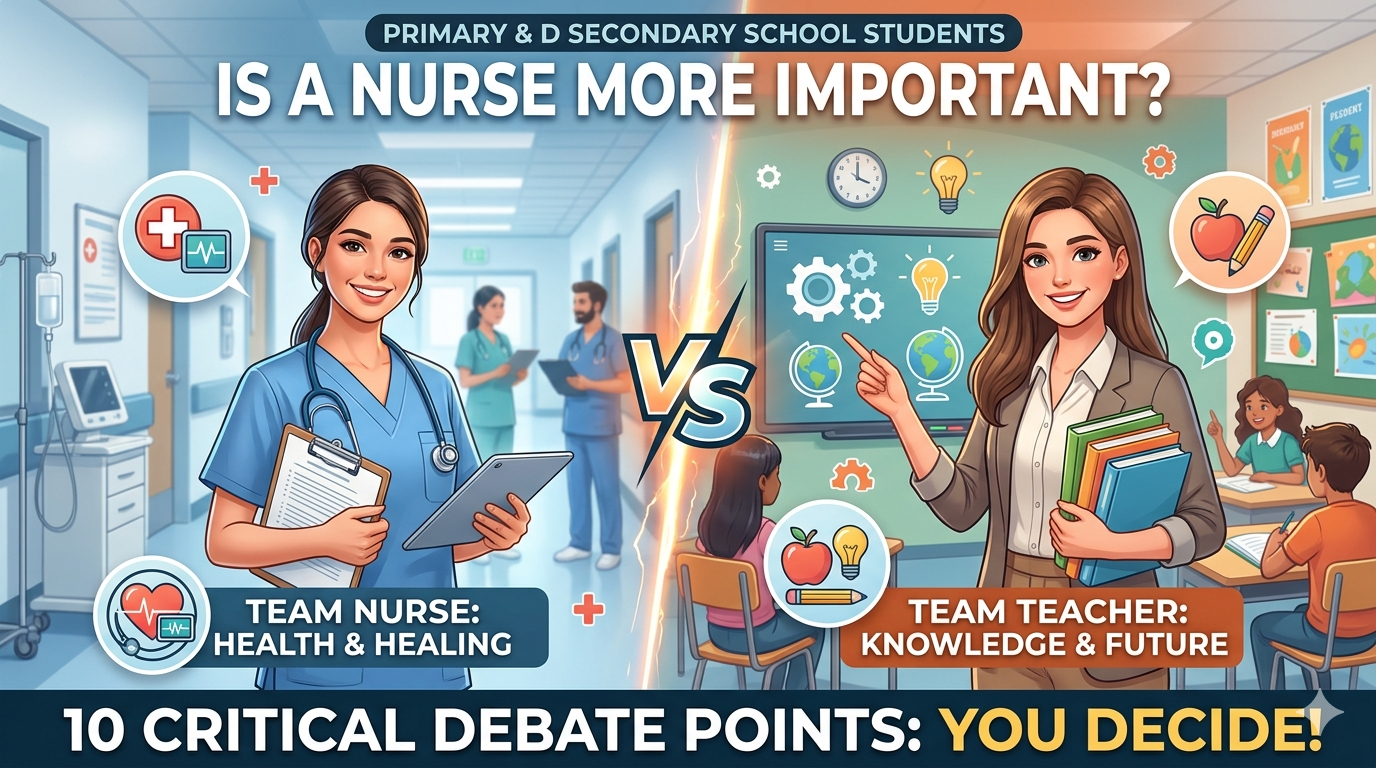
Nurse vs Teacher: Who Matters More to Society?
A complete debate guide covering both sides — for Nigerian students and curious minds
Topic: Is a Nurse More Important Than a Teacher? | Both Sides | Nigerian Schools Debate Guide
Introduction: Two Professions, One Burning Question
Picture two people. The first wakes before sunrise, puts on a uniform, and walks into a hospital ward where twenty patients are sleeping — some fighting infections, some recovering from surgery, some in the precarious hours between crisis and stability. She checks vital signs, adjusts drips, changes dressings, and speaks softly to the patient who cannot sleep because pain and fear are keeping them awake. She will not leave until her twelve-hour shift ends.
The second wakes at a similar hour, prepares lesson notes, and walks into a classroom where forty children are waiting. Over the next six hours, she will open minds — explaining fractions, reading stories aloud, correcting writing, resolving conflicts between classmates, and pausing to give extra attention to the child who has been struggling with a concept for two weeks and finally, today, begins to understand it. She will mark books tonight.
Both of these women are doing something extraordinary. Both are changing lives. The question this blog post explores — is a nurse more important than a teacher? — is one that Nigerian school students encounter regularly in debate competitions and classroom discussions. It is also a question that adults find genuinely worth thinking about, because it forces us to examine what we truly value in the people who serve us and what we mean when we say that someone is ‘important’.
Check out: How to Use Spaced Repetition So You Never Forget What You Read (The Secret to Acing WAEC & JAMB)
This guide argues both sides of the debate fully and fairly. If you are a student preparing for a competition, you will find complete arguments for whichever side you have been assigned, sample speeches, rebuttal strategies, and performance tips. If you are a general reader, you will find a balanced, thoughtful exploration of two professions that Nigeria urgently needs to honour, reward, and support far better than it currently does.
Is a Nurse More Important Than a Teacher?
We begin by setting the scene — understanding what these professions actually are and what they mean in the Nigerian context. Then we present five strong arguments for the nurse’s greater importance, and five strong arguments for the teacher’s greater importance. A scorecard section helps you see where each side’s arguments are strongest. We close with two complete sample speeches, detailed guidance on handling counterarguments, tips for debate performance, and a conclusion that does justice to both professions.
HOW TO USE THIS GUIDE: Read the entire post even if you have only been assigned one side of the debate. Understanding the opposition’s best arguments before they make them is the single most effective preparation strategy available to any debater. The student who has read both sides thoroughly will outperform the student who has only prepared their own side, every time.
Setting the Scene: What These Professions Mean in Nigeria
The Nurse in the Nigerian Reality
Nursing in Nigeria is simultaneously one of the most important and most underappreciated professions in the country. With a population of over 220 million and an estimated 250,000 registered nurses — a ratio of roughly one nurse per 880 people against the WHO recommendation of one per 300 — the Nigerian nursing workforce is carrying a load that would test any system.
The fact that Nigeria’s healthcare system functions at all, in many communities and in many facilities, is a tribute to the professional commitment and personal sacrifice of its nurses.
Nigerian nurses are trained at Schools of Nursing and Midwifery across the country, following curricula regulated by the Nursing and Midwifery Council of Nigeria. Training typically runs three years for basic nursing and three years for midwifery, with degree programmes available at universities that extend training to four or five years. Specialisation — in areas such as intensive care, community health, psychiatry, paediatrics, and nurse anaesthesia — requires additional years of training and examination.
On the ground, Nigerian nurses serve across an enormous range of settings: tertiary teaching hospitals in major cities, state general hospitals, local government health centres, private clinics, community health posts, school health programmes, occupational health in workplaces, and through the Integrated Maternal, Newborn and Child Health programmes operating in rural and underserved communities. In many of these settings — particularly at the primary healthcare level — the nurse is not supporting a doctor. The nurse is the healthcare system.
The Teacher in the Nigerian Reality
Teaching in Nigeria is, on paper, one of the most respected professions in the country. In practice, it is one of the most undercompensated, underresourced, and undervalued — a gap between rhetoric and reality that represents one of the greatest ongoing injustices in Nigerian public life.
Nigeria has approximately 700,000 teachers in its public primary and secondary schools, teaching over 50 million students. The system also includes hundreds of thousands of private school teachers, vocational education instructors, adult literacy teachers, and university lecturers.
Read more: How to Create Flashcards for Quick Revision: The Ultimate Guide for Nigerian Students
Nigerian teachers are trained primarily at Colleges of Education, which award the Nigeria Certificate in Education — the minimum qualification for teaching — and at universities, which offer Bachelor of Education degrees or postgraduate teaching diplomas.
The Teachers Registration Council of Nigeria regulates teacher registration, though enforcement of professional standards across the enormous and diverse Nigerian teaching workforce remains a significant challenge.
Teachers in Nigeria work in conditions that range from excellent — well-resourced private schools with small class sizes and good facilities — to extremely challenging — rural public schools with overcrowded classrooms, inadequate furniture, no electricity, and textbooks shared among multiple students. Despite these conditions, Nigerian teachers continue to shape the intellectual development of the nation’s young people, and the best among them do so with a dedication and creativity that inspires deep admiration.
Quick Snapshot: Where Each Side Has the Edge
Before the full arguments, here is a three-column scorecard showing the key dimensions of this debate and which profession has the stronger claim on each:
| Dimension of Importance | Nurse Has Edge | Teacher Has Edge |
| Immediacy of impact | Yes — impact is real-time and life-saving | Long-term — impact unfolds over years |
| Breadth of service | Serves those who are sick | Serves entire population, healthy or not |
| Producing other professionals | No — nurses are produced, not producers | Yes — teachers produce every profession |
| Emergency response | Yes — nurses are frontline emergency care | No — teaching has no emergency equivalent |
| Prevention of illness | Partial — through health education | Strong — through health literacy and education |
| Long-term national development | Important contributor | Primary engine of national development |
| Cultural & civic formation | Not primary role | Central role — shapes values and citizenship |
| Irreplaceability at crisis moment | Very high — no substitute at the bedside | Lower — learning can be deferred; death cannot |
| Generational compounding | Limited — heals individuals | Very high — shapes generations of professionals |
As the table shows, neither side dominates entirely. The nurse holds the edge in urgency, immediacy, and crisis-moment irreplaceability. The teacher holds the edge in breadth, generational reach, and the production of all other professionals including nurses. Both arguments are genuinely strong — and a well-prepared debater on either side can win.
Check out: List of 34 Trade Subjects in Nigerian Secondary Schools (2026 Updated Guide)
The Case for the Nurse: Five Arguments Why Nursing Matters More
If you are arguing that the nurse is more important, these five arguments give you the core of your case. Each is written with full Nigerian context, deep explanation, and a ready-to-use debate line.
Argument 1 — Nurse: Nurses Operate Where the Difference Between Life and Death Is Measured in Minutes
There is a specific kind of importance that belongs exclusively to the professional who stands between a human being and death in real time — where the stakes of action or inaction are not abstract, not long-term, not indirect, but immediate and irreversible. The nurse is that professional. And in the Nigerian healthcare context, the nurse is often the only person in that position.
Consider the clinical reality of nursing in a busy Nigerian hospital. A nurse managing a six-bed post-operative bay at Lagos University Teaching Hospital may be the first person to observe that a patient’s blood pressure has been declining steadily over the past forty minutes and that the surgical site is showing signs of internal bleeding. The surgeon is in theatre. The house officer is in another ward. It is the nurse who recognises the pattern, who makes the clinical judgement to escalate urgently, and whose timely intervention — calling for the team, preparing for emergency re-exploration, maintaining the patient’s airway and circulation — makes the difference between the patient surviving and not.
These moments of clinical vigilance and rapid response are not exceptional in nursing — they are the daily fabric of the work. Every shift, in wards across Nigeria, nurses are making dozens of clinical observations and minor decisions that collectively keep patients moving toward recovery rather than deteriorating into crisis. The nursing assessment is not a passive documentation exercise. It is an active, continuous act of surveillance that substitutes for the physician’s presence during the hours when the physician is not there.
Teaching, for all its enormous importance, does not have an equivalent of this emergency, time-critical dimension. A student who does not fully understand today’s lesson has tomorrow, next week, and next term to revisit the material. A patient who does not receive the right nursing intervention at the right moment may have no next chance. This asymmetry in the stakes of professional action is the foundation of the nurse’s claim to greater importance.
DEBATE LINE: “Teaching shapes the future. Nursing determines whether there is a future to be shaped. At the moment when a patient’s condition deteriorates in a ward at two in the morning, no teacher can help them. Only the nurse, trained and present and watching, can. The nurse works at the edge of life and death every single shift. No other profession carries that weight more consistently or more bravely.”
Argument 2 — Nurse: Nursing Is Nigeria’s Primary Defence Against Maternal and Child Mortality
Two of the most devastating public health failures in Nigeria are maternal mortality and under-five child mortality. Nigeria has one of the highest maternal mortality ratios in the world — with estimates suggesting that a Nigerian woman faces a lifetime risk of dying from pregnancy-related causes many times higher than a woman in a comparable country.
Check out: How to Avoid Daydreaming/Zoning Out in the Library: A Student’s Guide to Staying Focused
Under-five mortality remains one of the leading causes of childhood death in Nigeria, with millions of preventable deaths occurring annually from conditions that are manageable with skilled nursing care.
The professional who stands most directly between Nigerian women and children and these preventable deaths is the nurse — specifically the midwife, the community health nurse, and the paediatric nurse. The midwife who conducts skilled antenatal care is identifying the risk factors — pre-eclampsia, anaemia, foetal malpresentation, gestational diabetes — that, undetected, become the emergencies that kill. The midwife present at delivery is the professional who manages active labour safely, who responds to shoulder dystocia, who recognises postpartum haemorrhage and initiates immediate management, who resuscitates the newborn who does not breathe spontaneously at birth.
In a country where many deliveries occur in settings without doctor attendance — where a nurse-midwife or community health officer is the most qualified person in the room — the nurse’s skill, training, and clinical judgement are all that stand between a mother and a preventable death. And the community health nurse who follows up on newborns in the days after discharge, who identifies the jaundiced baby or the poorly feeding infant whose condition would otherwise deteriorate unobserved, is performing surveillance that directly prevents neonatal deaths.
No teacher, however excellent and however important, can reduce maternal mortality. No lesson plan prevents a postpartum haemorrhage. No classroom discussion resuscitates a newborn. These are exclusively nursing contributions to the survival of Nigerians, and they represent some of the most urgent and most consequential work being done in the country.
DEBATE LINE: “Every Nigerian mother who survived a complicated delivery because a skilled midwife was present is alive because of a nurse. Every child who survived their vulnerable first weeks because a community health nurse was checking on them is alive because of a nurse. In the battle against Nigeria’s maternal and child mortality crisis, the nurse is on the frontline — and the frontline is where importance is most clearly demonstrated.”
Argument 3 — Nurse: Nurses Spend More Time With Patients Than Any Other Healthcare Professional
Time with patients is a measure of intimacy, of influence, and ultimately of therapeutic impact. In the Nigerian healthcare system, the relationship between a patient and their nurse is, by a significant margin, the most time-intensive professional relationship in that patient’s healthcare experience. A ward doctor may round on patients for thirty to sixty minutes in the morning.
See also: How to Study for Multiple Choice Questions: The Secret to Acing JAMB and WAEC
An outpatient doctor may spend ten to fifteen minutes per consultation. But the ward nurse spends twelve hours in continuous proximity to patients — monitoring, intervening, educating, supporting, and building the kind of sustained professional relationship that has measurable therapeutic effects.
This extended presence gives nurses a quality of knowledge about their patients that no other professional in the hospital possesses. The nurse who has been caring for a patient across three shifts knows how that patient typically sleeps, knows what their baseline confusion level is, knows that they are usually in better spirits after their family visits, and knows that the subtle change in their demeanour this morning — a little more withdrawn, a little less responsive — is not just a bad day but a warning sign worth investigating. This longitudinal, relationship-based knowledge is one of nursing’s most powerful clinical tools.
Research in health sciences consistently demonstrates that nursing presence — the quality and continuity of nurse-patient contact — is one of the strongest predictors of patient outcomes in hospital settings. Higher nurse staffing ratios correlate with lower rates of in-hospital mortality, lower rates of hospital-acquired infections, shorter lengths of stay, and better patient satisfaction. These are not soft benefits. They are hard clinical outcomes, directly tied to the quantity and quality of nursing care.
The teacher also builds relationships with students over time — relationships that have genuine impact on learning outcomes. But no educational research suggests that the teacher’s relationship with students is a matter of hourly life-or-death vigilance. The nurse’s extended, intensive, clinically consequential presence at the patient’s side is a dimension of professional importance that is unique to nursing.
DEBATE LINE: “The doctor visits the patient. The nurse lives with the patient through the shift. It is the nurse who knows the patient — truly knows them — who knows when something is wrong before any monitor sounds an alarm. That depth of presence, that sustained and vigilant attention, is what makes nursing irreplaceable at the individual patient level.”
See also: Parents Are NOT Solely to Blame for the Misconduct of Their Children
Argument 4 — Nurse: Nurses Are the Public Health Educators Who Reach Families at the Most Teachable Moments
There is a form of teaching that nurses do that is uniquely powerful — and it is often overlooked in the comparison between nurses and teachers. The nurse who sits with a mother and explains how to recognise the danger signs in her newborn, who demonstrates correct breastfeeding technique, who explains how to mix oral rehydration solution, who teaches a diabetes patient how to manage their blood sugar through diet — that nurse is doing education. But it is education delivered at a moment of maximum receptivity, when the parent is holding their vulnerable new baby and will remember every word.
In public health terms, this kind of teaching — delivered at the point of care, in the context of a real health need, to a motivated recipient whose life circumstances make the information immediately relevant — is among the most effective health education that exists.
Compare it to health education delivered in a school classroom, where students may receive the information years before it becomes personally relevant and where the emotional stakes of remembering it are much lower. The nurse’s teaching happens when it matters most, to the people who need it most, in the setting where it is most likely to be retained and acted upon.
Across Nigeria’s network of primary healthcare facilities, nurses and community health workers routinely conduct health education sessions on topics including maternal nutrition, immunisation schedules, family planning, malaria prevention, hygiene and sanitation, and the recognition of danger signs in children under five.
These sessions, reaching millions of Nigerian parents and community members annually, directly translate into improved health behaviours and reduced disease burden. The nurse is not just a clinical practitioner — the nurse is a community health educator whose teaching reaches people at the most teachable moments of their lives.
DEBATE LINE: “The teacher educates the child in the classroom. The nurse educates the parent at the bedside, the clinic, and the health post — at the exact moment when that parent is most motivated to learn and most likely to act on what they learn. Nursing education is experiential, contextualised, and timed for maximum impact. In health education, the nurse is the most effective teacher of all.”
Argument 5 — Nurse: The World Cannot Function Without Nurses — As the COVID-19 Pandemic Proved
History has given us a natural experiment that settled, with tragic clarity, which professions are truly essential when society faces existential stress. The COVID-19 pandemic, which reached Nigeria in February 2020 and disrupted nearly every dimension of national life, demonstrated beyond any reasonable doubt which professionals were indispensable to the survival of human beings under crisis conditions.
Schools closed. Teachers — through no fault of their own — were largely unable to deliver their services for months. Online learning reached only a fraction of Nigerian students. Examinations were postponed. The educational year was disrupted in ways whose consequences for student learning will take years to fully assess. This was a genuine loss, and it mattered.
Hospitals, by contrast, could not close. The pandemic created the most intense nursing emergency in living memory. Nigerian nurses — in Lagos, in Abuja, in Kano, in Port Harcourt — were treating COVID-19 patients under conditions of profound personal risk, often with inadequate personal protective equipment, in facilities that were overwhelmed. Some of them paid with their health. Some paid with their lives. They did not stop.
That contrast — the school that closed, the hospital that could not — reveals something fundamental about the nature of nursing’s importance. Teaching is essential for the long-term development of society. Nursing is essential for the immediate survival of the sick.
When society is under maximum stress — when the choice is between functions that can be deferred and functions that cannot — nursing is among the functions that cannot be deferred. That essential, non-deferrable quality is the strongest possible argument for the nurse’s greater importance.
DEBATE LINE: “The pandemic closed the schools. The pandemic could not close the hospitals. Nigerian nurses kept working when every other profession retreated — treating patients, risking their own health, keeping the healthcare system alive when it was under the greatest pressure in living memory. Essential professions are the ones that cannot stop even when everything else does. Nursing is that profession.”
Check out: How to Use the Cornell Method to Take Better Lecture Notes (A Guide for Nigerian Students)
The Case for the Teacher: Five Arguments Why Teaching Matters More
If you are arguing that the teacher is more important, these five arguments form the backbone of your case. Each is developed in depth with Nigerian context, supporting reasoning, and a strong debate line.
Argument 1 — Teacher: Every Nurse in Nigeria Was Shaped by a Teacher Before They Ever Entered a Ward
Let us trace the professional journey of a Nigerian nurse back to its very beginning. Long before she set foot in a School of Nursing, long before she administered her first injection or documented her first patient assessment, she was a student. She sat in a primary school classroom and learned the alphabet — taught by a teacher.
She studied basic science and learned about the human body — taught by a teacher. She sat the WAEC examinations that determined her admission to nursing school — prepared by teachers. She gained the literacy, the numeracy, the scientific foundation, and the learning skills that nursing school demanded of her — built by teachers, over twelve or more years of formal education.
And inside the nursing school, who delivered her professional education? Nurse educators — who are teachers. The lecturer who taught her pharmacology and explained how different drug classes work at the cellular level. The anatomy and physiology instructor who showed her how the cardiovascular system, the respiratory system, and the renal system interact.
The clinical instructor who supervised her first patient assessments and guided her through the unfamiliar territory of real clinical practice. Every competency a nurse possesses was built through teaching.
This is not merely a historical observation about how nurses came to exist. It is a structural argument about what makes nursing as a profession possible. Nursing knowledge is not innate — it is transmitted. And the transmission of that knowledge, from one generation of practitioners to the next, is the work of teaching. Remove teachers from the chain of professional formation, and within one generation, the nursing profession runs dry. No new nurses are trained. The existing workforce ages out. And the healthcare system — for which nursing is the backbone — collapses.
The nurse heals individuals. The teacher sustains the profession that heals individuals. Between the sustainer and the sustained, the sustainer is always more foundational.
DEBATE LINE: “Every skill a nurse has, every drug name she knows, every clinical sign she can recognise — a teacher put that knowledge in her mind. The nurse is the product. The teacher is the producer. In any system of value, the person who creates what others depend on occupies the more fundamental position. The teacher creates the nurse. That makes the teacher more important.”
Check out: How to Register for NYSC Mobilization: The Complete Guide for Fresh Graduates
Argument 2 — Teacher: Education Determines the Health of a Population Over Decades — Not Just Individuals in Crisis
The nurse’s strongest argument is the immediacy of their impact — the life saved today, in this ward, in this hour. It is a genuinely powerful argument. But when we assess the importance of a profession to society, we must look not only at the immediate but at the cumulative and the structural. And when we examine health outcomes at the population level over decades, education is one of the most powerful determinants of health that exists.
The evidence for this is overwhelming and consistent across countries, cultures, and time periods. A woman with secondary education in Nigeria is significantly more likely to seek antenatal care, to deliver in a health facility with a skilled attendant, to fully immunise her children, to recognise danger signs in a sick child and seek care promptly, and to practise appropriate nutrition for her infant and herself. Each of these behaviours directly reduces the risk of maternal death, infant death, and childhood illness. Each is a product of education — built by teachers.
At the community level, communities with higher average educational attainment have lower rates of preventable infectious disease — not because they have more nurses but because educated community members practice better hygiene, understand disease transmission, are more likely to use bed nets consistently, more likely to complete courses of treatment, and more likely to participate in vaccination campaigns. Education is, in epidemiological terms, a population-level health intervention of the highest order.
The nurse treats the patient who has already fallen ill. The teacher prevents the illness by building the knowledge, the decision-making capacity, and the economic independence that protect health. Between treatment and prevention, prevention is always the more desirable and the more cost-effective outcome. The professional who drives prevention at the population level — the teacher — is making the more important contribution to the health of Nigerian society as a whole.
DEBATE LINE: “Give Nigeria more nurses and you treat more sick people. Give Nigeria better teachers and you produce fewer sick people to treat. The teacher does not merely contribute to health — the teacher determines the health trajectory of entire generations. Over the long arc of Nigerian development, the teacher’s contribution to population health dwarfs even the most heroic individual acts of nursing care.”
Argument 3 — Teacher: Teachers Are Responsible for Nigeria’s Economic Development — The Foundation of All Other Progress
Healthcare requires money. Hospitals must be built, equipped, and maintained. Medicines must be purchased. Medical and nursing staff must be trained and paid. The entire infrastructure of healthcare — the buildings, the technology, the supply chains, the administrative systems — is expensive, and that expense must be met from the national and household economies.
The quality of healthcare available to Nigerians is not primarily a function of how many nurses are trained. It is a function of how developed and how productive the Nigerian economy is.
And economic development, in every serious analysis of how it happens, is driven primarily by education. The human capital that education builds — the skills, the knowledge, the problem-solving capacity, the capacity for innovation and adaptation — is the most important driver of sustained economic growth that development economists have identified.
The East Asian economic miracles of the twentieth century — South Korea, Singapore, Taiwan, Japan — were driven by massive, sustained, serious investments in education. Their prosperity enabled their healthcare systems. Their healthcare systems did not produce their prosperity.
In Nigeria, the communities with the strongest educational traditions have historically been the most economically productive, the most innovative, and the most capable of sustaining high-quality public services — including healthcare. The famous productivity of Nigerian professionals in diaspora — in medicine, in engineering, in finance, in academia — is the product of education. The education that Nigerian teachers provided. The value that Nigerian teachers created.
When a teacher educates a child who goes on to become a successful entrepreneur, that teacher has created a taxpayer whose contributions fund the hospital where nurses work, the pharmaceutical companies that produce the medicines those nurses administer, and the engineering firms that maintain the medical equipment those nurses use. The teacher’s economic contribution is not direct — it is structural and systemic. But structural and systemic contributions are always the more foundational ones.
DEBATE LINE: “The hospital that nurses work in was built with public money. That public money came from a productive, tax-paying economy. That economy was built by educated, skilled, innovative Nigerians. Those Nigerians were educated by teachers. The economic foundation on which all healthcare — including all nursing — depends is an educational product. The teacher built the system within which the nurse works.”
Argument 4 — Teacher: Teachers Are the Guardians of Language, Culture, and National Identity
Nigeria is one of the most culturally diverse nations on earth — home to over 250 ethnic groups, more than 500 languages, and millennia of accumulated cultural heritage across regions as different from each other as the dry savannas of the far north and the mangrove forests of the Niger Delta. This diversity is Nigeria’s greatest source of richness and one of its most persistent challenges. Sustaining a coherent national identity across such diversity — building the shared values, the shared language, and the shared sense of belonging that make nationhood possible — is one of the most important and most difficult tasks that Nigerian society faces.
The teacher is the professional at the centre of that task. When a teacher in a primary school in Borno State teaches her students to sing the national anthem and explain what it means, she is doing nation-building work. When a teacher in Lagos leads her class in studying Nigerian history — the pre-colonial kingdoms, the colonial encounter, the independence movement, the civil war, the gradual building of democratic institutions — she is connecting those students to a shared national story. When a literature teacher introduces students to Chinua Achebe, Wole Soyinka, Chimamanda Ngozi Adichie, and other Nigerian writers, he is cultivating a shared cultural vocabulary that crosses ethnic and regional lines.
English — Nigeria’s national language, the medium of government, commerce, and inter-ethnic communication — is a skill that must be taught. It is not acquired naturally or inherited. It is built, over years of instruction, by teachers. Without teachers building this shared linguistic capacity across the country’s enormous diversity, Nigeria’s capacity to function as a unified national entity would be profoundly compromised.
The nurse serves individual patients in moments of physical vulnerability. The teacher serves the nation in the ongoing project of holding it together as a coherent, functioning, historically aware society. Both are essential. But the one who works at the level of national identity and cultural transmission is doing something of unique and irreplaceable importance — and that is the teacher.
DEBATE LINE: “A nurse keeps Nigerian bodies alive. A teacher keeps Nigerian identity alive — the history, the languages, the cultural inheritance, the sense of shared nationhood that makes ‘Nigeria’ mean something. A nation of physically healthy but culturally rootless, historically ignorant, and civically disengaged people is not a great nation. It is the teacher who prevents that outcome. The teacher’s work is the work of civilisation itself.”
Argument 5 — Teacher: The Teacher Is the Only Professional Whose Absence Would Destroy Every Other Profession
This is the argument that, when understood fully, is the most difficult for the nurse’s side to defeat. It is a thought experiment about dependency and foundation. Ask: if all nurses disappeared from Nigeria tomorrow, what would happen? The answer is terrible: sick people would go untreated, maternal deaths would spike, epidemic diseases would go unmanaged, and suffering would increase enormously. This is a genuine catastrophe, and it illustrates powerfully how important nurses are.
Now ask: if all teachers disappeared from Nigeria tomorrow, and remained absent for a full generation, what would happen? Not just to education — to everything. The next generation of doctors would not be trained. The next generation of nurses would not be trained. The engineers who build hospitals would not exist. The pharmacists who supply medicines would not exist. The administrators who manage health systems would not exist. The legislators who fund healthcare would be illiterate. The voters who hold governments accountable for healthcare quality would be unable to read their ballot papers.
The disappearance of nurses, terrible as it would be, is a catastrophe that an educated society can eventually address — by training new nurses, by mobilising existing allied health professionals, by seeking international support. It is a healthcare crisis. The disappearance of teachers is a civilisational crisis. It is a crisis from which recovery is not possible within a human lifetime, because the mechanism for rebuilding every other profession — education — has itself been destroyed.
This thought experiment reveals the teacher’s position in the hierarchy of societal importance. The nurse is necessary. The teacher is foundational. Necessary things can be rebuilt when lost. Foundational things, when removed, take everything else with them. The teacher is the only professional whose permanent absence would eventually eliminate the nursing profession — and every other profession — entirely.
DEBATE LINE: “Remove nurses from Nigeria and the country faces a terrible health crisis. Remove teachers from Nigeria for a generation and the country has no nurses, no doctors, no engineers, no leaders — no functioning modern society of any kind. The nurse is essential. The teacher is foundational. Foundational is always more important than essential, because foundational is what makes essential things possible.”
Check out: How to Use Spaced Repetition So You Never Forget What You Read (The Secret to Acing WAEC & JAMB)
Two Complete Sample Speeches — Adapt These for Your Competition
Study the structure and the key moves in each speech. Then rewrite them entirely in your own voice. The best debate speeches sound natural and personal — not like a borrowed script.
Speech One: Arguing the Nurse Is More Important
“Good morning, distinguished judges, respected timekeeper, honourable opponents, and all present. I rise today to argue that a nurse is more important to Nigerian society than a teacher.
I want to begin by asking this panel to travel with me — to a maternity ward in a rural general hospital in Kogi State. It is late at night. A young mother has just delivered her baby, and something is wrong. She is bleeding heavily. The doctor who attends this facility visits twice a week — and this is not one of those nights. There is no doctor. There is a nurse.
That nurse assesses the situation. She identifies postpartum haemorrhage. She initiates the emergency protocol she was trained for — oxytocin, fundal massage, IV access, urgent referral preparation. Her hands are steady. Her mind is clear. Her training, her presence, and her courage are all that stand between this young mother and death. And because of the nurse — because she was there, and trained, and watching — the mother lives.
Distinguished judges, that scene plays out across Nigeria every single day and every single night. Not metaphorically. Not as an illustration. As a lived reality, in hundreds of facilities, managed by thousands of nurses who are there when no one else is.
Today the proposition will demonstrate that nurses operate where the difference between life and death is measured in minutes. That they are Nigeria’s primary defence against the maternal and child mortality crisis that claims too many lives. That they spend more sustained, clinically consequential time with patients than any other healthcare professional. That they are powerful health educators at the most teachable moments in people’s lives. And that the COVID-19 pandemic proved beyond any doubt that nursing is among the most essential and non-deferrable services in society.
The opposition will speak about the teacher who produces nurses. We respect and honour teachers profoundly. But today we ask the panel to consider: what use is the nurse’s education if the nurse is not there at midnight in Kogi State? What use is years of training if the professional trained is absent at the moment of maximum need? The nurse’s importance is not theoretical or eventual. It is immediate, physical, and life-determining. Vote for the proposition. I thank you.”
Speech Two: Arguing the Teacher Is More Important
Read also: How to Apply for NYSC Relocation: The Complete “No Stress” Guide for PCMs
“Distinguished judges, honourable opponents, and all gathered here. I stand to argue, on behalf of the proposition, that the teacher is more important to society than the nurse.
My honourable opponents have asked you to think about the nurse in Kogi State who saved a mother’s life at midnight. It is a moving and true story, and we honour that nurse deeply. But I want to ask this panel to think about what happened before that midnight moment.
Before that nurse could stand in that ward and save that life, she spent three years at a School of Nursing. Before nursing school, she completed six years of secondary school. Before secondary school, she completed six years of primary school. At every stage of that fourteen-year journey — from the first letter of the alphabet to the last clinical examination — teachers were there. Teachers built the mind that held the knowledge. Teachers built the discipline that prepared her for the demands of nursing training. Teachers built the scientific literacy that allowed her to understand pharmacology and physiology and clinical assessment.
And the mother whose life was saved? She knew to go to the health facility. She understood that something was wrong. She could communicate her symptoms clearly. She could understand the nurse’s instructions. She could give informed consent. All of that capacity — the health literacy, the communicative ability, the understanding of how the healthcare system works — was built by teachers.
Distinguished judges, today the proposition will show that the teacher is the creator of every nurse in Nigeria. That education is the most powerful long-term determinant of population health. That teachers drive the economic development that funds the hospitals and buys the medicines that nurses use. That teachers are the guardians of national identity and civic character. And that the teacher is the only professional whose permanent absence would ultimately eliminate the nursing profession itself.
The nurse is the hero of the midnight emergency. The teacher is the architect of the civilisation within which that midnight emergency can be successfully managed. Between the architect and the hero, the architect comes first. Vote for the proposition. I thank you.”
Check out: Parents Are NOT Solely to Blame for the Misconduct of Their Children
Handling the Opposition: Your Rebuttal Toolkit
If You Are Arguing the Nurse Side:
- When the opposition says ‘teachers produce nurses’: Acknowledge it genuinely: ‘Teachers contribute to the formation of nurses — we agree. But the nurse who emerges from that formation goes on to save lives directly and irreversibly in ways that the teacher’s work, for all its value, does not replicate. The teacher gives the nurse the tools. The nurse uses those tools to prevent death. The use of the tool, at the critical moment, determines whether people live or die. That use — not the tool’s manufacture — is where the greatest importance lies.’
- When the opposition says ‘education prevents illness’: Concede the point and redirect: ‘Education does contribute to health literacy — that is a real and valuable contribution. But it does not eliminate the need for skilled nursing care. Even the most educated, health-literate Nigerian gets sick, gives birth, has accidents, and develops chronic conditions that require nursing management. Prevention reduces frequency. It does not eliminate the need. And when the need arises, only the nurse can meet it.’
- When the opposition says ‘teachers serve everyone’: Acknowledge and reframe: ‘Teachers serve everyone in the educational system. Nurses serve everyone who is sick — and at some point in their lives, everyone is sick. But the people the nurse serves are at their most vulnerable, their most helpless, and their most in need of immediate professional attention. Importance is not only about breadth. It is about depth of need, urgency of service, and irreversibility of the consequences of absence. On all three of those measures, the nurse’s service is more important.’
If You Are Arguing the Teacher Side:
- When the opposition says ‘nurses save lives in real time’: Acknowledge and expand: ‘Nurses save lives in real time — we celebrate that truth. But let us complete the picture. Who trained the nurse to save that life? A teacher. Who built the health literacy that brought the patient to the facility in time to be saved? Teachers. Who manages the public health system, the hospital administration, the pharmaceutical supply chain, and the nursing regulatory framework that makes that life-saving moment possible? Educated professionals — produced by teachers. The nurse saves the life at midnight. The teacher built everything that made that midnight save possible.’
- When the opposition says ‘schools closed during COVID but hospitals did not’: Turn the argument: ‘The opposition’s COVID example actually supports our case. Yes, schools closed — and the consequences were severe and will take years to fully address. That damage to an entire generation’s education — the learning loss, the increased dropout rates, the widening of inequality — is evidence of just how important education is. The fact that its disruption caused harm at national scale is not evidence that teaching is less important than nursing. It is evidence that both are essential. And in terms of which profession’s elimination would ultimately cause more lasting harm, the teacher’s disappearance — by eliminating the training of all future nurses — is the more catastrophic long-term loss.’
- When the opposition says ‘nurses are at the bedside for twelve hours’: Acknowledge and contrast: ‘Nurses spend twelve hours a day with their patients. Teachers spend fifteen or more years with each generation of students. The nurse’s presence is intensive and clinical. The teacher’s presence is developmental and generational. Both are important forms of sustained engagement — but the teacher’s engagement, over the longer time horizon and across the broader range of human formation, produces a deeper and more lasting transformation of the person.’
Check out: How to Register for NYSC Mobilization: The Complete Guide for Fresh Graduates
Seven Tips for Winning This Debate
- Open with a vivid scene, not a definition. The best openings drop the audience into a specific moment — a hospital ward at midnight, a classroom in Kogi State, a woman in labour. Scenes create emotional investment before you have made a single formal argument. Definitions create boredom. Always open with a scene.
- Choose your strongest argument and build toward it. Structure your speech so that your arguments build in power toward a climax. Start with solid, logical arguments and save your most emotionally resonant or most logically unassailable argument for last. For the nurse side, the COVID argument is a strong closer. For the teacher side, the ‘thought experiment’ disappearance argument is the most difficult for the opposition to defeat.
- Use the word ‘irreplaceable’ strategically. On the nurse side: ‘At the bedside, in the emergency, the nurse is irreplaceable.’ On the teacher side: ‘In the formation of every other professional, including the nurse, the teacher is irreplaceable.’ Irreplaceability is the most powerful claim a profession can make, and both sides have genuine claims to it in different contexts.
- Anticipate and pre-empt the opposition’s best argument. Before the opposition makes their strongest point, acknowledge it yourself — and then explain why it does not defeat your case. ‘The opposition will tell you that teachers produce nurses. We acknowledge that truth freely. But…’ This pre-emption shows confidence, takes the wind out of the opposition’s sails, and demonstrates that you have thought about the issue from all angles.
- Use Nigerian statistics and examples. Specific Nigerian statistics — maternal mortality rates, nursing shortages, the impact of Awolowo’s free education policy, the nurse-to-patient ratios in Nigerian hospitals — ground your arguments in real Nigerian experience and demonstrate genuine preparation. Judges in Nigerian competitions are always more impressed by specific local knowledge than by generic global arguments.
- Practice speaking at a deliberate pace. Many students speak too quickly during debates, especially when nervous. A deliberate pace — slightly slower than feels natural — gives your words more authority, gives the judges more time to absorb your best points, and projects confidence. Pause after each of your key debate lines and let it settle before moving on.
- Maintain composure during the opposition’s speech. Experienced debaters listen carefully during the opposition’s arguments, take quick notes, and maintain a calm, attentive expression. Visibly reacting — grimacing, whispering to teammates, showing frustration — undermines your credibility and suggests you are rattled. Listen calmly, note the points you intend to rebut, and respond with measured confidence.
Questions Students Ask About This Debate Topic
Which side is stronger — nurse or teacher?
See also: The Lekki Headmaster: Themes and Symbolism (Complete Literature Guide)
Most experienced debaters consider the teacher side to have the stronger structural argument — the ‘teachers produce nurses’ point is logically very difficult to defeat. However, the nurse side has tremendous emotional power, particularly around maternal mortality, emergency care, and the COVID-19 evidence. Both sides are genuinely winnable with good preparation. The side that wins in a specific competition is usually the one whose debaters prepared more thoroughly and argued more confidently — not the one with the ‘objectively stronger’ case.
How is this debate different from the nurse vs doctor debate?
The nurse vs doctor debate is about two healthcare professionals, where the comparison is primarily within the healthcare domain. The nurse vs teacher debate crosses domains — comparing healthcare to education — which makes it philosophically richer and strategically more complex. The nurse vs teacher debate requires debaters to engage with fundamental questions about what society needs most and at what timescales importance is measured. It is a more challenging but also more intellectually rewarding debate topic.
What if both sides argue the ‘upstream vs downstream’ point?
Both sides can legitimately use upstream-downstream logic, which is what makes this debate interesting. The teacher side argues that education is upstream of healthcare — education produces nurses. The nurse side argues that health is upstream of education — you must be healthy before you can learn. When both sides use this argument, the debate becomes a genuine contest about which upstream factor is more foundational. The teacher side usually has the stronger version of this argument because the educational chain — teacher produces nurse who heals patient — is more direct and more clearly documented than the health chain in the context of education.
Can this post be used for essays and other written assignments?
Yes. Each of the ten arguments in this guide can be expanded into a full body paragraph in an argumentative essay. Choose the side you are arguing, write a clear introduction that states your position, develop each argument as a separate body paragraph with a topic sentence, supporting evidence, and a link back to your thesis, address the opposing view in a dedicated paragraph before providing a counter, and write a conclusion that restates your position and summarises your strongest evidence. The sample speeches can also serve as models for essay introductions and conclusions.
Read more: How to Use the Pomodoro Technique to Crush WAEC and JAMB (Without Burning Out)
Conclusion: Two Kinds of Heroism, One Nation in Need of Both
The question of whether a nurse is more important than a teacher does not have a single, universally correct answer — and any guide that pretends it does is not being honest with you. The answer depends on how you define importance, at what timescale you measure it, and which dimension of human flourishing you prioritise.
If you define importance as the most direct, most urgent, most immediately irreversible impact on human survival, the nurse makes a powerful case. In the wards and health centres and birthing rooms of Nigeria, nurses are doing work that determines whether specific human beings live or die today, and they are doing it with remarkable dedication under conditions of serious constraint.
That work deserves the nation’s deepest gratitude and far better remuneration and professional support than Nigerian nurses typically receive.
If you define importance as the most foundational, most generative, most broadly distributed contribution to the long-term flourishing of human society, the teacher makes an equally powerful case. In classrooms from primary school through university, teachers are building the human capacity that makes every other profession — including nursing — possible.
They are transmitting knowledge, building character, cultivating civic consciousness, and driving the economic development on which all other social investment depends. Nigerian teachers also deserve far more than they receive — in pay, in professional development, in social recognition, and in the material resources they need to do their work effectively.
Whatever side of this debate you have been assigned, argue it with full commitment and with genuine respect for the profession you are arguing against. Because the truth is that Nigeria is not well served by choosing between nurses and teachers — it is best served by honouring both, investing in both, and building a society in which skilled nurses and excellent teachers are able to do their extraordinary work under conditions worthy of the importance of what they do.
Two heroic professions. One Nigeria that needs both desperately. Argue your side — and honour them both.
Debate – Is a Nurse More Important Than a Teacher? | Complete Guide — Both Sides | Nigerian Schools