JAMB Subject Combination for Engineering 2026: The Complete Admission Guide
Let’s be honest for a second. The JAMB brochure is confusing. Opening that PDF often feels like staring at a map written in a language you don’t speak. You just want to know what subjects to register so you don’t get screened out before you even step into the exam hall.
I’ve seen it happen too many times. A brilliant student scores 290 in JAMB but gets disqualified because they chose Biology instead of Geography, or they ignored Chemistry. It’s painful, and I don’t want that for you.
If you are aiming for Engineering in JAMB 2026—whether it’s Civil, Mechanical, Computer, or Electrical—you are in the right place. We are going to strip away the confusion and look at exactly what the Nigerian curriculum demands.
What is the JAMB Subject Combination for Engineering 2026?
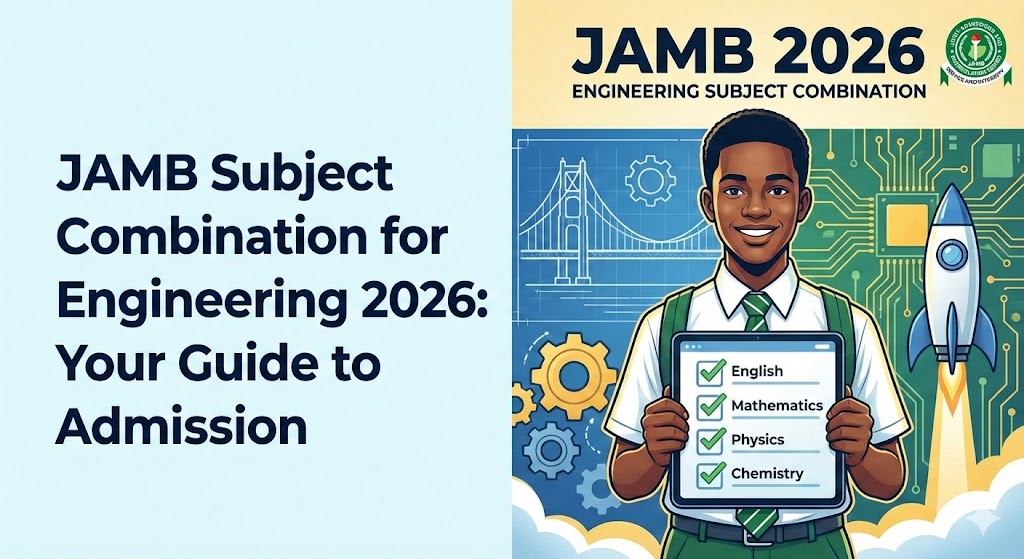
The standard JAMB subject combination for Engineering 2026 is Use of English, Mathematics, Physics, and Chemistry.
This “Big Four” combination is accepted by 99% of Nigerian universities (including UNILAG, OAU, UI, FUTA, and UNILORIN) for core engineering courses like Electrical, Mechanical, Civil, and Computer Engineering.
Why These 4 Subjects? (The “Big Four” Explained)
You might be wondering, “Why can’t I just pick the subjects I find easy?”
Here is the thing: Engineering is basically applied Physics and Maths. Universities need to know you have the foundation to build bridges, code software, or design engines without causing a disaster.
Let’s break down the requirements based on the Nigerian University Commission (NUC) standards.
1. Use of English (The Compulsory One)
This is non-negotiable. It doesn’t matter if you are studying Engineering or Yoruba Language; you must sit for Use of English. It’s the key that opens the JAMB door.
2. Mathematics (The Engine)
You cannot do Engineering without Math. It’s impossible. Whether you are calculating the load on a beam (Civil) or voltage drops (Electrical), Math is your daily bread.
-
Note: In JAMB, this is standard Mathematics, not Further Maths. However, having Further Maths knowledge is a massive advantage for the actual questions.
3. Physics (The Law)
Physics explains how the world works. Gravity, force, electricity, thermodynamics—these are the raw materials of engineering. If you hate Physics, you might want to rethink Engineering.
4. Chemistry (The Material)
This is the one that trips people up. “Why do I need Chemistry for Computer Engineering?”
Most Nigerian universities require it because engineering often deals with materials (silicon chips, concrete mix, fuel). It is the standard fourth subject.
Departmental Variations: When the Rules Change
While the “Big Four” (Eng, Math, Phy, Chem) works for almost everyone, there are a few special cases in the Nigerian curriculum.
Agricultural & Bio-Resources Engineering
This is where things get a bit flexible. Some universities (like FUNAAB or universities of technology) might accept Biology instead of Physics or Chemistry, but this is rare.
-
Safest Bet: Stick to the Big Four. If you must choose Biology, check the specific school’s requirement in the JAMB brochure first.
Biomedical Engineering
This is a growing field in Nigeria (UNILAG and UNILORIN are big on this).
-
The Twist: Because it deals with the human body, some schools accept Biology in place of Agricultural Science or sometimes Chemistry.
-
Recommendation: Don’t gamble. Most schools still prefer Physics and Chemistry because the medical part comes later.
Software Engineering vs. Computer Science
This is a common confusion.
-
Software Engineering often falls under the Faculty of Engineering, requiring Maths, Physics, and Chemistry.
-
Computer Science often falls under the Faculty of Science. While they prefer the same combo, some schools are lenient and might accept Biology or Economics instead of Chemistry (rare, but possible).
The O’Level Requirements (WAEC/NECO)
Your JAMB combo is useless if your O’Level result is messy. For Engineering, the requirement is strict. You need at least a Credit (C6) in five subjects at not more than two sittings.
The 5 Compulsory Credits:
-
Mathematics
-
English Language
-
Physics
-
Chemistry
-
Departmental Requirement: Usually Further Mathematics, Biology, or Technical Drawing.
Wait, what about Further Maths?
Many students ask me, “Sir, is Further Maths compulsory for WAEC?”
Strictly speaking? For many schools, No. You can enter with a credit in standard Mathematics.
However, competitive schools like UNILAG or UI respect a student with Further Maths. It boosts your chances during screening, even if it’s not officially “compulsory” on paper.
Common Misconceptions (Don’t Fall for These)
Every year, I see students make the same mistakes in the CBT center. Let’s clear them up.
Myth 1: “I can choose any Science subject as my fourth one.”
False. You cannot choose Geography or Biology for Mechanical Engineering just because you find them easier than Chemistry. The system will likely reject you during admission screening.
Myth 2: “Agricultural Science counts as a Science subject for Engineering.”
Mostly False. Unless you are applying specifically for Agricultural Engineering, Agric is usually considered a “filler” subject for admission calculation, not a core requirement.
Myth 3: “Private Universities don’t care about the combination.”
False. Private unis like Covenant or Babcock follow NUC guidelines strictly. They might be faster with admission, but they won’t admit you to Engineering without Physics and Maths.
Real-Life Application: Why This Matters
Let’s step out of the classroom for a minute. Why does the Nigerian government insist on this combination?
Think about the Third Mainland Bridge in Lagos. It stands because Civil Engineers calculated the physics of the load it carries and the chemistry of the concrete so it doesn’t corrode in the lagoon water.
Think about Paystack or Flutterwave. Those systems are built by software engineers who understand logic (Maths) and hardware constraints (Physics).
When you sit for these subjects in JAMB, you aren’t just ticking boxes. You are proving you have the mental discipline to solve Nigeria’s infrastructure problems. That’s the real goal.
The “Exam Corner”: Likely Questions & Strategy
Since we are talking about the JAMB subject combination for Engineering, the “exam” here is the JAMB test itself. You need to know what to expect from these specific subjects.
Here are 5 types of questions you will see in the Engineering subject combination, and how to tackle them.
Question 1 (Physics – Mechanics)
-
Topic: Motion and Projectiles.
-
Sample: A stone is projected at an angle of 30° to the horizontal with a velocity of 40m/s. Calculate the time of flight. (Take g = 10m/s²).
-
The Trick: JAMB loves projectile motion.
-
Model Answer: Use the formula $T = \frac{2u \sin \theta}{g}$.
u = 40, θ = 30°, g = 10
sin 30° = 0.5
Calculation: (2 × 40 × 0.5) / 10 = 40 / 10 = 4 seconds
-
Tip: Memorize your “special angles” (sin 30, cos 60) because JAMB calculators are basic.
Question 2 (Chemistry – Organic)
-
Topic: Hydrocarbons.
-
Sample: Which of the following is used in the ripening of fruits?
-
A. Ethene
-
B. Ethane
-
C. Ethyne
-
D. Ethanol
-
-
Model Answer: A. Ethene.
-
Tip: For Engineering aspirants, Organic Chemistry is high-yield. Know your Alkanes, Alkenes, and their industrial uses.
Question 3 (Mathematics – Calculus)
-
Topic: Differentiation.
-
Sample: If $y = x^2 – 4x + 3$, find the minimum value of $y$.
-
Model Answer:
-
Differentiate: $dy/dx = 2x – 4$.
-
Set to 0 for stationary point: $2x – 4 = 0 \Rightarrow x = 2$.
-
Substitute $x=2$ back into the original equation: $2^2 – 4(2) + 3 = 4 – 8 + 3 = -1$.
-
-
Tip: Calculus usually carries 3-5 questions in JAMB Math. Don’t skip it.
Question 4 (Physics – Electricity)
-
Topic: Ohm’s Law and Circuits.
-
Sample: Three resistors of 2Ω, 3Ω, and 6Ω are connected in parallel. What is the equivalent resistance?
-
Model Answer:
Formula: 1/Req = 1/R1 + 1/R2 + 1/R3
1/Req = 1/2 + 1/3 + 1/6
LCM is 6. So, (3 + 2 + 1) / 6 = 6/6 = 1.
Req = 1Ω
-
Tip: Know the difference between Series and Parallel formulas instantly. Speed is everything.
Question 5 (Use of English – Concord)
-
Topic: Subject-Verb Agreement.
-
Sample: The principal, as well as the teachers, _____ present at the meeting.
-
A. were
-
B. are
-
C. is
-
D. have been
-
-
Model Answer: C. is.
-
Tip: When using “as well as,” the verb follows the first subject (The principal). Since “Principal” is singular, the verb is singular (“is”).
Frequently Asked Questions (FAQ)
Q: Can I combine Physics, Chemistry, and Biology for Engineering?
A: Generally, no. Most universities require Mathematics instead of Biology. Biology is usually for Medicine, Pharmacy, or Anatomy students.
Q: Does Further Mathematics count as a JAMB subject?
A: No. In JAMB, you register for “Mathematics.” Further Maths is not a standalone subject option in the UTME exam, though it helps you solve the hard questions.
Q: What is the cut-off mark for Engineering in 2026?
A: It varies by school. For top federal universities like UNILAG or UI, you should aim for 250+ to be safe. For state universities, 200+ might get you in.
Q: Can I study Software Engineering without Chemistry?
A: It is risky. While it’s a computer course, because it is under the “Faculty of Engineering,” 95% of Nigerian schools will demand Chemistry. Check the specific school’s requirement in the brochure to be sure.