Let’s be honest for a second. Gaining admission to study Law in Nigeria is like a battle royale. Whether you are aiming for the University of Lagos (UNILAG), University of Ibadan (UI), or Ahmadu Bello University (ABU), the competition is fierce. Everyone wants that prestigious “LL.B” title.
But here is the thing: failing to get in doesn’t always happen because a student isn’t smart.
Often, it happens because of a simple, avoidable mistake during registration. If you choose the wrong JAMB subject combination for Law in 2026, it doesn’t matter if you score 350. The JAMB CAPS system will reject you, and the university won’t even look at your file.
I’ve seen bright students lose an entire year just because they picked Economics instead of Literature. Don’t let that be you.
Let’s break down exactly what you need to tick the right boxes.

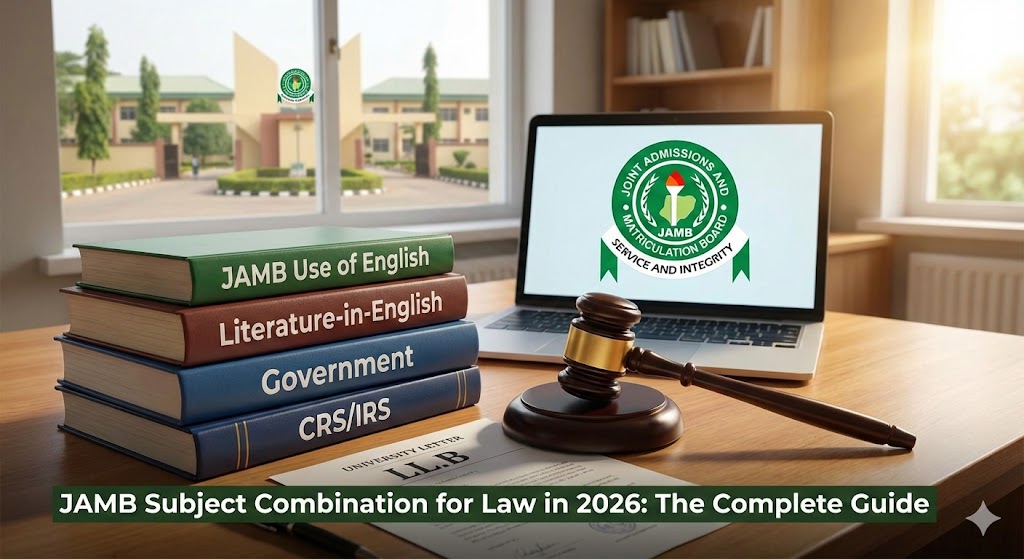
The JAMB subject combination for Law in 2026 (Quick Answer)
If you are in a rush, here is the standard combination accepted by 95% of Nigerian universities for Law:
1. Use of English (Compulsory) 2. Literature-in-English (Non-negotiable) 3. CRS or IRS (Christian Religious Studies or Islamic Religious Studies) 4. Government or History
Now, let’s look at why these matter and where the exceptions are.
The Breakdown: Understanding Your Choices
You might be thinking, “Can I swap one of these?” The answer is usually no, but let’s look at the specifics.
1. Use of English This is the only subject JAMB forces on you. You don’t have a choice here. However, for Law, you need to do more than just pass. Law is a course built on language. If your English score is low, your aggregate score drops significantly.
2. Literature-in-English This is the backbone of the Law faculty. According to the official JAMB Brochure, Literature is compulsory for Law in almost every university. Why? Because Law requires you to read massive amounts of text, analyze cases, and understand nuance. If you run away from Literature in secondary school, you will struggle in your first year of Law.
3. CRS / IRS Most federal and state universities prefer Religious Studies. It deals with morality and ethics, which aligns with legal studies.
4. Government or History You need to understand the framework of the state. Government is the most popular choice here, and frankly, it is usually easier to score high in Government than in History. Stick to what gives you the marks.
The Big Question: Do I Need Mathematics?
This is the most common question I get in my DMs. “Sir, I hate Maths. Can I escape it?”
For JAMB: Yes, you can escape it. You do not need to write Mathematics in JAMB to study Law. Stick to the Arts subjects listed above.
For O’Level (WAEC/NECO): This is where it gets tricky. Years ago, you could get a D7 (Pass) in Maths and still get admission for Law. Things have changed.
Today, top-tier schools like UNILAG, OAU, and UI usually require a Credit (C6) in Mathematics in your WAEC or NECO results. They view it as a test of basic logic. However, some state universities and private universities might still accept a Pass (D7) or E8.
My honest advice? Don’t take the risk. Work hard to secure at least a C6 in Mathematics. It keeps your options open.
O’Level Requirements (WAEC/NECO/GCE)
Your JAMB score is only half the battle. You need 5 Credits in your O’Level results at not more than two sittings.
Here is what your WAEC result should look like:
-
English Language: Credit (C6 or better)
-
Literature-in-English: Credit (C6 or better)
-
Mathematics: Credit (C6 is the safest bet)
-
Any other 2 Arts/Social Science subjects: (e.g., Government, CRS, Economics, Civic Education).
Note: If you are combining results (e.g., WAEC and NECO), ensure the names on both certificates match exactly. If the order of your name is different, that is an issue you need to fix at the court registry immediately.
Do Requirements Change Based on the University?
Yes, they can. While the standard list I gave you works for almost everyone, there are slight variations.
Federal Universities (UNILAG, UNN, UI): These schools are strict. They almost always demand Literature and rarely accept Economics as a substitute for Government or Religion. They also strictly require the C6 in Maths.
Private Universities (Covenant, Babcock, Afe Babalola): They tend to be a bit more flexible with the O’Level Maths requirement, but for JAMB, they still stick to the Arts subjects.
The “Economics” Debate: Some students ask if they can write Economics in JAMB instead of CRS/IRS. Technically? Some schools accept it. Practically? It’s risky. Economics is often classified as a Social Science, while Law is an Arts course in many faculties. Unless you are 100% sure your school of choice accepts Economics, stick to CRS/IRS. It is safer, and honestly, it is usually easier to score 70+ in CRS than in Economics.
Always confirm with the JAMB Integrated Brochure and Syllabus System (IBASS) before you register. It’s the only authority that matters.
Common Mistakes That Cost Students Admission
I’ve watched students cry after the Post-UTME results come out, not because they failed, but because they made technical errors.
-
The “Combo” Clash: You register for English, Lit, Govt, and… Biology. Why? Because you did well in Biology in SS2? JAMB doesn’t care. That combination is invalid for Law.
-
Ignoring the Subject Strengths: Don’t pick History if you haven’t opened a History textbook in two years just because it sounds “cool.” Pick Government if that is what you were taught in class. You need high scores, not style points.
-
Waiting for NECO: If you are using “Awaiting Result,” make sure your result will actually be ready before the university’s admission list is compiled.
Final Advice
Getting into the Law faculty is a marathon. It starts with selecting the right JAMB subject combination for Law in 2026, but it ends with high scores.
Don’t just aim for 200. In 2026, a score of 200 won’t get you Law in a major university. Aim for 270 and above. Read the recommended literary texts—actually read them, don’t just watch the summary on YouTube.
You have the roadmap now. The rest is up to the work you put in. Good luck!