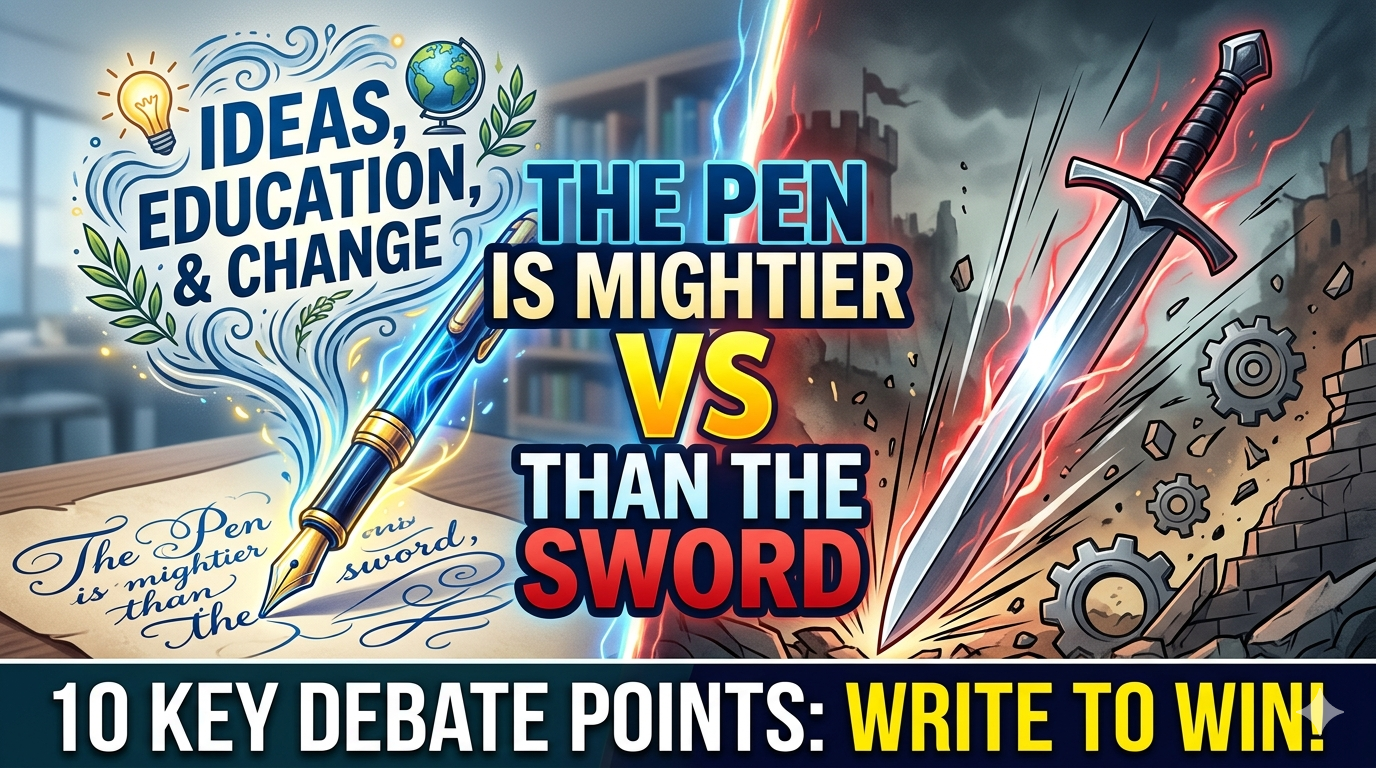
Is the Pen Really Mightier Than the Sword?
A complete debate guide on Pen is mightier than the sword debate points for secondary school students — 10 points for each side
Debate Motion: The Pen Is Mightier Than the Sword | Proposition & Opposition | Secondary School
Introduction: The Question That Has Haunted History
Imagine two people standing at the crossroads of history. The first holds a sword — forged steel, sharp and immediate, capable of splitting rock and ending life in a single stroke. The second holds a pen — a slender instrument of ink and intention, capable only of making marks on a surface. Which one changes the world?
The answer seems obvious at first glance. And then you start thinking about it. You think about Adolf Hitler — who had both a pen and an army, and whose written manifesto was as much a weapon as his Panzer divisions. You think about Nelson Mandela — who spent 27 years in prison, separated from his army, but whose pen kept producing letters and writings that sustained a liberation movement and eventually dismantled apartheid. You think about the Nigerian military coups that rewrote the country’s political reality overnight — and then you think about Chinua Achebe, whose pen rewrote how Africa understood itself and was understood by the world.
The debate motion ‘The pen is mightier than the sword’ has been argued in secondary school competition halls across Nigeria and around the world for generations. It is one of the most intellectually rich debate topics in secondary school education precisely because neither side has a simple, complete answer. Both sides have genuine power. Both sides have compelling evidence. And the student who understands both sides deeply will argue either one far more convincingly than the student who has only memorised one set of bullet points.
This guide gives you everything you need to master this debate. Ten complete, fully developed arguments for the proposition — the pen is mightier. Ten complete, fully developed arguments for the opposition — the sword is mightier. Two original sample speeches. A comprehensive rebuttal toolkit. A rich evidence table covering Nigerian and international history. Eight debate performance tips. And answers to the questions students most frequently ask about this classic motion.
Pen is mightier than the sword debate points for secondary school
Read the entire guide, whatever side you have been assigned. Understand each argument as a genuinely intelligent position rather than a set of talking points to memorise. Then walk into your debate hall knowing that you are the most prepared person in the room.
NOTE FOR STUDENTS: The best debaters do not just learn their own side — they understand the full debate. When you know the opposition’s best arguments before they make them, you can prepare your rebuttals in advance, and you project the kind of calm, comprehensive confidence that wins competitions.
Unpacking the Metaphor: What Are We Really Arguing?
Before making any argument in this debate, you must be absolutely clear about what the pen and the sword represent. This is not a debate about whether a literal pen can defeat a literal sword in a physical fight. That is obviously absurd. It is a debate about two forms of power, and what each one means in the context of human history, society, and change.
The Pen Symbolises:
- Written language in all forms — books, newspapers, constitutions, laws, pamphlets, manifestos, academic texts
- Oral communication when committed to record — speeches, testimonies, arguments made public
- Education, knowledge transmission, and the building of human intellectual capacity
- Journalism, the free press, and the accountability function of media
- Literature, poetry, and art — the works that shape cultural identity and human empathy
- Digital communication in the modern age — social media, blogs, online journalism
- Science and its written documentation — research papers, textbooks, technical manuals
- Diplomacy — the negotiations, treaties, and agreements that govern international relations
The Sword Symbolises:
- Military force in all its forms — armies, weapons, warfare, conquest
- Physical coercion by the state — police power, imprisonment, the threat and use of violence
- The hard power of governments and non-state armed actors — the capacity to compel by force
- Revolutionary and liberation movements where armed struggle was the primary instrument
- Terrorism, armed rebellion, and any use of political violence to achieve ends
- The capacity to destroy — cities, populations, institutions, civilisations
- Border control, territorial sovereignty, and the military underpinning of state power
What ‘Mightier’ Means:
Both sides must argue what ‘mightier’ means — and both sides can gain advantage by defining it carefully. The proposition argues that ‘mightier’ means more effective at producing lasting, meaningful, and fundamentally human change over the full arc of history.
The opposition argues that ‘mightier’ means more decisive at the critical moments when history actually pivots — when the outcome is uncertain and force determines the result. Whichever definition you choose, establish it clearly at the beginning of your speech.
Evidence at a Glance: Pen vs Sword Through History
| Area of Contest | Evidence for the Pen | Evidence for the Sword |
| Ending wars | All wars ended with written peace treaties | Only military victory creates conditions for peace |
| Changing governments | Watergate — journalism removed Nixon without force | Every Nigerian military coup changed govt overnight |
| Independence movements | Gandhi’s writings mobilised 400 million Indians | Most African independence required armed struggle |
| Building lasting institutions | Roman law still shapes legal systems worldwide | Roman military created the empire that spread the law |
| Social justice | Abolitionist literature built momentum to end slavery | Civil War actually ended US slavery by military force |
| Nigerian political history | Saro-Wiwa’s writing put Ogoni cause on world stage | Federal military ended Biafra; coups changed rule |
| Freedom of expression | The free press holds power accountable globally | Press freedom only exists where protected by law/force |
| Civilisational spread | Greek philosophy shaped Western thought for millennia | Alexander’s conquests spread that philosophy by sword |
| Modern influence | #EndSARS mobilised youth through social media | Lekki toll gate showed force limits digital movements |
| Science and medicine | Published research saved billions through vaccines etc. | Military funding drives most major scientific research |
Read more: Village Life Is Better Than City Life Debate Points
Section One: Ten Arguments for the Proposition
The following ten arguments build the case that the pen is mightier than the sword. Each is developed fully with historical and Nigerian context, and each ends with a debate-ready closing line.
Argument 1 [Proposition]: Words Planted in Minds Cannot Be Killed — Unlike Soldiers
An army can be defeated in battle. A general can be captured or killed. An empire can be overthrown by a rival power. Military victories are reversible — history is full of examples of conquered territories that later gained independence, of dominant powers that were eventually supplanted by rising rivals. The sword’s power, however overwhelming at the moment of its exercise, is ultimately temporary.
But an idea that has taken root in the collective mind of a people or a generation is extraordinarily difficult to destroy. The Roman Catholic Church banned Galileo’s heliocentric model of the solar system, forced him to recant, and placed his works on its Index of Forbidden Books. Galileo died under house arrest. Yet within a generation, his ideas had transformed the scientific understanding of the universe across Europe — because ideas written down and shared cannot be uninvented. The idea survived the silencing of the man who expressed it.
In Nigeria, the military governments of the 1980s and 1990s could imprison journalists and ban publications. They could assassinate Dele Giwa with a letter bomb. But they could not un-read the articles he had published. They could not erase the consciousness he had raised in readers who had already encountered his work. The ideas were out. The pen had already done its work before the sword struck. This is the pen’s deepest source of power: it operates on the interior life of human beings in a way that physical force simply cannot reach.
CLOSING LINE: “You can kill a soldier. You can destroy an army. You can burn a building. But you cannot unthink a thought that has already been thought by a million minds. The pen plants seeds in human consciousness that no sword can uproot. That is the pen’s most undefeatable power.”
Argument 2 [Proposition]: The Greatest Revolutions in Human Thought Were Sparked by the Pen
The Scientific Revolution of the sixteenth and seventeenth centuries — the transformation of humanity’s understanding of the universe, from a geocentric model governed by religious authority to a heliocentric model governed by empirical observation and mathematical reasoning — was sparked not by armies but by books. Copernicus published De Revolutionibus in 1543. Galileo published his Dialogue Concerning the Two Chief World Systems in 1632. Isaac Newton published Principia Mathematica in 1687. Each of these publications built on the previous, each circulated through the network of educated Europeans who could read Latin, and together they changed how every educated person in the world understood the cosmos.
The Enlightenment of the eighteenth century — the intellectual movement that produced the philosophical foundations of modern democracy, human rights, and the separation of church and state — was driven entirely by writers. John Locke’s Two Treatises of Government articulated the principles of consent of the governed and limited government that directly inspired the American and French Revolutions. Voltaire’s Candide and Montesquieu’s The Spirit of the Laws questioned religious and political authority in ways that destabilised the intellectual legitimacy of absolute monarchy across Europe. These were not men with armies. They were men with pens.
The intellectual revolutions produced by the pen have had more lasting consequences for how human beings organise their societies, understand their rights, and conceive of their relationship to government than any military revolution in the same period. The ideas of Locke and Voltaire are still alive in the constitutional democracies that now govern most of the world. The regimes against which they wrote have long since been swept away.
CLOSING LINE: “Copernicus changed how humanity understood its place in the universe — not with a sword, but with a diagram and an argument published in a book. Newton explained the laws governing the physical world with nothing but a pen and a proof. The pen did not merely describe the Scientific Revolution. The pen was the Scientific Revolution.”
Argument 3 [Proposition]: Journalism Has Brought Down Powers the Sword Could Not Touch
In a properly functioning democracy, the most powerful check on governmental abuse is not an opposing army — it is a free and fearless press. History has repeatedly demonstrated that investigative journalism can achieve what armed resistance cannot: the removal of powerful leaders, the exposure of systematic corruption, and the restoration of accountability to institutions that had believed themselves above scrutiny.
The Pentagon Papers — a classified US government study of the Vietnam War, leaked to the New York Times by Daniel Ellsberg in 1971 — revealed that successive US administrations had systematically deceived the public and Congress about the nature and prospects of the Vietnam War.
See more: How to Apply for NYSC Relocation: The Complete & No Stress Guide for PCMs
No armed group had obtained this information. A government analyst with a photocopier and a newspaper editor with a pen produced a political earthquake that changed the course of American history and strengthened press freedom permanently.
In Nigeria, the investigative journalism of Dele Giwa and the team at Newswatch Magazine in the 1980s created such alarm among the military establishment that Giwa was assassinated with a letter bomb — a fact that has never been officially resolved but that stands as one of the most chilling testimonies to how seriously the military regime feared his pen.
The regime had tanks and soldiers. But it feared Giwa’s typewriter more. That asymmetry of fear is revealing: the sword does not fear other swords as much as it fears the pen that exposes what it does with those swords.
CLOSING LINE: “The Nigerian military had tanks, jets, soldiers, and absolute power. And it feared a journalist with a typewriter enough to kill him. Ask yourself: why does the sword always move to silence the pen if the pen is the weaker weapon? The answer is that power knows — even when it will not admit it — that the pen is the greater threat.”
Argument 4 [Proposition]: Written Laws and Constitutions Have Permanently Constrained Raw Power
One of the most enduring achievements of the pen in human history is the creation of the legal and constitutional frameworks that have permanently reduced the arbitrary power of rulers and soldiers. Before the development of constitutional government, the word of a king or a general was law — and that word was enforced by the sword alone. The pen changed this by codifying rights, establishing limits on power, creating independent judiciaries, and producing the legal architecture that has made modern democratic governance possible.
The transformation began with the Magna Carta in 1215, when English barons compelled King John to sign a document acknowledging that even the king’s power was subject to law. That document — sixteen hundred words of Latin written on parchment — has been described as the foundation of constitutional government in the English-speaking world. It established a principle that no sword could establish: that law, not force, is the ultimate source of political legitimacy.
Every subsequent development in the constitutionalisation of power — the English Bill of Rights, the American Constitution and its Bill of Rights, the French Declaration of the Rights of Man, the Universal Declaration of Human Rights — has been a product of the pen. And each has achieved something remarkable: the permanent, structural reduction of the power of the sword over the individual.
A Nigerian citizen today cannot be held indefinitely without trial, cannot be subjected to torture, cannot be silenced purely on the whim of a ruler — because these protections are written into the Nigerian Constitution. The pen created those protections. No sword ever could.
CLOSING LINE: “Before the pen wrote the Magna Carta, kings had absolute power. After it, even kings were subject to law. The pen did not just describe the limits of power — the pen created them, and enshrined them in a form that has outlasted every king who has ever tried to ignore them. That is a depth of power that no sword has ever achieved.”
Check out: Best Universities to Study Medicine in Nigeria – Ranking, Fees & Requirements
Argument 5 [Proposition]: African Literature Changed How a Continent Understood Itself
One of the most profound forms of power that the pen exercises is the power to shape identity — to determine how a people understands its own history, values, and worth.
In the context of African history, this power has been of extraordinary importance, because the centuries of colonial encounter had produced a vast body of written material — by European explorers, missionaries, administrators, and novelists — that portrayed Africa as primitive, uncivilised, and lacking in history or intellectual tradition worthy of serious consideration.
It was the pen of African writers that dismantled this narrative — not African armies. Chinua Achebe’s Things Fall Apart, published in 1958, presented pre-colonial Igbo society with the depth, complexity, ambiguity, and full humanity that no previous work of European literature had afforded an African community.
It showed the world — and showed Nigerians — that African civilisation had its own philosophy, its own governance, its own art, its own moral complexity, and its own response to the destabilising encounter with colonial power.
Wole Soyinka, who won the Nobel Prize for Literature in 1986, and who continued to write and speak and protest against political repression in Nigeria throughout decades of military rule, demonstrated that the pen was not merely a cultural instrument but a political one — that literature and intellectual engagement were acts of resistance as real as any armed struggle. The pen of African literature did not fight colonialism with weapons. It fought it with truth, dignity, and the reclamation of a narrative that had been stolen.
CLOSING LINE: “No army gave Africa back its dignity after colonialism. Chinua Achebe did. Wole Soyinka did. The writers who said: our history is real, our culture is deep, our humanity is equal to anyone’s. They wrote Africa’s liberation where no soldier could reach — in the minds and hearts of millions of readers around the world. The pen liberated the African soul.”
Argument 6 [Proposition]: The Pen Crosses Borders That the Sword Cannot Reach
Military power is bounded by geography, by logistics, by the limits of physical force projection. An army can only be where its soldiers are. It can only control territory within its reach. It can only influence people it can physically access. These are fundamental limitations of the sword that the pen does not share.
A book published in Lagos can be read in London, New York, Beijing, and Buenos Aires. A newspaper article published in Abuja can influence the opinions of government officials, investors, and human rights organisations on every continent simultaneously. A speech recorded and uploaded online reaches audiences the speaker will never meet, in places they have never visited, in languages they may not speak once translation services render it accessible. The pen’s power is geographically unlimited in a way that the sword’s power can never be.
This geographical reach gives the pen a form of influence in international affairs that armed force cannot replicate. Nigeria’s Afrobeats musicians — whose music is itself a form of cultural expression, a pen of sound — have done more to build Nigeria’s international soft power and attract international interest in Nigerian culture than any military operation could achieve. The cultural diplomacy exercised through Nigeria’s creative industries is a form of pen power that reaches young people in Europe, America, and Asia who may never have direct political or diplomatic contact with the Nigerian state.
CLOSING LINE: “The sword rules where its soldiers stand. The pen rules where its words are read — and words can be everywhere at once. A book crosses every border. An idea leaps every wall. The pen’s power is geographically limitless in a way that the sword, bound always to the place where its blade falls, can never be.”
See more: How to Survive the 3 Weeks NYSC Orientation Camp: The Ultimate Survival Guide for New Corpers
Argument 7 [Proposition]: Education Has Lifted More People Out of Poverty Than Any Military Campaign
The most persistent form of human suffering — more widespread, more durable, and more destructive of human potential than any single war — is poverty. And the most consistently effective weapon against poverty in human history is education. The pen, in its role as the instrument of education — the textbook, the notebook, the teacher’s writing on the board, the examination paper — has done more to improve the material conditions of human life than any sword wielded by any general.
The spectacular economic transformations of East Asia in the second half of the twentieth century — the rises of South Korea, Taiwan, Singapore, and China from poverty to prosperity within a single generation — were not achieved by military conquest. They were achieved by massive investment in education, in literacy, in the systematic development of human capital through the pen. South Korea in the 1950s had a standard of living comparable to some of the poorest African countries. Within forty years, it was a global leader in electronics, automotive manufacturing, and technology — driven by an educated workforce built by teachers, textbooks, and the pen.
In Nigeria, the communities that have historically produced the most doctors, lawyers, engineers, business leaders, and professionals — the communities that have achieved the most economic mobility across generations — are the communities with the strongest educational traditions.
The Lagos families who invested in their children’s education in the 1960s are the families whose grandchildren are running companies and practising medicine today. The pen of education built that intergenerational wealth in a way that no amount of force could replicate.
CLOSING LINE: “South Korea was as poor as Nigeria in 1950. Today it is one of the world’s most prosperous economies. It was not built by the sword — it was built by the systematic investment in education, in knowledge, in the pen. No military campaign in history has done what a good school system does for a generation. The pen builds the future. The sword only destroys parts of the present.”
Argument 8 [Proposition]: The Pen Has Always Outlived the Sword That Tried to Silence It
Throughout history, every attempt by armed power to silence the pen — to burn books, ban newspapers, imprison writers, execute journalists — has ultimately failed. The ideas survive the silencing. The books are reprinted. The banned texts circulate underground. The executed writer becomes a martyr whose message reaches millions more people after their death than it ever did during their lifetime.
The Nazi book burnings of 1933 — in which the German Student Union burned tens of thousands of books by Jewish, communist, and pacifist authors in public squares across Germany — are remembered today as one of the most vivid images of the regime’s brutality.
But the books they burned are still read. The works of Heinrich Heine, Sigmund Freud, Karl Marx, and hundreds of other banned writers are available in every library in the world. The Nazi state that burned them lasted twelve years. The ideas in those books have outlasted the Third Reich by decades and will continue to outlast it for centuries.
Ken Saro-Wiwa was hanged by the Abacha regime on November 10, 1995. In the years since his death, his writing has been published and republished across the world. The Ogoni cause he championed has been taken up by international environmental organisations and legal advocates.
Shell Oil has faced legal proceedings in multiple countries partly as a result of the international attention that Saro-Wiwa’s pen drew to the environmental destruction of the Niger Delta. The sword silenced the man. It could not silence the words. The pen proved mightier than the execution.
CLOSING LINE: “Every regime that has ever tried to silence the pen by force has ultimately failed. The books survive the bonfires. The ideas outlast the censors. Ken Saro-Wiwa’s pen speaks louder today, from the grave, than the military government that killed him. The sword can silence a voice for a moment. The pen echoes across eternity.”
Argument 9 [Proposition]: The Digital Pen Has Given Ordinary Citizens Power That Once Belonged Only to Armies
One of the most significant developments of the twenty-first century is the democratisation of the pen through digital technology. In previous eras, the pen’s power was concentrated in the hands of those who controlled printing presses, newspaper distribution networks, and broadcasting infrastructure — which meant, in practice, governments, large corporations, and wealthy individuals.
The digital revolution has changed this completely, putting the power of the pen into the hands of anyone with a smartphone.
A single video, filmed on a mobile phone by an ordinary Nigerian, can now reach millions of people in minutes — triggering political consequences that governments cannot simply suppress through force.
The footage of police brutality that circulated during the #EndSARS protests of 2020 created an international record of events that the Nigerian government could not simply deny or erase. International media organisations, foreign governments, and global audiences had already seen the footage before any official response could be formulated. The digital pen had outmanoeuvred the sword’s information control capacity entirely.
Globally, the Arab Spring demonstrated that social media — the digital pen in its most populist form — could mobilise millions of people against entrenched authoritarian regimes faster than those regimes could respond.
In Tunisia, Egypt, Libya, and elsewhere, governments that had maintained power for decades through the sword found themselves confronted with popular movements organised and sustained through the pen — through Facebook posts, Twitter messages, and YouTube videos that bypassed every traditional information control mechanism the sword had relied upon.
CLOSING LINE: “A smartphone and a Twitter account now give an ordinary citizen the power to broadcast to millions, to document injustice in real time, and to mobilise movements that governments cannot easily suppress. The digital pen has democratised power in a way that no weapon in history has achieved. The twenty-first century does not belong to the army. It belongs to the person with a story, a phone, and the courage to post.”
Argument 10 [Proposition]: The Pen Builds; the Sword Can Only Destroy — and Building Is Always More Important
Consider what the pen has produced over the course of human history, compared to what the sword has produced. The pen has produced the Bible and the Quran — texts that have given billions of human beings moral frameworks, spiritual sustenance, and the sense of transcendent meaning that allows them to face suffering, loss, and death with resilience and hope. The pen has produced the works of Shakespeare, which have illuminated human psychology, the nature of power, and the complexity of love and ambition across 400 years of continuous performance and study. The pen has produced the scientific literature from which vaccines, antibiotics, and agricultural technology have emerged to extend and improve human life on an extraordinary scale.
The sword has produced the First World War — 20 million dead. The Second World War — 70 to 85 million dead. The Holocaust — 6 million systematically murdered. The Rwandan Genocide — 800,000 killed in 100 days. The Biafran War — estimated 1 to 3 million dead, many from famine caused by the military blockade. Every time the sword has been the primary instrument of human action, the primary product has been suffering, destruction, and death.
This asymmetry — between what the pen creates and what the sword destroys — is perhaps the most fundamental argument for the pen’s greater power. Power is not only the capacity to destroy. It is the capacity to build. It is the capacity to create lasting value, to produce things worth having, to generate the conditions of human flourishing. By this measure — the measure of what is actually produced — the pen has no rival. The sword’s record of production is a record of ruin. The pen’s record is the record of civilisation itself.
CLOSING LINE: “The sword produced the Holocaust, the Biafran famine, the Rwandan Genocide. The pen produced Shakespeare, the Quran, the polio vaccine, and the Universal Declaration of Human Rights. Ask which has done more for humanity, and the answer is not even close. The pen builds what the sword destroys. Building is always mightier than destroying.”
Check out: The Lekki Headmaster: Themes and Symbolism (Complete Literature Guide)
Section Two: Ten Arguments for the Opposition
The following ten arguments build the case that the sword is mightier than the pen. Each is developed fully with historical context, and each ends with a debate-ready closing line.
Argument 1 [Opposition]: Power That Cannot Defend Itself Is Not Power — the Pen Needs the Sword
The proposition’s most fundamental error is treating the pen as independent of the political and physical conditions that make its exercise possible. In reality, the pen’s power is entirely dependent on a prior condition: the existence of a social order in which writing, reading, and publishing are physically safe.
Every library that houses books, every printing press that reproduces them, every newspaper office that produces journalism, every university that teaches critical thinking — all of these institutions exist within a context of physical security that is ultimately maintained by force.
When that physical security is removed — when a community is occupied by a hostile military power, when a government decides to eliminate the press by force, when armed groups destroy educational institutions — the pen falls silent immediately.
Taliban rule in Afghanistan demonstrated this with brutal clarity: when armed power forbids girls from attending school and destroys the infrastructure of education, the pen is powerless to continue its work. The pen did not overcome the Taliban’s prohibition on female education.
International military intervention eventually removed the Taliban government — and the pen began working again under the protection of that force.
This relationship of dependency is foundational. The pen does not merely coexist with force — the pen depends on force for its very existence. The society in which the pen can exercise its power is a society in which force has already been deployed to create and maintain the conditions of safety and order. To argue that the pen is mightier than the sword is to ignore the sword that made the pen’s existence possible.
CLOSING LINE: “The pen writes in safety. The sword creates the safety. Before the pen can write a single word in freedom, the sword must have established the conditions in which freedom is possible. The pen is mightier in the world the sword has already secured. Take away the sword, and the pen has nothing to write on — except its own epitaph.”
Argument 2 [Opposition]: Nigeria’s Political History Was Written by the Sword, Not the Pen
Let us bring this debate home — to the country we live in, the history we share, the political reality that shapes our daily lives. The political history of Nigeria, from independence to the present day, is a history in which the sword has consistently been the decisive instrument of political change. Not the pen.
Nigeria gained independence from Britain in 1960. Within six years — in January 1966 — a military coup ended the First Republic and killed its Prime Minister, Abubakar Tafawa Balewa. The second coup of July 1966 killed the head of state who had come to power in the first coup.
The civil war of 1967 to 1970 was the most violent and consequential event in Nigerian history, claiming over a million lives and permanently shaping the country’s federal structure. The coups of 1975, 1983, 1985, and 1993 each changed Nigerian government through military force, not through the persuasive power of newspapers, novels, or public speeches.
Throughout this entire period, Nigerian writers, journalists, and intellectuals were writing. Achebe was writing. Soyinka was writing. The newspapers were publishing. The pens were working furiously. But the pens did not determine who governed Nigeria. The soldiers did. This is not a criticism — it is an observation. In the political reality of Nigeria’s experience, the sword has been the decisive instrument of governance change in ways that the pen, for all its cultural and moral importance, has not matched.
CLOSING LINE: “From 1966 to 1999, Nigeria was governed for most of its existence by military governments that came to power through coups — through the sword. Throughout that period, Nigeria had excellent writers, brave journalists, and articulate advocates. They did not determine who held power. The generals did. Nigeria’s political history tells us plainly which was mightier. It was not the pen.”
Check out: How to Register for NYSC Mobilization: The Complete Guide for Fresh Graduates
Argument 3 [Opposition]: The Pen Has Been the Sword’s Most Effective Weapon — Not Its Alternative
The proposition presents the pen and the sword as opposed instruments — one the tool of wisdom and justice, the other the tool of brute force. But this is a false dichotomy that ignores one of the most important lessons of modern history: that the pen has been most effectively deployed not as an alternative to the sword but as its servant and amplifier.
The most devastating military campaigns in modern history were accompanied by the most sophisticated propaganda machines ever created. Nazi Germany’s Goebbels used every form of the pen — newspapers, films, radio broadcasts, posters, books — to build the popular support and ideological framework that made the Holocaust possible.
Mao Zedong’s Little Red Book — literally a pen product — was used to mobilise the Cultural Revolution, in which millions of people were persecuted and killed. In Rwanda in 1994, Radio Mille Collines — a broadcast medium, a form of the pen — used the airwaves to incite Hutu citizens to murder their Tutsi neighbours, contributing directly to a genocide that killed 800,000 people in 100 days.
These examples demonstrate that the pen is a neutral instrument of power — no more inherently oriented toward justice and enlightenment than a sword is inherently oriented toward injustice and oppression.
The pen that serves the sword is more dangerous than any army — because it provides the ideological fuel that makes large-scale organised violence against civilians possible. The opposition does not argue that the sword is good. We argue that the pen, by itself, is no guarantee of goodness — and that the claim to moral superiority that the proposition implies is historically unearned.
CLOSING LINE: “The pen that wrote Mein Kampf was mightier than the pen that wrote pacifist poetry — because it was backed by a sword, and because it was used in the sword’s service. The pen is not the opposite of the sword. The pen can be the sword’s deadliest weapon. When it is, the sword wins every time.”
Argument 4 [Opposition]: Military Technology Has Shaped the Modern World More Than Any Text
The modern world — its borders, its balance of power, its technological infrastructure — was shaped primarily by military technology and military competition, not by written ideas. The nuclear deterrence that has defined international relations since 1945 is a product of the sword — specifically of the Manhattan Project, the development of atomic weapons, and the doctrine of mutually assured destruction that has prevented direct military conflict between major powers for eight decades. This peace — whatever its moral complexities — was maintained by the sword of nuclear deterrence, not by the pen of international law or diplomatic correspondence.
The internet itself — arguably the most transformative technology in human history, and the platform on which the digital pen now operates — was originally developed by the United States military’s ARPANET project in the late 1960s. The Global Positioning System (GPS) that makes modern navigation, logistics, and delivery systems possible was developed by the US Department of Defense.
Check out: How to Apply for NYSC Relocation: The Complete “No Stress Guide for PCMs
The jet engine that makes global travel possible was developed primarily for military aircraft. Many of the most consequential technologies in modern life — radar, microwave ovens, the internet, GPS, the World Wide Web’s underlying protocols — trace their origins to military research and development.
This does not mean that technology is morally neutral or that military development is always beneficial. It means that the sword — in its role as the driver of technological investment and innovation — has shaped the material infrastructure of the modern world in ways whose scale and significance rival or exceed the influence of any pen.
CLOSING LINE: “The internet you use to access news and social media was invented by the military. The GPS in your phone was built by soldiers. The jet that connects Lagos to London was designed for war. The digital pen that the proposition celebrates as the future of power operates on infrastructure built by the sword. Before you can pick up the digital pen, the sword had to build the platform it writes on.”
Argument 5 [Opposition]: Territorial Boundaries That Define Our World Were Drawn by the Sword
Every national border in the world today exists because, at some point in history, military force established and defended it. The borders of Nigeria — the borders that define who is a Nigerian, what territory Nigeria claims, and what resources Nigeria controls — were drawn by British colonial military force, contested through armed conflict during decolonisation, and maintained through the military victory of federal forces in the civil war of 1967 to 1970. These borders were not drawn by the pen of diplomats working in peaceful negotiation. They were drawn by soldiers, ratified by force, and subsequently formalised in written agreements.
The proposition may argue that the written treaties that formalise borders are products of the pen. But treaties are signed after wars — after the military outcome has already determined what the treaty will say. The pen records the outcome of the sword’s work. It does not determine it. The map of Africa — including Nigeria’s map — was drawn at the Berlin Conference of 1884 to 1885, where European powers divided the continent among themselves without African input.
Read now: How to Avoid Daydreaming/Zoning Out in the Library: A Student’s Guide to Staying Focused
That conference produced documents — a product of the pen. But the territories those documents described had already been claimed through military conquest. The pen was the notary. The sword was the agent.
CLOSING LINE: “Every map in the world is a record of military history — of which sword was stronger, which army conquered, which force prevailed. Nigeria’s borders exist because the British military established them and the Nigerian federal army defended them. The pen of the Berlin Conference described a carve-up that the sword had already accomplished. In geopolitics, the pen is the sword’s secretary, not its superior.”
Argument 6 [Opposition]: Many of the World’s Greatest Injustices Were Described by the Pen but Ended by the Sword
The proposition rightly celebrates the role of written advocacy in exposing injustice and building the moral case for change. Abolitionist literature documented the horrors of slavery with devastating clarity. Suffragist pamphlets made the intellectual case for women’s right to vote with irrefutable logic.
Anti-apartheid writing exposed the dehumanisation of South African racial segregation to the world. We acknowledge all of this. But in case after case, the pen described the injustice for decades — sometimes for centuries — before the injustice was actually ended. And in most cases, what finally ended it was not more persuasive writing but a shift in the balance of power.
Slavery was described, condemned, and argued against by writers for hundreds of years before it was abolished. William Wilberforce campaigned in the British Parliament for decades. The abolitionist press produced volumes of testimony and argument.
Yet slavery persisted — until the economic, political, and military conditions changed in ways that made abolition politically achievable. In the United States, it took the Civil War — 620,000 soldiers killed, four years of the most devastating military conflict in American history — to actually end slavery. The pen had been making the case for 250 years. The sword ended it in four.
If the pen were truly mightier, injustice would yield to eloquent argument and moral persuasion alone. But it rarely does. Oppressive systems do not typically dismantle themselves in response to powerful writing. They dismantle when the power dynamics that sustain them shift — and those power dynamics are almost always ultimately rooted in the balance of physical and military force.
CLOSING LINE: “Abolitionists wrote beautifully and argued brilliantly about the evil of slavery for two hundred and fifty years. Slavery ended in America after four years of civil war. The pen described the problem. The sword solved it. If describing a problem were the same as solving it, the pen would be mightier. It is not.”
Argument 7 [Opposition]: State Power Ultimately Rests on the Monopoly of Legitimate Force
Political science has long understood that the state’s authority rests ultimately on its monopoly of legitimate force — its exclusive right to use physical compulsion within its territory. This insight, associated with the German sociologist Max Weber, captures something fundamental about how political power actually works: that behind every law, every court order, every constitutional provision, and every act of governance lies the implicit threat of physical enforcement. The state’s pen writes laws. The state’s sword enforces them.
When a state loses its monopoly on legitimate force — when armed groups, criminal organisations, or separatist movements establish their own violent power within the state’s territory — the state’s written authority collapses. We have seen this in parts of Nigeria, where in some regions the authority of the formal state has been effectively displaced by armed non-state actors.
In those regions, the Nigerian Constitution — a product of the pen — does not protect citizens effectively because the enforcement mechanism — the sword — has been overwhelmed or displaced.
This reality reveals the foundational relationship between pen and sword in political life. The pen writes the rules. But the sword is what makes the rules real. Without the capacity for enforcement — without the sword behind every court order, every police instruction, every constitutional provision — the pen’s rules are advisory at best and irrelevant at worst. In the ultimate analysis, political authority is grounded in the capacity for force. The pen is how that authority is expressed. The sword is how it is exercised.
CLOSING LINE: “When armed groups take over communities in Nigeria’s north-east, the Nigerian Constitution does not protect those communities. The written law is powerless where the sword has been defeated. The law is only as real as the force behind it. The pen governs. The sword rules.”
Argument 8 [Opposition]: In the Decisive Moments of History, the Sword Has Acted While the Pen Has Watched
History turns on decisive moments — moments of maximum crisis, maximum uncertainty, and maximum consequence, where the outcome is not yet determined and where what happens in the next hours or days will shape the world for generations. At such moments, the pen offers analysis, commentary, and the articulation of principles. The sword acts.
On the beaches of Normandy on June 6, 1944, the decisive battle that began the liberation of Western Europe from Nazi occupation was not fought by journalists or philosophers. It was fought by soldiers — young men from America, Britain, Canada, and the Allied nations — who stormed fortified beaches under withering fire, who died in extraordinary numbers, and who, through military courage and sacrifice, turned the tide of the war against fascism. No newspaper editorial changed the outcome at Normandy. No written argument altered the course of the battle. Soldiers with weapons did.
In Nigeria, the military operation that ended the Biafran secession and preserved Nigeria’s territorial integrity was a military operation. The question of whether Nigeria would remain a single country or split into multiple states was decided by armies, not by arguments. Political figures on both sides wrote and spoke extensively about the righteousness of their cause throughout the conflict. But the outcome — the preservation of a united Nigeria — was determined by which side had greater military strength and staying power, not by which side had the more persuasive writers.
CLOSING LINE: “At Normandy, the soldiers did not stop to read philosophical treatises about the evil of fascism. They fought. They died. They won. The liberation of Europe was not written into existence — it was fought into existence. At the decisive moment of history’s most important battle, the sword acted where the pen could only watch.”
Argument 9 [Opposition]: The Pen’s Influence Is Slow — the Sword’s Impact Is Immediate
The pen changes the world — we acknowledge this. But the pen changes the world slowly, over decades and generations, through the gradual accumulation of shifted minds, changed attitudes, and altered cultural consensus.
This slowness is not a weakness in contexts where time is not of the essence. But in contexts where immediate action is required — where injustice is happening now, where people are dying today, where a crisis demands a response in hours rather than years — the pen’s gradualism is a profound practical limitation.
The partition of India in 1947 created one of the greatest humanitarian disasters in modern history — the mass displacement of up to 15 million people and the deaths of between 200,000 and 2 million in communal violence. Every political argument, every written plea, every newspaper editorial calling for peaceful transition was overwhelmed by the immediate physical reality of mass violence.
The pen did not stop the partition violence. The guns of both the Indian and Pakistani militaries eventually established the physical separation that ended the immediate killing — not perfectly, not justly, but with the decisive finality that only force can produce.
In every situation where people are in immediate danger — where a community is under attack, where civilians are being killed, where a crisis demands immediate physical intervention — the sword is the instrument that can respond in real time. The pen can condemn, document, and demand accountability. But it cannot stop a bullet already fired. The sword acts in the present. The pen acts on the future.
CLOSING LINE: “When a community is under attack tonight, the pen can write about it in tomorrow’s newspaper. The sword can protect it tonight. Immediate protection from immediate danger requires immediate force. In a world where crises are real and urgent and deadly, the sword’s immediacy is not a limitation — it is its greatest strength.”
Argument 10 [Opposition]: The Most Enduring Peace in History Was Achieved Through Overwhelming Military Superiority
The longest period of peace between major powers in recorded history — the roughly eight decades since the end of the Second World War during which no direct military conflict has occurred between nuclear-armed great powers — was achieved not through the pen of international law, diplomatic correspondence, or the United Nations Charter, but through the sword of nuclear deterrence.
The doctrine of mutually assured destruction — the knowledge that any nuclear first strike would result in the total annihilation of the attacking nation — has created a strategic equilibrium that has prevented world war for eighty years.
This peace has not been maintained by the power of eloquent argument or by the moral authority of international law. It has been maintained by the most devastating weapons ever invented — weapons that represent the ultimate expression of the sword’s power.
The United Nations, whose charter is one of the most important pen products of the twentieth century, has been unable to prevent numerous wars, genocides, and mass atrocities since its founding. The nuclear weapons of the great powers have maintained the specific peace between those great powers in ways that the UN Charter has demonstrably failed to achieve.
The implication for the debate is clear: the most durable achievement of modern geopolitics — the prevention of global nuclear war — is an achievement of the sword. The pen of international law and diplomacy was insufficient to prevent the Cold War from repeatedly coming close to direct military confrontation.
It was the overwhelming destructive power of the sword — the thermonuclear arsenal — that made rational actors on both sides choose deterrence over destruction. The sword’s power, in this context, literally saved the world.
CLOSING LINE: “The longest peace in modern history was bought not by the United Nations Charter but by nuclear weapons — by the ultimate sword. The pen of international law failed repeatedly to prevent war in the twentieth century. The sword of nuclear deterrence succeeded where the pen failed. The most important peace of our age is a peace written in the language of the sword.”
Check out: How to Register for NYSC Mobilization: The Complete Guide for Fresh Graduates
Sample Speeches for Both Sides
Proposition Speech: The Pen Is Mightier
“Distinguished judges, honourable opponents, teachers, and fellow students — I rise today to argue for the timeless truth that the pen is mightier than the sword.
My opponents will speak to you about armies and conquests and the decisive role of military force in history. They will cite the Norman Conquest, the Civil War, the Nigerian military coups. They will argue that the sword — not the pen — has been the decisive instrument at the turning points of history. We do not deny any of these facts. We simply ask the panel to consider a different question: not who won the battles, but who shaped the world that followed.
The Roman Empire fell. But the Roman pen gave us laws that still govern courts today. Nazi Germany lost the Second World War. But the Nazi pen — the propaganda of Goebbels — gave us a permanent lesson in how words can corrupt a civilisation, and inspired the Universal Declaration of Human Rights — the pen’s most ambitious attempt to prevent the sword from ever doing that again.
In Nigeria — our Nigeria — the military held power for most of our post-independence history. Coup after coup, sword after sword. And throughout all of that, Chinua Achebe was writing. Wole Soyinka was writing. Dele Giwa was writing until a letter bomb silenced him permanently. And what remains today? The coups are footnotes in history textbooks. Things Fall Apart is read on every continent. The pen outlasted every sword that tried to define Nigeria.
Today, a teenager with a smartphone has the power to document injustice, to tell a story that reaches millions, to start a movement that makes governments respond. The digital pen is the most democratically powerful instrument in human history.
The sword wins the moment. The pen wins history. Vote for the proposition. I thank you.”
Check out: How to Use the Feynman Technique to Understand Difficult Topics (Stop Cramming, Start Passing)
Opposition Speech: The Sword Is Mightier
“Distinguished judges, respected proposition, and all present — I stand to argue not out of love for violence or contempt for wisdom, but out of a commitment to the truth that this debate deserves.
The proposition has given you beauty. They have given you Achebe and Galileo and the Declaration of Independence. They have given you the inspiring vision of ideas outlasting empires. We respect every word of it.
But we ask the panel: what happened to the beautiful pens that were not backed by sufficient force? Galileo was silenced for decades. Dele Giwa was assassinated. Ken Saro-Wiwa was hanged. The proposition wants us to celebrate these martyrs of the pen as proof that the pen is mightier. We ask instead: if the pen were truly mightier, why did they die? The sword killed them. The pen was not mightier on those specific, terrible days.
Nigeria’s Constitution is a magnificent pen product. But in communities where armed groups have displaced state authority, the Constitution does not protect citizens today. The pen proclaimed their rights. The sword — failing to enforce those rights — left them unprotected. The pen is only as strong as the force prepared to back it.
We do not argue that the sword is good. We argue that the sword is decisive in the ways that matter most — when safety is at stake, when territory is contested, when the existence of a state is in question, when the immediate survival of human beings depends on physical protection. The pen describes these realities. The sword determines them.
Vote for the opposition. Vote for an honest reckoning with how power actually works. I thank you.”
Read more: Parents Are NOT Solely to Blame for the Misconduct of Their Children
Rebuttal Toolkit: Responding to the Best Arguments
Proposition Rebuttals:
- Opposition says ‘laws need force to enforce them’: Respond: ‘We agree that enforcement requires force. But consider what determines which laws are worth enforcing, what rights deserve protection, and what justice requires. The pen. Every law the sword enforces was written first by a thinker, a legislator, a judge. The pen gives the sword its purpose and its direction. Without the pen to write the law, the sword enforces nothing — it merely terrorises. The pen gives meaning to the sword’s power. The meaning is mightier than the mechanism.’
- Opposition says ‘Nigerian history was decided by coups’: Acknowledge and expand: ‘The coups came and went. The men who made them are mostly forgotten. Chinua Achebe is taught on six continents. Wole Soyinka won the Nobel Prize. Ken Saro-Wiwa’s legacy shapes international environmental law. Which has proven more consequential for how Nigeria is understood in the world — the coups that changed governments temporarily, or the literature that changed how humanity sees Africa permanently? The pen won the longer war.’
- Opposition says ‘the pen served the sword in Nazi Germany’: Turn the point: ‘The opposition’s example of Nazi propaganda actually proves our case. The Nazis understood that military power alone was insufficient — they needed the pen to justify their sword, to build public support, to maintain ideological coherence. They needed the pen to make their sword possible. The pen was so essential to their project that they made controlling it their first priority. This is not evidence that the sword is mightier. It is evidence that even the sword admits it needs the pen.’
Opposition Rebuttals:
- Proposition says ‘ideas outlast empires’: Concede and reframe: ‘Ideas do outlast empires — when those ideas are protected and transmitted by states with sufficient force to maintain educational institutions, libraries, and cultural transmission. The ideas of Socrates survived because Athens, and later Rome, had the military power to maintain the civilisations that preserved them. Ideas do not preserve themselves. Armed societies preserve ideas. The sword protects the library where the pen’s ideas live.’
- Proposition says ‘Gandhi won without force’: Qualify with context: ‘Gandhi succeeded against a specific colonial power in a specific historical moment — a Britain weakened by world war, sensitive to international opinion, and facing an independence movement whose leaders had explicitly ruled out violent resistance. Against a different colonial power, in a different historical moment, the same strategy would likely have failed. Indeed, Gandhi himself said that his method was designed for use against a regime with some moral conscience — and that it would have been ineffective against Hitler. The pen is mightier when the sword already agrees to be constrained by conscience. When it does not, the pen is insufficient.’
- Proposition says ‘#EndSARS proves the digital pen’s power’: Contextualise the outcome: ‘The #EndSARS movement achieved real things — international attention, the nominal disbanding of SARS. But the fundamental power structures that the movement challenged remained intact. The government did not fall. The security apparatus was restructured cosmetically, not transformed fundamentally. The protest was met with force at Lekki. The digital pen mobilised. The physical sword set the ultimate limits of what that mobilisation could achieve. This is not a victory for the pen. It is evidence of the ongoing contest in which the sword continues to hold the decisive cards.’
Eight Tips to Win This Debate
- Define your terms immediately. In your very first paragraph, define what you mean by ‘mightier’. Proposition: mightier means more effective in producing lasting historical change. Opposition: mightier means more decisive at the critical moments when outcomes are uncertain. Whichever definition you set, the rest of your arguments should flow from it. Judges reward debaters who control the framework of the discussion.
- Use the specific over the general. Naming specific books, specific laws, specific battles, specific people is always more persuasive than general claims. Do not say ‘literature changed how Africa is seen.’ Say ‘Chinua Achebe’s Things Fall Apart, translated into 60 languages and studied on every continent, changed how Africa is seen.’ Specificity signals preparation and conviction.
- Use the contrast structure. Build your arguments as explicit contrasts: ‘The Roman sword built an empire that lasted 500 years. The Roman pen gave us laws that have lasted 2,500 years.’ ‘The coup of January 1966 is a footnote in Nigerian history. Things Fall Apart is studied in universities worldwide.’ Contrasts are memorable and logical in a way that single claims are not.
- Know your Nigerian examples cold. Nigerian examples — the civil war, the military coups, Chinua Achebe, Wole Soyinka, Dele Giwa, Ken Saro-Wiwa, #EndSARS — connect the debate to lived Nigerian reality and demonstrate cultural awareness. Every student should be able to deploy at least three specific Nigerian examples per side.
- Practise the turn. A turn is when you use the opposition’s own example to support your case. Proposition turn on Nazi propaganda: ‘The Nazis needed the pen to make their sword possible — proving the pen’s indispensability.’ Opposition turn on Gandhi: ‘Gandhi’s method required a morally constrained opponent. Against unconstrained force, even Gandhi admitted the pen was insufficient.’ Turns are the most impressive moves in competitive debating.
- Address your weakest point before the opposition does. Every position in this debate has a weak point. The proposition’s weak point: the pen cannot stop immediate physical violence. The opposition’s weak point: military victories are temporary while ideas persist. Acknowledging your own weakness and explaining why it does not defeat your case is far more persuasive than hoping the judges do not notice it.
- Build emotional power toward your conclusion. The most effective speeches build in emotional power toward the end, so that the final argument carries the most weight and the closing line delivers the strongest impact. Plan your arguments in ascending order of emotional resonance and end on the point that is most likely to linger in the judges’ minds.
- Speak to the judges, not at your paper. This technical tip matters enormously. Judges decide in favour of debaters who appear confident and engaged — who look at them, who speak at a measured pace, and who seem to genuinely believe what they are saying. Practise your speech until you no longer need to look at your notes for more than a glance. The content in this guide is strong enough to win on its merits. Deliver it with your eyes up and your voice steady.
Check out: How to Survive the 3 Weeks NYSC Orientation Camp: The Ultimate Survival Guide for New Corpers
Questions Students Ask About This Debate
Where does the phrase ‘the pen is mightier than the sword’ come from?
The phrase was coined by the English novelist, playwright, and politician Edward Bulwer-Lytton in his 1839 historical play Richelieu; Or the Conspiracy. In the play, the scheming Cardinal Richelieu, unable to use military force against his enemies, declares: ‘Beneath the rule of men entirely great / The pen is mightier than the sword.’
The line was so memorable that it quickly entered common usage and has been quoted — and debated — ever since. Knowing the origin of the phrase adds historical depth to your speech and demonstrates genuine scholarship.
Which side has more historical support?
Both sides have substantial historical support, which is why this motion has sustained debate for so long. The proposition has strong support in the long arc of history — the durability of ideas, the power of journalism, the role of education in transformation.
The opposition has strong support in the short arc of history — the military decisions that determined the outcomes of specific conflicts, coups, and crises. The side that wins a specific debate is usually the side that defines ‘mightier’ most effectively and argues their case with the most specific evidence and the most confident delivery.
Can I argue that both the pen and sword are needed?
In a formal debate competition, you must argue the position you have been assigned — either for or against the motion. You cannot argue a middle position. However, in an essay or a class discussion, a nuanced conclusion that acknowledges the interdependence of the pen and sword — that each needs the other, but that in the long run the pen produces more lasting and more fundamentally human achievements — is both intellectually honest and impressively sophisticated.
What is the best single argument for each side?
For the proposition, the strongest single argument is that ideas — once written and widely distributed — cannot be destroyed even by military force, and that the accumulated effect of written ideas has shaped human civilisation more profoundly than any military campaign. For the opposition, the strongest single argument is that every pen writes within a space of safety that the sword created and maintains — meaning the pen’s power is dependent on and subordinate to the sword’s prior establishment of order. Both are structurally difficult to defeat and should be known deeply by anyone arguing either side.
Check out: How to Handle Panic Attacks in the Exam Hall: A Survival Guide for Nigerian Students
Conclusion: Why This Debate Will Never Be Fully Resolved — and Why That Is Its Greatest Value
The debate over whether the pen is mightier than the sword will never produce a universally agreed answer — because both sides are genuinely right about different things, at different timescales, in different contexts. The sword has been decisive at the critical moments of political and military history. The pen has been decisive in the longer arc of cultural, intellectual, and civilisational development. The sword acts in the present. The pen acts on the future.
What makes this debate so valuable as an educational exercise is precisely this irreducibility. It cannot be won by memorising a list of bullet points. It can only be won by genuinely understanding the full complexity of the question — the ways in which power operates in human societies, the relationship between force and ideas, the difference between winning a battle and winning history. The student who comes to understand these things through arguing this debate has gained something far more valuable than a competition trophy.
In the Nigerian context — where the pen of our writers has given us one of the most celebrated literary traditions in the world, and where the sword of our military history has shaped the political reality we live in — this debate is not abstract. It is the story of our country.
Argue it with that awareness, with the seriousness it deserves, and with the passion of someone who knows that the question of how change happens — through words or through force — is not just a debate topic but a question that shapes the future.
Read both sides of this guide. Know both arguments. Understand the evidence. Prepare your rebuttals. And then, whatever side you have been assigned, walk into that hall and argue it with everything you have. Because the best thing this debate can do for you is not to give you an answer. It is to give you the tools to think.
The pen wrote this guide to help you win with either weapon. Use it well.
Debate: The Pen Is Mightier Than the Sword | Secondary School | Both Sides — 10 Arguments Each