Primary 4 second term PVS lesson notes on farm tools
Prevocational Studies (PVS) is an important subject in the Primary 4 curriculum. In the second term, one of the key topics pupils learn is farm tools.
This topic helps young learners understand basic agricultural practices, identify common tools, and learn how these tools are used safely on the farm.
This detailed guide is written for primary school teachers, parents, lesson note writers, and tutors. It provides well-structured Primary 4 second term PVS lesson notes on farm tools, using simple explanations, clear objectives, and child-friendly activities.
Meaning of Farm Tools
Farm tools are simple tools used by farmers to carry out farming activities. These tools help farmers to prepare the land, plant crops, remove weeds, and harvest farm produce.
For Primary 4 pupils, farm tools can be explained as:
-
Tools used on the farm
-
Tools that make farming easier
-
Tools farmers use to grow food
Importance of Teaching Farm Tools in Primary 4
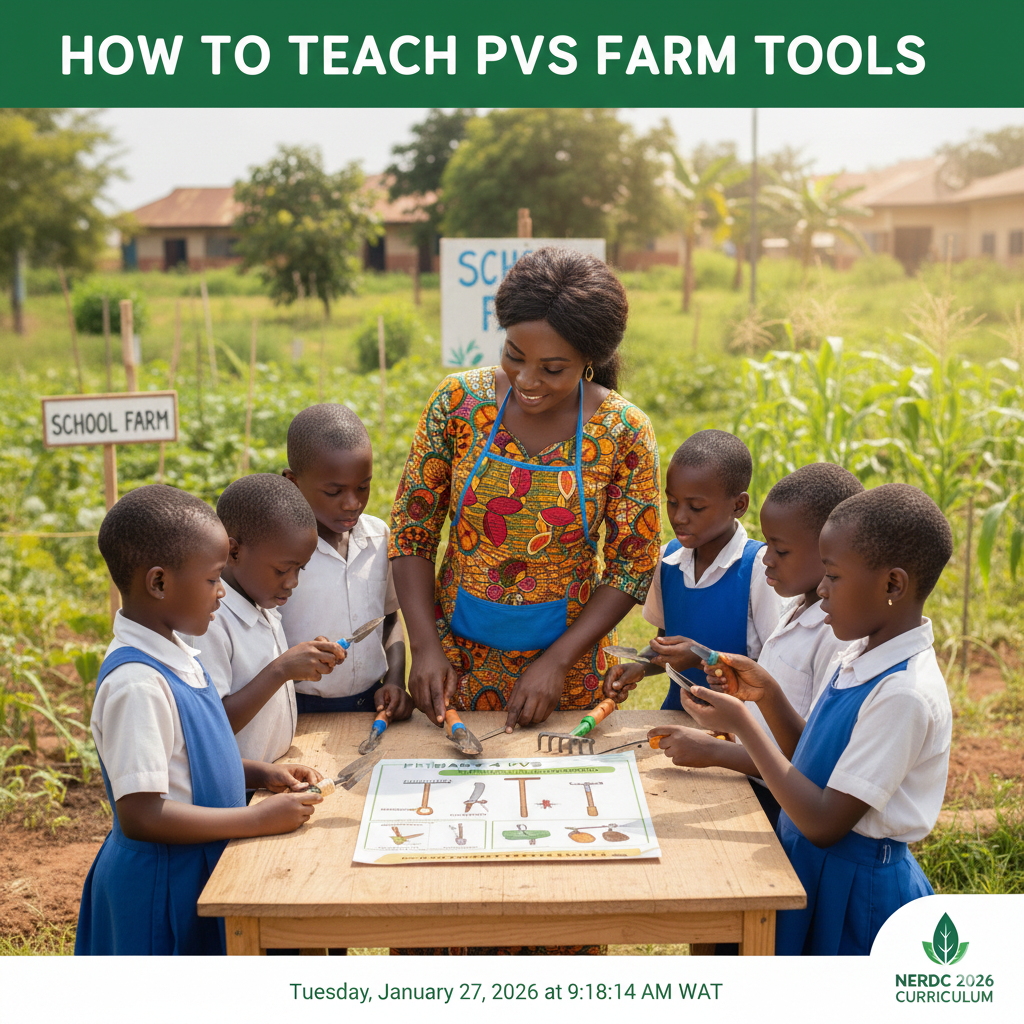
Teaching farm tools at this level helps pupils:
-
Understand basic farming activities
-
Appreciate agriculture and food production
-
Learn how to identify and name farm tools
-
Develop safety awareness when handling tools
-
Build interest in farming and agriculture
This topic also supports environmental studies and practical learning.
Learning Objectives for the Lesson
By the end of the lesson, pupils should be able to:
-
Explain what farm tools are
-
Identify common farm tools
-
State the uses of different farm tools
-
Mention basic safety rules when using farm tools
Examples of Farm Tools for Primary 4
Below are common farm tools suitable for Primary 4 second term PVS.
Hoe
The hoe is a simple farm tool used for:
-
Digging the soil
-
Making ridges
-
Removing weeds
Cutlass
A cutlass is a sharp farm tool used for:
-
Clearing bushes
-
Cutting grasses
-
Harvesting some crops
Teachers should emphasize safety when teaching about cutlass use.
Rake
A rake is used for:
-
Gathering dry leaves
-
Levelling the soil
-
Cleaning the farm
Shovel
A shovel is used for:
-
Scooping soil
-
Moving sand or manure
-
Filling holes
Watering Can
Check out: How to Use the Cornell Method to Take Better Lecture Notes (A Guide for Nigerian Students)
A watering can is used for:
-
Watering crops
-
Supplying water to seedlings
-
Irrigating small gardens
Wheelbarrow
A wheelbarrow helps farmers to:
-
Carry farm tools
-
Transport crops
-
Move manure and soil
Garden Fork
A garden fork is used for:
-
Loosening soil
-
Turning compost
-
Mixing manure with soil
Uses of Farm Tools
Farm tools are used for different farming activities such as:
-
Clearing land
-
Planting crops
-
Weeding
-
Watering plants
-
Harvesting produce
Teachers should link each tool to its specific use during lessons.
Safety Rules When Using Farm Tools
Teaching safety rules is very important.
Basic safety rules include:
-
Do not play with farm tools
-
Sharp tools should be handled by adults
-
Keep tools in their proper place after use
-
Do not run while holding farm tools
-
Always follow teacher’s instructions
Teaching Methods for Farm Tools Lesson
Effective teaching methods make the lesson interesting and easy to understand.
See more: Top Debate Points on Why Mother Is Better Than Father
Demonstration Method
-
Show real farm tools in class
-
Demonstrate how each tool is used
-
Allow pupils to observe closely
Discussion Method
-
Ask pupils questions about farming
-
Encourage pupils to share experiences
Visual Aids
-
Charts and pictures of farm tools
-
Flashcards with tool names
Suggested Lesson Plan Outline
Introduction
-
Ask pupils if they have seen farmers at work
-
Discuss tools farmers use
Presentation
-
Explain the meaning of farm tools
-
Show examples and explain uses
Activity
-
Pupils identify farm tools from pictures
-
Group discussion on tool uses
Conclusion
-
Revise names and uses of farm tools
-
Ask simple questions
Classroom Activities for Pupils
-
Matching tools with their uses
-
Drawing farm tools
-
Role play of simple farming activities
These activities help reinforce learning.
Assessment and Evaluation
Check out: How to Cram for an Exam in 24 Hours: The “Emergency” Guide to Passing (Without Fainting)
Teachers can assess pupils through:
-
Oral questions
-
Written exercises
-
Practical identification of tools
Sample Evaluation Questions
-
What are farm tools?
-
Name two farm tools you know.
-
Mention one use of a hoe.
-
State one safety rule on the farm.
Teaching Aids and Materials
-
Real farm tools (if available)
-
Pictures or charts
-
Flashcards
-
Blackboard and chalk
Role of Parents in Supporting Learning
Parents can help by:
-
Talking to children about farming
-
Showing farm tools at home or farm
-
Encouraging interest in agriculture
Importance of Farm Tools to Farmers
Farm tools help farmers to:
-
Work faster
-
Reduce stress
-
Produce more food
-
Improve farming efficiency
Teaching this helps pupils value agriculture.
Conclusion
Primary 4 second term PVS lesson notes on farm tools are essential for helping pupils understand basic agricultural practices. By teaching the meaning, examples, uses, and safety rules of farm tools, teachers lay a strong foundation for agricultural knowledge and environmental awareness.
With simple explanations, practical demonstrations, and engaging activities, pupils can easily understand and enjoy this topic. These lesson notes support effective teaching and help pupils develop interest in farming and respect for the tools that help produce the food they eat every day.