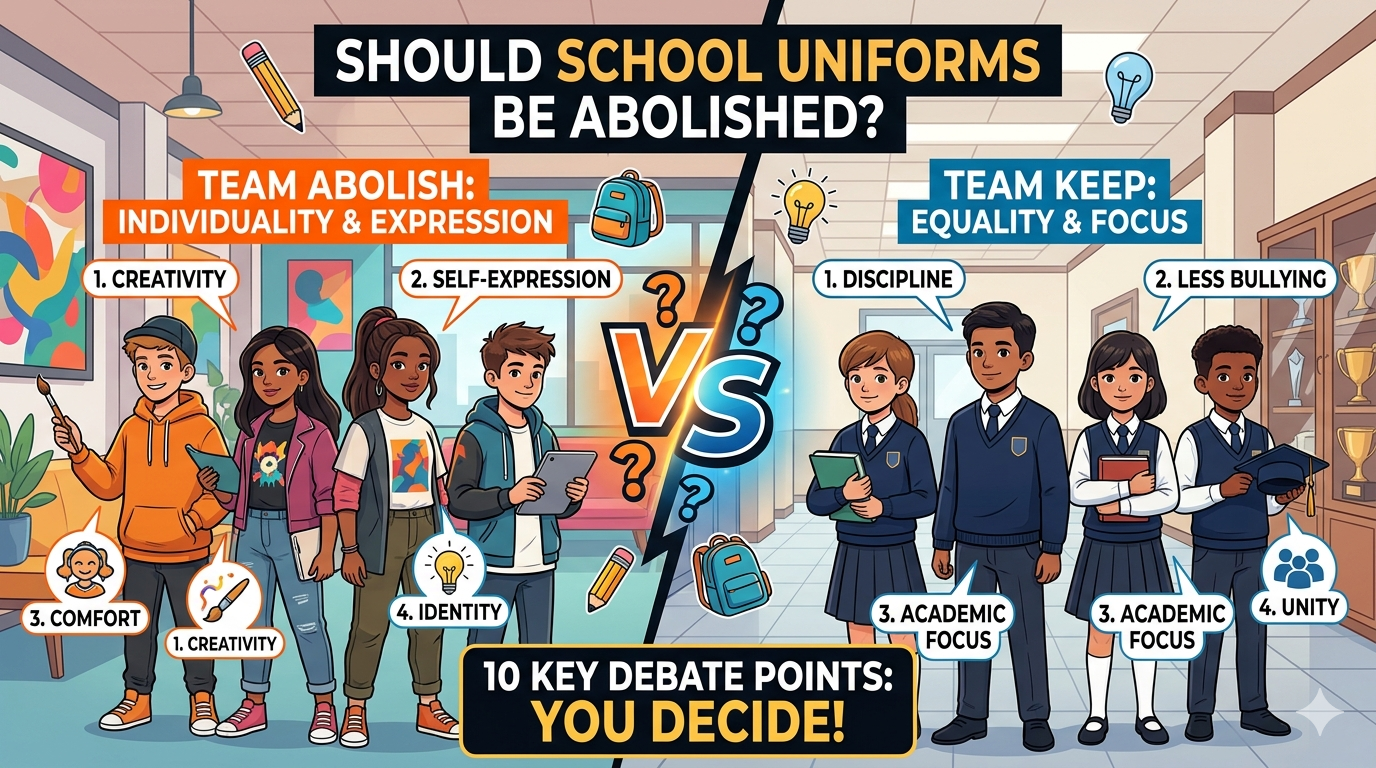
Should School Uniforms Be Abolished?
A complete debate guide for Nigerian students — both sides fully argued
Debate Topic: School Uniforms Should Be Abolished | Proposition & Opposition | Nigerian Schools
Introduction: A Debate That Touches Every Nigerian Student
Here is a question that every Nigerian secondary school student has probably asked at some point — whether silently, to a friend, or in a moment of genuine frustration on a hot Monday morning while wrestling with a stubborn collar button: why do we wear uniforms?
Why is it that in a country of remarkable cultural diversity, individual creativity, and vibrant self-expression, hundreds of thousands of young people spend the most formative years of their lives dressed identically?
The debate topic ‘School uniforms should be abolished’ is one of the most consistently popular topics in Nigerian secondary school competitions and classroom exercises — and it is popular for the best possible reason: students have genuine opinions about it, drawn from genuine daily experience.
Whether you are for or against school uniforms, you have lived the reality that makes this debate immediate and personal. You know what it is like to be inspected at the school gate. You have felt the specific social dynamic of a school where everyone looks the same.
You may have felt the embarrassment of having a uniform that does not quite fit, or the pride of wearing a school’s colours in a competition.
But as with all the best debate topics, what looks like a simple, obvious question reveals genuine complexity when examined carefully. The case for abolishing school uniforms — and the case for keeping them — both rest on real arguments about equality, identity, freedom, economic justice, school culture, and what education is actually for.
Neither side is obviously right. Both sides have genuine points. And the student who understands both sides deeply will argue either one far more convincingly than the student who has only memorised one set of talking points.
This guide gives you everything you need to argue both sides. Ten fully developed points for the proposition — uniforms should be abolished. Ten fully developed points for the opposition — uniforms should be kept.
A side-by-side comparison table. Two complete sample speeches. A rebuttal guide. Eight performance tips. A FAQ section. And a conclusion that puts the whole debate in its proper Nigerian context.
Read the entire guide whatever side you have been assigned. The debater who understands both sides always performs better than the one who only prepared their own.
SEO NOTE: This article is optimised for searches including ‘should school uniforms be abolished debate’, ‘school uniform debate Nigeria’, ‘arguments for and against school uniforms’, and ‘school uniform debate points for secondary school’. Share it with classmates preparing for the same topic.
The Debate at a Glance
Read now: Farmer vs Doctor: 10 Compelling Reasons Why the Doctor Is More Important
| Dimension | Abolish Uniforms (For the Motion) | Keep Uniforms (Against the Motion) |
| On equality | Uniforms still cost money — true equality needs more than dress | Uniforms hide wealth differences that would otherwise divide students |
| On identity | Clothing is self-expression; uniforms suppress individuality | School identity and pride are built through shared appearance |
| On cost to families | Uniforms are an added financial burden, especially for the poor | A single uniform set costs less than a full civilian wardrobe |
| On discipline | Dress does not determine behaviour or academic effort | Uniform culture establishes broader standards of school discipline |
| On creativity | Suppressing dress expression limits creative development | Creativity is built in classrooms, not in clothing choices |
| On global trends | Many top-performing countries have no school uniforms | Nigeria’s diverse, large school system needs visual order |
| On focus | Students distracted by dress would refocus on academics | Without uniforms, students are distracted by fashion competition |
| On freedom | Personal freedom includes the right to choose what you wear | Institutional rules are a normal feature of organised education |
| On Nigerian context | Uniform enforcement creates fear-based school culture | Uniforms are part of Nigerian school heritage and cultural pride |
Part One: Ten Arguments for Abolishing School Uniforms
If you have been assigned to argue that school uniforms should be abolished, these ten arguments build your case in full. Each is developed with Nigerian context and ends with a debate-ready line.
Point 1 [Abolish Uniforms]: Uniforms Create the Illusion of Equality While Real Inequality Persists
The most common argument for school uniforms in Nigeria is that they level the social playing field — that by dressing every student identically, uniforms eliminate the visible markers of economic difference that would otherwise create social hierarchies based on who can afford the most fashionable clothes.
This is an appealing argument. But it is fundamentally superficial, because it addresses the symptom of inequality — visible wealth differences in dress — rather than the cause, which is the actual inequality of economic circumstance that no dress code has ever reduced.
In Nigerian schools, the economic inequality that uniforms are supposed to hide does not disappear because everyone is wearing the same colour blouse. It shows up in other ways — in the quality of the shoes worn with the uniform, in whether the uniform is newly made or worn and faded, in who has a new school bag and who carries a secondhand one, in who brings lunch money and who does not, in who lives nearby and arrives fresh and who travels long distances and arrives exhausted. The markers of economic difference are persistent and creative. They find expression despite uniforms, not because of the absence of them.
More fundamentally, the equality argument for uniforms is dishonest about what equality actually means. True equality in education means equal access to qualified teachers, equal access to functional laboratories and libraries, equal class sizes, and equal opportunities for academic and extracurricular development.
Read also: How to Handle Panic Attacks in the Exam Hall: A Survival Guide for Nigerian Students
None of these forms of equality are addressed by school dress codes. The Nigerian student who attends an underfunded public school in a uniform is not equally educated to the student who attends a well-resourced private school in the same uniform. Dress is a fig leaf over the real inequalities that the educational system perpetuates.
If the argument for uniforms is an argument about equality, it is an argument that stops far too soon. Real educational equality requires real educational investment — in teachers, resources, and institutional quality — not a shared dress code that creates the appearance of equality while the structural inequalities underneath remain untouched.
DEBATE LINE: “Uniforms do not create equality. They create the appearance of equality while the real inequalities — in school quality, teacher availability, and family economic circumstances — continue as before. A student in a worn, ill-fitting uniform at an underfunded public school is not the equal of a student in a pristine uniform at a well-resourced private school. True equality is not achieved by dressing children identically. It is achieved by educating them equally. We do not yet do that in Nigeria.”
Point 2 [Abolish Uniforms]: Uniforms Suppress the Development of Individual Identity at a Critical Stage
Secondary school — the years roughly between eleven and seventeen — is among the most critical periods of human identity formation. It is during these years that young people are developing their sense of who they are: their values, their aesthetic sensibilities, their relationship to creativity, their understanding of how they want to present themselves to the world.
This identity formation is a genuine developmental task, not a distraction from education. The person who emerges from secondary school with a strong, coherent, authentic sense of self is better equipped for university, for professional life, and for adult relationships than the person who has spent five years in an environment that systematically suppressed personal expression.
Clothing is one of the most immediate and most universal forms of human self-expression. What we wear communicates something about who we are, what we value, what cultural traditions we belong to, and how we want to be perceived by the world. This communicative function of dress is not trivial or superficial — it is deeply human. Across cultures and across history, human beings have used clothing as a medium of identity expression, social communication, and cultural affiliation.
When a school imposes a uniform that allows no individual expression — the same blouse, the same skirt or trousers, the same shoes, the same tie, the same belt — it is not simply regulating dress.
It is communicating to young people that their self-expression does not matter within the school environment, that conformity is more valued than individuality, and that the institution’s desire for visual uniformity takes precedence over their developing sense of personal identity. This message, delivered daily for five years across some of the most formative years of a person’s life, has real developmental consequences.
Countries that have removed or significantly reduced school uniform requirements — and there are many, including the United States, most of Europe, and a growing number of African nations — have not found that their students’ identities disintegrate or their schools descend into chaos.
What they have found is that students who have more ownership over their presentation to the world tend to develop more confident, more authentically grounded personal identities — which is precisely the outcome that education should be aiming for.
DEBATE LINE: “At the exact stage of life when young people should be exploring who they are and developing the authentic self that they will carry into adulthood, school uniforms send a daily message: your self-expression does not matter here. Five years of that message does not build confidence and identity — it suppresses them. Abolishing uniforms would restore to Nigerian students their most personal form of self-expression during the years when it matters most.”
Point 3 [Abolish Uniforms]: The Financial Burden of Uniforms Falls Hardest on the Poorest Families
School uniform requirements in Nigeria impose a specific and significant financial burden on every family whose child attends a school with a mandatory dress code — and this burden falls most heavily on the families who can least afford it.
See more: How to Use the Feynman Technique to Understand Difficult Topics (Stop Cramming, Start Passing)
A complete set of school uniforms — the day uniform, the sports kit, the corporate wear for special occasions, the compulsory school shoes — represents a significant upfront expenditure that must be renewed as children grow, replaced as items wear out or are damaged, and in many schools purchased at premium prices from school-mandated suppliers who enjoy a captive customer base.
In Nigerian schools that require uniforms to be purchased from specific approved suppliers — which is the norm in many private and some public schools — parents have no ability to seek cheaper alternatives. The school’s uniform supplier sets the price. The parent pays it or the child cannot attend.
This captive market arrangement benefits the supplier (often with a financial relationship to the school) and disadvantages the parent. The family that cannot afford a new set of uniforms at the beginning of a new school year, or whose child’s uniform has become too small or too worn, faces genuine hardship — and sometimes the child faces the humiliation of being turned away at the school gate.
The proposition that uniforms reduce financial pressure because all children wear the same thing ignores this reality. A child from a wealthy family who wears free dress to school wears items that were purchased once and last for years.
A child from a poor family that must buy new uniforms every year as the child grows, that must replace items damaged in normal active school life, and that must purchase from a mandated expensive supplier pays a continuous financial cost that free dress would not impose.
In a country where basic school fees are already a significant financial challenge for millions of families, and where the quality gap between schools means that families feel compelled to pay for private education they can barely afford, adding a mandatory uniform cost to the financial burden of schooling is an additional injustice that falls disproportionately on the poor. Abolishing uniforms would be a meaningful, practical step toward reducing the financial barriers to school access for Nigeria’s most economically vulnerable families.
DEBATE LINE: “For a wealthy family, the school uniform is a minor inconvenience. For a poor family, it is a financial hardship — a mandatory expenditure that cannot be avoided, that must be renewed as children grow, and that must often be purchased from school-mandated suppliers at prices that allow no negotiation. Uniforms do not relieve economic inequality in schools. For poor families, they add to it.”
Point 4 [Abolish Uniforms]: Uniform Enforcement Creates a Culture of Fear and Punishment at the School Gate
Anyone who has attended a Nigerian secondary school knows the ritual: the morning inspection. Students line up at the school gate or in the assembly ground while teachers or prefects inspect their uniforms item by item — the shoes must be black and polished, the socks must be the right colour and height, the shirt must be tucked in, the belt must be of the approved type, the hair must be the correct length, the tie must be tied in the correct knot.
Students who fail the inspection face punishment — detention, corporal punishment in some schools, suspension from class, or public humiliation in front of their peers.
This morning ritual establishes a particular kind of relationship between students and the school institution — one grounded in compliance and fear rather than in genuine engagement and respect. The student who arrives at school each morning anxious about whether their uniform meets the exact standard of whichever teacher is doing the inspection that day is not arriving in the optimal psychological state for learning.
They are managing anxiety, calculating risk, and positioning themselves in a compliance relationship with authority that is fundamentally different from the motivated engagement with learning that education should inspire.
The power that uniform enforcement gives to teachers and prefects over students is also a form of institutional authority that can be — and has been — abused. The teacher who uses uniform inspection as an opportunity to humiliate, to single out particular students, or to exercise arbitrary authority creates an environment of fear that damages the trust between students and institution that effective teaching depends on.
The student who has been publicly mocked or physically punished for wearing the wrong socks is not the student who will raise their hand confidently in that teacher’s class.
Abolishing the uniform removes this daily compliance ritual from the school experience. It removes a daily source of anxiety, a daily test of rule-following that has nothing to do with learning, and a daily exercise of institutional power over students that has consistently problematic consequences for the school culture it creates.
Schools that do not inspect uniforms can redirect the energy currently spent on dress compliance toward the things that actually matter: learning, pastoral care, and the building of genuinely positive student-teacher relationships.
DEBATE LINE: “The daily uniform inspection in Nigerian schools establishes, before a single lesson has been taught, that this is an institution of compliance rather than an institution of learning. The student who begins the day anxious about their shoe colour is not the student who arrives ready to learn. Abolishing uniforms abolishes this daily ritual of institutional power and replaces it with nothing — because schools do not need it.”
Point 5 [Abolish Uniforms]: Students in Schools Without Uniforms Perform Just as Well Academically
One of the implicit assumptions behind the argument for school uniforms is that uniforms contribute positively to academic outcomes — that the discipline associated with uniform wearing transfers to academic discipline, that the equality of dress creates an equality of focus, and that the institutional culture of uniform compliance produces a school environment more conducive to learning.
These are testable claims, and when they have been tested in educational research, the results are consistent and clear: school uniforms have no significant positive effect on academic achievement.
Studies conducted in the United States, the United Kingdom, and various other countries that have compared the academic outcomes of uniform and non-uniform schools — controlling for socioeconomic factors and school quality — have found no consistent evidence that uniform policies improve examination results, attendance rates, or academic engagement.
Some studies have found marginally positive effects in specific contexts; others have found no effect or marginally negative effects. The overall weight of the evidence does not support the claim that school uniforms are academically beneficial.
Many of the world’s highest-performing education systems operate without mandatory school uniforms. Finland, South Korea, Singapore, Japan — countries whose secondary school graduates consistently outperform Nigerian graduates on international measures of academic achievement — have varied approaches to school dress.
Japan has uniforms; Finland does not. South Korea has uniforms; Singapore has them in some schools. The presence or absence of uniforms does not predict educational system performance.
In the Nigerian context, where WAEC pass rates have been a persistent national concern and where genuine academic improvement is urgently needed, the focus of school policy should be on the factors that actually drive academic outcomes: teacher quality, class sizes, curriculum coverage, and resource availability.
Uniforms are a distraction from this agenda. Abolishing them would allow schools to redirect the time, energy, and administrative resource currently invested in dress code management toward the factors that genuinely improve learning.
DEBATE LINE: “Finland educates its children without school uniforms and produces some of the world’s most literate, most numerate, and most creatively capable graduates. If uniforms were genuinely essential to academic success, Finland would have them. The evidence that uniforms improve academic outcomes does not exist. The evidence that great teaching and great resources improve outcomes is overwhelming. Let us focus on what works.”
Point 6 [Abolish Uniforms]: Uniforms Conflict With Religious and Cultural Expression Rights
Nigeria is home to over 250 ethnic groups and two major world religions — Christianity and Islam — alongside significant communities practising African traditional religions and their various syncretised forms. Each of these traditions has its own cultural and religious practices around dress — practices that carry deep spiritual and communal significance for the people who maintain them.
The school uniform requirement, which imposes a standardised secular institutional dress code on every student regardless of their religious or cultural background, creates genuine conflicts with these practices that have real consequences for specific students.
See more: How to Use the Cornell Method to Take Better Lecture Notes (And Stop Cramming)
Muslim female students, for whom modest dress including the hijab is a religious obligation and a matter of faith identity, have faced significant conflicts with school uniform policies at various Nigerian institutions.
The question of whether Muslim girls should be permitted to wear the hijab as part of their school uniform has generated legal proceedings and considerable public controversy, touching fundamental questions about religious freedom and the state’s authority to regulate religious expression in educational settings.
Whatever the specific legal resolution in individual cases, the existence of this conflict reveals that the school uniform — presented as a neutral, equalising institution — is in fact culturally specific and potentially exclusionary in its impact on students from non-dominant religious and cultural backgrounds.
Beyond the hijab question, various ethnic and cultural traditions around dress, hair, and personal adornment that are meaningful to specific Nigerian communities can conflict with the standardised requirements of school uniform policies.
The student who is told that their culturally significant hair braiding style, or their traditionally important head covering, or their religious practice of wearing specific colours or items of clothing conflicts with the school uniform code is being asked to choose between their educational access and their cultural and religious identity. This is an unreasonable demand that a school system respectful of Nigeria’s genuine diversity should not make.
DEBATE LINE: “A country with 250 ethnic groups and two major world religions cannot have a school dress code that is truly neutral. Every uniform policy makes choices — about modesty, about colour, about hair, about accessories — that advantage some cultural traditions and disadvantage others. Abolishing uniforms removes this institutional imposition of cultural norms and allows every student to attend school in dress that is consistent with their religious and cultural identity.”
Point 7 [Abolish Uniforms]: Freedom of Expression Includes the Freedom of Personal Dress
Human rights frameworks, including the Nigerian Constitution’s provisions on freedom of expression, protect not only the freedom to speak and write but the broader freedom of personal expression — the freedom to communicate ideas, values, and identity through the full range of expressive human activities.
Courts in various countries have recognised that dress is a form of personal expression that falls within the scope of freedom of expression protections, on the basis that what a person wears communicates something about who they are and what they believe.
Check out: The Complete List of 26 Tradepreneur Subjects for WAEC: How to Choose a Profitable Skill
The school uniform removes this freedom from the most fundamental dimension of daily personal expression. Students who have no choice about what they wear to school are students whose freedom of personal expression is compulsorily restricted during the hours they spend in school — which, for a secondary school student, represents the majority of their active waking hours across the majority of their developmental years. This is a significant restriction on a significant freedom.
The justification for restricting freedom must always be proportionate to the restriction. In the case of school uniforms, the claimed justifications — equality, discipline, school identity — have been examined and found wanting throughout this guide.
If these justifications are insufficient, the restriction cannot be justified. And a restriction on freedom that cannot be justified should be removed. This is the fundamental liberal argument for abolishing school uniforms: that they impose a restriction on personal freedom without adequate justification, and that unjustified restrictions on freedom should be ended.
This argument is sometimes dismissed as abstract or theoretical — but rights are precisely the kind of thing that must be defended abstractly and in principle, because rights that are only protected when convenient are not rights at all.
The right of Nigerian students to present themselves to the world in a manner consistent with their personal identity, cultural heritage, and individual expression is a genuine right that deserves the same serious protection as any other.
DEBATE LINE: “Freedom of expression includes the freedom to express yourself through what you wear. When school compels identical dress for every student, it restricts this freedom for nine or ten months of every year across five years of secondary school. For a restriction on fundamental freedom to be justified, the justification must be compelling. The arguments for school uniforms are not compelling enough to justify five years of compulsory conformity in personal expression.”
Point 8 [Abolish Uniforms]: Uniforms Do Not Prevent the Social Hierarchies They Claim to Eliminate
The social hierarchy argument for uniforms rests on the premise that if students dress identically, they cannot sort themselves by economic status through dress. But social hierarchies are persistent and creative. They do not disappear when one of their expression mechanisms — clothing — is removed. They find other means of expression, often more deeply embedded in behaviour, language, social capital, and the less visible but equally real markers of economic and social difference.
In Nigerian schools with strict uniform policies, students sort themselves by the quality of the uniform items — whose shoes are newest and most polished, whose uniform is most recently made and best fitted, whose hair is most elaborately styled within the rules, who has accessories that technically comply with the dress code but clearly signal economic status.
They sort themselves by phone ownership — who has the latest smartphone and who does not. They sort themselves by transport — who arrives in a family car and who takes a danfo bus. They sort themselves by lunch — who brings money for the tuck shop and who does not.
The social hierarchies that uniforms are supposed to prevent are more deeply rooted than dress can address. They are rooted in the genuine economic inequality between students’ families — inequality in income, in occupational status, in housing quality, in access to private tutoring, in the quality of nutrition available at home. No dress code addresses these inequalities.
The suggestion that it does is a comfortable fiction that allows schools to claim they are addressing inequality while the actual sources of inequality — economic and educational — remain untouched.
If anything, the argument that uniforms address social inequality by hiding it is an argument for ignoring the real problem. Abolishing uniforms would force schools and policymakers to confront the actual sources of inequality in Nigerian education rather than managing their visible symptoms through a dress code.
Read now: How to Use the Pomodoro Technique to Smash Your WAEC and JAMB Exams
DEBATE LINE: “Social hierarchies do not disappear because everyone wears the same uniform. They find other expressions — in phone quality, in transport, in lunch money, in the subtle markers of economic difference that no dress code can conceal. The uniform is a fig leaf over social inequality, not a solution to it. Remove the fig leaf and you see the problem clearly enough to actually address it.”
Point 9 [Abolish Uniforms]: Free Dress Prepares Students for the Diversity of Adult Professional Life
Adult professional life in Nigeria — in its offices, hospitals, law firms, government agencies, schools, and businesses — requires the ability to dress appropriately for a wide range of contexts, to exercise personal judgement about what appropriate dress means in specific professional settings, and to develop the personal style that communicates professional competence and individual character simultaneously.
These are not trivial skills. The young professional who arrives at their first job interview in inappropriate dress, who cannot read a workplace dress culture, or who has never had to think about clothing as a professional communication tool, is at a disadvantage relative to the peer who has spent years exercising and developing these judgements.
School uniforms, by removing clothing decisions from students’ daily lives for the entirety of their secondary education, deprive them of five years of practice in the judgement that adult professional dress requires. The secondary school student who wears a uniform every day from JSS1 to SS3 arrives at university or at their first employment without having seriously engaged with the question of how to dress for different contexts, what their personal style communicates, or how to balance personal expression with institutional expectation. They must learn these things from scratch at a point in their lives when the stakes of getting it wrong are considerably higher than a school gate demerit.
Countries that have abolished school uniforms have not produced generations of adults who cannot dress themselves appropriately for professional contexts. What they have produced are young people who have been practising contextual dress judgement throughout their education — who arrive at professional life with well-developed intuitions about appropriate dress because they have spent years making and learning from dress decisions rather than having those decisions made for them by institutional policy.
DEBATE LINE: “Adult professional life requires the ability to dress appropriately for different contexts — formal presentations, client meetings, casual Fridays, creative industry environments, corporate boardrooms. School uniforms deprive students of five years of practice in the judgement that contextual dressing requires. Abolish uniforms and give students the daily practice in dress decision-making that adult professional life will demand of them.”
Point 10 [Abolish Uniforms]: Schools That Trust Their Students Build Better Educational Communities
The fundamental question underlying the school uniform debate is a question about the relationship between educational institutions and the students they serve. Is the school an institution that controls its students — managing their appearance, their movements, their expression, and their behaviour through a system of rules, inspections, and punishments — or is the school a community that trusts its students, treats them as developing persons with genuine agency, and invests in their capacity for self-governance rather than in their capacity for institutional compliance?
These two models of the school-student relationship produce different educational cultures, different student-teacher relationships, and different long-term outcomes. The school that treats students as subjects to be managed produces students who are compliant within institutional settings but who struggle to exercise autonomous judgement when institutional management is removed.
The school that treats students as developing persons deserving of trust and reasonable autonomy produces students with stronger self-regulation, more genuine engagement with the institution’s values, and better preparation for the responsible autonomy that adult life requires.
The school uniform is one expression of the control model of student management. It sends a specific institutional message: we do not trust you to present yourself appropriately without being told exactly how to do it.
Abolishing the uniform would send a different message: we trust you to make reasonable choices, and we will support your development of the judgement that good choices require. This message of institutional trust — the message that the school believes in its students’ capacity for responsible self-governance — is among the most powerful positive messages an educational institution can send.
Schools in Nigeria that have experimented with greater student autonomy — in dress, in self-governance, in institutional participation — have often found that students rise to meet the expectation of trust. Students who are treated as trustworthy tend to be trustworthy.
The school that abolishes uniforms as part of a broader culture of student trust and institutional respect for student agency may find that the academic and social outcomes justify the change far more effectively than any dress code.
DEBATE LINE: “The school that trusts its students to dress responsibly is the school that believes in its students as developing persons with genuine agency. That trust is educationally powerful. It produces students who engage with school values from the inside rather than complying with school rules from the outside. Abolish uniforms not just as a dress policy — but as a statement that this school trusts and respects the people it serves.”
Part Two: Ten Arguments for Keeping School Uniforms
If you have been assigned to argue against the motion that uniforms should not be abolished — these ten arguments build your case comprehensively.
Point 1 [Keep Uniforms]: Uniforms Genuinely Reduce Visible Wealth-Based Social Divisions
The proposition argues that uniforms only create the appearance of equality while real inequality persists beneath the surface. We acknowledge that uniforms do not eliminate economic inequality — nothing can do that except structural economic change.
But the specific argument that uniforms reduce the visible, daily expression of that inequality in the school environment is both logically sound and supported by what students and teachers in uniformed schools actually report.
Adolescence is a period of acute social sensitivity. Teenagers are powerfully attuned to status signals within their peer groups, and they are acutely aware of who has more and who has less — who is dressed in the latest fashion, whose clothes are labelled with prestigious brands, whose appearance signals economic affluence.
Research conducted in various school contexts has found that non-uniform environments generate more social stratification based on dress — more bullying related to clothing choices, more social exclusion of students who cannot afford fashionable dress, and more attention devoted to fashion competition rather than to learning.
In Nigerian schools, where the economic gap between the most and least affluent students can be very wide, the potential for fashion-based social stratification in a non-uniform environment is significant.
The student whose family cannot afford to send them to school in fashionable clothes faces daily social signalling about their economic position — signalling that is humiliating, that is not addressed by any of the learning that happens in the classroom, and that damages both self-esteem and the social experience of school. Uniforms, whatever their other limitations, remove this specific dimension of daily economic humiliation.
DEBATE LINE: “The proposition says uniforms do not eliminate inequality. We agree. But they eliminate fashion-based social stratification — the daily, visible sorting of students by what their parents can afford to dress them in. The student who cannot afford the latest trainers but wears the same uniform as their wealthier peers is spared a specific, daily, adolescent humiliation that uniforms prevent and free dress would restore. That specific protection is genuinely valuable.”
Point 2 [Keep Uniforms]: Uniforms Build School Pride and Institutional Identity
There is a form of social belonging that is among the most important psychological resources available to adolescents — the sense of being part of something larger than themselves, of belonging to a community with a shared identity, a shared history, and a shared set of values.
This sense of institutional belonging is one of the strongest predictors of school engagement, academic motivation, and positive school experience. Students who feel they belong to their school — who have pride in its identity and commitment to its values — are students who engage more actively, attend more consistently, and perform better academically.
The school uniform is one of the most tangible expressions of this institutional identity and the belonging it creates. When a student wears the distinctive colours and insignia of their school, they are not simply complying with a dress regulation — they are visibly affiliating with a community, signalling their membership of an institution whose history and values they share.
Read now: How to Study for Multiple Choice Questions: The Secret to Acing JAMB and WAEC
The Nigerian student who wears the uniform of Government College Ibadan, or King’s College Lagos, or any other school with a strong institutional tradition, wears something that carries genuine meaning — a meaning that decades of alumni, notable achievements, and accumulated institutional culture have invested in those specific colours.
The school sporting events, the debate competitions, the cultural festivals at which schools compete wearing their distinctive colours — these are moments of genuine institutional pride whose emotional force depends in part on the visual identity that uniforms provide.
The abolition of uniforms would dissolve this visual dimension of school identity — the immediate, visible recognition of which school’s students are on the field, in the debate hall, in the examination room. The loss of this visual identity would be a real loss — not merely a cosmetic one — to the institutional culture and the student belonging that uniform-based school identity supports.
DEBATE LINE: “When Government College Ibadan alumni meet anywhere in the world, decades after leaving school, they recognise something in each other that is rooted in a shared institutional identity that their school colours embodied. The school uniform is not just clothing — it is a flag. It is the visible expression of a community that students belong to, compete for, and carry with pride long after they have left. Abolishing uniforms would abolish this institutional identity along with the dress code. That is a loss that the proposition does not adequately reckon with.”
Point 3 [Keep Uniforms]: Uniforms Are More Economical for Families Than a Full Civilian Wardrobe
The proposition argues that uniforms impose a financial burden on families. We argue the opposite: that for most Nigerian families, a school uniform policy is significantly less expensive than the alternative of maintaining a varied civilian wardrobe for a school-going child over a five-year secondary education. Let us examine this claim carefully.
A typical secondary school student in free dress requires a wardrobe that is adequate for the full school week — five different outfits at minimum, to avoid the social embarrassment of wearing the same clothes repeatedly.
For adolescents who are acutely sensitive to peer judgement about dress, the social pressure to have varied and fashionable clothing in a non-uniform environment is real and financially significant. The family that sends their child to school in free dress is not simply providing five basic outfits and stopping — they are managing continuous social pressure to keep the child’s wardrobe current, fashionable, and socially acceptable to their peer group.
Contrast this with the uniform requirement: a set of two or three uniform items — shirts or blouses, trousers or skirts, shoes, a tie — that are worn in rotation throughout the school year and replaced when worn out or outgrown.
The total cost of this wardrobe, even accounting for the renewal costs as children grow, is for most Nigerian families significantly less than the cost of the varied, fashion-sensitive civilian wardrobe that a non-uniform environment would generate. In countries that have moved from uniform to free dress environments, parents and school administrators have consistently reported that clothing costs for school-going children increased rather than decreased after the change.
DEBATE LINE: “In a non-uniform school, the minimum acceptable wardrobe is five daily outfits — plus the social pressure to rotate fashionably, which is relentless among adolescents. One school uniform set is cheaper than five casual outfits, and it can be worn on rotation indefinitely. For the majority of Nigerian families, the uniform is not a financial burden — it is a financial relief. The proposition has the economic argument exactly backwards.”
Point 4 [Keep Uniforms]: Uniforms Establish a Psychological Mode of Engagement With School
There is a well-documented psychological phenomenon called ‘enclothed cognition’ — the influence that clothing has on the wearer’s psychological state and cognitive performance. Research in psychology has found that specific types of clothing are associated with specific cognitive states: people who wear laboratory coats perform better on tasks associated with careful, systematic thinking; people who wear formal professional dress report feeling more authoritative and focused. These effects are not purely social — they operate through the wearer’s own psychological response to what they are wearing.
The school uniform activates a version of this enclothed cognition effect. Putting on the school uniform is a daily ritual of psychological transition — a signal, processed automatically and unconsciously, that the mode of engagement appropriate to this clothing is the mode of the school: attentive, disciplined, engaged with learning, operating within institutional expectations.
The uniform is a daily psychological switch that moves the student from home mode to school mode. This transition is not trivial — it is one of the micro-mechanisms through which school culture shapes student behaviour.
Teachers and school administrators in Nigerian schools consistently observe that students in uniform — particularly at the beginning of the school year when uniform standards are freshest — tend to present with a more formal, more attentive, more school-appropriate behavioural profile than the same students in casual dress on school trip days or other non-uniform occasions. This observation is not scientific proof of causation. But it is consistent with the enclothed cognition research and with the common-sense understanding that what we wear affects how we behave.
DEBATE LINE: “Putting on the school uniform is a daily act of psychological preparation for school. It sends a message to the brain — and to everyone around you — that you are in school mode now. This psychological transition is part of the daily ritual of school engagement. Abolish the uniform and you remove one of the micro-mechanisms through which students shift from home behaviour to school behaviour. The effect may seem small. But across five years of schooling, micro-mechanisms accumulate into macro-outcomes.”
Point 5 [Keep Uniforms]: Without Uniforms, Fashion Competition Distracts From Learning
The proposition argues that without uniforms, students would focus more on learning because they would not be preoccupied with uniform compliance. This argument fundamentally misunderstands the direction of the distraction. The distraction that uniforms prevent is not distraction from uniforms — it is distraction from the fashion competition that free dress inevitably generates.
Adolescents, as a developmental category, are powerfully concerned with peer acceptance and social status. These concerns are not defects of character — they are normal features of a developmental stage during which social belonging is a primary psychological need.
In a non-uniform school environment, dress becomes one of the primary arenas in which adolescent status competition plays out: who is wearing the most fashionable clothes, whose outfit is most admired, whose school bag is the right brand. This competition is continuous, it is socially costly for those who cannot or do not win it, and it occupies a significant amount of mental and social energy that would otherwise be available for engagement with learning.
Nigerian schools, with their diverse economic populations and their culture of acute social awareness among young people, would not be exempt from this dynamic. The introduction of free dress in Nigerian secondary schools would not produce classrooms of liberated, self-expressive learners focused on academic growth. It would produce classrooms in which a significant portion of student social energy — energy that is currently absorbed by the relatively simple question of uniform compliance — is redirected toward the much more complex and demanding question of fashion status competition. Teachers who have managed both uniform and non-uniform classrooms consistently report that the fashion competition dynamic in non-uniform environments is a real and significant source of social distraction.
DEBATE LINE: “The proposition says uniforms distract students. We say they focus students. Without uniforms, the distraction is not uniforms — it is fashion competition. Which shoes does she have? How much did his jacket cost? Why is she wearing the same outfit as last Tuesday? These are the questions that fill the social attention of adolescents in non-uniform environments. Uniforms eliminate this competition entirely. The classroom is more focused, not less, when everyone is dressed the same.”
Point 6 [Keep Uniforms]: Uniforms Make Schools Safer and More Secure
School security in Nigeria is a genuine and serious concern. Incidents of unauthorized entry into school premises, of students leaving school without permission, of conflicts between students from different schools escalating into violence in shared spaces — these are not hypothetical risks. They are documented features of the Nigerian school security environment, particularly in urban areas where multiple secondary schools share proximity and where large numbers of young people interact in transition spaces like bus stops, markets, and public streets.
School uniforms provide a simple, effective, immediately visible mechanism for identifying who belongs to which school and whether a person on school premises is a student, staff member, or unauthorized visitor. The teacher or security guard who needs to determine quickly whether an unfamiliar person on school grounds is a student of that school or an intruder can do so instantly in a uniformed school and cannot do so in a non-uniform environment. This identification function is practically valuable — it deters unauthorized entry by making it instantly visible, and it enables rapid response when security concerns arise.
Beyond intruder identification, uniforms help manage student behaviour in the community outside school. A student in school uniform who behaves badly in public — at a bus stop, in a shop, in any public space — is instantly identifiable as a representative of their school.
This identification creates an accountability that free dress removes: the uniformed student who misbehaves in public is misbehaving as a visible representative of their institution, with direct consequences for the school’s reputation. This community accountability function of the uniform is a genuine deterrent to the kind of student misconduct that reflects on the school.
DEBATE LINE: “A school in which everyone wears the same identifiable uniform is a school that can quickly answer the question: does this person belong here? In Nigeria’s urban school environments, where security concerns are real, the ability to instantly identify students and distinguish them from intruders has genuine safety value. The uniform is not only a dress code — it is a security system.”
Point 7 [Keep Uniforms]: Uniforms Teach Students That Institutional Life Has Rules — a Crucial Life Lesson
The opposition between uniforms and freedom that the proposition constructs is fundamentally misleading about the nature of adult life. Adult professional and civic life is not a domain of unlimited personal freedom — it is a domain governed by rules, expectations, conventions, and institutional requirements that often constrain individual preference in the interest of collective function.
The employee who dresses inappropriately for their workplace does not get to invoke their right to self-expression. The court attendee who ignores the dress requirements of legal proceedings does not get to appeal to personal freedom. The hospital visitor who ignores infection control requirements does not get to prioritise individual comfort over collective safety.
Learning to accept that institutional membership comes with rules and constraints — including rules about dress — is a genuinely important developmental lesson. The school is the first major institution that most Nigerian young people encounter, and the lessons it teaches about how to function within institutional frameworks shape how students will engage with institutions throughout their lives.
A school that teaches students to comply with reasonable institutional rules — including a dress code — is teaching students something genuinely useful about how organised human societies function.
The proposition frames this as oppression. We frame it as preparation. Adults who cannot function within institutional constraints — who treat every institutional rule as an imposition on their personal freedom rather than as a reasonable condition of collective membership — struggle in the workplace, in civic life, and in the full range of institutions they must navigate as adults.
The secondary school that requires uniform compliance is, at least in part, teaching students that institutional membership sometimes requires subordinating personal preference to collective norms. This is not oppression. It is education for citizenship.
DEBATE LINE: “Every workplace has a dress code of some kind. Every court has protocols. Every hospital has regulations. Adult life is not a zone of unlimited personal freedom — it is a world of institutions with expectations. The school uniform is the first and most visible lesson in a curriculum that every student needs: that institutional membership comes with rules, that those rules apply to you regardless of personal preference, and that compliance with reasonable institutional norms is a social skill worth developing.”
Point 8 [Keep Uniforms]: The Practical Challenges of Transitioning Away From Uniforms Are Underestimated
Even if we accept, for the sake of argument, that abolishing school uniforms would be theoretically beneficial, the proposition has not seriously engaged with the practical challenges of implementing this change in the Nigerian school context. These challenges are real, they are significant, and they deserve honest attention before any policy change of this scale is contemplated.
Nigeria has over 30,000 secondary schools serving more than 13 million students. A policy change abolishing school uniforms would require each of these schools to develop, communicate, and enforce new dress guidelines that specify what is and is not appropriate for the school environment — guidelines that would inevitably be contested, that would require ongoing enforcement, and that would generate disputes between students, parents, and school management about where the line falls between acceptable and unacceptable dress. The administrative burden of managing this transition — and the ongoing administrative burden of managing a non-uniform dress environment — is not negligible.
The proposition presents the abolition of uniforms as a simple policy change that removes an unnecessary constraint. In reality, it replaces one set of clearly defined dress norms with a much more complex and contested set of dress expectations whose management would consume significant institutional energy.
Schools that have moved from uniform to non-uniform environments in other countries have consistently found that the transition generates more, not fewer, dress-related conflicts and administrative challenges — because the boundaries of acceptable dress are less clear than the bright lines of a uniform policy.
DEBATE LINE: “The proposition makes abolishing school uniforms sound simple. It is not. Thirty thousand Nigerian secondary schools would each need to develop, communicate, and enforce new dress guidelines — guidelines that are inevitably more ambiguous, more contested, and more administratively demanding than a clear uniform policy. The practical cost of this transition has not been counted. Count it before advocating for the change.”
Point 9 [Keep Uniforms]: Nigerian School Culture and Heritage Are Embodied in the Uniform Tradition
The school uniform tradition in Nigeria is not simply an inherited British colonial imposition that has outlived its relevance. It has been adopted, adapted, and made genuinely Nigerian over the decades since independence, and it has become part of the cultural fabric of Nigerian education in ways that carry genuine meaning for generations of Nigerians who have lived it.
The distinctive uniforms of Nigeria’s most celebrated schools — the specific colours, the specific insignia, the specific traditions associated with specific institutions — are part of the cultural heritage of Nigerian education that is woven into the shared memory of millions of Nigerians.
When Nigerian alumni gather — at reunions, at homecomings, in professional associations — the shared experience of the school uniform is part of what they share. The stories of the morning inspection, of the prefect who was feared for their merciless tie-straightening, of the teacher who could identify an improperly polished shoe from thirty metres — these stories are part of the common cultural vocabulary of the Nigerian school experience. They are part of what Nigerian school alumni recognise in each other. They are part of what makes the Nigerian school experience distinctively and recognisably Nigerian.
Abolishing school uniforms would abolish this cultural tradition — not just the dress code itself but everything the dress code has accumulated in meaning over generations of Nigerian school life.
It would be a discontinuity with a heritage that has genuine cultural value, imposed in the name of abstract rights arguments that do not sufficiently account for the concrete cultural meanings that the uniform tradition has accumulated. Before discarding this heritage, the proposition should make a more compelling case for why the abstract benefits of abolition outweigh the concrete cultural costs.
DEBATE LINE: “Every Nigerian who went through secondary school has a uniform story — the inspection that caught them out, the prefect they feared, the first day they put on those colours. These stories connect generations of Nigerians across decades of shared educational experience. The uniform is not just cloth — it is cultural memory. Abolish it and you abolish a thread in the fabric of what it means to have been educated in Nigeria.”
Point 10 [Keep Uniforms]: The Focus Should Be on Improving Education, Not Abolishing Its Symbols
We close with the argument that is, in many ways, the most important: that the proposal to abolish school uniforms is a misallocation of the reform energy that Nigerian education urgently needs.
Nigeria’s public schools face genuine, urgent, life-altering problems: a teacher shortage crisis, inadequate funding, crumbling infrastructure, overcrowded classrooms, and WAEC pass rates that reveal serious learning deficits across millions of students. These are the problems that demand the attention and the advocacy of everyone who cares about Nigerian education.
The campaign to abolish school uniforms — whatever its theoretical merits — is not a campaign that addresses any of these genuine educational priorities. Abolishing uniforms will not recruit a single qualified mathematics teacher. It will not repair a single broken laboratory.
It will not reduce a single overcrowded classroom. It will not improve the income of a single poorly paid teacher struggling to motivate themselves to give their best for a system that does not reward their effort. It will not produce a single improvement in the WAEC results that determine the future opportunities of millions of Nigerian students.
At a time when Nigerian education faces genuine, urgent, and deeply consequential challenges, the proposal to direct reform energy toward school dress policy is a proposal to rearrange the furniture while the house is on fire. The Nigerian students who need educational reform need better teachers, better resources, better institutions, and better-funded schools.
They do not need a different dress code. The reform energy that the proposition wants to spend on abolishing uniforms is reform energy that Nigeria’s educational crisis needs directed at the actual educational problems that are preventing millions of Nigerian students from receiving the quality of education they deserve.
DEBATE LINE: “Nigeria has a teacher shortage. Nigeria has crumbling school infrastructure. Nigeria has overcrowded classrooms and consistently poor WAEC results. These are the crises that demand educational reform energy. Abolishing school uniforms addresses none of them. If you genuinely care about Nigerian education, spend your reform energy where it will make a genuine difference — on teacher quality, school resources, and the genuine educational inequalities that determine whether Nigerian students succeed or fail.”
Sample Speeches for Both Sides
Proposition Speech: Uniforms Should Be Abolished
“Distinguished judges, honourable opponents, teachers, and students — I want to begin by asking everyone in this hall to think about the last time they were told exactly what to wear, with no choice, no variation, and no possibility of expressing anything of who they are through their clothing.
For the students in this room who attend uniformed schools — which is most of you — that moment was this morning. You put on the same colours as every other student in your school. You were inspected at the gate. You were told that your tie was not straight or your shoes were not polished. And then you came here, to argue about education.
The proposition today argues that this daily experience — the uniform, the inspection, the compulsory conformity — should end. Not because fashion matters more than learning. But because the reasons given for imposing this conformity on millions of Nigerian students do not hold up to scrutiny.
We will show that uniforms do not create equality — they create the appearance of equality while real inequality persists. That they do not save families money — they impose mandatory costs that poor families struggle to meet. That the academic research does not support the claim that uniforms improve learning. That they conflict with the religious and cultural identities of students from minority traditions. And that the daily ritual of uniform enforcement creates a school culture of compliance and fear rather than of learning and trust.
The Nigerian student is not a uniform. They are a person — with an identity, a culture, a sense of self that deserves the space to be expressed, even within the reasonable expectations of a school community. Abolish the uniform, and give them that space. Vote for the proposition. I thank you.”
Opposition Speech: Uniforms Should Be Kept
“Distinguished judges, respected proposition, and all present — I want to begin by agreeing with something the proposition just said: Nigerian students are not uniforms. They are people — and the school uniform knows this. The school uniform has never claimed to be the whole of a student’s identity. It has claimed only to be their identity for the six hours they spend in school.
The proposition has built an eloquent case for personal freedom, for cultural expression, for the rights of students to choose what they wear. We respect every word of it. But we note that none of these rights are under threat outside of school hours. The Nigerian student who hangs up their uniform at three-thirty in the afternoon is free to dress exactly as they please for the remaining sixteen and a half hours of the day. The uniform restricts nothing but the school day itself — and during the school day, the institution’s legitimate interest in maintaining a functional learning environment is exactly what is at stake.
Today the opposition will show that uniforms genuinely reduce the fashion-based social stratification that free dress would introduce. That they build school identity and institutional pride that student belonging depends on. That they are more affordable for most families than a full civilian school wardrobe. That they establish the psychological mode of school engagement. And that the reform energy the proposition wants to spend on dress code abolition is reform energy that Nigeria’s education crisis desperately needs directed at actual educational problems.
School is not a fashion show. It is not a platform for self-expression through clothing. It is an institution with a specific purpose — education — and the uniform serves that purpose by creating the conditions in which education is most effectively pursued. Keep the uniform. Keep the focus. Vote for the opposition. I thank you.”
Rebuttal Guide: Handling the Other Side’s Arguments
If You Are Arguing the Proposition:
- When opposition says ‘uniforms reduce fashion competition’: Reframe: ‘The opposition concedes that social competition among adolescents is powerful and persistent. We agree. But removing one arena of that competition — clothing — does not eliminate the competition. It relocates it to phones, bags, transport, and other status markers that the uniform cannot control. Rather than fighting an impossible battle against adolescent social competition through dress codes, abolishing uniforms acknowledges the reality and focuses school energy on the things schools can actually control: teaching quality, curriculum, and genuine learning.’
- When opposition says ‘uniforms build school identity’: Acknowledge and distinguish: ‘School identity is real and valuable — we do not dispute it. But school identity does not depend on identical dress. It depends on shared values, shared achievements, shared traditions, and the genuine community that a school builds through its academic and extracurricular life. The schools with the strongest alumni loyalty and the most powerful institutional identities are schools known for their academic culture, their sporting achievements, and their graduates — not primarily for their uniforms. School identity survives the abolition of uniforms because it was never primarily about the uniform.’
- When opposition says ‘uniforms teach compliance with institutional rules’: Challenge the premise: ‘We accept that institutional rules are a normal feature of organised life. We question whether dress is the right domain for this lesson. Schools have countless legitimate rules — about attendance, about behaviour in class, about respect for teachers and peers, about deadlines and submissions. These rules teach institutional compliance in ways that are directly connected to the purposes of education. The uniform rule teaches compliance with a dress code. The lesson learned is compliance with institutional aesthetics, not compliance with institutional purpose. That is not the lesson that education should prioritise.’
If You Are Arguing the Opposition:
- When proposition says ‘uniforms suppress individual identity’: Contextualise: ‘Identity is not formed primarily through clothing choices. Identity is formed through values, relationships, intellectual engagement, creative achievement, and the full range of human experience — most of which unfolds inside the school building rather than on its doorstep. The Nigerian student who develops their identity through academic achievement, through sporting excellence, through artistic expression, through deep friendship and moral growth, through engagement with their cultural heritage — that student is forming a rich and authentic identity that no uniform has suppressed. Clothing is the most superficial layer of identity. The uniform restricts only that layer.’
- When proposition says ‘the evidence shows no academic benefit from uniforms’: Accept and reframe: ‘We accept that the research evidence on uniforms and academic outcomes is mixed. We note that the research evidence on abolishing uniforms and improving outcomes is equally mixed. The absence of strong evidence in either direction means that this debate cannot be settled on academic outcomes data alone. It must be settled on the other arguments — about equality, identity, culture, and the practical realities of managing Nigerian schools. And on those arguments, as the opposition has demonstrated, the case for keeping uniforms is stronger.’
- When proposition says ‘uniforms conflict with religious expression’: Distinguish the principle from the policy: ‘The specific religious and cultural conflicts that arise from rigid uniform policies — particularly around the hijab — are real and deserve to be addressed. But the solution is uniform policies that are flexible enough to accommodate religious requirements within a broader framework of institutional dress standards, not the abolition of uniform requirements entirely. Most Nigerian schools can and should accommodate religious dress requirements within their uniform policy. That accommodation is good policy. Abolition is an overreaction.’
Read now:
Eight Tips for Winning This Debate
- Open with something every judge in the room has experienced. Both sample speeches above begin with a moment that every Nigerian student knows — the morning uniform check. This immediate personal connection creates engagement before any formal argument has been made. Openings that connect with shared experience are almost always more powerful than openings that begin with definitions.
- Define ‘abolish’ clearly — it is the key word. Does ‘abolish’ mean no dress code at all, or simply no mandatory uniform? The proposition should clarify that abolishing the uniform does not mean allowing completely inappropriate dress — it means replacing a mandatory identical uniform with reasonable dress guidelines that allow personal expression within appropriate limits. This clarification makes the proposition’s position more defensible and more appealing to judges.
- Use the Nigerian context specifically. Reference the morning gate inspection. Reference the hijab controversies that have generated legal proceedings in Nigeria. Reference Government College Ibadan or King’s College Lagos when discussing institutional identity. Reference WAEC pass rates when arguing about educational priorities. Nigerian-specific examples and references are always more powerful in Nigerian competitions than generic international comparisons.
- Do not let the other side own the equality argument. Both sides can claim the equality argument. Proposition: uniforms create false equality while real inequality persists. Opposition: uniforms reduce visible fashion-based inequality. The side that develops their version of this argument most specifically, with the most concrete examples of how inequality does or does not manifest in the specific context of Nigerian schools, will tend to win this exchange.
- The opposition’s strongest argument is the ‘reform priorities’ argument. For the proposition, the hardest argument to rebut is the opposition’s final point — that abolishing uniforms does not address any of Nigeria’s genuine educational problems and misdirects reform energy. The proposition’s best response is that rights are not subject to a hierarchy of urgency — that the right to self-expression does not become less real because other problems also need addressing. Multiple reforms can be pursued simultaneously.
- Use concrete examples, not abstract principles alone. Arguments about freedom of expression and institutional belonging are more persuasive when they are illustrated with specific, vivid examples — the student whose hijab conflicts with the uniform policy, the FGC alumnus who tears up when their school colours appear on a competition field, the poor family that cannot afford a new uniform set when the old one is outgrown. Specific examples make abstract principles feel real and important.
- The rebuttal is where debates are won. Both sides in this debate have strong initial arguments. The debate is often won or lost in the rebuttal — in the quality and speed of responses to the opposition’s arguments. Practise your rebuttals as carefully as you practise your initial speech. Know the opposition’s three strongest arguments and have two responses to each ready before you enter the debate hall.
- End with a strong image, not a summary list. The final line of a speech should be memorable, not informative. Both sample speeches end with short, punchy, memorable closing images. ‘School is not a fashion show — it is an institution. Keep the focus. Keep the uniform.’ Or: ‘The Nigerian student is not a uniform. Give them back their identity. Abolish it.’ Your closing line is what judges remember. Make it worth remembering.
Frequently Asked Questions
Is this debate topic common in Nigerian secondary schools?
Yes, extremely common — and consistently popular because it is personally relevant to every secondary school student. It is used in inter-house debates, interschool competitions, and classroom exercises across Nigeria. It is considered an accessible topic because every student has direct personal experience of the issue being debated, making arguments feel genuine rather than abstract.
Which side is easier to argue?
In competitive experience, the opposition side — keeping uniforms — tends to be marginally easier to argue in the Nigerian context, because judges in Nigerian competitions are themselves products of a uniformed school tradition and tend to have instinctive sympathy with the institutional arguments for keeping uniforms.
The proposition side — abolishing uniforms — tends to be harder but more impressive when argued well, because it requires making the case against a deeply entrenched institutional practice. The proposition that wins this debate convincingly in a Nigerian competition tends to leave a stronger impression than the opposition that wins it, because the bar for the argument is higher.
Can the debate be argued about specific changes to uniform policy rather than total abolition?
In formal competitive debate on the motion as stated, you must argue the full motion — the abolition of school uniforms, not merely their reform. However, in classroom discussions, essays, and the rebuttal phase of formal debates, the distinction between abolition and reform is worth engaging with.
Many of the arguments in this guide for abolishing uniforms could be partially satisfied by less rigid uniform policies — allowing greater flexibility in specific items, accommodating religious dress requirements, reducing the punitive enforcement culture around uniform compliance. This nuanced middle ground is worth knowing even if the debate motion requires a more absolute position.
What is the most powerful argument on each side?
For the proposition — abolish uniforms — the most powerful argument is the false equality point: that uniforms create the illusion of equality while the real inequalities that determine educational outcomes persist untouched. This argument is philosophically strong, emotionally resonant, and difficult for the opposition to defeat without conceding significant ground.
For the opposition — keep uniforms — the most powerful argument is the reform priorities point: that abolishing uniforms addresses none of Nigeria’s genuine educational crises and misdirects the energy that the system urgently needs directed at actual problems.
This argument is practically compelling and connects the dress code debate to the larger educational justice concerns that make it feel genuinely important.
Conclusion: More Than a Dress Code
The debate about school uniforms is, at its surface, a debate about clothing. But the arguments it generates reach into much deeper questions about education, equality, identity, freedom, institutional culture, and the purpose of secondary schooling itself.
What kind of institution should a secondary school be? What values should it embody? What relationship should it have with the students it serves? How should it balance institutional order with individual freedom, collective identity with personal expression, tradition with reform?
These are questions worth taking seriously — whether you are a secondary school student arguing this topic in a competition, a parent thinking about what you want your child’s school experience to be, a teacher reflecting on the institutional culture you help to create, or a policy maker thinking about what Nigerian education needs to look like in the next generation.
The arguments on both sides of this debate are genuine. The equality case for uniforms is real — visible fashion competition genuinely harms students who cannot compete economically. But the equality critique of uniforms is also real — the shared dress code does not touch the structural inequalities that determine educational outcomes.
The institutional identity case for uniforms is real — school colours carry genuine meaning for generations of Nigerian alumni. But the identity suppression critique is also real — five years of compulsory identical dress is five years of reduced space for personal expression during the most identity-formative years of life.
The best outcome of this debate is not a clear winner. It is a more nuanced, more honest, more fully considered understanding of what school uniforms do and do not accomplish — and a sharper sense of the much more important reforms that Nigerian education actually needs.
Use this debate as practice for the larger conversations about educational quality, equity, and the future of Nigerian schooling that are far more consequential than any dress code.
Whether in uniform or in free dress — every Nigerian student deserves an excellent education. Fight for that, above all else.
Debate: Should School Uniforms Be Abolished? | Both Sides — 10 Points Each | Nigerian Schools