Debate: Watching TV is a Waste of Time for Pupils (5 Winning Points)
Good day, students! Looking for the winning points for your next debate? You’ve come to the right place.
Today, we are tackling a very common and heated topic in Nigerian schools. You might love your cartoons or movies, but if you are standing to propose the motion, you need to be convincing. The motion before us is that Watching tv is a Waste of Time for Pupils.
Let’s define our terms simply. When we say it is a “waste of time,” we mean that the hours spent in front of that screen could be used for things that actually add value to your life, like studying, exercising, or learning a skill. TV often takes away more than it gives.
Please note that this article provides arguments specifically supporting the motion for educational debate purposes. It is designed to help students build strong persuasive skills and does not necessarily reflect a hatred for television media.
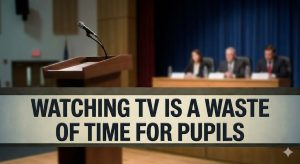
Winning Debate Points on Why Watching TV is a Waste of Time for Pupils
Here are five strong arguments you can copy, adapt, and use to win your debate. Remember, when you get to the podium, speak with confidence!
1. It Kills Academic Performance
Chairman, panel of judges, let’s be honest with ourselves. The biggest enemy of high grades is distraction. And what is the biggest distraction in the home? The television.
Watching tv is a Waste of Time for Pupils because it steals the precious time meant for revision and homework. You cannot solve complex Mathematics problems while focusing on a movie subtitle. It’s impossible.
Research has shown time and again that students who spend hours glued to the screen often struggle to finish assignments. While your mates are studying to pass WAEC or JAMB, you are busy keeping up with a series that won’t help you in the exam hall. It’s a direct trade-off: TV time often equals lower grades.
2. It Destroys the Reading Culture
There was a time when students read novels, newspapers, and encyclopedias for fun. But today? That culture is dying, and the television is the murderer.
Why stress your brain reading a 300-page book when you can just watch the movie version in two hours? This is the lazy mentality TV creates. It feeds you images and sounds so you don’t have to use your imagination.
When you read, you build your vocabulary and improve your grammar. When you watch TV, you are just a passive observer. You aren’t thinking; you’re just staring. For a pupil who wants to be a leader of tomorrow, sacrificing reading time for screen time is a massive mistake.
3. It Causes Health Issues (The “Couch Potato” Effect)
Let’s talk about health. Have you ever noticed that after watching TV for three or four hours, you feel tired even though you didn’t do any work?
Sitting in one spot for hours contributes to a sedentary lifestyle, often called being a “couch potato.” This lack of physical activity is a leading cause of obesity among young people today. Instead of playing football, running, or engaging in outdoor activities that build strong bones and muscles, pupils are glued to a box.
And it’s not just about weight. Think about your eyes. Staring at the blue light from screens for long periods strains the eyes and can lead to long-term defects. Is a cartoon worth wearing glasses for the rest of your life? I don’t think so.
4. It Exposes Pupils to Inappropriate Content
My opponent might argue that TV is for “education.” But let’s look at the reality. How many pupils actually watch the news or documentaries? Very few.
Most pupils are watching music videos, reality shows, or movies that are rated for adults. These programs often contain violence, foul language, and scenes that are not suitable for a young, developing mind.
When a child sees violence on TV, they might start to think it is normal behavior. This negative influence affects how they relate to teachers and fellow students. Watching tv is a Waste of Time for Pupils because, largely, it serves as a portal to bad morals rather than good education.
5. It Stifles Creativity and Critical Thinking
Finally, let’s look at how the brain works. When you draw, write, or build something, you are being creative. You are the active creator.
But TV makes you a passive consumer. It tells you what to think, how to feel, and when to laugh. You stop asking “why” and “how” because the screen gives you all the answers. This kills critical thinking skills.
A pupil who spends their afternoon building a toy car or writing a short story is developing a brain that can solve problems. A pupil watching TV is just letting time pass by. That is the definition of a waste.
Frequently Asked Questions (FAQs)
What if the opponent says TV has educational channels? That is their strongest point. You should counter it by saying: “Yes, educational channels exist, but statistics show that 90% of pupils watch entertainment, not education. We must judge based on reality, not potential.”
How do I start my speech? Always observe protocols. Start by greeting the Chairman, the Panel of Judges, the Timekeeper, and the audience. Then, clearly state your name and that you are there to support the motion that Watching tv is a Waste of Time for Pupils.
Can I use these points for a primary school debate? Absolutely. Just simplify the grammar a little bit. Instead of “Sedentary lifestyle,” you can say “It makes you lazy and fat.”
Conclusion / Summary
To wrap up, television might be entertaining, but for a student who wants to succeed, it is a dangerous trap. It lowers academic performance, destroys the reading culture, harms physical health, exposes children to vices, and kills creativity.
The hours lost to the screen can never be recovered. So, stick to your books and outdoor play.
Once again, this article is for educational debates. Television has its pros and cons, and this script focuses solely on the arguments supporting the motion to help students prepare for competitions.
What do you think? Drop your opinions in the comments section below… Also, feel free to share this post with your coursemates or those in your team!