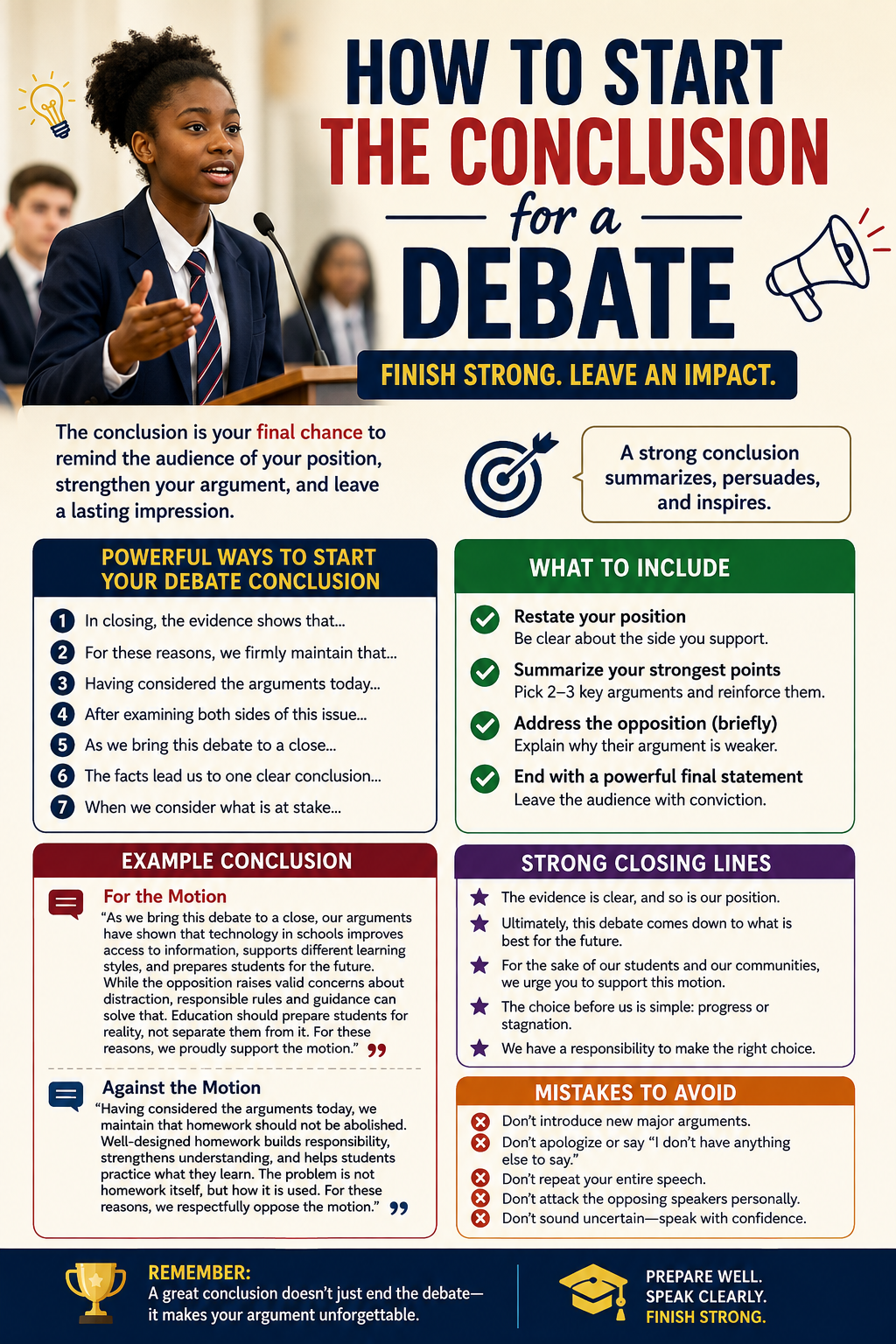
Knowing how to start the conclusion for a debate can be difficult, especially when you have already presented several arguments and do not want to sound repetitive.
The conclusion is your final opportunity to remind the audience what your side stands for, strengthen your main argument, and leave the judges with something worth remembering.
A strong debate conclusion should not introduce completely new points. Instead, it should bring your best arguments together, answer the main issue clearly, and end with confidence.
Whether you are preparing for a secondary school debate, classroom presentation, debate competition, or public speaking assignment, the opening sentence of your conclusion matters.
Below are simple ways to begin a debate conclusion, examples for both sides of an argument, useful phrases, common mistakes to avoid, and complete closing statements you can adapt.
See now How to Use the Cornell Method to Take Better Lecture Notes (A Guide for Nigerian Students)
What Is a Debate Conclusion?
A debate conclusion is the final section of your speech.
Its purpose is to bring your argument to a clear and convincing end.
By the time you reach the conclusion, you should already have explained your major points, supported them with reasons or examples, and challenged the opposing side where necessary.
The conclusion should therefore answer one important question:
Why should the audience or judges accept your side of the debate?
A good conclusion usually does three things.
First, it reminds the audience of your position.
Second, it briefly reinforces your strongest arguments.
Third, it finishes with a memorable final statement.
The conclusion does not need to be long. A short, focused ending is often stronger than repeating your entire speech.
How to Start the Conclusion for a Debate
One of the easiest ways to start is by clearly signaling that you are bringing your argument together.
You can begin with phrases such as:
“In closing, the evidence clearly shows that…”
“Having considered the arguments presented today…”
“For these reasons, we firmly maintain that…”
“After examining both sides of this issue…”
“As we bring this debate to a close…”
“The arguments presented today lead us to one clear conclusion…”
“When we consider the facts, the choice becomes clear…”
These opening lines help the audience recognize that you are no longer introducing arguments. You are now showing what those arguments mean.
The strongest option depends on the tone of your debate.
For a formal competition, “For these reasons, we firmly maintain that…” sounds confident and professional.
For a school debate, “As we bring this debate to a close…” is simple and easy to remember.
1. Start by Restating Your Position
One of the safest ways to begin a debate conclusion is to restate your position in different words.
Do not repeat the exact wording from your introduction.
Instead, remind the audience what your team has demonstrated.
For example, imagine the debate topic is:
“Online friendships are just as meaningful and real as face-to-face friendships.”
If you support the motion, you could begin:
“As we bring this debate to a close, our arguments have shown that genuine friendship is built on trust, loyalty, communication, and emotional support, not simply physical distance.”
If you oppose the motion, you could say:
“Having considered the arguments presented today, we maintain that face-to-face friendships provide forms of connection, shared experience, and physical support that online communication cannot fully replace.”
Both openings immediately tell the audience where the speaker stands.
2. Start With “For These Reasons”
“For these reasons” is one of the simplest and most useful debate conclusion starters.
It connects your conclusion directly to the arguments you have already presented.
For example:
“For these reasons, we strongly believe that school uniforms should remain compulsory.”
You can then briefly mention the most important reasons.
“They promote equality, reduce pressure over clothing, and help students maintain a stronger sense of school identity.”
This approach works particularly well when your debate has several clear arguments that can be summarized quickly.
Avoid listing every single point again. Choose the strongest two or three.
Check out How to Use the Cornell Method to Take Better Lecture Notes (A Guide for Nigerian Students)
3. Start by Referring to the Evidence
A conclusion becomes more persuasive when you remind the audience that your position is based on reasoning rather than opinion alone.
Useful starters include:
“The evidence presented today clearly demonstrates that…”
“When we examine the facts, it becomes difficult to deny that…”
“The examples and arguments we have presented point to one conclusion…”
Suppose the topic is:
“Social media does more harm than good to teenagers.”
A supporting speaker might say:
“The arguments presented today point to one clear conclusion: although social media has benefits, its effects on distraction, unhealthy comparison, privacy, and online pressure cannot be ignored.”
This sounds stronger than simply saying, “I still believe social media is bad.”
4. Start by Asking a Final Question
A rhetorical question can make a debate conclusion more memorable.
A rhetorical question is a question asked to make the audience think rather than to receive an answer.
For example:
“If education is meant to prepare students for the future, can we really justify ignoring the technology that will shape that future?”
You can then follow it with your position:
“For that reason, we strongly support the responsible use of technology in schools.”
Another example might be:
“If friendship is measured by loyalty, understanding, and support, should distance alone make that friendship less real?”
This style works best when the question directly connects to your strongest argument.
Do not ask several questions in a row. One powerful question usually has more impact.
5. Start With the Main Principle Behind Your Argument
Some debates are stronger when the conclusion returns to a larger principle such as fairness, responsibility, freedom, safety, education, equality, or opportunity.
For example:
“At the heart of this debate is a simple principle: every student deserves the opportunity to learn in a safe and supportive environment.”
You could then continue:
“For that reason, bullying cannot be treated as a minor school issue. Schools must take firm action to prevent it.”
This technique moves the conclusion beyond individual facts and reminds the audience why the issue matters.
It is especially effective in debates about education, human rights, school rules, technology, the environment, and social issues.
6. Start by Showing What Is at Stake
Another strong approach is to remind the audience about the consequences of the decision being debated.
For example:
“This debate is not simply about whether students should use phones in school. It is about whether technology helps learning or constantly competes for students’ attention.”
Or:
“The issue before us goes beyond convenience. It concerns the kind of environment we want future generations to inherit.”
This gives your conclusion greater importance.
Once you establish what is at stake, connect it directly to your position.
Read also JAMB 2026 Novel Summary: The Lekki Headmaster by Kabir Alabi Garba (Complete Guide)
7. Start by Answering the Opposition
A strong debater does not only repeat their own arguments. They also show why the opposing side has failed to prove its case.
You might begin:
“The opposing side has raised important concerns, but those concerns do not outweigh the evidence we have presented.”
Then explain why.
For example:
“Although they argue that homework teaches responsibility, excessive homework can reduce sleep, increase stress, and leave students with little time for other forms of learning.”
This approach can be particularly effective for the final speaker on a debate team because that speaker often needs to compare both sides.
Stay respectful. Attack the argument, not the person presenting it.
Strong Debate Conclusion Starters
If you need a quick phrase to help you begin, try one of these:
“In closing, we firmly believe that…”
“To bring our argument together…”
“For all the reasons presented today…”
“Having examined both sides of this issue…”
“The evidence leads us to one clear conclusion…”
“At the heart of this debate is…”
“When all these arguments are considered…”
“The opposing side has failed to prove that…”
“Our position remains clear…”
“The choice before us is simple…”
“Ultimately, this debate comes down to…”
“As we conclude, let us remember that…”
Each of these can be followed by your position and one or two of your strongest reasons.
See now Is the Internet Helpful or Harmful to Students?
How to Structure a Debate Conclusion
A simple debate conclusion can follow this structure:
Step 1: Signal the Ending
Use a phrase such as:
“As we bring this debate to a close…”
Step 2: Restate Your Position
Say clearly what you believe.
“We firmly maintain that students should be allowed to use technology responsibly in the classroom.”
Step 3: Summarize Your Strongest Reasons
Mention your strongest two or three arguments.
“Technology gives students faster access to information, supports different learning styles, and develops skills they will need in the modern workplace.”
Step 4: Respond to the Other Side if Necessary
Briefly show why their argument is weaker.
“While distractions are a genuine concern, responsible rules and teacher supervision can manage them without removing useful technology completely.”
Step 5: Finish With a Strong Final Line
End confidently.
“Education should prepare students for the future, not separate them from it. For these reasons, we proudly support the motion.”
That structure is simple enough for secondary school students to remember but strong enough for formal school debates.
Debate Conclusion Example for Supporting a Motion
Consider the topic:
“School uniforms should be compulsory.”
A complete conclusion could sound like this:
“As we bring this debate to a close, the reasons for compulsory school uniforms remain strong. Uniforms reduce unnecessary competition over clothing, create a clearer sense of school identity, and help students focus more attention on learning. The opposition may argue that uniforms limit personal expression, but students have many other ways to express their personalities without turning clothing into a daily competition. Schools exist primarily for education, discipline, and development. A simple dress code that supports those goals is reasonable. For these reasons, we firmly support the motion that school uniforms should be compulsory.”
Notice that the conclusion does not introduce a completely new argument.
It brings existing ideas together and clearly tells the audience why the motion should be supported.
Debate Conclusion Example for Opposing a Motion
Consider the topic:
“Homework should be abolished.”
A speaker opposing the motion could conclude:
“Having considered the arguments presented today, we cannot accept the claim that homework should be abolished completely. Poorly designed or excessive homework may create problems, but that does not mean all homework has no value. When used properly, homework allows students to practise difficult skills, prepare for examinations, develop responsibility, and identify areas they have not yet understood. The solution to excessive homework is better homework, not the removal of homework altogether. Education requires both classroom instruction and independent practice. For these reasons, we respectfully but firmly oppose the motion.”
This conclusion acknowledges the other side while defending a clear position.
Short Debate Conclusion Example
Sometimes you may only have a few seconds left.
A shorter conclusion could be:
“In closing, our arguments have shown that this policy would create more problems than it solves. It would increase costs, reduce fairness, and fail to address the real issue. For these reasons, we strongly oppose the motion. Thank you.”
Short conclusions can still be effective when every sentence has a clear purpose.
Powerful Final Sentences for a Debate
Your final sentence should sound decisive.
Check out Art Is Better Than Science: 15 Powerful Reasons Creativity Shapes the World
Avoid ending with uncertainty such as:
“So, I think maybe our side is better.”
Instead, finish with confidence.
Examples include:
“For these reasons, we proudly support the motion.”
“That is why this House must reject the motion.”
“The evidence is clear, and so is our position.”
“Progress requires action, not excuses.”
“The future will be shaped by the choices we make today.”
“A fair society should protect opportunity, not restrict it.”
“Education should prepare students for reality, not shield them from it.”
“For the sake of our students, our communities, and our future, we urge you to support this motion.”
Your final line should fit the topic rather than sounding dramatic simply for the sake of drama.
How Not to Start a Debate Conclusion
Some conclusion starters weaken your speech.
Avoid beginning with:
“I don’t really have anything else to say…”
This sounds unprepared.
Also avoid:
“That’s basically all my points.”
It does not reinforce your argument.
Another weak opening is:
“Like I said before…”
A conclusion should sound deliberate rather than repetitive.
Try not to begin by apologizing either:
“Sorry if my debate wasn’t very good…”
Even if you made mistakes earlier, your conclusion is your opportunity to recover and finish strongly.
Avoid introducing an entirely new major argument as well. If the point is important enough to change the debate, it should usually have appeared earlier in your speech.
Common Mistakes Students Make in Debate Conclusions
Repeating the Entire Speech
A conclusion is a summary, not a second version of your debate.
Choose only the strongest arguments.
Introducing New Evidence
New statistics, examples, or major arguments can confuse the audience because the opposition has had no opportunity to respond to them.
Use the conclusion to strengthen what you have already established.
Speaking Too Quickly
Students often rush because they know time is almost finished.
Slow down slightly during the conclusion. Your final lines deserve to be heard clearly.
Sounding Uncertain
Avoid phrases such as:
“I guess…”
“Maybe…”
“I personally sort of think…”
Debate requires a clear position.
Use stronger language such as:
“We maintain…”
“We have demonstrated…”
“The evidence shows…”
“We firmly support…”
Attacking the Opposing Speakers Personally
You can challenge arguments without insulting the people making them.
Instead of saying:
“The opposing speaker clearly doesn’t understand the topic…”
Say:
“The opposition’s argument does not address the central problem…”
The second version sounds more mature and persuasive.
How Long Should a Debate Conclusion Be?
For many secondary school debates, the conclusion may take around 30 seconds to one minute, depending on the total speaking time.
Read now How to Use the Cornell Method to Take Better Lecture Notes (A Guide for Nigerian Students)
The most important factor is not length.
It is focus.
A useful conclusion often contains around four parts:
Your position.
Your strongest reasons.
A short response to the opposition.
A memorable final sentence.
If you can accomplish those things clearly in a short paragraph, you do not need to make the conclusion longer simply to fill time.
Should You Say “Thank You” at the End of a Debate?
Yes, if it fits the debate format used by your school or competition.
After your final persuasive sentence, you can simply say:
“Thank you.”
However, make your argument the true ending.
Compare these two versions.
Weak:
“So that’s all. Thank you.”
Stronger:
“For these reasons, we firmly believe that every student deserves equal access to quality education. We proudly support the motion. Thank you.”
The second version allows the persuasive message to remain in the audience’s mind.
Easy Debate Conclusion Template
You can adapt this template to almost any topic:
“As we bring this debate to a close, we firmly maintain that [state your position]. Our arguments have shown that [strong reason one], [strong reason two], and [strong reason three]. While the opposing side argues that [brief opposing claim], this does not outweigh [your response]. Ultimately, [larger principle or key message]. For these reasons, we strongly support/oppose the motion. Thank you.”
Do not memorize the template word for word for every debate.
Use it as a structure and adapt the language to your topic.
Frequently Asked Questions
What Is the Best Way to Start a Debate Conclusion?
A simple and effective opening is:
“As we bring this debate to a close, our arguments have shown that…”
It clearly signals the ending and gives you an easy transition into your strongest points.
See more Oppose the Motion: A Female Child Is Better Than a Male Child
Can I Start a Debate Conclusion With “In Conclusion”?
Yes, but you do not have to.
“In conclusion” is grammatically correct, although phrases such as “As we bring this debate to a close” or “For these reasons” can sound more natural and persuasive.
What Should I Say in the Last Sentence of a Debate?
Restate your position confidently and connect it to the importance of the issue.
For example:
“For these reasons, we firmly support the motion and believe this is the fairest choice for students.”
Should I Add a New Argument in My Conclusion?
Usually, no.
The conclusion should strengthen and summarize arguments you have already presented rather than introducing a completely new major point.
How Do I Make My Debate Conclusion Powerful?
Keep it short, clear, and confident. Mention your strongest arguments, respond briefly to the opposition, and finish with a memorable sentence that directly supports your position.
Bringing Your Debate to a Strong Finish
Learning how to start the conclusion for a debate becomes much easier when you stop treating the conclusion as another argument.
Your job is to bring the debate together.
Start with a clear transition, restate your position, remind the audience of your strongest reasons, address the opposition where necessary, and finish with confidence.
You do not need complicated vocabulary or a dramatic speech.
A simple conclusion delivered clearly can be much more persuasive than a long ending filled with repetition.
The goal is for the judges and audience to know exactly what your side believes and why your arguments deserve to win.
When your final words are clear, focused, and connected to the main issue, you give your debate the strongest possible finish.