7 Winning Points: Why Democracy is Not the Best System of Government for Nigeria
Good day, students! Looking for the winning points for your next debate? You’ve come to the right place.
Today, we are tackling a very controversial but powerful topic: Democracy is Not the Best System of Government for Nigeria.
Let’s be honest. We’ve been singing the praises of democracy for over two decades now, but look around you. Are things getting better? Or are we just changing drivers while the car remains broken? The truth is, while democracy sounds good on paper, the reality in Nigeria is very different.
Meaning of Terms Before we dive into the points, let’s define the terms simply. Democracy is often defined as a government of the people, by the people, and for the people. But in the context of this debate, we are arguing that this Western-style system is too expensive, too corrupt, and too divisive for a developing nation like ours.
This article provides debate points supporting one side of the motion for educational purposes. It is designed to help students build strong arguments and does not necessarily reflect the personal political views of the author.
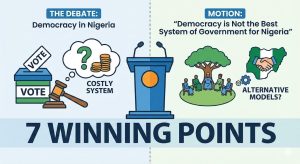
Winning Debate Points on Why Democracy is Not the Best System of Government for Nigeria
Here are 7 strong, persuasive arguments you can use to win this debate.
1. The Cost of Governance is Too Expensive
My first point is strictly about money. Democracy is undoubtedly the most expensive form of government to run, and frankly, Nigeria cannot afford it. Think about it. We have a President, a Vice President, 109 Senators, 360 House of Representatives members, 36 Governors, and thousands of political appointees. All of them earn massive salaries and allowances.
Research shows that a huge chunk of Nigeria’s budget goes into “Recurrent Expenditure”—basically, paying salaries to politicians—rather than “Capital Expenditure” like building roads, schools, or hospitals. In a country where millions are living in poverty, spending billions to maintain a democratic structure is a waste of resources. We need a leaner, cheaper system that focuses on development, not on feeding politicians.
2. It Fuels Corruption and “Godfatherism”
Let’s face it: in Nigeria, democracy has become a business. To win an election, you need billions of Naira. Where does this money come from? It comes from “Godfathers” who sponsor candidates. And once that candidate wins, they must pay back their Godfather with government contracts and public funds.
This turns leadership into a transaction. It’s no longer about who is the best for the job; it’s about who has the richest backers. As long as our version of democracy requires massive funds to campaign, corruption will never end. It’s a systemic trap that other systems, like a merit-based selection, might avoid.
3. It Divides Us Along Tribal and Religious Lines
If you check our list of popular debate topics for Nigerian schools, you’ll see that unity is always a big issue. Sadly, democracy in Nigeria often makes this worse. Every four years, politicians weaponize our differences to get votes.
They tell the North to vote against the South, or Christians to vote against Muslims. Instead of uniting us, the quest for votes tears us apart. A system that forces ethnic groups to compete for power in a “winner-takes-all” game will always create tension. We need a system that emphasizes unity and consensus, perhaps closer to our traditional African roots, rather than this Western competitive model.
4. The Decision-Making Process is Too Slow
Imagine a building is on fire. Do you call a committee meeting to vote on whether to use water or sand? No, you act immediately! Nigeria is in an emergency state regarding infrastructure and economy, yet democracy is incredibly slow.
For a simple road to be fixed, it has to go through budget proposals, legislative debates, committee oversights, and approval signings. Months or years pass, and nothing gets done. Countries like China or the UAE developed rapidly because their systems allow for quick, decisive action. They don’t waste time debating every single move in a parliament while their people suffer.
5. It is a Western Concept Imposed on Us
Why are we forcing ourselves to wear a shirt that doesn’t fit? Democracy is a product of Western history and culture. It works for them because it evolved with their society. In Nigeria, we have our own unique history of kingdoms, emirates, and consensus-building.
Trying to copy-paste the American style of government into Nigeria is like trying to force a square peg into a round hole. It ignores our traditional respect for elders and community consensus. We should be looking for a “home-grown” system of government that respects our African heritage, rather than struggling with a foreign system that clearly isn’t working for us.
6. Elections Are Often a Selection, Not an Election
Let’s get real. How many times have you heard that an election was “free and fair”? Almost never. In many cases, the results are decided before the first vote is cast. Ballot boxes are snatched, figures are changed, and the judiciary often has the final say, not the people.
If the “voice of the people” is constantly silenced by rigging and violence, then can we even call it democracy? It’s a charade. We are spending billions on Independent National Electoral Commission (INEC) logistics just to have a “selection” disguised as an “election.” It’s a waste of time and hope.
7. It Prioritizes Popularity Over Competence
Finally, democracy is a popularity contest. It doesn’t matter if you are intelligent, capable, or have a great plan. If you can dance on stage, share bags of rice, and make people laugh, you win.
This is why we often end up with leaders who have no idea how to run an economy. It’s the same argument we make when we say education is better than money—value matters. We need a system that prioritizes competence and merit (Epistocracy), where leaders are chosen based on their ability to solve problems, not their ability to share money at rallies.
Frequently Asked Questions (FAQs)
Q: What is the alternative to democracy? A: You don’t have to support military rule to oppose democracy. You can argue for a “Benevolent Meritocracy” (rule by the most qualified) or a “Constitutional Monarchy” adapted to our traditional institutions. The point is to find what works for Nigeria.
Q: How do I start my debate speech? A: Start strong! Don’t be boring. You can find excellent opening lines in our guide on how to start a debate step-by-step. A good greeting sets the mood for victory.
Q: Won’t the judges think I hate freedom? A: No. Make it clear that you love your country and want it to work. You are not attacking freedom; you are attacking a system of government that has failed to deliver development.
Conclusion
To wrap it up, let’s look at the facts. High cost of governance, corruption, slow decision-making, and tribal division are the fruits we have harvested from this tree called democracy. It’s time we stop pretending that a system imported from the West is the only way to govern.
Nigeria needs a system that is cost-effective, culturally relevant, and development-focused. Democracy, in its current form, is simply not that system.
This post is for educational debate purposes only. We respect all forms of government and believe in the importance of civic engagement.
What do you think? Do you agree that democracy is too expensive for Nigeria? Drop your opinions in the comments section below… Also, feel free to share this post with your coursemates or those in your team!
Beyond The Ballot: Can Democracy Survive in Africa?
This video explores the current challenges facing democracy across the African continent and discusses whether the system is truly delivering for its citizens, which perfectly aligns with your debate points.