Should Schools Be Year-Round?
School is an important part of every child’s life.
Pupils go to school to learn Mathematics, English, Basic Science, Social Studies, Civic Education, and other subjects. They also make friends, develop talents, and prepare for the future.
Most schools in Nigeria divide the academic year into three terms. After each term, pupils usually have a holiday. The longest break often comes after the third term.
But some people believe schools should operate throughout the year with shorter holidays between learning periods.
This brings us to an important debate question:
Should schools be year-round?
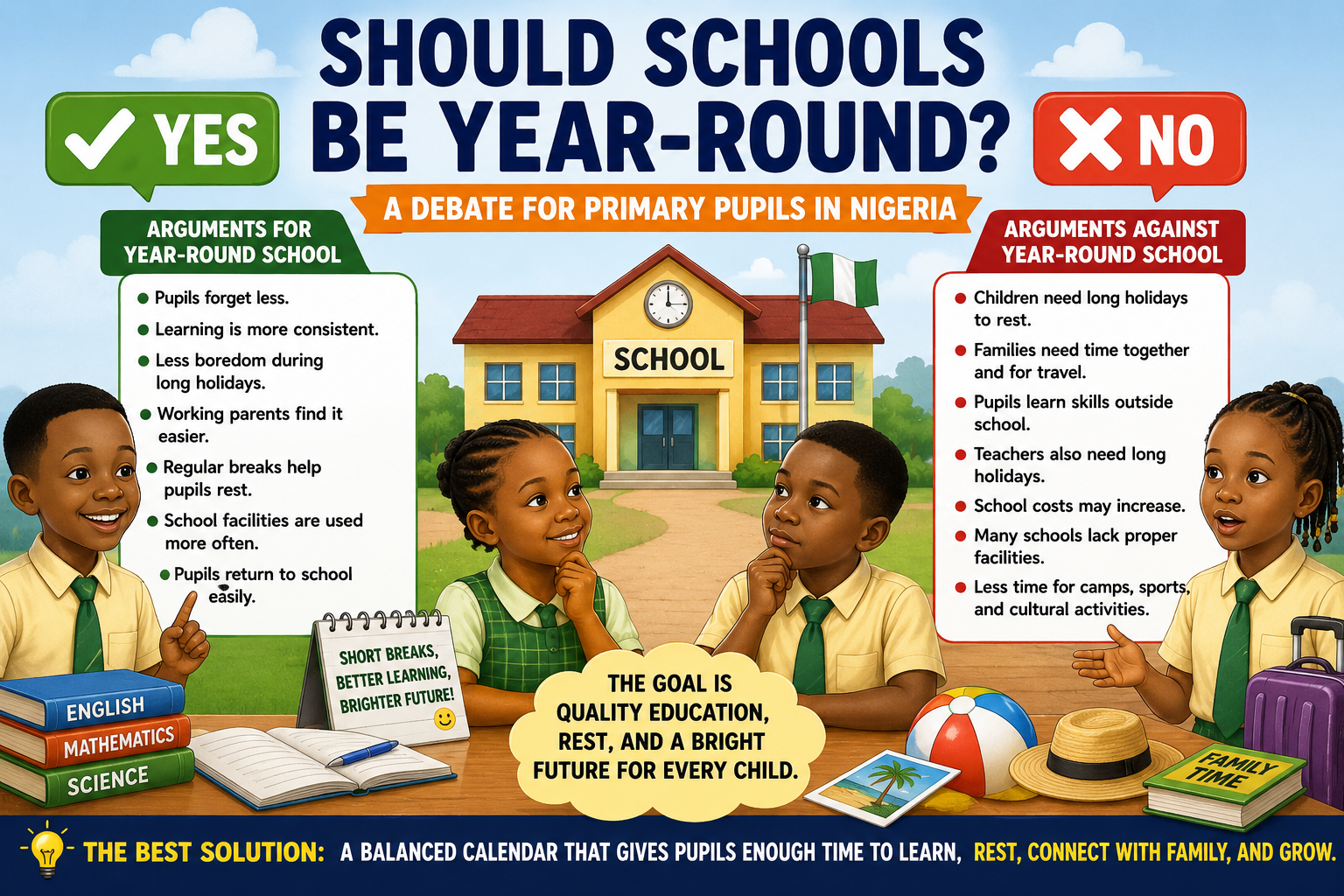
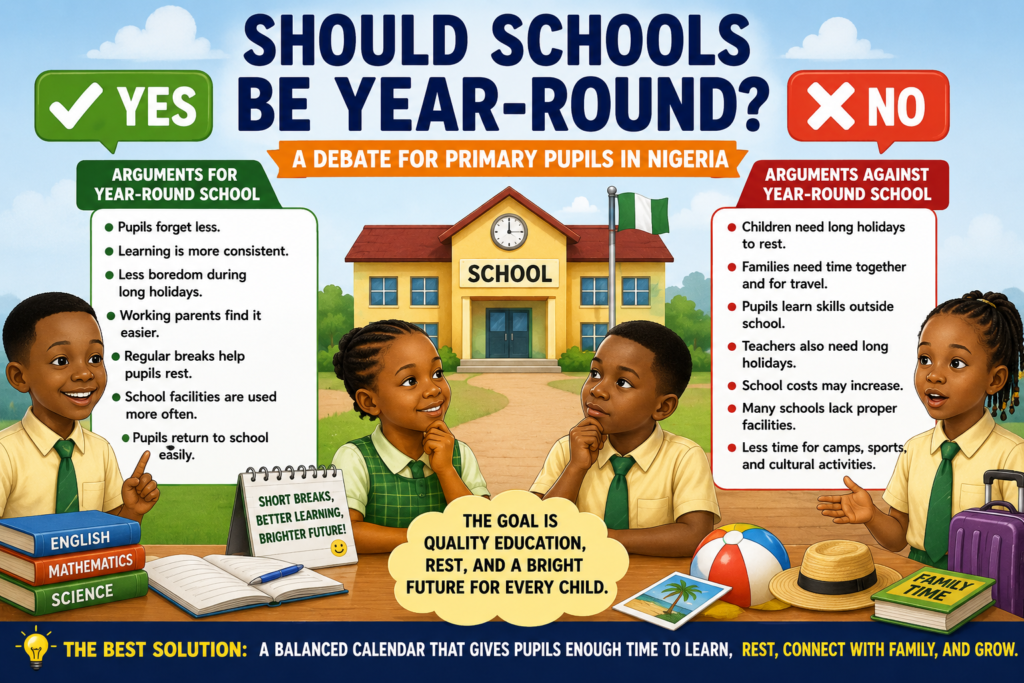
Supporters believe year-round schooling can help pupils remember what they learn, reduce long holiday boredom, and make better use of school facilities.
Opponents argue that children need long holidays to rest, spend time with family, travel, help at home, and prepare mentally for a new school year.
Both sides have reasonable arguments.
The best answer may depend on how year-round schooling is organised and whether pupils still receive enough breaks.
Check out Art Is Better Than Science: 15 Powerful Reasons Creativity Shapes the World
What Does Year-Round School Mean?
Year-round school does not necessarily mean pupils attend classes every day without holidays.
It usually means that the school year is divided into shorter learning periods with more frequent breaks.
For example, instead of attending school for several months and then having one very long holiday, pupils may:
- Attend school for eight or nine weeks
- Take a two- or three-week break
- Return for another learning period
- Continue this pattern throughout the year
The total number of school days may remain almost the same.
The main difference is how the holidays are arranged.
How Does the Nigerian School Calendar Work?
Most Nigerian primary and secondary schools use a three-term academic calendar.
The school year usually includes:
- First term
- Second term
- Third term
Between the terms, pupils have holidays.
There may also be shorter breaks for Christmas, Easter, public holidays, mid-term breaks, and other occasions.
After the third term, many schools close for a longer holiday before the next academic session begins.
Supporters of year-round schooling believe this long break could be shortened and divided into several smaller holidays.
See now How to Use the Cornell Method to Take Better Lecture Notes (A Guide for Nigerian Students)
Reasons Schools Should Be Year-Round
There are several arguments in favour of year-round schooling.
1. Pupils May Forget Less
During a very long holiday, some pupils forget parts of what they learned.
A child who understood multiplication, spelling, grammar, or fractions during the term may return to school needing a lot of revision.
Teachers may spend several weeks reviewing old topics before beginning new lessons.
With shorter breaks, pupils may remember more.
They return to school sooner, so learning continues more smoothly.
2. Learning Can Become More Consistent
Year-round schooling can create a steady pattern of learning and rest.
Pupils attend school for a period, take a short holiday, and then return.
This may be better than studying for many months and then staying away from school for a very long time.
A regular learning routine can help children remain focused.
3. Pupils May Have Less Time to Become Bored
Long holidays can be exciting at first.
Children may sleep more, watch television, play games, visit relatives, and enjoy freedom from schoolwork.
However, after several weeks, some pupils may become bored.
They may spend too much time:
- Watching television
- Playing video games
- Using phones
- Wandering around
- Getting into trouble
Year-round schooling can reduce extremely long periods without structured activity.
4. It May Help Working Parents
Some parents work throughout the year.
When schools close for a long holiday, they may struggle to find someone to supervise their children.
Parents may need to pay for:
- Holiday lessons
- Childcare
- Summer programmes
- Private tutors
- Transport to relatives’ homes
A year-round system with shorter holidays may make childcare easier for some families.
5. Teachers Can Revise Difficult Topics More Often
Frequent breaks can give teachers opportunities to identify pupils who need extra help.
During short holiday periods, schools may organise optional revision classes for children struggling with:
- Reading
- Writing
- Mathematics
- Science
- Spelling
This could help pupils improve before they fall too far behind.
6. School Facilities Can Be Used More Regularly
School buildings, libraries, laboratories, playgrounds, and computer rooms may remain unused during long holidays.
Year-round schooling allows these facilities to be used more consistently.
This could help schools make better use of the resources they already have.
7. Shorter Breaks May Improve Discipline
Some pupils find it difficult to return to a school routine after a long holiday.
They may become used to:
- Sleeping late
- Watching television for many hours
- Avoiding homework
- Playing throughout the day
Returning to early mornings, uniforms, lessons, and assignments may become difficult.
Shorter breaks can make the transition back to school easier.
8. Pupils Can Receive More Frequent Rest
Year-round schooling does not have to mean less rest.
Instead of one long holiday, pupils may receive several shorter holidays.
This can prevent them from becoming too tired during the term.
For example, after eight weeks of lessons, pupils may receive a two-week break to rest before the next learning period.
9. It Can Support Continuous Academic Progress
Some pupils improve when they practise regularly.
Reading, writing, and Mathematics require repeated practice.
Very long breaks can interrupt that progress.
A year-round system can help pupils continue developing their skills throughout the year.
10. Schools Can Organise Better Enrichment Activities
Short breaks could be used for optional programmes such as:
- Sports
- Music
- Art
- Reading clubs
- Coding
- Drama
- Cultural activities
- Science projects
These activities can help pupils learn outside the regular classroom.
Reasons Schools Should Not Be Year-Round
Although year-round schooling may have benefits, there are also strong arguments against it.
1. Children Need Long Holidays to Rest
School can be tiring.
Pupils wake up early, attend lessons, complete assignments, prepare for tests, and sometimes attend extra classes after school.
A long holiday gives children time to rest properly.
Short breaks may not be enough for some pupils to recover from academic pressure.
2. Families Need Time Together
Long holidays allow children to spend more time with:
- Parents
- Grandparents
- Cousins
- Uncles
- Aunts
- Family friends
Some families live far apart and can only visit one another during long school holidays.
A shorter break may make family travel more difficult.
3. Children Can Learn Outside School
Not all learning happens in the classroom.
During holidays, children may learn:
- Cooking
- Farming
- Trading
- Sewing
- Craftwork
- Music
- Religious lessons
- Family traditions
- Community responsibilities
These experiences can teach useful life skills.
A long holiday can provide time for this kind of learning.
4. Teachers Also Need Rest
Teachers work hard.
They prepare lessons, mark assignments, write reports, manage pupils, attend meetings, and organise examinations.
Teachers need enough time to rest and prepare for a new academic session.
Year-round schooling may increase stress if staff members do not receive proper breaks.
5. School Costs May Increase
Keeping schools open for more periods during the year may increase expenses.
Schools may need to pay for:
- Electricity
- Water
- Security
- Cleaning
- Transport
- Staff salaries
- Maintenance
- Learning materials
Parents may also face more regular school-related costs.
6. Some Schools Lack Proper Facilities
Many Nigerian schools do not have enough:
- Classrooms
- Teachers
- Toilets
- Desks
- Books
- Electricity
- Water
- Computers
Before introducing year-round schooling, these problems may need to be addressed.
Keeping pupils in school for more periods will not automatically improve education if the learning environment is poor.
7. Pupils Need Time for Holiday Activities
Some pupils participate in important programmes during long holidays.
These may include:
- Sports camps
- Religious camps
- Cultural festivals
- Family businesses
- Educational trips
- Holiday lessons
- Skill training
A year-round calendar could make these activities more difficult.
8. Very Hot Weather Can Affect Learning
Some parts of Nigeria experience periods of intense heat.
Many classrooms do not have air conditioning or reliable electricity.
Attending school during very hot periods may be uncomfortable, especially in crowded classrooms.
School calendars may need to consider local weather conditions.
9. Families May Find Travel Difficult
Parents often plan family trips around school holidays.
If schools have many short breaks instead of one long holiday, travelling long distances may become expensive and stressful.
Families may not have enough time to visit relatives in other states.
10. Children Need Time to Be Children
Children should not spend every part of the year worrying about lessons and examinations.
They need time to:
- Play
- Explore
- Rest
- Imagine
- Build friendships
- Discover interests
- Enjoy childhood
A good education should not remove all free time.
Should Nigerian Schools Be Year-Round?
Nigerian schools could benefit from some features of year-round schooling, but the system may not suit every school.
Schools in large cities may have different needs from schools in rural communities.
Private schools may have more facilities than some public schools.
Some parents may prefer shorter, regular breaks.
Others may need one long holiday for travel, farming, family responsibilities, or cultural activities.
Therefore, Nigeria may need a flexible approach rather than one rule for every school.
Would Year-Round School Mean No Holidays?
No.
This is a common misunderstanding.
Year-round schooling usually includes holidays.
The difference is that the breaks are shorter and spread across the year.
For example, pupils could attend school for nine weeks and then receive a three-week break.
They would still have time to rest.
However, they may not receive one extremely long holiday.
Read also How to Handle Panic Attacks in the Exam Hall: A Survival Guide for Nigerian Students
Does Year-Round School Improve Learning?
It may help some pupils.
Shorter breaks can reduce how much children forget.
Pupils may return to lessons without needing several weeks of revision.
However, school calendars alone do not guarantee better learning.
The quality of education also depends on:
- Good teachers
- Useful textbooks
- Proper classrooms
- Regular attendance
- Effective teaching methods
- Parental support
- Safe schools
- Enough learning materials
A bad school will not automatically become good simply because it operates year-round.
Is Year-Round School Better for Working Parents?
It may be helpful for some working parents.
Long holidays can create childcare problems.
A year-round calendar may reduce the number of weeks children stay at home without supervision.
However, parents will still need childcare during the shorter breaks.
The system may make planning easier, but it will not remove every challenge.
Do Teachers Prefer Year-Round School?
Different teachers may have different opinions.
Some may enjoy having more frequent breaks.
Others may prefer one long holiday for rest, travel, further study, or family responsibilities.
Teachers should be included in decisions about changing the school calendar.
Their health and workload matter.
Should School Holidays Be Shorter?
School holidays could be adjusted where necessary, but they should not become too short.
Children need rest.
A better solution may be to reduce extremely long breaks while keeping enough time for family, recreation, and other activities.
The goal should not be to keep children in school every day.
The goal should be to create a healthy balance.
Advantages of Year-Round School
The main advantages include:
- Pupils may forget less
- Learning can remain consistent
- Long holiday boredom may reduce
- Working parents may find childcare easier
- Pupils can receive more frequent breaks
- Schools can organise regular revision
- School facilities can be used more often
- Returning to school may become easier
Disadvantages of Year-Round School
See now The Importance of Girl Child Education in Nigeria Debate: Why It Matters More Than Ever
The main disadvantages include:
- Children may not get a long rest
- Family travel may become difficult
- Teachers may become tired
- School expenses may increase
- Pupils may miss holiday programmes
- Some schools lack proper facilities
- Children may have less time for family and community learning
- Parents may struggle to adjust their schedules
Debate Points Supporting Year-Round School
A pupil supporting the motion can use these points:
- Pupils will forget less during shorter holidays.
- Learning will be more regular.
- Long holiday boredom will reduce.
- Working parents will have fewer childcare problems.
- Pupils will receive several short breaks.
- Teachers can revise difficult topics more often.
- School facilities will be used more regularly.
- Pupils may return to school with less difficulty.
Debate Points Opposing Year-Round School
A pupil opposing the motion can use these points:
- Children need long holidays to rest.
- Families need enough time to travel and stay together.
- Pupils learn useful skills outside school.
- Teachers also need a long break.
- School expenses may increase.
- Many Nigerian schools lack proper facilities.
- Children need time for camps, sports, and cultural activities.
- Childhood should include enough free time.
Sample Debate Supporting the Motion
Good morning, Mr Chairman, panel of judges, teachers, co-debaters, and my fellow pupils.
My name is __________, and I am here to support the motion that schools should be year-round.
Year-round schooling does not mean that pupils will attend school every day without holidays. It means that the school year will include shorter and more regular breaks.
Long holidays can make pupils forget what they have learned. When they return to school, teachers may spend a lot of time revising old topics.
Year-round schooling can help pupils continue learning more steadily.
It can also reduce boredom during long holidays. Some pupils spend too much time watching television, playing games, or moving around without supervision.
Working parents may also find it easier when their children are not at home for several months.
Furthermore, pupils can still rest because year-round schools provide regular breaks.
For these reasons, I strongly support the motion that schools should be year-round.
Thank you.
Sample Debate Opposing the Motion
Good morning, Mr Chairman, panel of judges, teachers, co-debaters, and my fellow pupils.
My name is __________, and I am here to oppose the motion that schools should be year-round.
Children need long holidays to rest after months of lessons, tests, assignments, and examinations.
The holiday period also gives pupils time to stay with their families, visit grandparents, travel, learn skills, and participate in cultural or religious activities.
Teachers also need enough time to rest and prepare for the next academic session.
Many Nigerian schools lack classrooms, electricity, water, and other basic facilities. Keeping them open throughout the year may increase expenses without improving education.
Children should have enough time to play and enjoy their childhood.
For these reasons, I strongly oppose the motion that schools should be year-round.
Thank you.
Year-Round School Versus Traditional School Calendar
See more Should Students Use Mobile Phones in Class? Benefits, Risks, and the Best Way Forward
A traditional school calendar usually includes three terms and a long holiday after the final term.
A year-round calendar divides the year into more learning periods and shorter breaks.
Traditional Calendar
Advantages:
- Longer family holidays
- More time for travel
- Time for teachers to rest
- Opportunities for holiday programmes
- Time for children to learn skills at home
Disadvantages:
- Pupils may forget lessons
- Long holiday boredom
- Childcare problems for working parents
- Difficult return to school routines
Year-Round Calendar
Advantages:
- Shorter gaps in learning
- More regular breaks
- Less forgetting
- Continuous academic progress
- Better use of school facilities
Disadvantages:
- Less time for long trips
- More operating costs
- Shorter family holidays
- Possible stress for teachers and pupils
- Difficulty joining long holiday programmes
How Can Nigerian Schools Improve the Academic Calendar?
Schools do not have to choose between two extreme options.
They can improve the calendar by:
- Keeping reasonable term lengths.
- Providing proper mid-term breaks.
- Avoiding unnecessarily long holidays.
- Giving teachers enough preparation time.
- Organising optional holiday reading programmes.
- Providing sports, art, and skill activities.
- Giving pupils homework in moderation.
- Considering local weather and community needs.
- Consulting parents and teachers before making changes.
- Ensuring pupils still have enough time to rest.
Final Verdict: Should Schools Be Year-Round?
Schools should not operate continuously without proper holidays.
Children and teachers need time to rest.
Families also need time to travel, bond, and participate in cultural, religious, and community activities.
However, extremely long holidays may cause pupils to forget lessons and lose their learning routine.
A well-planned year-round calendar with frequent breaks could help some schools, but it should not be introduced without considering:
- School facilities
- Teachers’ welfare
- Parents’ needs
- Pupils’ health
- Local conditions
- Educational quality
The best solution may be a balanced calendar.
Schools can reduce very long breaks while still giving pupils meaningful holidays.
So, should schools be year-round?
They can be, as long as pupils and teachers receive enough regular breaks and the system truly improves learning.
The purpose of education is not to keep children inside classrooms throughout the year.
It is to help them learn, grow, rest, and prepare for the future.