How to Study Effectively in a Noisy Nigerian Hostel
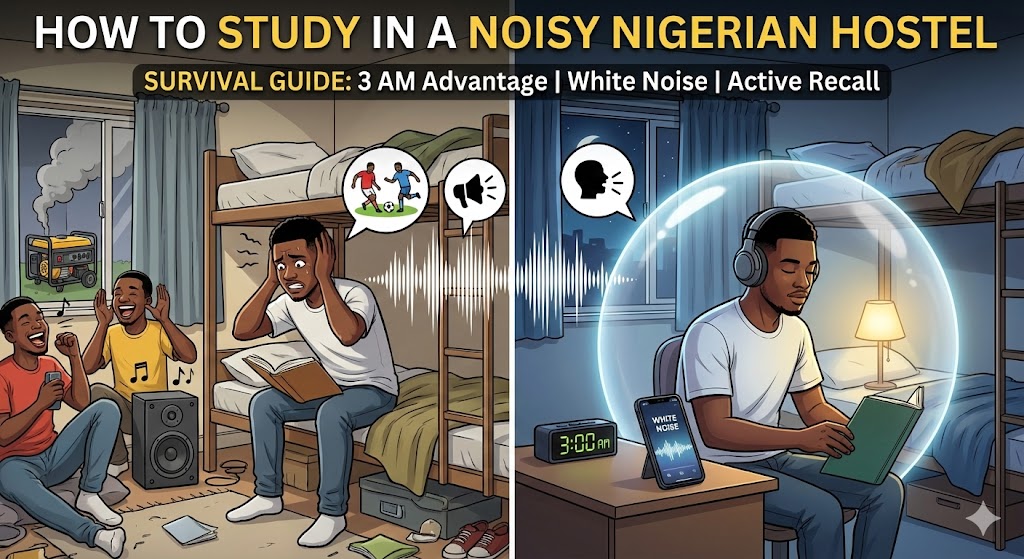
Picture this: It’s two weeks to your JAMB or semester exams. You have your chemistry textbook open, ready to crack some serious formulas. But just as you settle in, your roommate’s “I better pass my neighbor” generator roars to life. Next door, a heated debate about Messi vs. Ronaldo erupts.
Frustrating, right?
If you live in a typical student lodge or hostel in Nigeria, silence is a luxury you probably can’t afford. Yet, you still need to pass. figuring out how to study effectively in a noisy Nigerian hostel isn’t just a skill; it’s a survival mechanism.
I’ve been there. I know the struggle of trying to cram definitions while loud Afrobeats music shakes the window frames. But here is the good news: you don’t need absolute silence to get an A. You just need a better strategy.
Here are the practical ways I survived the noise and how you can too.
1. Master the “Unholy Hours” (The 3 AM Advantage)
Let’s be real. You cannot tell your neighbors to switch off their generator at 8 PM. They won’t listen.
Instead of fighting the noise, work around it. The hostel is usually chaotic between 7 PM and 11 PM. This is prime time for cooking, gisting, and shouting. Trying to study during this window is often a waste of mental energy.
The Fix: Flip your schedule. Sleep when the hostel is loud. Wake up when the hostel is dead.
I used to go to bed at 8:30 PM (earplugs in) and wake up at 3:00 AM. At that time, the generators are off, the “gist partners” are asleep, and the world is quiet. This period is the secret weapon for how to study effectively in a noisy Nigerian hostel. The retention rate at this hour is crazy high.
2. Create Your Own Bubble (White Noise is Key)
You might think you need expensive noise-canceling headphones to block out distractions. While those are great, most of us students are on a tight budget.
Here is a cheaper trick: White Noise.
White noise is a constant background sound (like rain falling or a fan whirring) that masks sudden noises like slamming doors or shouting.
-
Download a free app like “Rain Rain” or just search for “Rain sounds for studying” on YouTube.
-
Plug in your regular earpiece.
-
Play the sound at a comfortable volume.
It works because your brain stops paying attention to the specific words your roommates are saying and just hears a smooth hum. It helps you get into the zone fast. For more tips on building a solid routine, check out our guide on 10 effective study habits every student should develop.
3. Escape the Room: Finding Sanctuary Elsewhere
Sometimes, the room is just too hot and too loud. If your roommates decided to host a mini-party, don’t sit there fuming. Leave.
Every campus has hidden quiet zones. You just have to find them.
-
Empty Classrooms: In the evening, many departments leave classrooms open.
-
Religious Centers: The school chapel or mosque is often open and quiet for reading.
-
The Library: It sounds obvious, but many students avoid the library because it’s “boring.” Boring is good when you have exams.
Changing your environment can actually boost your memory retention. If you are struggling to cover your syllabus quickly, a change of scenery is one of the proven steps to prepare for an exam in a short time.
4. Use Active Recall to Lock In Focus
When the environment is noisy, passive reading (just staring at the pages) is dangerous. Your eyes are moving, but your brain is listening to the gossip next door.
You need to make your studying “aggressive.”
Don’t just read; write. Read a paragraph, close the book, and try to scribble down everything you remember. Read out loud to yourself (the sound of your own voice can drown out others). This technique helps you maintain concentration even when the environment isn’t perfect.
According to research by Learning Scientists, active recall is significantly more effective than re-reading, especially in distracting environments.
Common Mistakes Students Make When It’s Noisy
I’ve seen smart students fail because they handled the noise the wrong way. Avoid these traps:
-
The “Complainer”: This student spends 2 hours complaining about the noise and 30 minutes actually reading. Don’t be that person. Complaining doesn’t lower the volume.
-
Studying Hard Topics First: If the hostel is noisy, don’t start with complex Calculation courses like Physics or Further Maths. Start with something lighter, like copying notes or organizing your jotter. Save the hard stuff for the “Unholy Hours.”
-
The “Music” Trap: Listening to lyrical music (like Burna Boy or Davido) while reading is a bad idea. Your brain will start processing the lyrics instead of the textbook. Stick to instrumentals or lo-fi beats.
Wrapping Up
Finding how to study effectively in a noisy Nigerian hostel is all about adaptation. You can’t control your loud neighbors, and you can’t silence the generators. But you can control your schedule, your headphones, and your study methods.
Don’t let the environment become your excuse for failure. Adjust your time, find your corner, and crush those exams.
If you are looking for more ways to optimize your school life, you might want to look at the differences in learning environments in our article on boarding school vs day school, as it helps understand how environment affects learning.
For more insights on how noise pollution affects cognitive function, you can read this report by the National Institutes of Health.