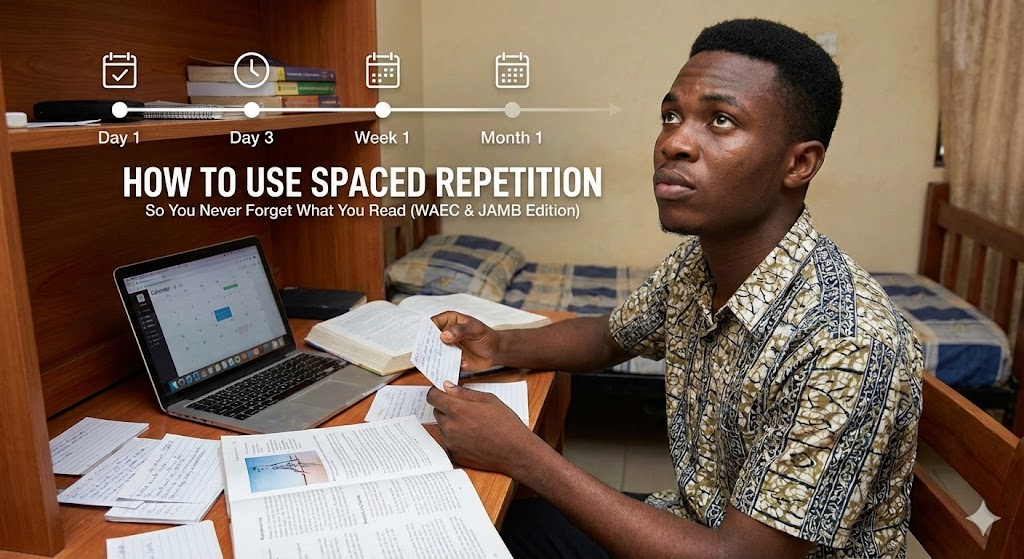
How to Use Spaced Repetition So You Never Forget What You Read (The Secret to Acing WAEC & JAMB)
Ever felt like your brain is a sieve? You spend hours reading for Biology or Government, you think you’ve mastered it, but two days later? Blank.
It’s painful. It makes you feel like maybe you aren’t “smart enough.” But here is the truth: your brain isn’t broken. You just haven’t been taught how to store information correctly.
Most Nigerian students rely on “cramming” (or la cram, la pour). It works for a day, maybe. But if you want to crush WAEC, JAMB, or those 400-level law exams, you need a better strategy. Learning how to use Spaced Repetition so you never forget what you read is that strategy. It’s the closest thing to a memory cheat code I’ve found.
Here is how to stop wasting your study time and start remembering everything.

The “Forgetting Curve” (Why You Forget)
Before we fix the problem, you need to know why it happens.
In the late 1800s, a psychologist named Hermann Ebbinghaus discovered something scary called the “Forgetting Curve.” He found that if you learn something today, you will forget about 50% of it by tomorrow. By next week? You might remember less than 10%.
That is why reading a textbook once is a waste of time. Your brain thinks that information isn’t important, so it deletes it to save space.
Spaced Repetition hacks this system. instead of reading a topic for 5 hours straight (which leads to burnout), you review it at specific intervals just as you are about to forget it.
Step 1: Create a Review Timetable
You don’t need to be a genius to do this. You just need discipline.
When you finish a topic—let’s say, “Cell Biology”—don’t just close the book and move on forever. You need to schedule reviews.
Here is a schedule that works wonders for most students:
-
Review 1: Immediately after reading (summarize what you just read).
-
Review 2: 1 day later (24 hours).
-
Review 3: 3 days later.
-
Review 4: 1 week later.
-
Review 5: 1 month later.
It sounds like a lot of work, but these reviews only take 10-15 minutes. It is far better than relearning the whole topic from scratch a week before exams. This consistency is one of the 10 effective study habits every student should develop if they want to stop struggling with grades.
Step 2: Stop Rereading, Start “Active Recall”
This is where most people get it wrong. They think “reviewing” means opening the textbook and reading the highlighted parts again.
That is lazy studying. It feels good because the words look familiar, so you tell yourself, “Yes, I know this.” But you don’t. You just recognize it.
To really learn how to use Spaced Repetition so you never forget what you read, you must combine it with Active Recall.
Don’t read the page. Close the book. Ask yourself: “What are the functions of the Executive arm of government?” Force your brain to dig up the answer.
If you struggle to remember, good. That struggle is actually your brain building stronger connections. It’s like lifting weights; if it’s too easy, muscles won’t grow.
Step 3: Use Flashcards (The Secret Weapon)
You can’t carry your big textbooks everywhere. Flashcards are the best tool for Spaced Repetition.
You can use physical paper cards or apps. Personally, I recommend digital apps because they automate the timing for you.
-
Anki: This is the king of memory apps. It uses an algorithm to show you cards you struggle with more often and hides the ones you already know.
-
Quizlet: Very popular and easier to use than Anki, though the spaced repetition features are sometimes paid.
If you prefer paper, that’s fine too. Just keep two piles: “Hard” and “Easy.” Review the “Hard” pile every day, and the “Easy” pile every 3 days.
Using tools like this is crucial when you are trying to figure out how to prepare for an exam in a short time. You don’t have time to waste on what you already know.
Common Mistakes Students Make
Even with this method, you can mess up. Here are the traps to avoid:
1. Being Dishonest with Yourself When you flip a flashcard and see the answer, don’t say, “Oh yeah, I knew that.” If you didn’t say it before flipping the card, you didn’t know it. Mark it as “Failed” and review it again sooner.
2. Breaking the Chain Spaced Repetition relies on consistency. If you skip your reviews for a week, the “Forgetting Curve” will catch up with you, and you’ll have to start over.
3. Cramming the Night Before This method is the opposite of cramming. It takes pressure off you during exam week. But if you wait until the night before to start, Spaced Repetition can’t save you. You can read more about why this is dangerous in this guide by Harvard University’s Academic Resource Center.
Does It Actually Work for Nigerian Exams?
Absolutely.
Whether it’s objective questions in JAMB or theory in WAEC, the exams test your retrieval strength.
Imagine sitting in the exam hall. You see a question. If you used how to use Spaced Repetition so you never forget what you read, the answer pops up instantly because you’ve retrieved it 5 or 6 times over the last month.
If you only crammed it once? You’ll likely experience that terrible “it’s on the tip of my tongue” feeling.
Also, for students engaging in extracurriculars like debates, memorizing points is key. You can apply this same technique when learning how to start a debate greeting in secondary school.
Conclusion
School is hard enough without having to relearn the same thing five times.
Spaced Repetition isn’t magic, but it feels like it. It buys you freedom. You spend less time staring at books and more time actually understanding the material (or sleeping!).
Try it for just one subject this week. Download Anki, or cut up some paper for flashcards. You’ll be shocked at how much sticks.
For more insights on how memory works, check out this article from Psychology Today on memory improvement.
What study method have you been using? Are you team “Cram and Pour” or are you ready to try something new? Let me know in the comments!