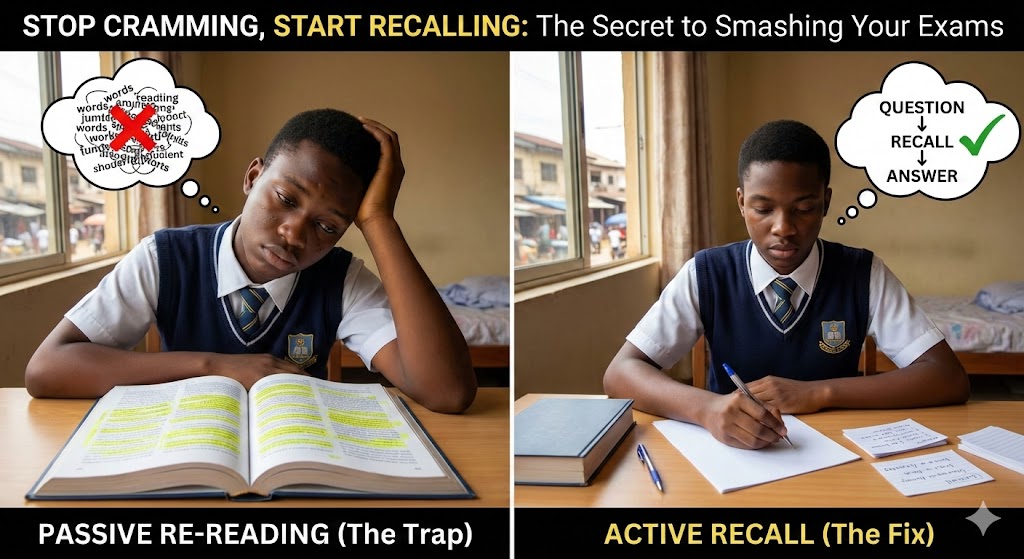
Ever read a textbook for three hours, feel like a genius, and then forget everything the moment you step into the exam hall?
It’s a painful experience. You put in the time. You skipped the party. You sat in the library while others were gisting. Yet, when the results come out, the grades don’t match your effort.
If this sounds like you, stop beating yourself up. You aren’t “dull.” You’re just studying the wrong way.
Most Nigerian students rely on passive review—highlighting lines and reading the same page five times. It feels productive, but it’s actually a waste of time. If you want to smash your WAEC, JAMB, or university semester exams, you need to learn how to use Active Recall instead of just re-reading notes.
The Trap: Why Re-reading Is a Lie
Here is the problem. When you read your notes over and over, your brain recognizes the words. You think, “Oh yeah, I know this.”
But that isn’t knowledge. That is just familiarity.
Imagine watching Messi play football on TV. You watch him dribble every weekend. Does that mean you can go to the pitch and dribble like him? No. Because watching is passive. Playing is active.
Re-reading is just watching the information. Active Recall is playing the match.
What is Active Recall?
Active Recall is simple. It means retrieving information from your brain without looking at the answer.
It’s the difference between reading “The capital of Nigeria is Abuja” (passive) and asking yourself “What is the capital of Nigeria?” and forcing your brain to answer “Abuja” (active).
That tiny struggle? That moment where you frown and try to remember? That is where the actual learning happens.
If you are serious about boosting your grades, this is how to use Active Recall instead of just re-reading notes effectively.
3 Ways to Use Active Recall (The Practical Steps)
You don’t need fancy apps or an iPad. You just need your brain and a piece of paper. Here are the three best methods I’ve seen work for students from Lagos to Kano.
1. The “Blurt” Method (Best for Theory)
This is my personal favorite. It’s brutal, but it works like magic.
-
Step 1: Read a section of your textbook or notebook. Keep it short—maybe one page.
-
Step 2: Close the book. Hide it.
-
Step 3: Take a blank sheet of paper and write down everything you can remember. Scribble diagrams, definitions, dates. Do not peek!
-
Step 4: Open the book and compare.
What did you miss? Did you forget the third law of motion? Did you mix up the dates for the amalgamation of Nigeria?
Pick up a red pen and fill in the gaps. This method exposes exactly what you don’t know. It saves you from that false confidence that leads to exam failure. For more strategies on managing your revision time, check out our guide on how to prepare for an exam in a short time.
2. The Question-Book Method
Stop writing summaries. Summaries are often just copying text from one place to another.
Instead, as you read, write questions for yourself.
If your biology note says: “Mitochondria is the powerhouse of the cell,” don’t write that down. Write: “What is the function of the mitochondria?”
When you revise later, don’t read the notes. Read the questions. Force yourself to answer them before you flip the page to check. This turns your notebook into a quiz.
3. The “Past Question” Hack
In Nigeria, Past Questions (PQ) are gold. But most students use them wrong. They look at the question, look at the answer at the back, and nod.
That’s useless.
To use how to use Active Recall instead of just re-reading notes with PQs, you must simulate the exam environment.
-
Pick a year (e.g., JAMB 2021 Physics).
-
Set a timer.
-
Answer the questions without looking at the answer key.
-
Only check your answers after you are done.
This forces your brain to recall information under pressure. If you are preparing for common entrance, we have resources like common entrance questions for primary six that you can use to practice this method today.
Why This Feels So Hard
Let me be honest with you. Active Recall is hard. It is tiring.
When you just re-read, your brain is relaxing. When you use Active Recall, your brain is sweating. You might get a headache. You might feel frustrated because you can’t remember simple things.
That frustration is good.
According to research from major institutions like Cornell University’s Learning Strategies center, that struggle strengthens the neural pathways in your brain. The harder it is to remember now, the easier it will be to remember in the exam hall.
Common Mistakes to Avoid
Even smart students mess this up. Here are two traps to watch out for:
-
Peeking too soon: You ask yourself a question, struggle for 2 seconds, and then flip the page to see the answer. Don’t do that. Give your brain at least 20-30 seconds to fight for the answer.
-
Only doing it once: Active recall works best with Spaced Repetition. Don’t just recall the topic today and forget it. Test yourself again in 3 days, then in a week. This is one of the 10 effective study habits every student should develop.
Conclusion
Changing your study habit is scary. It feels safer to just sit and read your notes for hours. But “safe” doesn’t get you a First Class or a 300+ in JAMB.
You have to be willing to test yourself. You have to be willing to get things wrong in your room so you can get them right in the exam hall.
So, tonight, close the textbook. Take a blank sheet of paper. And ask yourself: “What did I actually learn today?”
Mastering how to use Active Recall instead of just re-reading notes is the fastest way to turn your grades around.
For more tips on effective learning, you can also read about the benefits of retrieval practice on BBC Bitesize. It’s a game-changer.
Ready to start debating your way to better grades? Check out our latest topics on Debate: Education is Better Than Money.