How to Revise an Entire Semester’s Work in 3 Days
Maybe the ASUU strike made you lazy, maybe you spent too much time on TikTok, or maybe life just happened. Now, the exam timetable is out, the fear is kicking in, and you are staring at a pile of handouts that looks higher than the Eiffel Tower.
You are asking the impossible question: How to revise an entire semester’s work in 3 days?
Ideally, you shouldn’t be in this position. But you are here now. Panicking won’t help you pass MTH 101 or that wicked GST course. I’ve been there, sweating in a hot hostel room with 72 hours to go.
The good news? It is possible to pass. You might not get an ‘A’ in everything, but you can escape a carryover or an F9.
Here is the brutal, no-nonsense guide on how to revise an entire semester’s work in 3 days without crashing.

The Golden Rule: The 80/20 Principle
Before you open a single book, you need to understand one thing: You cannot read everything.
If you try to read every line of your textbook in 3 days, you will fail. Your brain will shut down.
Instead, use the Pareto Principle (80/20 rule). In almost every Nigerian exam—whether WAEC, JAMB, or UNILAG semester exams—80% of the marks come from 20% of the topics.
Your job isn’t to be a professor. Your job is to find that 20%.
Day 1: The “Skeleton” Strategy
Day 1 is about structure. You are building the skeleton of your knowledge.
1. Gather Your Materials Don’t start reading yet. Get your course outline, your lecture notes, and most importantly, your Past Questions (PQ). If you don’t have PQs, go and beg your serious coursemate or buy them at the faculty center.
2. The Traffic Light Method Go through your course outline and mark topics with three colors:
-
Green: Topics you know well (easy wins).
-
Yellow: Topics you have an idea about but need refreshing.
-
Red: Topics you have never heard of in your life.
3. Ignore the “Red” (For Now) This sounds crazy, but trust me. If a topic is extremely complex and you have zero clue about it, spending 5 hours trying to learn it from scratch is a waste of Day 1. Focus on securing the marks for the Green and Yellow topics first.
We actually talk more about prioritizing subjects in our guide on , which is a must-read if you are rushing.
Day 2: The “Meat” & The Past Question Hack
Now that you have the structure, Day 2 is for the heavy lifting. This is where you figure out exactly how to revise an entire semester’s work in 3 days without burning out.
1. The Past Question Reverse-Engineering Most students read their notes, then try the questions. That’s too slow.
Do it backward.
Open the Past Questions for the last 5 years. Look for patterns. Is there a specific theory that comes out every single year? Is there a calculation that always appears in Section B?
Study those topics intensely. If a question has appeared 4 times in 5 years, it is likely to appear again.
2. Use “Chunking” Don’t study for 6 hours straight. You will just be looking at the book while your mind is thinking about food.
Use the Pomodoro technique. Study for 45 minutes, then take a 10-minute break. Walk around. Stretch. This keeps your brain fresh.
3. Focus on Key Concepts, Not Definitions Don’t memorize definitions word-for-word (la cram, la pour) unless you absolutely have to. Understand the concept. If you understand how a market economy works, you can explain it in your own English. Examiners appreciate students who understand, not just robots who vomit text.
For more on building a solid reading routine, check out these .
Day 3: Active Recall & Simulation
It’s the final lap. Today isn’t for learning new things; it’s for making sure the information sticks.
1. Stop Reading, Start Reciting Closing your eyes and reciting what you know is 10x more effective than re-reading. This is called Active Recall.
Can you explain the topic to an imaginary 6-year-old? If you can’t explain it simply, you don’t know it.
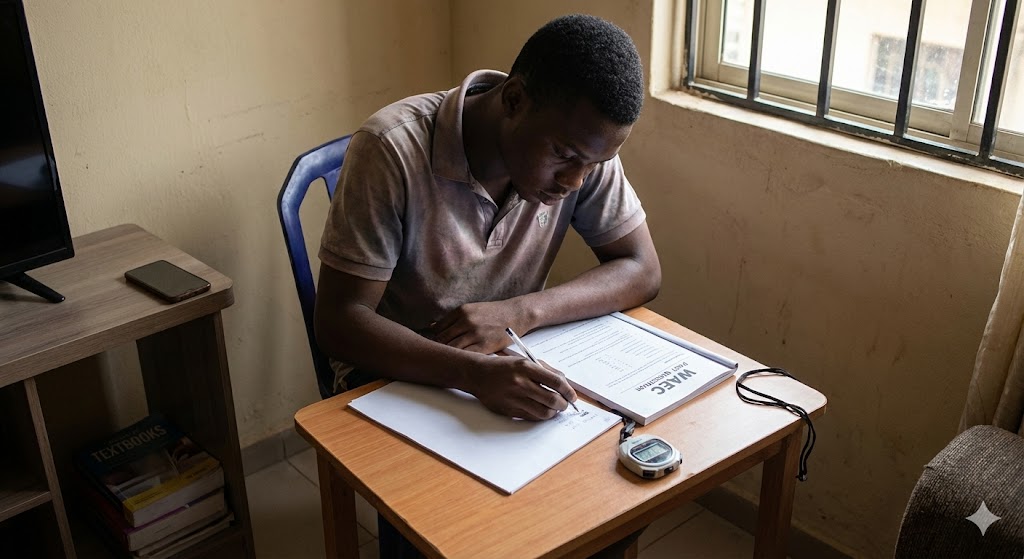
2. The Exam Hall Simulation Sit at your desk. Clear away your notes. Set a timer for 30 minutes and try to answer a past question paper.
This trains your brain to work under pressure. It also shows you exactly what you don’t know, so you can quickly rush back to your notes and fix it.
According to , simulating exam conditions is one of the best ways to reduce anxiety and improve performance.
The “Do Not” List (Please Read This)
I know you are desperate, but some “shortcuts” will actually make you fail.
-
Don’t pull 3 all-nighters: If you don’t sleep, your brain cannot convert short-term memory to long-term memory. You will read all night and forget everything by morning. Sleep at least 5-6 hours.
-
Don’t live on energy drinks: One can is fine. Three cans will make you jittery and crash your focus. Drink water.
-
Don’t panic when you see others: You will see students discussing complex topics at the exam venue entrance. Ignore them. Panic is contagious. Focus on what you know.
Research from the confirms that sleep deprivation significantly lowers academic performance, so don’t cheat your rest.
Conclusion
Learning how to revise an entire semester’s work in 3 days is not ideal. It is stressful, and it requires insane focus.
But you can do it.
Focus on the high-value topics. Use past questions as your map. Keep your cool. You aren’t trying to be the best student in the department right now; you are trying to be the smartest strategist.
Good luck. You’ve got this.