Public Schools Are Better Than Private Schools Debate Points (7 Winning Points)
Looking for the winning points for your next debate? You’ve come to the right place.
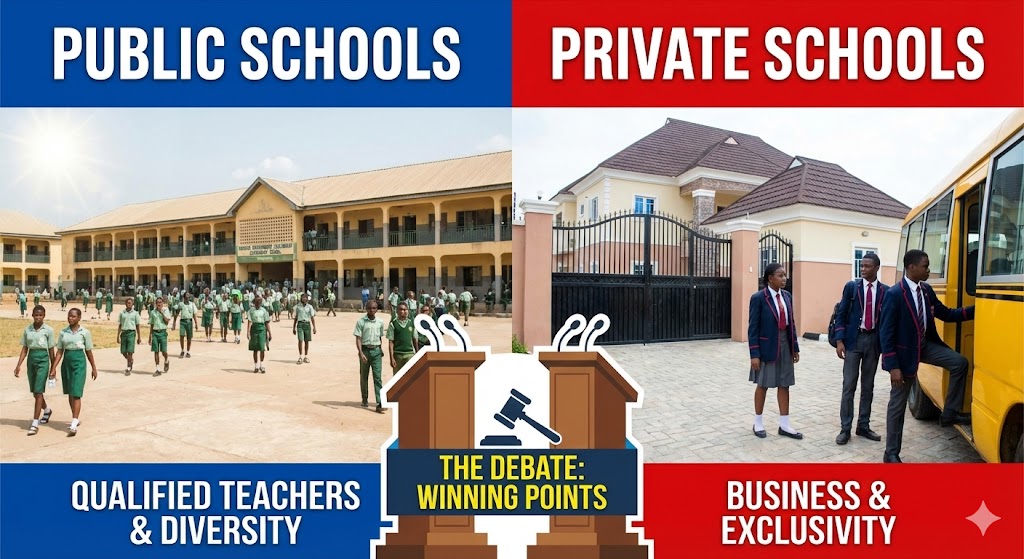
The battle between public and private education is one of the oldest debates in Nigerian schools. If you are supporting the motion that Public Schools are better than Private Schools, you might feel like the underdog. Private schools have the flashy buildings and the fancy buses, right?
But here is the secret: Public schools have the strongest logical arguments.
While private schools are often run as businesses, public schools are the backbone of our society, designed to give every Nigerian child a chance, regardless of their background.
In this post, I’m going to give you the exact “copy-and-paste” script you need to win this debate. These are the points that judges love because they focus on facts, teacher quality, and the true purpose of education.
This article provides debate points for educational purposes only. Both public and private schools play vital roles in our education system. This content is meant to help students structure their arguments effectively.
Winning Debate Points on Why Public Schools Are Better Than Private Schools
1. The “Qualified Teachers” Argument (Certification Matters)
To begin, let’s talk about who is actually teaching us.
In the public school system, there is a strict standard. You cannot just walk in off the street and start teaching. Public school teachers in Nigeria generally possess higher academic qualifications—most have their NCE (Nigeria Certificate in Education), B.Ed, or even Masters degrees. They are professionals.
Now, look at many private schools. I am not talking about the ultra-expensive ones; I mean the average private school on your street. Who are the teachers? often, they are secondary school leavers or uncertified graduates waiting for a “better job.” They are underpaid and often overworked.
Public schools ensure that the people molding our future are actually trained to do so. That is quality control you simply don’t get in many unregulated private academies.
2. Education is a Right, Not a Business
My second point strikes at the heart of the matter. Education should be a right, not a commodity for the highest bidder.
Public schools are funded by the government because their goal is education. Private schools are owned by individuals or corporations because their goal is profit.
Think about it. When a private school owner has to choose between buying new library books or buying a new car for themselves, which one suffers? But in public schools, the focus remains on accessible education for all. By supporting public schools, we are supporting the idea that the son of a nobody can become somebody without his father breaking the bank.
3. The “Real World” Environment (Social Diversity)
Ever feel like private schools are a bubble? That’s because they are.
In a private school, you are surrounded by people exactly like you—same social class, same neighborhood, same background. That is not the real world.
Public schools are the melting pot of society. You sit next to the child of a mechanic, a doctor, a trader, and a civil servant. You learn how to interact with people from all walks of life. This social exposure is critical. It builds street smarts and emotional intelligence.
As we often mention in our guides on how to start a debate, connecting with the audience is key. Well, public schools teach you how to connect with everyone, not just the elite few.
4. Better Job Security Leading to Experience
Let’s be honest about the teachers again. Why do the best teachers eventually try to move to the public sector?
Job security.
Public school teachers have pension schemes, unions (like the NUT), and job stability. This means they stay in the system for 20 or 30 years. They become veterans. They have seen every type of student and know how to handle them.
In contrast, private schools often have a “revolving door.” Teachers come and go every term because the pay is low. How can a student learn effectively if their Maths teacher changes three times in one session? Stability breeds success, and public schools win here hands down.
5. Standardized Curriculum and Regulation
Public schools follow the National Policy on Education strictly. There are no shortcuts. They follow the curriculum set by the Ministry of Education to the letter.
Some private schools often try to “impress” parents by teaching foreign curriculums that have no relevance to the Nigerian context, just to look sophisticated. Or worse, they skip the hard parts of the syllabus to make sure students get “easy A’s” so their parents keep paying fees.
Public schools prepare you for the standard exams—WAEC, NECO, JAMB—without the fluff. They teach you what you need to know, not just what looks good on a brochure.
6. Land Mass and Infrastructure
Okay, I know what the opposition will say. “But private schools have fine paint!”
Paint is not infrastructure. Look at the land. Most public schools sit on acres of land. They have full-sized football pitches, dedicated running tracks, and separate buildings for laboratories.
Now look at the average private school. It is often a converted block of flats or a rented bungalow. Where is the football pitch? It’s a small patch of concrete. Where is the Agriculture farm? It doesn’t exist.
Public schools, especially the older established ones, have the space for true physical education and extracurricular activities. This is crucial for a child’s development, a point we touched on in our article about why students should wear uniforms—discipline and structure require the right environment.
7. Inclusivity (No Child Left Behind)
Finally, public schools do not discriminate.
If a student has a learning disability or special needs, private schools often reject them because they don’t want to “lower their standard” or deal with the extra work. Public schools are mandated by law to accept everyone.
According to bodies like UNESCO, inclusive education is the only way to build a fair society. Public schools are the only institutions doing this work. They don’t pick and choose the “smart” kids just to make their results look good. They take everyone and try to make them better. That is true heroism.
Frequently Asked Questions (FAQs)
Q: What is the strongest argument for the private school side? A: Their strongest point is usually “facilities” or “strike actions.” They will say public schools strike too much. You can counter this by saying that despite strikes, public school students still dominate in university admissions because they learn resilience and independent study habits.
Q: How do I start my speech? A: Don’t be boring! Start with a greeting that grabs attention. You can check out our list of best debate greetings to find a catchy opener.
Q: Are public school teachers really better? A: On paper? Yes. The government requires certification (TRCN) that many private schools simply ignore to save money. A certified teacher is always better than an uncertified one.
Conclusion / Summary
To wrap up, do not let the fancy gates of private schools fool you.
Public schools offer qualified professionals, social reality, educational stability, and true accessibility. They are built to serve the nation, not to make a profit. By choosing public schools, we choose a future where education is a right for all, not a privilege for a few.
This debate guide supports one side of the motion for academic practice. Both school systems have their unique merits and challenges.
What do you think? Drop your opinions in the comments section below… Also, feel free to share this post with your coursemates or those in your team!