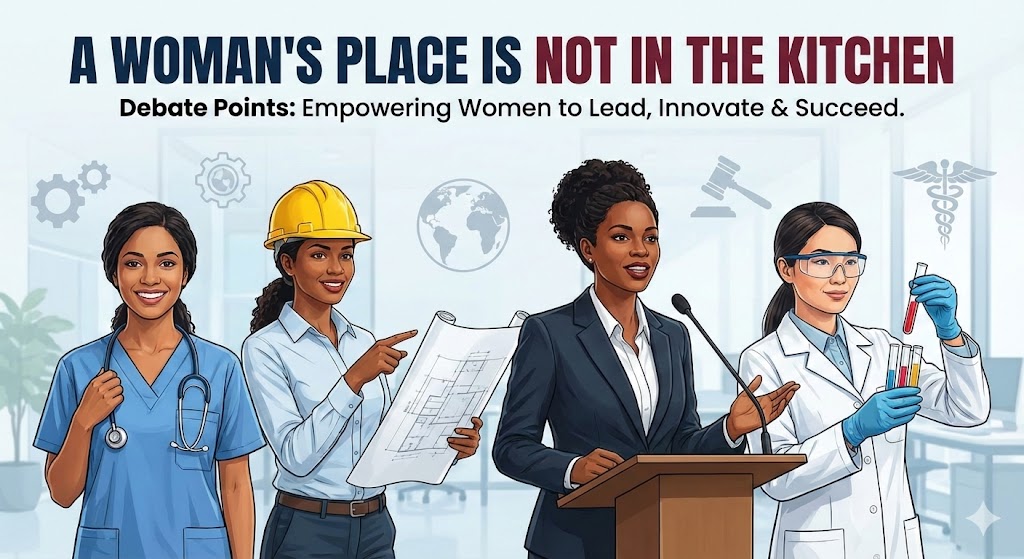
A Woman’s Place Is Not In The Kitchen Debate Points
Good day, Mr. Chairman, Panel of Judges, Timekeeper, co-debaters, and my attentive audience.
Are you preparing for a heated debate session and looking for strong, convincing arguments? You have landed on the right page. Today, I am here to provide you with the solid a woman’s place is not in the kitchen debate points that will help you secure that trophy.
The motion before us is quite interesting: “A Woman’s Place Is Not In The Kitchen.”
First, let’s clear the air. We are not saying cooking is bad. We are not saying women shouldn’t cook if they want to. What we are saying is that a woman’s “place”—her destiny, her limit, and her primary function—should not be defined by the four walls of a kitchen. To say a woman belongs only in the kitchen is to deny her potential to lead, to heal, to build, and to innovate.
This article is designed to provide debate points supporting the motion that women have roles beyond domestic duties. It is for educational and debating purposes and does not seek to undermine the value of homemaking or domestic care.

Winning Debate Points on Why A Woman’s Place Is Not In The Kitchen
If you want to win this, you need to speak with passion. Here are the points that will silence your opponents.
1. Women Are Pillars of National Development
My first point is quite simple: No nation can grow if half of its population is stuck cooking jollof rice all day.
Think about it. Women make up roughly half of the world’s population. If we limit them to the kitchen, we are effectively throwing away 50% of our brainpower, creativity, and leadership potential. Look at grand examples like Dr. Ngozi Okonjo-Iweala. She is the Director-General of the World Trade Organization. Imagine if her father had said, “Ngozi, drop your books and go to the kitchen.” Nigeria—and the world—would have lost a gem.
Women are engineers, pilots, and presidents. Restricting them to the kitchen is not just unfair to them; it is a loss to the entire country.
2. Education Has Changed the Narrative
Let’s be realistic. We are in the 21st century, not the Stone Age. We send the girl child to school, just like the boy child. We pay the same school fees. We buy the same textbooks.
So, why would we spend millions of Naira educating a girl, only to tell her that her degree belongs next to the gas cooker? It doesn’t make sense. As we often argue when discussing if a female child is better than a male child, girls are showing academic excellence everywhere. When a woman is educated, she acquires skills to save lives as a doctor, to defend the innocent as a lawyer, and to teach the next generation. Her place is in the office, the boardroom, the hospital, and the Senate—not just the kitchen.
3. Financial Stability Requires Two Incomes
Let’s talk about money. The economy is tough. Relying on just the man’s income is becoming harder for many Nigerian families.
When a woman works, she brings extra income into the household. She supports the husband and provides a better life for the children. If she is confined to the kitchen, the family loses that financial cushion. As we see in arguments where education is better than money, the value of a learned, working woman goes far beyond cash—it brings stability. A woman who earns can help pay school fees, build a house, and support her extended family. She cannot do that while merely stirring soup.
4. Intellectual Capacity Knows No Gender
Here is a question for my opponents: Does the brain have a gender? No.
Science has shown that women are just as intelligent, capable, and rational as men. There is no “cooking gene” that makes women better suited for the kitchen than men. In fact, many of the world’s best chefs are actually men! If men can excel in the kitchen, and women can excel in the boardroom, then it proves that gender roles are fluid. Limiting a woman to domestic chores is an insult to her God-given intellect.
5. Women in Leadership and Governance
If you look around, women are taking charge in places that matter. They are running successful businesses and leading huge organizations.
According to a report by UN Women, women’s equal participation and leadership in political and public life are essential to achieving the Sustainable Development Goals by 2030. When women lead, they often bring empathy, multitasking skills, and a different perspective that solves problems faster. If you lock that leadership potential in the kitchen, society suffers.
6. It Promotes Gender Equality and Respect
When we say a woman’s place is in the kitchen, we are treating her like a servant rather than a partner.
Marriage and society should be a partnership. A woman is a companion, a helper, and an equal. She is not a piece of kitchen equipment. When a woman is allowed to pursue her career and dreams, she commands more respect from her husband, her children, and society. It balances the power dynamic. Just like the points raised in the debate on whether mothers are better than fathers, we see that women play a complex, multi-faceted role in the home that goes way beyond cooking.
7. Mental Health and Personal Fulfillment
Finally, let’s look at the woman’s happiness. Not every woman finds joy in domestic chores.
Many women have dreams of becoming astronauts, writers, or inventors. Forcing them into a box where they only cook and clean can lead to depression and a lack of fulfillment. A happy woman makes a happy home. And a woman is happiest when she is achieving her dreams, whatever those dreams may be.
Frequently Asked Questions (FAQs)
What is the strongest argument against this motion? The opposition will likely say that the woman is the “keeper of the home” and that if she leaves the kitchen, the family structure will crumble. Your counter is that managing a home does not mean being stuck in the kitchen. You can be a CEO and still manage a happy home.
Can I use these points for a primary school debate? Yes, but simplify them. Focus heavily on the point that “Girls go to school too, so they should work too.” You can check out our list of easy debate topics for primary pupils for more age-appropriate ideas.
How do I start my speech? Start with confidence! Use a strong greeting. You can find some excellent examples in our guide on best debate greetings for students.
Conclusion / Summary
So, what have we established today? We have seen that women are intellectual giants, economic pillars, and national leaders.
To wrap up these a woman’s place is not in the kitchen debate points, remember this: The kitchen is a room in the house. It is not a prison for the female gender. Women belong in the Senate, in the hospitals, in the schools, and anywhere else their dreams take them.
This article supports one side of the debate for educational purposes. We acknowledge the vital role of homemakers and believe that a woman’s choice to be a homemaker should be respected, just as her choice to be a career woman is respected.
What do you think? Do you agree that women should aim for the boardroom and not just the kitchen? Drop your opinions in the comments section below! Also, feel free to share this post with your coursemates or those in your debate team!