The Lekki Headmaster by Kabir Alabi Garba is a contemporary Nigerian literary text that explores education, morality, leadership, and social change within a rapidly modernizing society.
Set against the backdrop of Lekki, one of Lagos’ most affluent and fast-developing areas, the novel contrasts traditional educational values with modern social pressures.
This guide provides a detailed analysis of the major themes and symbolism in The Lekki Headmaster, helping students understand the text better and prepare effectively for literature examinations.
Overview of The Lekki Headmaster
The novel centers on a principled school headmaster who believes strongly in discipline, integrity, and the transformative power of education.
As he navigates the realities of elite schooling in Lekki, he encounters moral compromise, parental pressure, materialism, and societal hypocrisy.
Check out: How to Study for Multiple Choice Questions: The Secret to Acing JAMB and WAEC
Through his experiences, the novel questions what education truly means in a society driven by wealth, status, and shortcuts to success.
Major Themes in The Lekki Headmaster
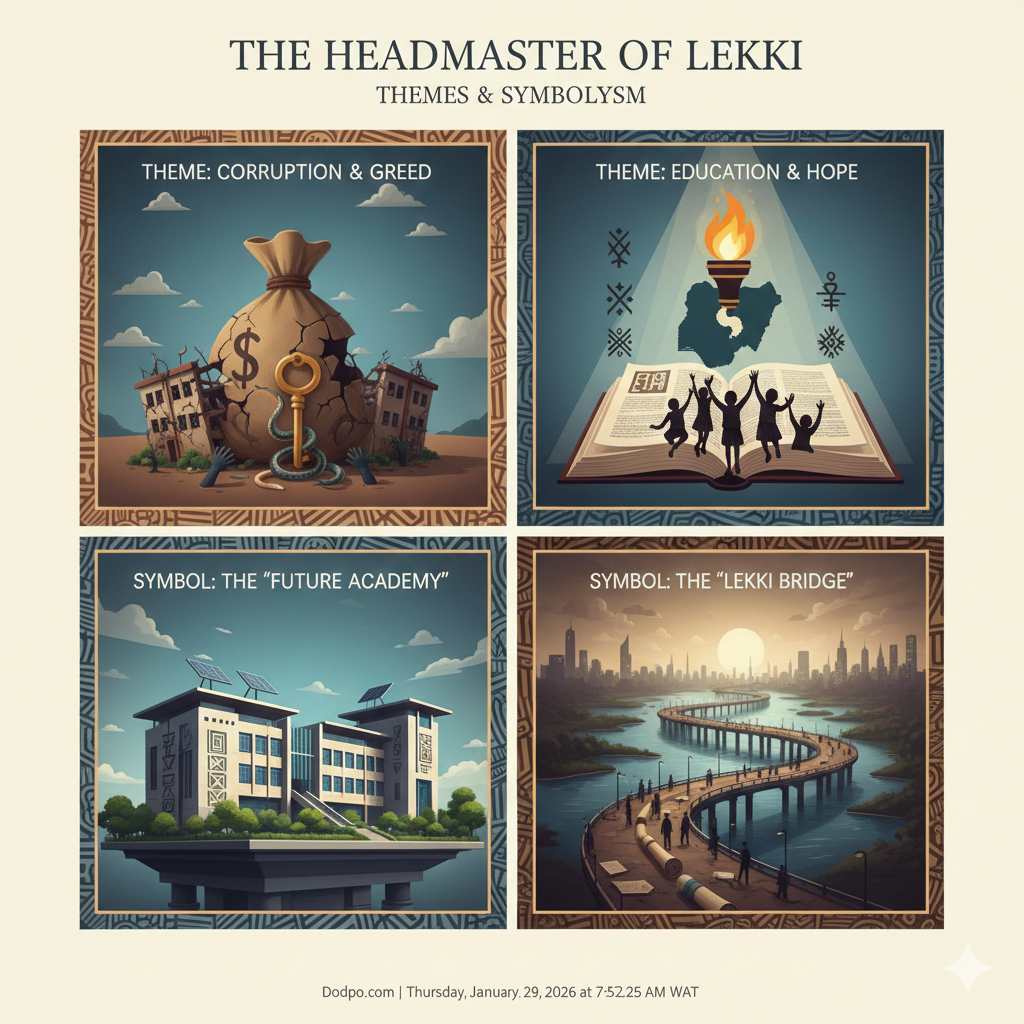
Theme 1: Education as a Tool for Moral Development
One of the strongest themes in The Lekki Headmaster is the idea that education should shape character, not just academic success.
The headmaster believes that:
-
Education should build honesty and discipline
-
Schools should produce responsible citizens
-
Moral values are as important as certificates
The novel criticizes a system where:
-
Examination success is valued above integrity
-
Parents encourage malpractice for good grades
-
Schools compromise standards for profit
This theme reminds readers that true education goes beyond textbooks and exams.
Theme 2: Integrity and Moral Uprightness
The headmaster symbolizes moral discipline in a corrupt environment. Despite pressure from wealthy parents and school owners, he remains firm in his principles.
Integrity is shown through:
-
His refusal to accept bribes
-
His insistence on discipline and fairness
-
His resistance to unethical practices
The novel contrasts his integrity with characters who:
Read more: How to Avoid Daydreaming/Zoning Out in the Library: A Student’s Guide to Staying Focused
-
Abuse power
-
Manipulate the system
-
Sacrifice ethics for comfort
This theme highlights the difficulty of staying honest in a morally compromised society.
Theme 3: Corruption in the Education System
The Lekki Headmaster exposes corruption as a major challenge facing modern education.
Forms of corruption presented include:
-
Examination malpractice
-
Admission manipulation
-
Favoritism toward wealthy students
-
Commercialization of education
The novel suggests that when education becomes a business, standards fall and students suffer. This theme is especially relevant in contemporary Nigerian society.
Theme 4: Wealth, Class, and Social Inequality
Lekki represents affluence and privilege, and the novel uses this setting to explore class differences.
Key ideas include:
-
Wealthy parents using influence to control schools
-
Poorer students being marginalized
-
Respect being tied to money rather than character
The headmaster’s struggles show how power often belongs to those with money, not those with values or competence.
Theme 5: Leadership and Responsibility
The novel presents leadership as service rather than authority.
The headmaster:
-
Leads by example
-
Enforces rules fairly
-
Accepts responsibility for his decisions
In contrast, other leaders in the novel:
-
Abuse power
-
Avoid accountability
-
Prioritize personal gain
This theme teaches that true leadership requires courage, sacrifice, and moral strength.
Theme 6: Tradition versus Modernity
The clash between traditional values and modern lifestyles is another central theme.
Traditional values include:
-
Respect for authority
-
Discipline and order
-
Moral upbringing
Modern influences include:
-
Materialism
-
Moral looseness
-
Obsession with status
The novel does not completely reject modernity but warns against abandoning values in the name of progress.
Read now: How to Apply for Student Loans in Nigeria (NELFUND Guide): The Complete Step-by-Step
Theme 7: Pressure and Compromise
Many characters in the novel face pressure to compromise their values.
Sources of pressure include:
-
Parents demanding special treatment
-
School owners prioritizing profit
-
Society rewarding unethical success
The headmaster’s refusal to compromise highlights the cost of integrity and the loneliness that often comes with doing the right thing.
Symbolism in The Lekki Headmaster
Symbolism plays a major role in deepening the novel’s message. Garba uses people, places, and actions to represent broader ideas.
Symbol 1: The Headmaster
The headmaster symbolizes:
-
Moral discipline
-
Ethical leadership
-
The ideal educator
He represents what education should stand for in society. His struggles reflect the challenges faced by honest individuals in corrupt systems.
Symbol 2: Lekki as a Setting
Lekki symbolizes:
-
Wealth and privilege
-
Modern Nigerian society
-
Social inequality
The choice of Lekki highlights the contrast between material success and moral decay. It shows how prosperity does not always produce ethical behavior.
Symbol 3: The School
The school represents:
-
Society in miniature
-
The future of the nation
-
A battleground between values and corruption
What happens in the school reflects what happens in the wider society. When standards fall in schools, society suffers.
Symbol 4: Examination Malpractice
Examination malpractice symbolizes:
-
Moral decay
-
Shortcuts to success
-
The failure of ethical upbringing
It reflects a society where results matter more than the process, and where dishonesty is normalized.
Symbol 5: Wealthy Parents
Wealthy parents in the novel symbolize:
-
Abuse of power
-
Entitlement
-
Social imbalance
They represent a class that believes money can buy everything, including integrity and fairness.
Symbol 6: Rules and Discipline
Rules in the novel symbolize:
-
Order and justice
-
Moral boundaries
-
Stability in society
The headmaster’s insistence on rules emphasizes the importance of structure in education and life.
How Themes and Symbolism Work Together
The themes and symbols in The Lekki Headmaster reinforce each other.
For example:
-
Lekki (symbol) strengthens the theme of wealth and inequality
-
The headmaster (symbol) reinforces integrity and leadership
-
The school (symbol) deepens the theme of education and morality
Together, they create a powerful critique of modern society and its values.
Examination Relevance of Themes and Symbolism
Understanding themes and symbolism is essential for success in literature exams.
Students should be able to:
-
Identify major themes
-
Explain symbols and their meanings
-
Use examples from the text
-
Link themes to real-life situations
These skills are tested in:
-
WAEC
-
NECO
-
JAMB
-
School examinations
Key Lessons from The Lekki Headmaster
Read also: A Woman’s Place Is Not In The Kitchen Debate Points (7 Winning Arguments)
The novel teaches readers that:
-
Integrity is costly but necessary
-
Education should shape character
-
Wealth does not equal morality
-
Leadership demands sacrifice
-
Society’s future depends on its schools
Conclusion
The Lekki Headmaster is more than a school novel; it is a mirror of modern society. Through powerful themes and rich symbolism, Kabir Alabi Garba exposes the moral struggles within education and challenges readers to rethink their values.
By understanding the themes and symbolism in The Lekki Headmaster, students gain deeper insight into the text and develop critical thinking skills essential for examinations and real life.