Here’s How to choose a trade subject in Senior Secondary School
Choosing a trade subject in Senior Secondary School (SSS) is one of the most important academic and career decisions a student will make.
Trade subjects are practical, skill-based courses designed to prepare students for employment, entrepreneurship, technical careers, or further vocational education after secondary school.
For students, parents, teachers, and guidance counselors, understanding how to choose the right trade subject can make the difference between a fulfilling future career and years of confusion.
This comprehensive guide explains everything you need to know—step by step—in clear, simple English.
What Is a Trade Subject in Senior Secondary School?
A trade subject is a vocational or technical subject offered at the senior secondary level that focuses on practical skills rather than purely academic theory.
Examples of Trade Subjects in SSS
-
Catering Craft Practice
-
Fashion Design and Clothing Construction
-
Data Processing
-
Auto Mechanics
-
Electrical Installation
-
Plumbing and Pipe Fitting
-
Carpentry and Joinery
-
Cosmetology / Beauty Care
-
Welding and Fabrication
-
Animal Husbandry
-
Photography
These subjects are designed to help students:
Check out: How to Use the Cornell Method to Take Better Lecture Notes (A Guide for Nigerian Students)
-
Learn hands-on skills
-
Become self-reliant
-
Prepare for technical careers or entrepreneurship
Why Choosing the Right Trade Subject Matters
The trade subject a student chooses can influence:
-
Career direction after secondary school
-
Admission opportunities into polytechnics and colleges
-
Ability to start a business early in life
-
Confidence, motivation, and academic performance
Choosing wrongly can lead to:
-
Loss of interest in school
-
Poor academic results
-
Wasted time and resources
That is why careful consideration is essential.
Key Factors to Consider When Choosing a Trade Subject
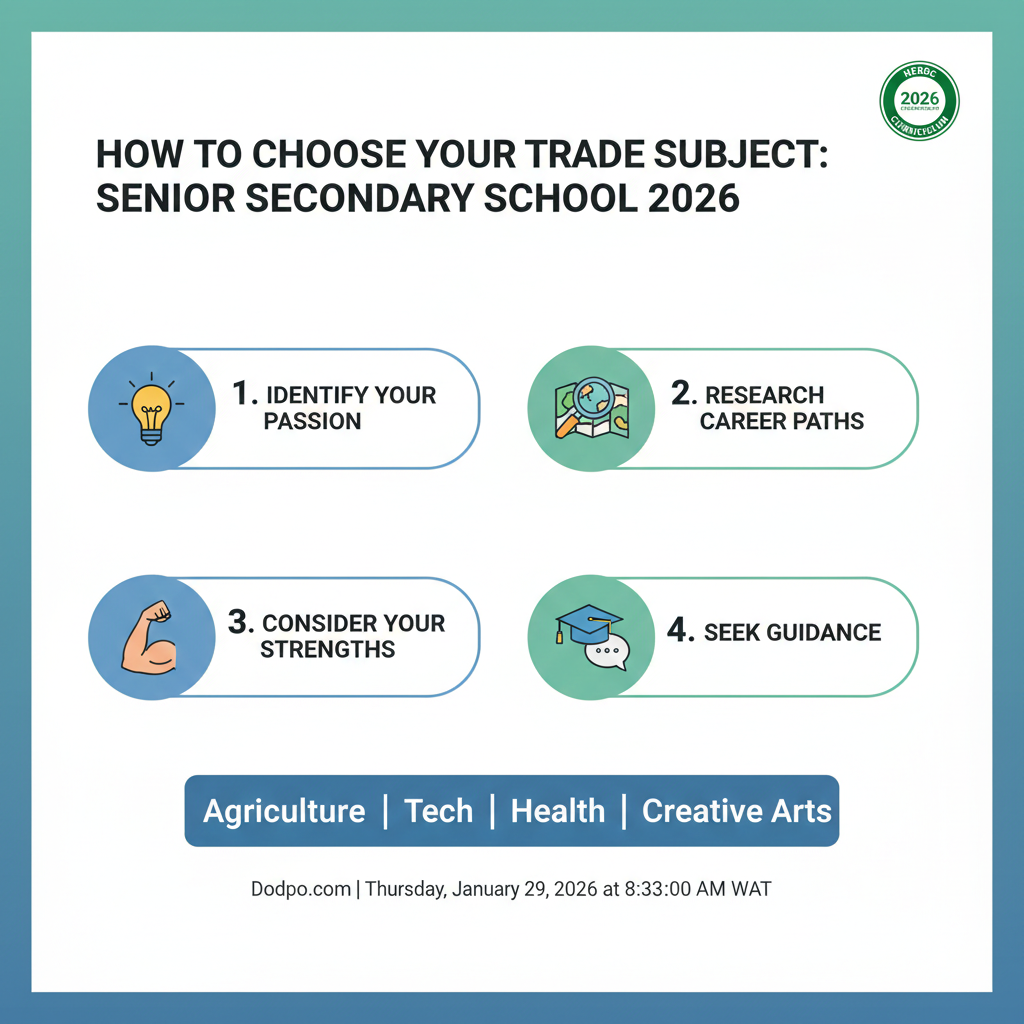
1. Identify the Student’s Interest and Passion
Interest is one of the most important factors when choosing a trade subject.
Students should ask themselves:
-
What activities do I enjoy doing naturally?
-
Do I prefer working with my hands or with computers?
-
Do I enjoy creating, repairing, designing, or organizing things?
Examples
-
A student who enjoys styling hair may excel in Cosmetology
-
A student who likes fixing gadgets may do well in Electrical Installation
-
A student who loves cooking may prefer Catering Craft Practice
When interest is present, learning becomes easier and more enjoyable.
2. Assess Natural Skills and Abilities
Every student has unique strengths.
Consider:
-
Physical skills (hand coordination, strength, precision)
-
Creativity and design ability
-
Problem-solving skills
-
Technical thinking
Skill-Based Matching
See also: How to Use the Pomodoro Technique to Smash Your WAEC and JAMB Exams
-
Good with measurements and tools → Carpentry, Plumbing
-
Creative and artistic → Fashion Design, Photography
-
Detail-oriented → Data Processing, Electronics
Choosing a trade subject that aligns with natural ability increases the chances of success.
3. Consider Future Career Goals
Trade subjects should align with what the student hopes to do after secondary school.
Ask questions such as:
-
Do I want to work immediately after school?
-
Do I plan to attend a polytechnic or technical college?
-
Do I want to start my own business?
Career-Oriented Examples
-
Auto Mechanics → Vehicle repair business or technical training
-
Fashion Design → Tailoring, fashion entrepreneurship
-
Electrical Installation → Industrial or residential electrical work
A trade subject should support long-term goals, not limit them.
4. Understand Admission and Examination Requirements
Some trade subjects are relevant for:
-
WAEC and NECO certification
-
Admission into polytechnics and technical colleges
-
Professional vocational training
Students should check:
-
WAEC syllabus requirements
-
Subjects required for further education
-
Practical examination expectations
Choosing a trade subject that supports future academic plans is very important.
5. Availability of Facilities and Qualified Teachers
Not all schools are equally equipped to teach every trade subject effectively.
Before choosing, confirm:
-
Availability of workshops or laboratories
-
Adequate tools and equipment
-
Qualified and experienced teachers
A trade subject without proper facilities may limit skill development.
6. Consider Market Demand and Employability
Some trade skills are more in demand than others.
Highly demanded trade skills include:
-
Electrical Installation
-
Plumbing
-
Fashion Design
-
Catering and Baking
-
Data Processing
-
Auto Mechanics
Students should consider skills that are:
-
Needed in their community
-
In demand locally and nationally
-
Able to generate income
7. Health and Physical Considerations
Some trade subjects are physically demanding.
Students should consider:
-
Physical strength and stamina
-
Allergies or health conditions
-
Ability to work long hours
For example:
-
Welding may not suit students with respiratory issues
-
Catering requires long periods of standing
-
Carpentry requires physical effort
Health should never be ignored when choosing a trade subject.
Role of Parents in Choosing a Trade Subject
Read also: How to Apply for Student Loans in Nigeria (NELFUND Guide): The Complete Step-by-Step
Parents play a vital role in guiding students.
What Parents Should Do
-
Encourage, not force, career choices
-
Observe the child’s interests and talents
-
Avoid imposing personal ambitions
-
Support practical and vocational careers
Trade subjects are no longer “last options.” They are powerful career pathways.
Role of Guidance Counselors and Teachers
Guidance counselors should:
-
Provide career guidance sessions
-
Explain subject requirements clearly
-
Assess student strengths and interests
-
Expose students to career options
Teachers should:
-
Identify student abilities early
-
Encourage skill development
-
Provide honest academic feedback
Common Mistakes to Avoid When Choosing a Trade Subject
Many students make avoidable mistakes.
Mistakes Include
-
Choosing based on peer pressure
-
Selecting a subject because it sounds easy
-
Ignoring personal interest
-
Choosing without understanding career prospects
-
Allowing parents or friends to decide entirely
Avoiding these mistakes leads to better outcomes.
Benefits of Studying Trade Subjects in Senior Secondary School
Trade subjects offer numerous advantages.
Key Benefits
-
Early skill acquisition
-
Self-employment opportunities
-
Reduced unemployment
-
Practical life skills
-
Financial independence
-
Confidence and creativity
Trade education prepares students for the real world.
Trade Subjects and Entrepreneurship
One major advantage of trade subjects is entrepreneurship.
Students can:
-
Start small businesses after graduation
-
Work as apprentices or freelancers
-
Combine trade skills with further education
Examples:
-
Fashion students can start tailoring businesses
-
Catering students can run food services
-
Electrical students can offer installation services
Trade subjects empower students economically.
How Students Can Test Their Trade Interest Early
Before finalizing a trade subject, students can:
-
Participate in school practical sessions
-
Observe professionals at work
-
Take short vocational courses
-
Volunteer or assist in workshops
Early exposure helps confirm interest.
Final Checklist Before Choosing a Trade Subject
Students should ask themselves:
-
Do I enjoy this trade?
-
Am I good at related skills?
-
Does my school have proper facilities?
-
Can this trade support my future goals?
-
Is there demand for this skill?
If most answers are “yes,” the choice is likely right.
Check out: How to Apply for NYSC Relocation: The Complete “No Stress Guide for PCMs
Conclusion
Choosing a trade subject in Senior Secondary School is a life-shaping decision that requires careful thought, guidance, and self-awareness.
By considering interest, ability, career goals, facilities, market demand, and health factors, students can make informed and rewarding choices.
Trade subjects are not inferior to academic subjects, they are practical pathways to success, independence, and fulfillment. When chosen wisely, they equip students with skills that last a lifetime.