Here is a complete guide on Requirements for Data Processing trade subject in WAEC.
Data Processing is one of the most practical and career-oriented trade subjects approved by WAEC. As technology continues to shape education, business, and everyday life, Data Processing has become an important subject for students who want to develop ICT, computer, and digital skills early.
This guide explains everything you need to know about the requirements for Data Processing as a WAEC trade subject, including eligibility, subject content, facilities, equipment, assessment structure, and career opportunities.
If you are planning to register for WAEC Data Processing or set it up in a school, this article provides a complete roadmap.
What Is Data Processing as a WAEC Trade Subject?
Data Processing is a vocational and technical subject that teaches students how to collect, process, store, retrieve, and present data using computers. It focuses on both theoretical knowledge and practical computer skills.
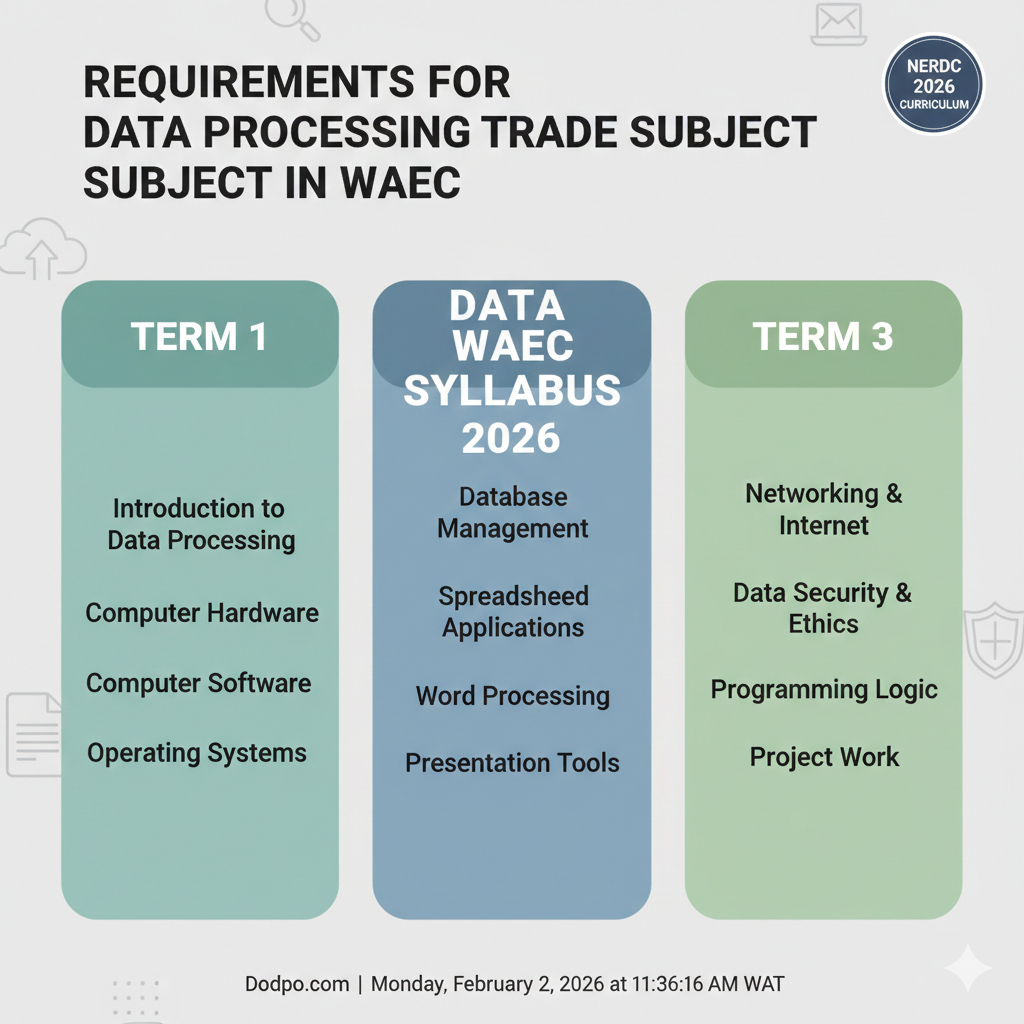
WAEC includes Data Processing under Trade Subjects, meaning it is designed to:
-
Prepare students for employment
-
Build practical ICT competence
-
Support entrepreneurship and self-reliance
-
Serve as a foundation for further studies in technology-related fields
Who Can Offer Data Processing in WAEC?
Check out: How to Use the Cornell Method to Take Better Lecture Notes (A Guide for Nigerian Students)
Data Processing is suitable for:
-
Senior Secondary School students (SS1–SS3)
-
Students in Technical Colleges
-
Students interested in ICT, business, or technology careers
Eligibility Requirements for Students
To register for Data Processing in WAEC, a student must:
-
Be officially enrolled in a recognized secondary school
-
Be registered for WAEC SSCE (School or Private)
-
Have basic computer literacy (recommended but not compulsory)
-
Be willing to participate in practical computer sessions
No specific science background is required, making Data Processing suitable for Arts, Commercial, and Science students.
WAEC Subject Combination for Data Processing
Data Processing can be combined with subjects such as:
-
Mathematics
-
English Language
-
Economics
-
Commerce
-
Financial Accounting
-
Civic Education
-
Office Practice
-
Physics
-
Computer Studies
This flexibility makes it a good choice for students across different academic streams.
WAEC Syllabus Requirements for Data Processing
The WAEC Data Processing syllabus is divided into theory and practical components. Students must understand both to succeed in the examination.
Core Topics in the WAEC Data Processing Syllabus
1. Introduction to Data Processing
Students learn:
-
Meaning of data and information
-
Data processing cycle
-
Types of data
-
Methods of data processing
2. Computer System Fundamentals
Read now: How to Use Spaced Repetition So You Never Forget What You Read (The Secret to Acing WAEC & JAMB)
This includes:
-
Components of a computer system
-
Hardware and software
-
Input, processing, storage, and output devices
-
System units and peripherals
3. Operating Systems
Topics covered include:
-
Meaning and functions of operating systems
-
Types of operating systems
-
File management
-
Booting and shutdown procedures
4. Word Processing
Students are expected to:
-
Create and edit documents
-
Format text and pages
-
Use tables and images
-
Save and print documents
5. Spreadsheet Processing
This section focuses on:
-
Creating worksheets
-
Using formulas and functions
-
Sorting and filtering data
-
Creating charts and graphs
6. Database Management
Students learn:
-
Meaning of databases
-
Creating and managing databases
-
Data entry and retrieval
-
Simple queries and reports
7. Data Communication and Networking
This includes:
-
Types of networks
-
Internet services
-
Email and online communication
-
Basic networking devices
8. Computer Ethics and Safety
Topics include:
-
Ethical use of computers
-
Cybercrime awareness
-
Health and safety precautions
-
Data security and privacy
Practical Requirements for Data Processing in WAEC
See also: How to Apply for Student Loans in Nigeria (NELFUND Guide): The Complete Step-by-Step
Data Processing is a practical-oriented subject, and WAEC places strong emphasis on hands-on skills.
Minimum Practical Requirements
Schools offering Data Processing must provide:
-
Functional computer systems (desktop or laptop)
-
A computer laboratory
-
Stable power supply or backup power
-
Basic computer accessories (keyboard, mouse, printer)
Recommended Software
WAEC expects students to be familiar with:
-
Word processing software
-
Spreadsheet software
-
Database software
-
Basic operating system tools
These may include commonly used office productivity applications.
WAEC Examination Structure for Data Processing
Paper 1: Objective Test
-
Multiple-choice questions
-
Covers theory and basic practical knowledge
-
Tests understanding of concepts and definitions
Paper 2: Essay and Practical
This paper is divided into two sections:
-
Theory Section: Short and long essay questions
-
Practical Section: Hands-on computer tasks such as document creation, spreadsheet calculations, or data entry
Students must pass both sections to perform well overall.
Skills Students Gain from Data Processing
Offering Data Processing in WAEC equips students with valuable life and career skills, including:
-
Computer literacy
-
Data handling and analysis
-
Digital communication
-
Problem-solving skills
-
Attention to detail
-
Technological confidence
Career Opportunities After Studying Data Processing
Students who study Data Processing can pursue careers such as:
-
Data entry clerk
-
Computer operator
-
Office assistant
-
ICT support staff
-
Administrative officer
-
Entrepreneur in digital services
It also provides a solid foundation for further studies in:
-
Computer Science
-
Information Technology
-
Data Science
-
Business Administration
-
Office Technology Management
Benefits of Choosing Data Processing as a Trade Subject
Read more: How to Apply for NYSC Relocation: The Complete “No Stress” Guide for PCMs
1. High Practical Value
Students gain real-world computer skills applicable in offices and businesses.
2. Employment Readiness
The subject prepares students for immediate employment after secondary school.
3. Entrepreneurial Advantage
Students can offer services such as typing, printing, data entry, and basic computer training.
4. Alignment with Digital Economy
Data Processing supports Nigeria’s growing digital and technology-driven economy.
Common Challenges in Offering Data Processing and Solutions
Challenge: Lack of Computers
Solution: Shared systems and practical rotations
Challenge: Power Supply Issues
Solution: Generators or alternative power sources
Challenge: Limited Qualified Teachers
Solution: Teacher training and ICT workshops
Tips for Students Preparing for WAEC Data Processing
-
Practice regularly on a computer
-
Study both theory and practical topics
-
Learn basic keyboard shortcuts
-
Understand WAEC past questions
-
Pay attention during practical classes
Tips for Schools Offering Data Processing
-
Equip a functional computer lab
-
Employ trained ICT teachers
-
Follow the WAEC syllabus strictly
-
Conduct regular practical assessments
Conclusion
Data Processing is one of the most relevant and future-focused WAEC trade subjects. Its requirements go beyond textbooks, emphasizing practical skills, digital literacy, and career readiness.
Students who meet the academic and practical requirements stand a strong chance of success in WAEC and beyond.
By offering Data Processing, schools empower students with skills that are valuable in higher education, employment, and entrepreneurship. For students, choosing Data Processing is a smart step toward thriving in a technology-driven world.