Debate guide — Opposition side | Nigerian primary and secondary schools
Motion: Parents Are to Blame for the Misconduct of Their Children | Against the Motion
Introduction: A More Complete Picture of Why Children Misbehave
When a child misbehaves — when a teenager skips school, joins a gang, becomes violent, or develops dishonest habits — the easiest and most reflexive response in Nigerian society is to point the finger at the parents. “Where were their parents?” is a phrase you hear constantly. It is understandable. Parents are the most visible figures in a child’s early life, and it is natural to hold them accountable when things go wrong.
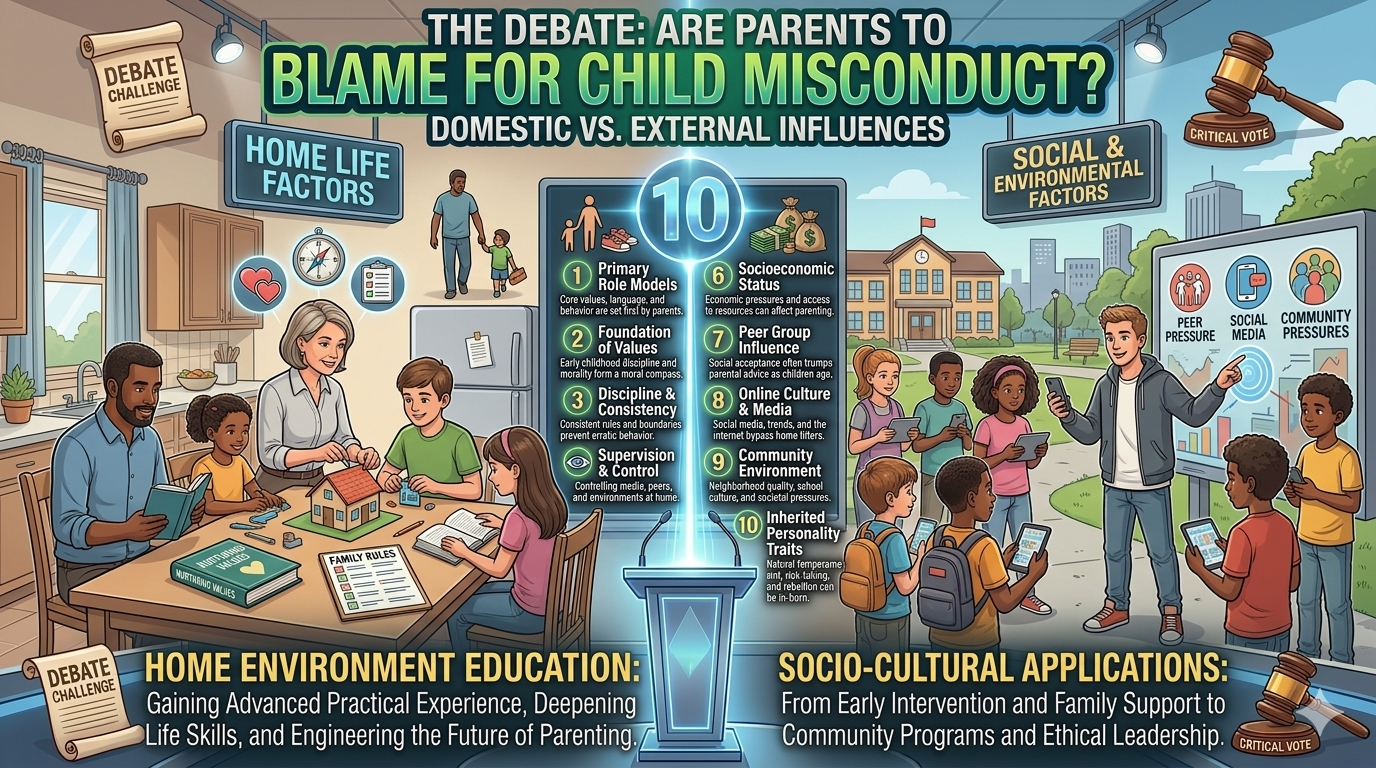
But is it accurate? Is it fair? And more importantly — is it useful? If we place all the blame for children’s misconduct on parents alone, we ignore the powerful and well-documented roles played by schools, communities, peer groups, economic conditions, social media, government policy, and the child’s own developing character.
We produce a simple answer to a complex problem. And simple answers to complex problems rarely lead to real solutions.
The opposition in this debate does not argue that parents play no role — they clearly do, and a significant one. What we argue is that the motion as stated — “parents are TO BLAME” is an oversimplification that ignores the many other forces that shape a child’s conduct.
Placing blame exclusively or primarily on parents is not only unfair to the millions of Nigerian parents who are doing their best in extremely difficult circumstances. It is also intellectually dishonest, because the evidence shows clearly that child development is the product of many influences, not one.
Parents Are NOT Solely to Blame for the Misconduct of Their Children
This guide equips you to argue the opposition side confidently and effectively. You have five strong arguments, a complete sample speech, strategies for countering the proposition’s best points, and practical tips for performing well in competition. As always understand the arguments rather than just memorising them, and speak from genuine conviction.
IMPORTANT: Arguing the opposition side does not mean you believe parents bear zero responsibility for their children. It means you are arguing that the motion is an oversimplification — that blame cannot and should not rest exclusively or primarily with parents when so many other powerful forces contribute to children’s conduct.
Point 1: Peer Influence Is Often More Powerful Than Parental Influence in Adolescence
Child development research consistently shows that as children move into adolescence — the years between roughly ten and eighteen — peer influence increasingly rivals and in many contexts surpasses parental influence over behaviour and values. This is not a failure of parenting. It is a normal, predictable, and universal feature of adolescent development.
The drive to belong to a peer group, to be accepted by age-mates, and to conform to social norms within that group is one of the most powerful motivational forces in human psychology during the teenage years.
In Nigerian schools and communities, this peer influence dynamic plays out every day. A child raised in a home with strong values, consistent discipline, and loving parental guidance can still fall into serious misconduct if they become deeply embedded in a peer group that normalises and rewards that misconduct.
The strength of the peer group’s influence is not determined solely by the parents — it is determined by the environment in which the child finds themselves, the options available to them for social connection, and the alternatives on offer.
Consider the situation of a well-raised child from a stable Lagos home who gains admission to a secondary school where a culture of bullying, drug use, and truancy is normalised among the most socially dominant students. The pressure on that child to conform to be accepted, to avoid being targeted — is enormous.
Many children with genuinely good parental foundations struggle and sometimes fail against that pressure. When they do, blaming the parents ignores the powerful institutional and social environment that overwhelmed the child’s home training.
Parents cannot be physically present with their children at every moment of the school day, in every social interaction, and in every peer exchange. The proposition asks parents to be held responsible for influences they cannot directly control. That is neither reasonable nor fair.
DEBATE LINE: “The parent can plant good seeds in the morning. But if the field the child walks through every day is full of thorns — hostile peer groups, dangerous school environments, negative community norms — the seeds planted at home will struggle to survive. We cannot blame the farmer alone for a harvest destroyed by the field.”
Point 2: Schools and Educational Institutions Share Significant Responsibility
Nigerian children spend a minimum of six hours a day, five days a week, nine months of the year in school. Over the course of their primary and secondary education, they will spend more waking hours in an educational institution than they spend in any other environment outside their home.
Read now: How to Cram for an Exam in 24 Hours: The “Emergency” Guide to Passing (Without Fainting)
What happens in those institutions the culture, the discipline systems, the values modelled by teachers and administrators, the quality of guidance and mentorship provided profoundly shapes children’s conduct.
Schools are not passive containers where children simply wait until it is time to go home. They are dynamic social environments with their own cultures, power structures, norms, and influence hierarchies. A school with strong pastoral care, consistent and fair discipline, dedicated teachers who build genuine relationships with students, and a culture of accountability produces better-behaved students.
A school where bullying is overlooked, where teachers model disrespect, where discipline is inconsistent and arbitrary, and where students feel unseen and unsupported produces conduct problems regardless of how good the parenting at home is.
Furthermore, teachers are trained professionals whose specific responsibility includes the social and moral development of the children in their care not just academic instruction.
When schools fail to fulfil this responsibility, when they allow misconduct to go unchecked within their walls, when they focus exclusively on examination results and ignore the holistic development of students, they contribute directly to the conduct problems they later complain about.
It is inconsistent to hold parents fully accountable for behaviour that occurs primarily within an institution that the parents did not design and cannot enter during school hours.
DEBATE LINE: “A child spends thousands of hours in school, under the care of professional educators trained specifically to shape conduct and character. When misconduct occurs in that environment, we cannot pretend that those thousands of hours of institutional influence are irrelevant and place all the blame on the home. Schools are co-educators of character, and they bear co-responsibility for its failures.”
Point 3: Poverty, Economic Inequality, and Social Deprivation Are Root Causes of Misconduct
To understand why children misbehave in Nigeria, you cannot separate the question from the economic and social context in which millions of Nigerian families live. Nigeria has a youth population of over 70 million people, and a significant percentage of them live in conditions of poverty that fundamentally constrain the options available to both parents and children.
Parents who work twelve to fourteen hours a day in physically demanding and poorly paid labour to keep their families fed cannot simultaneously provide the kind of intensive, engaged, present parenting that the proposition seems to expect. This is not negligence. This is survival.
The relationship between poverty and juvenile misconduct is one of the best-established findings in social science. Children growing up in communities with high unemployment, poor housing, inadequate sanitation, limited access to quality education, and restricted economic opportunity face environmental pressures that produce conduct problems at rates dramatically higher than those seen in more affluent communities. These pressures not inadequate parenting are the root cause of much of the misconduct we observe.
A child who is hungry, who lives in overcrowded and stressful housing, who attends an underfunded school with overcrowded classrooms and demotivated teachers, who sees no clear pathway to a legitimate and dignified adult life, who is surrounded by older community members whose only visible success came through illegal activity that child faces a set of structural pressures that would challenge the most dedicated parents in the world.
Blaming those parents for the child’s misconduct without acknowledging the structural conditions that surrounded both parent and child is not justice. It is scapegoating.
DEBATE LINE: “We cannot ask parents alone to bear the weight of a problem that has structural, economic, and institutional roots. When poverty forces a parent to choose between supervision and survival, they should not be blamed for the consequences of that impossible choice. The society that created the poverty bears a share of the blame.”
Point 4: Social Media, Technology, and Modern Culture Expose Children to Influences Beyond Parental Control
The world in which Nigerian children are growing up today is fundamentally different from the world in which their parents were raised. The internet, social media platforms, smartphone access, streaming entertainment, and the global reach of cultural content have created an information environment of staggering breadth and complexity that no previous generation of parents has had to navigate. And in that environment, a parent’s ability to control what their child is exposed to, what values are being transmitted to them, and what behaviours are being normalised and glamorised has been dramatically reduced.
Check out: How to Register for NYSC Mobilization: The Complete Guide for Fresh Graduates
A teenager with an Android phone and a data subscription has access to an essentially unlimited universe of content — including content that glorifies violence, promotes drug use, models disrespect for authority, normalises sexual misconduct, and celebrates criminal lifestyle as aspirational.
This content is available at any hour, in any location, and beyond the reach of any parent who is not physically monitoring their child’s device at every moment. Attempts by parents to restrict access are routinely circumvented by tech-savvy young people. The platforms themselves are designed to be maximally engaging, to override self-regulation, and to keep users — including children and teenagers — on them for as long as possible.
The misconduct that results from these exposures children adopting the aggressive language of rap and hip-hop culture, teenagers mimicking the violent behaviour they see glorified in videos, young people adopting values transmitted through social media that directly conflict with what their parents have taught them at home cannot reasonably be laid entirely at the parents’ feet.
These are global forces, designed by technology companies and content creators with enormous resources and sophisticated algorithms. A Nigerian parent doing their honest best cannot compete alone against these forces. Blaming them when their child is influenced by these powerful external systems is profoundly unjust.
DEBATE LINE: “Parents cannot sit beside their child at every moment and filter every piece of content that reaches them through the internet. When billion-dollar technology companies and global entertainment industries pour resources into capturing the attention and shaping the values of Nigerian children, we cannot blame the parent in a small flat in Mushin for failing to counteract all of that influence single-handedly.”
Point 5: Every Child Has Individual Moral Agency and Personal Responsibility
At some point in the development of any human being, the capacity for personal moral responsibility emerges. Children are not passive recipients of their environment they are active agents who observe, choose, reflect, and decide. Even within the same household, with the same parents providing the same guidance and the same example, different children develop different characters and make different choices.
The child who turns out well and the child who misbehaves may have grown up in the same home, attended the same school, and been raised under the same conditions. Their different outcomes cannot be explained entirely by their parenting.
Every child, as they grow, develops an internal moral compass — a sense of right and wrong that is influenced by many sources, including but not limited to their parents. By the time most children reach secondary school age, they have the capacity to understand the difference between right and wrong, to reflect on their choices before making them, and to choose better behaviour even under social pressure.
When a fifteen-year-old steals from a classmate, beats a younger student, or deliberately disrupts a classroom, they are not simply acting out the programming installed by their parents. They are making a choice a wrong choice, but their choice.
Holding parents entirely responsible for the choices their children make denies the child’s own moral agency. And ironically, denying children’s moral agency is not good for children. It removes from them the accountability that is itself a tool for character development.
Children who are never held personally responsible for their behaviour who learn that any misconduct will be attributed to their parents do not develop the internal moral discipline that leads to genuinely good character. Recognising the child’s own responsibility is not harsh. It is the foundation of genuine moral formation.
DEBATE LINE: “If parents are entirely to blame for their children’s conduct, then the child bears no responsibility. But a child who bears no responsibility for their own behaviour never develops a conscience. Assigning the child’s own moral agency entirely to the parent does not protect the child — it disables them. True accountability must include the child as a moral actor in their own right.”
Check out: How to Use the Pomodoro Technique to Smash Your WAEC and JAMB Exams
Sample Opposition Speech — Adapt This for Your Debate
Here is a complete opposition speech you can study, understand, and then rewrite in your own voice. The goal is not to memorise this word-for-word but to absorb its structure and arguments so you can deliver them naturally.
“Distinguished judges, honourable proposition, and all present — I rise to oppose this motion: that parents are to blame for the misconduct of their children.
Let me say this clearly at the outset: parents matter enormously. The home is the child’s first environment of moral learning, and what happens there is critically important. No responsible person disputes that. What we dispute is the word in this motion that makes it wrong. That word is ‘blamed.’
To blame parents — to place the responsibility for a child’s misconduct squarely, primarily, and almost exclusively on the parents — is to ignore the village. And we Nigerians know the proverb: it takes a village to raise a child. Today, the proposition wants to dismantle that village and reduce the entire question of child development to a single household. We refuse to let them do that.
The opposition will demonstrate today that peer pressure in adolescence regularly overwhelms even the best home training. We will show that schools, which hold our children for thousands of hours of their young lives, share significant responsibility for conduct within their walls and culture. We will prove that poverty and economic deprivation create conditions for misconduct that no parent can single-handedly overcome. We will demonstrate that social media and global digital culture expose children to influences that bypass even the most attentive parent. And we will defend the moral agency of the child themselves — their own capacity for choice, which must be part of any honest account of their conduct.
The proposition offers a simple story: a child misbehaves, so the parent is to blame. We offer a truthful story: a child misbehaves because they exist within a web of influences — family, school, peers, community, economics, and culture — and that web as a whole is responsible when the child goes wrong.
Distinguished judges, justice requires nuance. Simple blame is not justice — it is convenience. We urge this panel to reject the convenience of blaming parents alone, and to embrace the full complexity of truth. Vote for the opposition. I thank you.”
Answering the Proposition’s Best Arguments
Proposition: “The home is the child’s first school and parents are the first teachers”
Your response: “We accept this entirely — and it actually supports our position. The home is the first school, not the only school. After the home comes the primary school, the secondary school, the street, the peer group, the digital world. By the time a teenager commits a serious act of misconduct, they have passed through years of influence from all of these sources.
Check out: How to Use the Cornell Method to Take Better Lecture Notes (A Guide for Nigerian Students)
To say the first school bears all the blame while every subsequent school bears none is logically untenable. The child’s conduct by adolescence is the product of their entire developmental history, not just the first chapter.”
Proposition: “Parents who are absent or negligent cause misconduct”
Your response: “Let us be careful here. There is a difference between parents who are negligently absent — who choose indifference over engagement and parents who are absent because they are working two jobs to keep their family housed and fed. The proposition conflates these two very different situations. For parents in genuine economic hardship, absence is not a choice.
It is a consequence of a society that has failed to provide economic justice, affordable childcare, safe community environments, and supportive social services. When we blame that parent, we are blaming the victim of a systemic failure while letting the system itself go unexamined.”
Proposition: “Society and the law hold parents responsible”
Your response: “The law is a useful reference, but not an infallible moral guide. Laws change as society’s understanding evolves. And it is worth noting that the same legal systems the proposition cites also hold schools responsible for conduct within their gates, hold communities responsible for the environments they create, and increasingly recognise the role of systemic factors in juvenile offending.
The most progressive juvenile justice approaches in the world including in Nigeria’s own Child Rights Act, move away from blame toward rehabilitation and address the full range of factors that contribute to a child’s offending. The law is moving toward complexity. The proposition is moving backward toward simplicity.”
See more: How to Survive the 3 Weeks NYSC Orientation Camp: The Ultimate Survival Guide for New Corpers
Performance Tips for the Opposition Side
- Lead with acknowledgement, then pivot. The most effective opposition speeches do not open by denying the proposition’s strongest point — they acknowledge it and then immediately complicate it. Start with: “Parents matter enormously. What we dispute is whether they are solely and primarily to blame…” This shows fairness and immediately signals nuance over dismissal.
- Use the word ‘solely’ strategically. The motion says parents ‘are to blame’ — argue that this implies exclusive or primary blame, and that exclusive blame is what you oppose. You are not arguing that parents bear zero responsibility. You are arguing that blame must be shared across all contributing factors.
- Paint the full picture vividly. The opposition’s strongest tool is the complexity of real life. Describe a real Nigerian scenario — a child raised well but overwhelmed by peer pressure in a difficult school, or a child in a poor community whose parents work themselves to exhaustion and still cannot shield their child from environmental dangers. Real, vivid descriptions make abstract arguments concrete.
- Cite the village proverb confidently. “It takes a village to raise a child” is a proverb most Nigerian judges will know and respect. Using it confidently frames the entire debate in cultural terms that favour the opposition — yes, parents are part of the village, but the village as a whole bears the responsibility.
- End with a forward-looking call. Conclude your speech with a point about what blaming only parents actually achieves. “If we blame only parents, we let the schools off the hook. We let the government off the hook. We let the community off the hook. And the child continues to suffer.” This gives your conclusion a sense of purpose beyond just winning the argument.
Read more: How to Apply for Student Loans in Nigeria (NELFUND Guide): The Complete Step-by-Step
Conclusion: Fairness Requires the Full Truth
The opposition side of this debate is ultimately an argument for honesty, fairness, and complexity in the face of a simple but insufficient answer. Yes, parents influence their children deeply and profoundly. Yes, there are parents who fail in their responsibilities and whose failures contribute directly to their children’s misconduct. These things are true.
But the motion asks us to assign blame to parents as if they were the only relevant actors in the story of a child’s development. And that is not true. The peer group that normalises violence is relevant. The school that fails to provide a safe and nurturing environment is relevant. The poverty that strips parents of time and resources is relevant.
The social media algorithm that feeds harmful content to a thirteen-year-old at midnight is relevant. The government that underfunds youth services, public education, and community support is relevant.
Argue this side with confidence and with genuine passion for the truth. The opposition is not the easier side of this debate but it is the more honest one. And in a debate about the wellbeing of children and families, honesty matters more than simplicity.
The full truth is always more powerful than a simple answer.