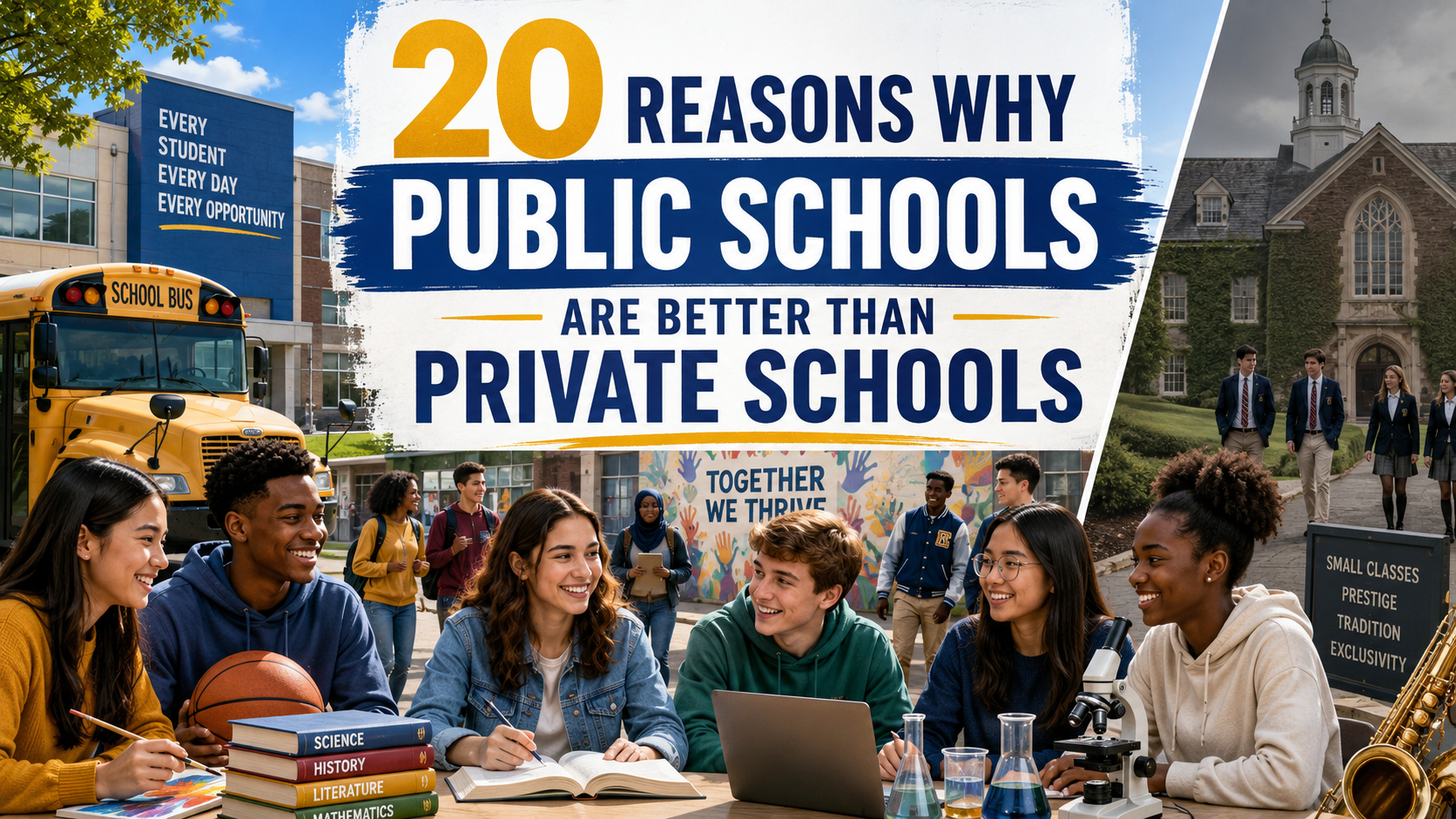
The debate over public schools vs private schools has been going on for years.
Some parents assume that paying tuition automatically means receiving a better education. Others believe private schools offer smaller classes, stricter discipline, and more personalized attention.
But the reality is more complicated.
Private schools can certainly provide excellent education, and many families choose them for good reasons. However, public schools also offer major advantages that are often underestimated.
In many communities, public schools provide qualified teachers, diverse student populations, specialized support services, sports, extracurricular activities, advanced academic programs, transportation, and access to education without expensive tuition fees.
For some children, a strong public school may actually provide a broader and more realistic educational experience than a private school.
So, why are public schools better than private schools in some situations?
Below are 20 important reasons parents, students, and educators should consider.
1. Public Schools Are More Affordable
See now How to Avoid Daydreaming/Zoning Out in the Library: A Student’s Guide to Staying Focused
One of the biggest advantages of public schools is cost.
Public schools are funded primarily through government and public revenue, which means families generally do not pay tuition in the same way they would at a private school.
Private school fees can become a major financial burden.
Tuition is often only the beginning.
Parents may also need to pay for:
Uniforms,
Books,
Transportation,
Technology fees,
Sports,
Excursions,
Meals,
Registration,
Examinations,
And extracurricular activities.
Those costs can quickly add up.
For many families, choosing a good public school allows them to invest the money they save in other important areas, such as tutoring, educational technology, university savings, music lessons, sports programs, travel, or family needs.
A school should help a child grow without placing unnecessary financial pressure on the entire household.
2. Public Schools Offer Greater Student Diversity
One of the strongest arguments in favor of public education is diversity.
Public schools often bring together students from different:
Economic backgrounds,
Cultures,
Religions,
Ethnic groups,
Languages,
Family structures,
And life experiences.
That exposure can be extremely valuable.
Children do not live in a world where everyone thinks, looks, speaks, earns, or believes the same way.
A diverse school environment gives students the opportunity to interact with people who may be different from them.
This can help develop empathy, communication skills, cultural awareness, tolerance, and social confidence.
Education is not only about passing examinations.
It is also about preparing young people to live and work successfully in a diverse society.
3. Public Schools Reflect the Real World
Because public schools usually serve broad communities, students often experience a wider range of personalities and backgrounds.
That can prepare them for real life.
In adulthood, people work with colleagues from different cultures, income levels, political views, religions, and educational backgrounds.
A child who learns early how to communicate respectfully with different kinds of people may become more adaptable later.
Private schools sometimes serve narrower demographic groups because of tuition costs, religious affiliation, selective admission, or geographic location.
That can create strong communities, but it may also reduce exposure to broader social diversity.
Public schools can provide a more representative picture of the society students will eventually enter.
See more The Lekki Headmaster: Themes and Symbolism (Complete Literature Guide)
4. Public Schools Usually Have More Government Oversight
Public schools typically operate under government education standards, regulations, curriculum requirements, teacher certification rules, and accountability systems.
That means they are often required to meet specific standards related to:
Curriculum,
Teacher qualifications,
Student safety,
Special education,
Assessment,
Accessibility,
Reporting,
And equal access.
Private schools may also maintain high standards, but regulations can differ depending on the country, state, or educational system.
Public oversight can give parents an additional layer of accountability.
If serious problems arise, there are often formal channels through education departments, school boards, inspectors, or government agencies.
5. Public School Teachers Often Meet Formal Certification Requirements
In many education systems, public school teachers must meet specific professional requirements before they can teach.
These may include:
Teaching degrees,
Professional certification,
Subject qualifications,
Background checks,
Ongoing training,
And continuing professional development.
Private schools can also employ excellent teachers, but hiring requirements may vary more widely.
A prestigious school building does not automatically guarantee that every teacher is highly qualified.
Teacher quality matters far more than school branding.
Public systems often have formal processes designed to ensure educators meet recognized standards.
6. Public Schools Often Provide More Special Education Services
Families with children who have additional learning needs may find strong support within public school systems.
Depending on the education system, public schools may offer services for students with:
Learning disabilities,
Physical disabilities,
Speech difficulties,
Autism,
ADHD,
Hearing or visual impairments,
Developmental challenges,
And other educational needs.
These services may include specialized teachers, classroom accommodations, therapists, counselors, individualized education plans, and support staff.
Some private schools provide excellent special education programs, but others may have limited resources or may not be designed to support students with complex needs.
Public education systems generally have broader legal and social responsibilities to serve a wider range of learners.
7. Public Schools Cannot Easily Exclude Students
Public schools are generally expected to educate children in the communities they serve.
They cannot simply build their reputation by accepting only the highest-performing students.
That matters when comparing school results.
A highly selective private school may produce impressive examination scores partly because it admits students who already meet strict academic standards.
Public schools often educate everyone.
High achievers.
Average students.
Students with learning difficulties.
Students from wealthy homes.
Students facing serious social or economic challenges.
Supporting such a broad population can be much harder.
When a public school succeeds academically, it may be doing so while serving a far more diverse group of learners.
See more The Government Should Prioritize Education Over Infrastructure
8. Public Schools Can Offer More Extracurricular Activities
Large public schools often have enough students and resources to support a wide range of activities.
Depending on the school, students may have access to:
Football,
Basketball,
Athletics,
Swimming,
Debate,
Drama,
Music,
Chess,
Robotics,
Coding,
Science clubs,
Student government,
Journalism,
Art,
And community service.
A larger student population can make it easier to form multiple teams, clubs, and societies.
Some private schools offer exceptional extracurricular opportunities, but smaller schools may have fewer choices simply because they have fewer students.
For a child who wants to explore several interests, a strong public school can provide an impressive variety of options.
9. Public Schools May Offer More Advanced Academic Programs
Some public schools offer specialized or advanced academic opportunities such as:
Advanced Placement courses,
Honors programs,
Gifted education,
STEM academies,
Technical education,
Vocational programs,
Dual enrollment,
Foreign languages,
And advanced science or mathematics.
Large public school districts may have the resources to offer more specialized courses than smaller private institutions.
A student interested in engineering, computer science, automotive technology, nursing, agriculture, or advanced mathematics may find programs that are difficult for a smaller private school to provide.
The best school is not always the school with the highest tuition.
Sometimes it is the school with the widest range of opportunities.
10. Public Schools Can Provide Better Sports Programs
Athletics can be a major advantage of public education.
Many public schools have established sports teams, coaches, competitions, facilities, and inter-school leagues.
Students may participate in:
Football,
Basketball,
Track and field,
Volleyball,
Tennis,
Swimming,
Baseball,
Wrestling,
And other sports.
Strong sports programs can teach discipline, teamwork, leadership, resilience, fitness, and time management.
They may also create scholarship opportunities for talented students.
While elite private schools can have excellent sports facilities, many public schools benefit from larger student bodies and established athletic networks.
11. Public Schools May Offer Better Transportation Options
Transportation is another practical advantage.
Many public school systems provide school buses or transportation services for eligible students.
This can make education more accessible for families who:
Do not own a car,
Work early or late hours,
Live far from school,
Have several children,
Or cannot afford daily private transportation.
Private school transportation can sometimes involve additional fees.
For working families, reliable public school transport can make a major difference in daily life.
Check out Pen is mightier than the sword debate points for secondary school
12. Public Schools Help Children Build Local Friendships
Attending a neighborhood public school often means children study with classmates who live nearby.
This can make friendships easier to maintain outside school.
Children may:
Walk home together,
Play in the same neighborhood,
Join local sports teams,
Attend the same community events,
And build long-term relationships.
Parents may also find it easier to connect with other families in the area.
A strong neighborhood school can become a social center for the entire community.
That sense of local connection is difficult to measure, but it can be extremely valuable.
13. Public Schools Can Strengthen Communities
Good public schools do more than educate students.
They can strengthen entire neighborhoods.
Schools often host:
Sports events,
Community meetings,
Performances,
Parent programs,
Career fairs,
Elections,
Adult education,
And local activities.
They create connections between families, teachers, businesses, and community organizations.
When public schools succeed, communities often benefit.
This is one reason public education is often described as a public good.
Its impact extends beyond individual students.
14. Public Schools Can Offer More Career and Technical Education
Not every student wants or needs the same academic path.
Some students thrive in traditional university preparation.
Others are more interested in practical skills and career-focused education.
Public school systems often provide access to technical and vocational programs in areas such as:
Engineering,
Agriculture,
Construction,
Automotive technology,
Healthcare,
Computer science,
Hospitality,
Business,
Culinary arts,
And skilled trades.
These programs can prepare students for employment, apprenticeships, certifications, technical colleges, or entrepreneurship.
Some private schools focus heavily on university preparation and may offer fewer vocational pathways.
Public education can sometimes provide more choices for students with different goals.
15. Public Schools Can Have More Educational Resources
Large public school districts may have access to resources that smaller private schools cannot easily provide.
These may include:
Libraries,
Science laboratories,
Computer labs,
Sports facilities,
Counselors,
School psychologists,
Nurses,
Special education professionals,
Career advisers,
And technology programs.
Of course, resources vary dramatically from one public school to another.
Some public schools struggle with funding.
Others are exceptionally well equipped.
The important point is that “private” does not automatically mean “better equipped.”
Some public schools have facilities and programs that compare favorably with expensive private institutions.
16. Public Schools Give Students More Freedom to Be Themselves
Some private schools operate around specific religious, cultural, behavioral, or philosophical expectations.
That can be a major advantage for families who share those values.
However, public schools may provide students with broader exposure to different perspectives.
Students may encounter different:
Beliefs,
Cultures,
Ideas,
Family backgrounds,
And worldviews.
This can encourage independent thinking.
Students learn that people can disagree and still cooperate.
They may become more comfortable forming their own opinions instead of assuming everyone around them thinks the same way.
That intellectual and social diversity can be a powerful part of education.
17. Public Schools Often Have Stronger Accountability to Parents and Communities
Public schools generally answer to public institutions.
Depending on the country or region, this may include:
Local education authorities,
School boards,
Government ministries,
Public inspectors,
Elected officials,
And community stakeholders.
Parents may attend public meetings, review performance reports, participate in school governance, or raise concerns through formal channels.
Private schools may be highly responsive to parents because families pay tuition, but decision-making can also be more centralized.
Public systems often have broader transparency requirements.
That can give families more formal ways to demand accountability.
18. Public Schools May Reduce Social and Economic Pressure
Private education can sometimes create strong social pressure around money, brands, status, holidays, technology, and family wealth.
That does not happen in every private school.
But in highly affluent school communities, some students may feel pressure to keep up with lifestyles their families cannot afford.
Public schools often include a broader range of economic backgrounds.
This can help normalize differences in income and lifestyle.
Children may learn that intelligence, friendship, character, talent, and leadership are not determined by how expensive someone’s clothes are or what car their parents drive.
That can be a valuable life lesson.
19. Public Schools Can Prepare Students for Competitive Environments
Public schools often require students to navigate larger and more diverse environments.
There may be more students.
More personalities.
More competition.
More distractions.
And fewer opportunities for teachers to guide every step.
For some students, that environment builds independence.
They learn to:
Advocate for themselves,
Manage time,
Find resources,
Communicate with different teachers,
Compete for opportunities,
And take responsibility for their own progress.
These are useful skills for university and employment.
Students who learn how to succeed in a large, complex environment may be better prepared for the realities of adulthood.
20. A Good Public School Can Deliver Excellent Education Without High Tuition
Perhaps the strongest argument is also the simplest.
A good public school can provide an outstanding education.
Public schools have produced:
Scientists,
Doctors,
Engineers,
Entrepreneurs,
Presidents,
Artists,
Teachers,
Athletes,
Researchers,
And business leaders.
A child’s future is not determined solely by whether the school charges tuition.
What matters more is the quality of:
Teachers,
Leadership,
Curriculum,
Family support,
Student motivation,
School culture,
Resources,
And opportunities.
A strong public school combined with involved parents and a motivated student can produce exceptional results.
Education quality should never be judged by price alone.
Are Public Schools Better Than Private Schools?
Not always.
The honest answer is that school quality varies.
Some private schools are exceptional.
Some public schools are exceptional.
Some schools in both categories struggle.
A private school may be better for a child who needs:
Smaller classes,
A specific religious environment,
A specialized curriculum,
International education,
Or a particular teaching philosophy.
A public school may be better for a child who benefits from:
Greater diversity,
More extracurricular activities,
Special education services,
Local friendships,
Advanced public programs,
Or a wider range of academic and vocational opportunities.
Parents should compare individual schools rather than simply comparing labels.
What Are the Main Advantages of Public Schools?
The biggest advantages of public schools generally include affordability, accessibility, diversity, government oversight, broad student services, extracurricular activities, sports, special education support, and community connection.
Public schools also educate a wider range of students.
That diversity can create a learning environment that prepares young people for the complexity of real life.
Check out The Importance of Girl Child Education in Nigeria Debate: Why It Matters More Than Ever
Do Public Schools Have Better Teachers Than Private Schools?
Not automatically.
Excellent and weak teachers can be found in both systems.
However, public school teachers are often required to meet formal certification and professional standards established by education authorities.
Private school hiring requirements can vary.
Parents should investigate teacher qualifications, experience, staff turnover, classroom practices, and professional development rather than assuming one school type always has better teachers.
Why Do Some Parents Prefer Public Schools?
Parents may choose public schools because they:
Do not charge traditional tuition,
Are close to home,
Provide transportation,
Offer diverse student populations,
Have strong sports programs,
Provide special education support,
Offer advanced academic programs,
And connect children with their local community.
For some families, a strong neighborhood public school offers everything they need.
Are Private Schools Always Better Academically?
No.
Academic performance depends on many factors.
Private schools may sometimes report strong examination results because they have smaller classes, selective admissions, greater financial resources, or highly involved families.
But many public schools also achieve excellent results.
When comparing schools, parents should consider:
Student progress,
Teacher quality,
Academic support,
Graduation rates,
Exam performance,
Curriculum,
Resources,
And university outcomes.
Do not judge a school using tuition fees alone.
Are Public Schools Better for Social Development?
Public schools can offer important social advantages because students often interact with people from a wider variety of backgrounds.
This exposure can help children develop:
Empathy,
Communication skills,
Cultural awareness,
Adaptability,
Conflict-resolution skills,
And confidence.
However, social development ultimately depends on school culture, leadership, peer relationships, and family involvement.
See also Oppose the Motion: A Female Child Is Better Than a Male Child
Public Schools vs Private Schools: Which Should Parents Choose?
The answer depends on the child.
Before choosing a school, parents should ask:
Does my child feel safe here?
Are the teachers good?
Does the school support struggling students?
Are high-performing students challenged?
What extracurricular opportunities exist?
How is discipline handled?
What is the school culture like?
What are the academic outcomes?
How much will the total cost be?
Is the school a good fit for my child’s personality?
A famous name is not enough.
An expensive fee is not enough.
And a public label does not automatically mean lower quality.
The best school is the one that gives your child the strongest opportunity to learn, grow, and succeed.
Final Thoughts
The idea that private schools are always better than public schools is too simplistic.
Public schools offer several powerful advantages.
They provide accessible education.
They expose children to diverse communities.
They often offer broad academic, athletic, technical, and extracurricular programs.
They support students with different learning needs.
They help strengthen local communities.
And most importantly, they can provide excellent education without requiring families to spend enormous amounts of money on tuition.
That does not mean every public school is better than every private school.
It means parents should look beyond reputation and price.
Visit the school.
Talk to teachers.
Speak with parents.
Review academic results.
Understand the curriculum.
Observe the students.
Ask about safety.
Compare extracurricular programs.
Then make the decision based on what your child actually needs.
A good education is not defined by whether a school is public or private.
It is defined by what students learn, how they grow, and how well the school prepares them for life.