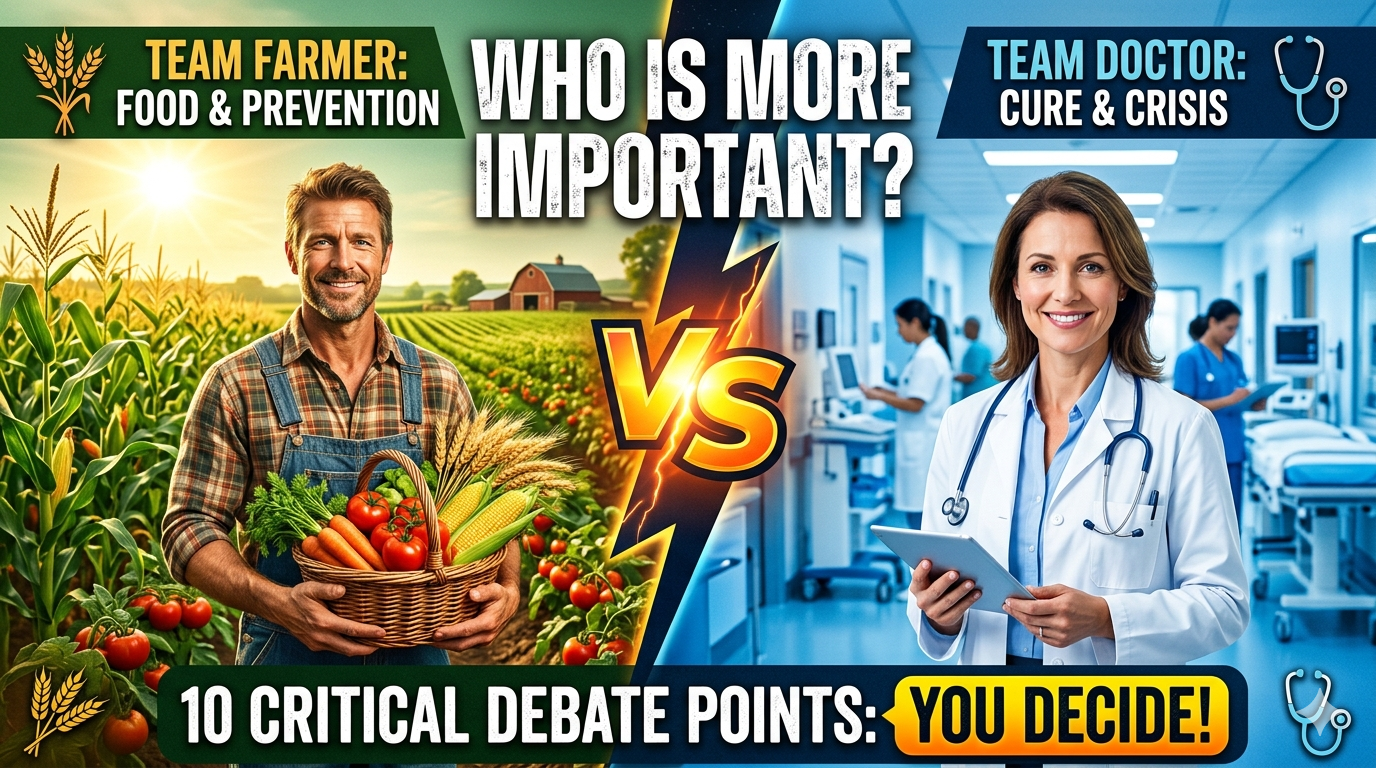
Who is more important between a farmer and a doctor debate points: A complete debate guide with arguments, speeches, and tips
Introduction: The Case for the Doctor in the Farmer vs Doctor Debate
The debate topic ‘who is more important between a farmer and a doctor’ is one that sparks genuine passion in Nigerian schools. Students, teachers, and parents all have strong views — partly because both professions are deeply valued in Nigerian culture and in Nigerian families, and partly because the question forces us to think seriously about what society really needs and what truly matters when lives are on the line.
This guide argues the case for the doctor. It is written for Nigerian primary and secondary school students preparing for debate competitions, but it is equally useful for anyone who wants to explore this fascinating question from the medical profession’s perspective. Every argument is developed fully, explained clearly, illustrated with Nigerian examples, and equipped with a debate line ready to use in competition.
Before we begin, let us be clear about one thing: farmers are extraordinary people who do work of immense importance. Nigeria’s farmers feed over 220 million people, many of them under conditions of severe resource constraint and climate uncertainty. They deserve far more support, recognition, and compensation than they typically receive. Nothing in this guide dismisses the farmer’s contribution.
But when we examine the full picture — when we look at what it actually means to live a human life of quality and dignity, not just to survive biologically but to live free from preventable suffering, to receive care when sick, to have access to the knowledge that protects health, and to have professionals who can stand between a patient and death at the most critical moments — the doctor’s case for greater importance becomes clear, urgent, and ultimately convincing.
Who is more important between a farmer and a doctor debate points
Ten complete arguments follow, plus a section on handling counterarguments, two sample speeches, and performance tips. Read everything carefully, understand the logic behind each argument, and prepare to argue this case with the conviction it deserves.
SEO NOTE: This article is optimised for search terms including ‘farmer vs doctor debate’, ‘who is more important a farmer or a doctor’, ‘doctor more important than farmer debate points Nigeria’, and related keywords. Share it with classmates preparing for the same topic.
Check out: Universities That Offer Business Administration: Full Guide for Students and Parents (2026)
Point 1: The Doctor Preserves the Life That Farming Sustains — Without Life, Food Is Irrelevant
The farmer’s strongest argument is that food is the most fundamental human need. We acknowledge this freely. But here is the critical question that the farmer’s side never fully answers: what use is food to a person who is dying of a disease that food cannot cure?
A child in the grip of severe cerebral malaria — one of Nigeria’s most deadly conditions — needs not food but immediate medical intervention: intravenous quinine or artemisinin, careful management of fever, monitoring for seizures, and the clinical judgement of an experienced doctor. Without that intervention, the child dies — regardless of how well nourished they were before the illness struck.
Food sustains the healthy body. Medicine restores the body when health breaks down. And health breaks down — in every life, at many points, sometimes critically. The farmer’s provision of food is a daily, ongoing contribution to survival. But the doctor’s intervention at moments of acute illness is often the difference between the patient living and dying. That difference — between life and death at the most acute, most critical moment — is what gives the doctor’s role its unique and irreplaceable importance.
Nigeria’s mortality statistics make this concrete. Malaria kills hundreds of thousands of Nigerians annually — not because Nigerians are malnourished but because they lack adequate access to timely, skilled medical treatment.
Maternal mortality in Nigeria is among the highest in the world — not because Nigerian mothers are unfed but because they lack access to skilled obstetric care at the moment of delivery. Neonatal mortality — the death of babies in the first month of life — kills hundreds of thousands of Nigerian children annually — not because they lacked food but because they lacked qualified medical attendance at birth and in those critical first weeks of life.
In each of these cases, the limiting factor is not food but medical care. The farmer kept these people alive until the medical crisis struck. The doctor was not there to save them at the critical moment. That absence — of the doctor, not the food — is what proved fatal. This is the doctor’s case in its starkest and most undeniable form.
DEBATE LINE: “Food keeps you alive from day to day. The doctor keeps you alive at the moment when food is powerless to help you — when disease strikes, when a baby is being born, when an injury needs emergency surgery. At those moments, no amount of food substitutes for skilled medical care. And in Nigeria, it is at precisely those moments that too many people die for lack of a doctor.”
Point 2: Doctors Control and Eliminate the Infectious Diseases That Devastate Farming Communities
There is a dimension of the farmer-doctor comparison that the farming side rarely acknowledges: the enormous burden that infectious disease places on agricultural productivity. In Nigeria and across sub-Saharan Africa, infectious diseases are among the most significant constraints on farming output — not because they damage crops directly but because they damage farmers.
A farming household whose primary labourers are incapacitated by malaria during the planting season loses its crop. A community decimated by a cholera outbreak cannot maintain its agricultural activities. A population weakened by chronic parasitic infections like schistosomiasis and hookworm cannot work at full productive capacity.
Doctors and the public health systems they lead have been the primary force behind the control of these devastating diseases. The near-eradication of smallpox globally — completed in 1980 — was achieved by doctors and public health workers. Smallpox once killed millions annually and devastated farming communities across the world. Its eradication was not achieved by better food — it was achieved by a vaccine developed and delivered by medical professionals.
In Nigeria, the massive campaigns against guinea worm disease — once endemic across many northern Nigerian states, causing incapacitating pain and rendering farmers unable to work during the agricultural season — have dramatically reduced its prevalence through medical intervention. Onchocerciasis (river blindness), which once blinded tens of thousands of Nigerian farmers and drove communities away from fertile river valleys, has been controlled through medical programmes delivering ivermectin treatment. Each of these disease control achievements directly restored and protected agricultural productivity.
This reveals a profound interdependence that cuts both ways: farming supports the nutrition that helps people resist disease; but medicine controls the diseases that would otherwise destroy farming communities. When we ask which profession contributes more to the other’s effectiveness, the doctor’s contribution to farming — through disease control — is just as real as the farmer’s contribution to health through nutrition.
DEBATE LINE: “A farming community ravaged by malaria cannot plant its crops. A village blinded by river blindness cannot harvest its fields. It is the doctor who controls the diseases that would otherwise destroy the farming communities that the opposition says are more important. Medicine protects the farmer. Without doctors controlling infectious disease, agricultural productivity itself would collapse.”
Point 3: The Doctor Provides Irreplaceable Specialised Knowledge That No Other Profession Possesses
Farming is an extraordinarily important skill — but it is a skill that can be learned, shared, and practised by large numbers of people without the same level of specialised, highly formal training that medicine requires. Millions of Nigerians farm.
They learn from their parents, from extension workers, from community knowledge, and from experience. The knowledge required to grow food, while genuinely complex and worthy of deep respect, is accessible to anyone willing to engage with the land.
Medical knowledge is different. It is specialised to a degree that requires years of formal scientific education before any practical application is possible. A person cannot learn to perform an appendectomy by watching their parents.
A person cannot learn to diagnose meningitis through community knowledge. A person cannot learn to manage a complicated labour from agricultural extension workers. These skills require the systematic acquisition of anatomy, physiology, pharmacology, pathology, and clinical reasoning — knowledge that takes over a decade to build to the level required for safe, independent medical practice.
This specialisation means that the doctor’s services are genuinely irreplaceable in a way that farming’s are not. If a farming community loses its farmers, other community members can learn to farm — slowly, inefficiently at first, but the learning curve is accessible.
Read more: How to Apply for Student Loans in Nigeria (NELFUND Guide): The Complete Step-by-Step
If a community loses its only doctor, no one else in the community can simply step up and perform surgery, manage a complicated pregnancy, or diagnose the cause of a fever that might be malaria, typhoid, meningitis, or any of a dozen other conditions with very different required treatments.
The irreplaceability of the doctor’s knowledge — and the extreme difficulty of substituting for it — is what gives the medical profession a claim to critical importance that farming, for all its breadth and reach, cannot quite match in this specific dimension.
DEBATE LINE: “If a community’s farmers leave, other community members can learn to grow food within a season. If a community’s only doctor leaves, the community has lost something that cannot be replaced by good intentions or community effort. Medical knowledge takes over a decade to build and cannot be improvised. That irreplaceable specialisation is the doctor’s most powerful claim to importance.”
Point 4: Doctors Save the Lives of Children Who Will Feed the Next Generation
Nigeria has one of the highest rates of child mortality in the world. Under-five mortality — the death of children before their fifth birthday — claims hundreds of thousands of Nigerian lives annually. The primary causes of these deaths are preventable and treatable medical conditions: malaria, pneumonia, diarrhoea, neonatal complications, and vaccine-preventable diseases. The vast majority of these deaths occur not because the children lacked food but because they lacked timely, skilled medical care.
Every child who dies before the age of five in Nigeria is a lost future. Lost to their family, lost to their community, and lost to the agricultural workforce of the future. The children who will grow Nigeria’s food in twenty years are the children alive today.
The doctor who saves a child from cerebral malaria, from neonatal sepsis, from severe pneumonia — that doctor is not just saving an individual life. That doctor is preserving a future farmer, a future agricultural worker, a future contributor to the food security that the farming side so rightly values.
Nigeria’s maternal mortality crisis tells the same story from a different angle. When a Nigerian mother dies in childbirth — from postpartum haemorrhage, from eclampsia, from obstructed labour — she leaves behind not just a grief-stricken family but in many cases a newborn who may not survive without her care, and older children who may be pulled from school to contribute to household labour.
The doctor — specifically the skilled obstetrician, the midwife, the anaesthetist who manages the mother’s care — is the professional whose presence at that moment determines whether the family remains intact or is fractured irreversibly.
The farmer cannot prevent a maternal death. The farmer cannot resuscitate a child with severe neonatal sepsis. At the moments of greatest physical vulnerability — birth, serious illness, injury — the doctor is the only professional capable of intervening. And those moments of greatest vulnerability are the moments that determine whether Nigeria’s agricultural workforce of the future actually survives to do its work.
DEBATE LINE: “Every farmer of the next generation is a child of this generation. The doctor who saves a child from malaria today is saving a farmer of tomorrow. The doctor who prevents a maternal death saves not just a mother but a whole family’s future. Nigeria’s agricultural future depends on the children who survive today — and it is the doctor, not the farmer, who determines how many of them do.”
Point 5: Doctors Work at the Intersection of Science, Compassion, and Human Dignity
Medicine is not merely a technical profession. It is a moral one. The doctor who sits with a patient, listens to their symptoms, examines them carefully, explains their diagnosis honestly, and treats them with skill and compassion is practising something that goes beyond the provision of food, shelter, or any other material need.
The doctor is affirming the patient’s dignity as a human being — affirming that their suffering matters, that their life is worth fighting for, and that they have a claim on the best available knowledge and care.
In Nigeria, where stigma around illness — particularly mental illness, HIV, tuberculosis, and certain other conditions — remains a significant barrier to healthcare access, the doctor’s moral role is especially important. The doctor who treats a patient with HIV with the same dignity and attention that they would give to any other patient is challenging social stigma and affirming the equal worth of every human life. The doctor who provides mental health care in a context where mental illness is widely misunderstood or dismissed is protecting the dignity of one of society’s most vulnerable groups.
This moral dimension of medicine — the commitment to the equal value of every human life, regardless of social status, wealth, ethnicity, or religion — is expressed in the Hippocratic tradition and in the oaths that Nigerian doctors take upon qualification. It is not shared, in quite the same explicit and professional form, by any other occupation.
The farmer produces food — a service of immense importance. But the doctor makes a formal commitment to the value of every human life that walks through their door. That commitment is one of civilisation’s most important moral achievements.
DEBATE LINE: “The farmer provides what the body needs to function. The doctor affirms what every patient needs to be recognised — the dignity of their suffering, the worth of their life, the commitment of a trained professional to fight for their survival regardless of who they are or where they come from. That moral commitment is not separable from the medical role. It is the medical role.”
Point 6: Medical Research Has Produced Discoveries That Transformed Human Life Expectancy
Two hundred years ago, the average human life expectancy globally was approximately 35 years. Today, it is over 70. That doubling of human lifespan — one of the most profound improvements in the conditions of human existence in all of history — is not primarily the result of improvements in food production, though those improvements have contributed.
It is primarily the result of medical discoveries: vaccines, antibiotics, antiseptic surgical techniques, blood transfusion, understanding of infectious disease transmission, and the systematic development of evidence-based treatments for the conditions that kill people.
In Nigeria, the most significant improvements in life expectancy in the twentieth century came from medical interventions. The introduction of antimalarial programmes reduced child mortality. Mass vaccination campaigns against smallpox, polio, measles, and other diseases saved millions of lives. The introduction of oral rehydration therapy — a simple, inexpensive medical intervention — dramatically reduced child deaths from diarrhoeal disease.
The development and introduction of antiretroviral therapy transformed HIV from a near-certain death sentence into a manageable chronic condition for the hundreds of thousands of Nigerians living with the virus.
Each of these life-saving developments was the product of medical research conducted by doctors and medical scientists. The farmer’s improvement of agricultural productivity contributed to better nutrition and thus better disease resistance — a real and important contribution. But the specific discoveries that targeted the specific diseases killing specific people — and defeated them — were medical achievements. The reduction in preventable deaths that has made modern Nigeria possible is substantially a medical achievement.
DEBATE LINE: “Human life expectancy has doubled in two centuries, and medical discovery is the primary reason why. Vaccines, antibiotics, and evidence-based treatment have saved more Nigerian lives than any improvement in agricultural productivity. The doctor’s contribution to how long and how healthily Nigerians live is not theoretical — it is written in the mortality statistics that have improved generation after generation.”
Check out: How to Avoid Daydreaming/Zoning Out in the Library: A Student’s Guide to Staying Focused
Point 7: The Doctor Provides Mental and Emotional Healthcare That Farming Cannot Address
Health is not only physical. The World Health Organisation defines health as ‘a state of complete physical, mental, and social well-being and not merely the absence of disease or infirmity.’ Mental health — the capacity to think clearly, feel emotions appropriately, maintain relationships, and function productively — is as essential to human wellbeing as physical health. And mental health is an area where the farmer’s contribution, however important in other dimensions, has no direct relevance.
Nigeria is experiencing a significant and largely unaddressed mental health crisis. Depression, anxiety, post-traumatic stress disorder, schizophrenia, bipolar disorder, substance abuse disorders, and suicide are all significant and growing causes of suffering in Nigerian communities. The WHO estimates that one in four Nigerians will experience a mental health condition at some point in their lives. The stigma surrounding mental illness in Nigeria means that most of those who suffer do so without professional support.
Doctors — specifically psychiatrists and clinical psychologists — are the trained professionals whose knowledge and skills can address these conditions. Talk therapy, psychiatric medication, crisis intervention, and the systematic assessment and treatment of mental health disorders are all medical activities. The reduction of mental suffering — which is as real and as devastating as physical suffering, and which has profound consequences for a person’s ability to participate in work, family, and community life — depends on medical care.
A farmer who is suffering from severe depression cannot tend their crops effectively. A community with high rates of substance abuse and untreated mental illness suffers in its agricultural productivity as well as in every other dimension of communal life. The doctor who addresses mental health is not serving a luxury need — they are addressing a fundamental dimension of human wellbeing that food production, however excellent, leaves entirely untouched.
DEBATE LINE: “Food sustains the body. But a person who is physically nourished and mentally broken cannot contribute fully to their family, their community, or their farmland. Mental illness affects one in four Nigerians. Its treatment is a medical responsibility. The doctor who treats mental suffering is addressing a dimension of human need that the farmer, however hardworking and however essential, has no capacity to reach.”
Point 8: Doctors Enable People to Work, Farm, and Contribute — By Restoring Their Health
There is a practical dimension of the doctor’s importance that often goes unacknowledged in this debate: the doctor enables productive work — including farming — by restoring health when illness strikes. A farmer with an untreated broken arm cannot plant. A farmer with unmanaged diabetes suffers from the complications of uncontrolled blood sugar — nerve damage, vision loss, kidney failure — that progressively destroy their ability to work.
A farmer with advanced cataracts, a condition treatable with a relatively simple surgical procedure, cannot see well enough to distinguish ripe from unripe crops, to navigate their field safely, or to read the agricultural extension materials that would help them improve their yields.
In each of these cases, the doctor’s intervention — setting the broken bone, managing the diabetes, performing the cataract surgery — does not just benefit the individual patient. It restores that individual’s capacity to work productively, to farm effectively, and to contribute to the food supply that the farming side rightly values.
The doctor is, in this sense, an enabler of farming itself. By keeping the agricultural workforce healthy, functional, and capable, medical care directly supports agricultural productivity.
In Nigeria, where agricultural productivity per hectare remains significantly below its potential partly because of the ill-health of the farming workforce, the expansion of rural healthcare access is not just a humanitarian priority — it is an agricultural policy priority. Healthier farmers farm better. Better farming produces more food.
More food improves nutrition. Better nutrition produces healthier people who need less medical care. The virtuous cycle is clear, and the doctor who enables that cycle by restoring the health of sick farmers is contributing directly to the food supply that the farming argument holds up as its foundation.
DEBATE LINE: “A sick farmer cannot feed anyone. The doctor who treats the farmer’s malaria, sets their broken bone, or restores their vision through cataract surgery gives back to the community not just a healthier person but a more productive farmer. The doctor enables the farming that feeds Nigeria. Medicine is not separate from agricultural productivity — medicine is its guardian.”
Point 9: Doctors Respond in Emergencies That Demand Immediate Action — Farming Cannot
One of the most distinctive aspects of the doctor’s importance is its emergency dimension. Medical emergencies do not schedule themselves. They do not wait for daylight, for the harvest season to end, or for a convenient time. A child having a febrile seizure needs immediate medical response.
A woman experiencing postpartum haemorrhage needs emergency obstetric intervention within minutes. A man brought to a health centre unconscious after a road traffic accident needs immediate assessment and stabilisation. A child with a suspected intussusception — an intestinal emergency common in young Nigerian children — needs surgery within hours.
These emergency situations are characterised by one defining feature: delay means death. There is no agricultural equivalent of this emergency dimension. A farmer who delays planting by a week loses some optimal growing time. A farmer who delays harvesting by a few days risks some crop loss. These are real costs, but they are measured in yield reductions, not in deaths occurring within the hour.
The irreversibility of medical emergencies — the fact that a patient who does not receive timely care at the moment of crisis may not survive to be treated later — gives the doctor’s emergency role a moral and practical weight that no other professional dimension can match.
In Nigeria, where access to emergency medical care is severely limited for large parts of the rural population, this emergency gap is literally costing lives every day.
The one-hour rule for heart attack treatment — the understanding that the chance of surviving a myocardial infarction drops dramatically with every hour of delay in receiving definitive treatment — is known to every cardiologist. But it is not known to the millions of Nigerians who live hours from the nearest functional emergency department.
The doctor who is present in rural communities, who can respond to medical emergencies without the patient needing to travel hours for care, is saving lives in the most direct and time-critical way imaginable.
DEBATE LINE: “When a child is having a severe malaria seizure, no quantity of food can help them. When a mother is haemorrhaging after childbirth, no harvest can save her. Medical emergencies require immediate medical response, and delay means death. The doctor is the only professional trained and equipped to respond at those moments. That emergency capability — that capacity to stand between a patient and death in real time — is what places the doctor’s importance beyond comparison.”
Point 10: A Society With Good Healthcare Can Solve Food Problems — A Sick Society Cannot Solve Anything
Our final argument draws on the relationship between health and capability that runs through every dimension of this debate. A society whose people are healthy — whose children survive infancy, whose adults live long productive lives free from debilitating disease, whose elderly contribute experience and wisdom to their communities rather than being overwhelmed by preventable illness — is a society with the human capital to solve its problems. Including its food problems.
The most significant improvements in Nigerian agricultural productivity in recent decades have come from educated, healthy farmers adopting improved techniques — better seed varieties, better soil management, better irrigation, better pest control, better post-harvest storage.
These improvements require healthy people who can learn, who have the cognitive capacity to absorb new information, and who have the physical vitality to implement new practices. Health is a prerequisite for the kind of agricultural innovation that will allow Nigeria to feed its growing population in the decades ahead.
A healthy, well-governed society with strong institutions can identify food security challenges and mount systematic responses — agricultural investment, irrigation infrastructure, subsidised inputs, improved extension services, better market access for farmers.
A society overwhelmed by disease — where child mortality is high, where adults are chronically ill, where the health system has collapsed — cannot mount these systematic responses. It is too busy managing the immediate crisis of sickness and death to address the long-term challenge of food production.
This is why the doctor’s importance, in the final analysis, is foundational to all other forms of development — including agricultural development. Healthy societies can improve their farming. Sick societies cannot improve anything. The doctor who builds the health of the population is building the capacity for every other improvement in Nigerian life, including the agricultural improvements that will feed the next generation.
DEBATE LINE: “A healthy Nigeria can solve its food problems. A sick Nigeria cannot solve anything. The doctor who reduces child mortality, controls epidemic disease, and restores the health of working adults is building the human capital on which every other form of national development — including food production — depends. Health is the precondition for progress. The doctor is the guardian of health. Therefore the doctor is the guardian of Nigeria’s future.”
Check out: How to Survive the 3 Weeks NYSC Orientation Camp: The Ultimate Survival Guide for New Corpers
Rebutting the Farmer’s Side: Three Key Responses
“Food is more basic than medicine — you can live without doctors but not without food”
Response: “We agree that food is more basic than medicine in terms of daily biological necessity. But ‘more basic’ is not the same as ‘more important’. Air is more basic than food — you can survive longer without food than without air. Does that make the air more important than the farmer? Importance is not simply about biological priority.
It is about which professional contribution produces the greatest positive difference in the quality and duration of human life. And when we measure that contribution across the full range of what doctors do — saving lives at moments of acute crisis, controlling epidemic disease, advancing medical science, protecting maternal health — the doctor’s importance emerges clearly.”
“Farmers existed before doctors — farming is more ancient”
Response: “Antiquity does not determine importance. Many things that came first in human history have been superseded by later developments that are more important. The stone axe came before the surgeon’s scalpel. The herbal remedy came before the evidence-based pharmaceutical. The village elder who diagnosed illness by observation came before the trained physician.
History’s first movers are not automatically history’s most important contributors. What matters is the impact on human life and human wellbeing — and by that measure, modern medicine has transformed human existence in ways that even the most important agricultural improvements have not matched.”
“The farmer feeds more people than the doctor treats”
Response: “This comparison confuses breadth of service with depth of importance. The farmer provides daily sustenance to many people. The doctor provides life-saving intervention to people at the moment of maximum need. A bodyguard protects far fewer people than a farmer feeds — but the bodyguard’s protection, at the critical moment, may be the difference between living and dying.
Similarly, the doctor’s intervention at the critical moment of illness or injury — when the patient is at their most vulnerable and when delay means death — is importance measured not in breadth but in irreplaceability. No farmer can do what the doctor does at that moment.”
Read also: JAMB 2026 Novel Summary: The Lekki Headmaster by Kabir Alabi Garba (Complete Guide)
Sample Debate Speech — Doctor Side
Study this speech carefully. Understand its structure and argument progression. Then rewrite it entirely in your own natural voice.
“Distinguished judges, honourable opponents, and all present — I stand today to argue that the doctor is more important to society than the farmer.
Let me begin with a scene that happens hundreds of times every day across Nigeria. A mother is in labour. It is past midnight. The birth has been going on for many hours and something has gone wrong. The baby is in the wrong position. The mother is exhausted, frightened, and beginning to haemorrhage. In that room, in that moment, with that mother’s life hanging in the balance — what does the scene need?
Not food. There is food. The mother ate this morning, grown by a farmer. What that scene needs, desperately, immediately, and with a margin of minutes rather than hours, is a skilled doctor — an obstetrician who can assess the situation, make the decision, perform the procedure, and bring both mother and child through safely. Without that doctor, one or both of them may not survive the night.
That scene is not rare. It plays out in hospitals and health centres and homes across Nigeria every single night. And it illustrates the core of our argument today: food sustains the healthy person. The doctor saves the person when health breaks down — at the moment when no other professional can help, when the margin between life and death is measured in minutes, and when no quantity of food, however nutritious, can substitute for skilled medical care.
The proposition will show today that the doctor preserves life at the moments when food is powerless. That doctors control the infectious diseases that devastate farming communities. That medical research has doubled human life expectancy. That doctors save the children who will grow tomorrow’s food. And that a healthy society can solve its food challenges — but a sick society cannot solve anything at all.
Distinguished judges — the farmer gives us the strength to face each day. The doctor gives us the days. Vote for the proposition. Vote for the profession that stands between us and death when no one else can. I thank you.”
See also: How to Avoid Daydreaming/Zoning Out in the Library: A Student’s Guide to Staying Focused
Debate Performance Tips — Doctor Side
- Open with a vivid medical emergency. A midnight labour crisis, a child in a malaria seizure, a road accident victim — these vivid scenes are emotionally powerful and immediately establish the stakes of the doctor’s work. Judges feel the urgency before you have made a single formal argument.
- Use the phrase ‘at the critical moment’. The doctor’s importance is most visible at critical moments — moments of acute illness, emergency, and maximum vulnerability. Repeating ‘at the critical moment’ throughout your speech builds a rhetorical pattern that emphasises the irreplaceable nature of medical intervention.
- Reference Nigeria’s specific health statistics. Mentioning Nigeria’s maternal mortality rate, under-five mortality figures, malaria death toll, and doctor shortage statistics shows genuine research and grounds your arguments in Nigerian reality. Judges are impressed by specific, accurate data.
- Use the ‘minutes versus days’ contrast. Food protects health over days and weeks. Medical emergencies demand response in minutes. Making this contrast explicit — ‘the farmer’s contribution protects you over weeks; the doctor’s saves you in minutes’ — is a punchy, memorable way to establish the urgency of the medical role.
- End with a memorable closing image. The closing speech sample ends with ‘the farmer gives us the strength to face each day; the doctor gives us the days.’ Short, balanced, memorable closing images like this stay with judges long after the debate ends. Craft your own memorable closing line.
Read now: How to Create Flashcards for Quick Revision: The Ultimate Guide for Nigerian Students
Frequently Asked Questions
What makes this debate topic popular in Nigerian schools?
This topic is popular because it puts two genuinely important, highly respected professions in direct comparison and forces students to think carefully about foundational questions: what does society need most? What does ‘important’ actually mean? It also connects to real Nigerian experiences — the importance of agriculture to Nigerian livelihoods and the critical challenges in Nigerian healthcare — which makes the arguments feel relevant and meaningful rather than abstract.
Can I argue both sides for different competitions?
Absolutely, and doing so is excellent preparation. Understanding both sides of a debate argument makes you a stronger debater on either side, because you understand the opposition’s best arguments and can anticipate and address them. Many of the best debate students deliberately study both sides of every topic they are assigned.
What is the strongest single argument for the doctor?
The emergency medicine argument — Point 9 in this guide — is widely considered the strongest single argument for the doctor’s side. It is emotionally compelling, logically clear, and difficult for the farming side to defeat because it identifies a specific, urgent, irreplaceable dimension of the doctor’s work that farming simply cannot address. If you are short on preparation time, prioritise understanding this argument thoroughly.
Read now: JAMB 2026 Novel Summary: The Lekki Headmaster by Kabir Alabi Garba (Complete Guide)
Conclusion: The Doctor at the Bedside of a Nation
The doctor’s importance to society is written in every life saved, every epidemic controlled, every maternal death prevented, every child who survived their first year because a skilled medical professional was present at the right moment. It is written in the doubled life expectancy of the modern world. It is written in the suffering that medicine has learned to prevent, to manage, and in many cases to eliminate entirely.
The farmer feeds the nation — that is true and important. But the doctor keeps the nation alive at the moments when feeding is not enough. And in a country like Nigeria, where maternal mortality is among the world’s highest, where child mortality claims hundreds of thousands of young lives annually, where epidemic diseases still kill and disable far too many people, and where the doctor shortage is a declared national emergency — those moments arrive far too often, and their outcomes are far too often determined by whether a skilled medical professional is available.
Argue the doctor’s case with the full understanding of what is at stake. These ten arguments are strong, evidence-based, and deeply relevant to Nigerian reality. Use them well. Make the case. Win the debate.
The doctor stands between us and death. Argue that truth powerfully.