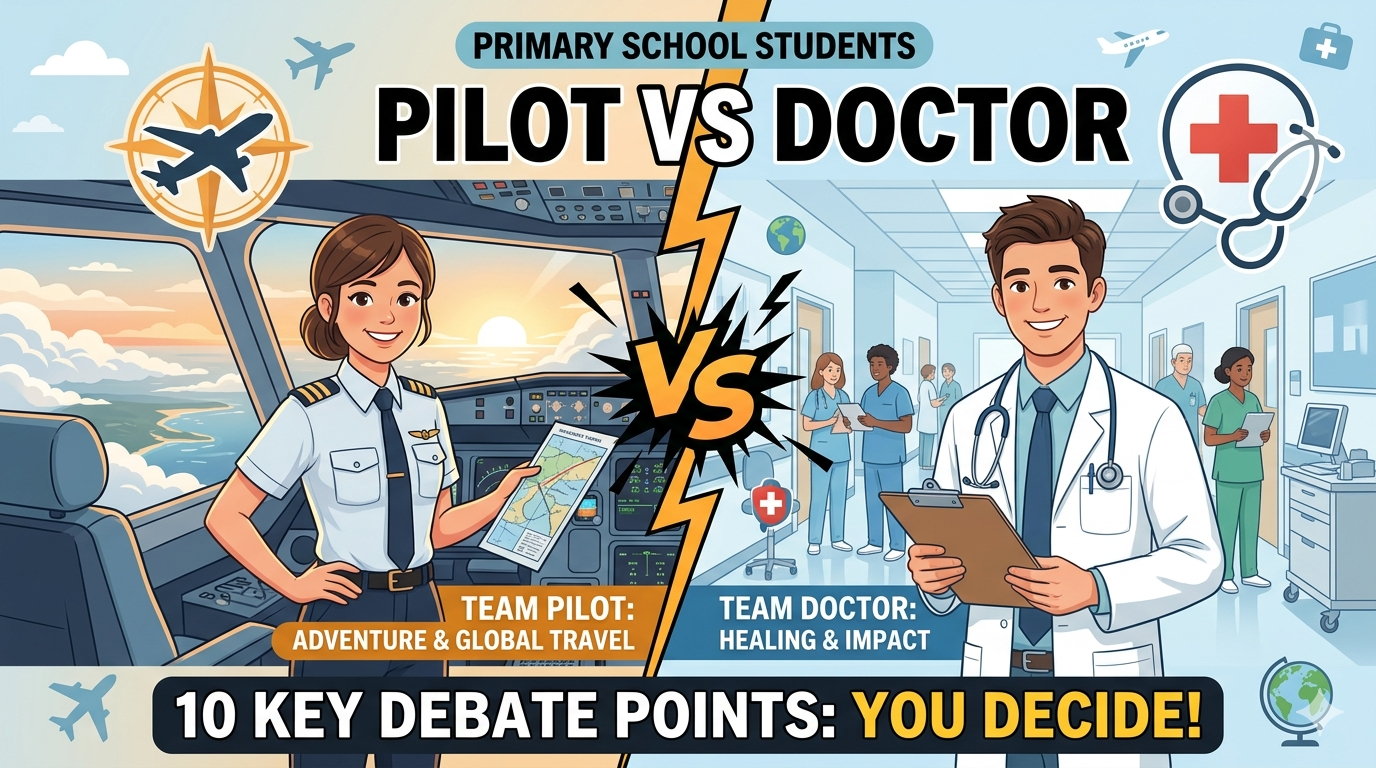
Pilot vs Doctor: Who Is More Important to Society?
A fresh debate guide for Nigerian students on Why a Pilot is better than a Doctor – both sides argued in full
Debate Motion: A Pilot Is More Important Than a Doctor | Both Sides | Nigerian Schools
Introduction: Two Skies, Two Kinds of Heroism
Close your eyes and picture two different heroes. The first is standing in a cockpit at dawn, running through a pre-flight checklist with unhurried precision, about to take responsibility for 240 passengers who will place their lives in their hands without a second thought. The second is standing in a consultation room at mid-morning, listening to a patient describe symptoms that do not yet have a name, piecing together evidence with the patience of a scientist and the compassion of a healer.
Both of these people are doing something extraordinary. Both of them will face moments today — perhaps several — where a wrong decision has serious consequences. Both of them trained for years to be ready for those moments. And the question this debate asks is one that sounds simple but reveals enormous depth the moment you begin to explore it seriously: which one is more important to society?
The debate topic ‘a pilot is more important than a doctor’ is appearing with increasing frequency in Nigerian secondary school debate competitions and classroom exercises, and for good reason.
It challenges students to look past the obvious answer — which most people assume is the doctor — and to engage seriously with the role that aviation plays in modern Nigerian life, the scale of the pilot’s responsibility, and the interconnectedness of the two professions. When argued well, this debate produces some of the most creative and intellectually surprising arguments that secondary school competitions have to offer.
Why a Pilot is better than a Doctor
This is a complete debate guide covering both sides in full. You will find ten fresh arguments for the pilot’s case, ten fully developed arguments for the doctor’s case, two original sample speeches, a comprehensive rebuttal section, a three-column verdict table, eight performance coaching tips, and a FAQ section addressing the questions students ask most about this topic.
Whether you have been assigned the pilot’s side or the doctor’s side, read the entire guide — because the student who understands both sides is always the stronger debater on either one.
IMPORTANT NOTE: Both pilots and doctors are magnificent professionals who contribute enormously to Nigerian society and deserve far better recognition, compensation, and support than they currently receive. This debate is a structured intellectual exercise — not a commentary on either profession’s worth.
Setting the Terms: What This Debate Is Really About
Before making any argument in this debate, it helps to establish clearly what we mean by the two professions and what ‘more important’ means in this context.
The Pilot
For the purposes of this debate, a pilot is any professionally trained and licensed aviator — including commercial airline pilots operating passenger jets, cargo pilots, military pilots, helicopter pilots, charter pilots, and the growing cadre of drone operators in commercial and military applications. In Nigeria, pilots are licensed by the Nigerian Civil Aviation Authority (NCAA) and operate under International Civil Aviation Organisation (ICAO) standards. Nigerian pilots serve with Air Peace, Aero Contractors, Dana Air, United Nigeria Airlines, and international carriers, as well as with the Nigerian Air Force.
The Doctor
For this debate, a doctor is any registered medical practitioner — from the general practitioner in a community clinic to the neurosurgeon in a tertiary hospital, from the public health physician designing vaccination campaigns to the psychiatrist treating mental illness, from the rural health officer managing primary care to the consultant cardiologist at the University of Lagos Teaching Hospital. In Nigeria, doctors are registered by the Medical and Dental Council of Nigeria (MDCN) and serve across a wide spectrum of settings.
What Does ‘More Important’ Mean?
The strongest debaters define ‘more important’ in terms that favour their side. The pilot’s side argues that more important means greater simultaneous reach, greater enablement of other professions and industries, and greater consequences when things go wrong.
The doctor’s side argues that more important means more universal necessity, more direct contribution to human survival, and greater irreplaceability in the specific moments of life-or-death crisis. State your definition clearly at the beginning of your speech and argue consistently from it.
Who Has the Edge? A Three-Column Verdict Table
| Debate Dimension | Pilot Has Edge Here | Doctor Has Edge Here |
| Number of lives at stake per professional action | Yes — hundreds per flight simultaneously | No — typically one patient at a time |
| Universality of service | No — only those who travel by air | Yes — every human being needs a doctor |
| Enabling other industries and professions | Yes — enables trade, medicine, diplomacy | Partial — enables productive workforce |
| Consequences when things go wrong | Yes — mass casualty potential per incident | Serious but individual in most cases |
| Directness of preserving life | Indirect — transports; does not heal | Yes — diagnosis and treatment saves life directly |
| Training rigor and continuous assessment | Yes — mandatory 6-monthly sim checks | Yes — but less frequent formal checks |
| Impact on Nigerian economy | Yes — aviation drives trade and remittances | Partial — healthy workforce drives economy |
| Irreplaceability at critical moment | Yes — no substitute for pilot in cockpit | Yes — no substitute for doctor at bedside |
| Long-term civilisational importance | Partial — aviation is modern; not ancient | Yes — medicine predates and outlasts aviation |
| Public health at population level | No — pilots do not do population health | Yes — doctors protect entire communities |
Read also: How to Handle Panic Attacks in the Exam Hall: A Survival Guide for Nigerian Students
The table shows a genuinely close contest with the pilot leading on scale and enabling, and the doctor leading on universality and direct human impact. Both sides have a real case — the winner in debate will be the one who argues their dimension of importance most convincingly.
Section One: Ten Points Why the Pilot Is More Important
These ten points build the case for the pilot’s greater importance. Each is written with fresh angles, Nigerian context, and a strong closing line ready for use in debate.
Point 1 [Pilot]: The Pilot Is the Only Professional Whose Error Can Kill Hundreds in Seconds
There is a specific category of professional responsibility — one defined by the scale of potential catastrophe that rides on a single act of judgement — that belongs to very few occupations on earth. The commercial airline pilot is in that category.
When a pilot makes a critical error during the approach to land, or mismanages a loss of cabin pressure at altitude, or fails to correctly respond to an engine failure on take-off, the potential consequence is not the loss of one life but the loss of every life on board — which on a widebody aircraft could be 300 to 500 passengers.
The aviation industry’s entire safety culture is built around this reality. The Crew Resource Management training that all commercial pilots undergo teaches them to manage the social and psychological dynamics of a flight deck so that errors do not compound.
The checklists — running to dozens of pages for normal procedures and hundreds for abnormal ones — exist because the consequences of a missed item can be catastrophic. The mandatory simulator checks every six months, in which pilots must demonstrate competency in handling multiple simultaneous emergencies, exist because the aviation industry knows that the cost of under-prepared pilots is measured in mass casualties.
No other peacetime civilian profession carries this specific form of responsibility. The doctor’s errors are grievous and sometimes fatal to individual patients. But no doctor’s single clinical decision has ever killed 300 people simultaneously. The scale and simultaneity of the pilot’s accountability is a genuine measure of extraordinary professional importance — the kind of importance that the aviation safety system treats with absolute seriousness every single day.
CLOSING LINE: “No single decision a doctor makes has ever killed 300 people at once. A pilot’s single decision can. The aviation safety system — its simulators, its checklists, its mandatory proficiency checks — exists precisely because the world understands that scale of responsibility. That is the measure of the pilot’s importance: not what they do when everything goes right, but what depends on them when things go wrong.”
Point 2 [Pilot]: Nigeria’s Economic Survival Depends More on Aviation Than Most People Realise
The Nigerian economy is often discussed in terms of oil revenue, agriculture, and the financial services sector. What is less often acknowledged is the degree to which aviation underpins and enables all of these sectors. Nigeria’s oil industry depends on aviation to rotate offshore workers to and from the rigs in the Gulf of Guinea.
Read more: How to Apply for NYSC Relocation: The Complete No Stress Guide for PCMs
Nigeria’s export commodities — cocoa, sesame, cashew nuts, rubber, and cut flowers — reach international markets partly through air freight. Nigeria’s financial sector is staffed partly by professionals who travel regularly between Lagos, Abuja, Port Harcourt, and Kano by air. Nigeria’s diplomatic relationships are sustained by ministers and officials who travel internationally by air.
Consider what would happen to the Nigerian economy if all air travel ceased for one month. International investors could not visit. Business executives could not attend meetings in other cities. Nigerian exporters could not meet their international buyers.
Nigerian students could not travel to or return from universities abroad. The Nigerian diaspora could not send representatives home to oversee family businesses and investments. The economic disruption within a single month would be measured in billions of naira — potentially hundreds of billions.
Compare this to the economic disruption that would result from removing all doctors for a month. The suffering would be immense and the human cost terrible. But the economy would not stop in the same structural way. Factories would continue operating. Markets would continue trading.
Government would continue functioning. Pilots, by providing the physical connectivity on which Nigeria’s engagement with the global economy depends, are an economic infrastructure asset whose importance is consistently underestimated in comparisons of professional importance.
CLOSING LINE: “Grounding all flights in Nigeria for thirty days would cost the economy hundreds of billions of naira and disrupt every sector that depends on connectivity — which is almost all of them. The pilot is not just a transportation professional. The pilot is a critical infrastructure asset on whom Nigeria’s economic relationship with the world depends.”
Point 3 [Pilot]: Pilots Are the Logistics Chain That Delivers Healthcare Itself
One of the most powerful arguments for the pilot’s importance is what happens when you trace the supply chain of healthcare backwards. A doctor in a Nigerian hospital uses drugs, diagnostic equipment, surgical instruments, laboratory reagents, blood products, and medical devices — many of which, at some point in their journey from manufacturer to patient, travelled by air.
See now: How to Handle Panic Attacks in the Exam Hall: A Survival Guide for Nigerian Students
The cold-chain logistics for temperature-sensitive vaccines depends on air freight for the initial international shipment. Specialised diagnostic equipment — MRI machines, CT scanners, laboratory analysers — arrives in Nigeria by sea or air cargo. Emergency supplies during outbreaks are airlifted.
During the 2014 Ebola crisis, the international response that helped Nigeria contain the outbreak included air-freighted personal protective equipment, laboratory reagents, and logistical support from international organisations.
During COVID-19, Nigeria’s vaccine supply — arriving from manufacturing facilities in India, China, and Europe — was air-freighted. The doctors who administered those vaccines, the nurses who ran the immunisation clinics, the public health officials who managed the campaigns — all of them depended on the logistical chain that aviation provided.
This means the pilot is not simply a professional who competes with the doctor for importance. The pilot is part of the supply chain on which the doctor depends. Remove the pilot from that supply chain, and the doctor’s ability to practise modern evidence-based medicine is severely compromised. In this sense, the pilot’s importance is not separate from the doctor’s importance — it is embedded within it.
CLOSING LINE: “The vaccine in the doctor’s syringe arrived in Nigeria by air. The diagnostic machine the doctor uses arrived by air. The specialist who trained the doctor travelled internationally by air. Trace any element of modern Nigerian healthcare back far enough and you will find a pilot somewhere in the supply chain. The pilot is not competing with the doctor — the pilot is the doctor’s logistics partner, without whom modern medicine cannot function.”
Point 4 [Pilot]: The Pilot Operates Under Conditions of Absolute Non-Negotiable Fitness
One of the most striking differences between the pilot’s professional requirements and those of almost any other profession — including medicine — is the absolute, non-negotiable medical and psychological fitness standard that pilots must maintain throughout their careers.
A commercial pilot in Nigeria must pass a Class 1 medical examination, administered by an aviation medical examiner approved by the NCAA, at regular intervals — annually for pilots over 40, every six months for airline transport pilots over 60. These examinations test eyesight, cardiovascular health, neurological function, psychological fitness, and a range of other health indicators.
The consequence of failing this medical examination is immediate: the pilot cannot fly until they are recertified. A pilot who develops a heart condition, a pilot whose eyesight deteriorates beyond the required standard, a pilot whose psychological assessment raises concerns — each of these pilots is immediately grounded, regardless of their experience, their seniority, or the operational impact of their absence.
No other civilian profession subjects its practitioners to this level of continuous, mandatory, career-determining medical fitness verification.
Paradoxically, this means that pilots must maintain a standard of personal health that exceeds what is formally required of doctors — creating an irony that is worth noting in a debate about which profession is more important. The doctor who becomes ill with a chronic condition may continue to practise, perhaps with adjustments, for the rest of their career. The pilot who develops the same condition may be immediately grounded. The implication is that the aviation industry considers the pilot’s physical fitness so consequential — because of what rides on it — that no compromise is tolerable. That zero-tolerance standard is itself a measure of importance.
CLOSING LINE: “A pilot who develops high blood pressure at fifty may be grounded the next day. A pilot whose eyesight dips below aviation standards cannot fly until it is corrected. No other profession subjects its members to this level of mandatory, career-determining fitness verification — because no other profession’s physical fitness has such immediate, direct consequences for the lives of hundreds of people. The absolute fitness standard is itself evidence of the absolute importance.”
Point 5 [Pilot]: Aviation Carries Nigeria’s Most Urgent and Irreplaceable Cargo: Human Organs
See now: How to Use the Pomodoro Technique to Smash Your WAEC and JAMB Exams
Perhaps the most life-or-death contribution that aviation makes to healthcare is one that many people never think about: the transportation of human organs for transplant. When a donor organ becomes available — a kidney, a liver, a heart, a pair of lungs — the window of viability is measured in hours, not days.
A heart must be transplanted within four to six hours of harvest. A liver within twelve to twenty-four hours. A kidney within twenty-four to thirty-six hours. These time windows are absolute biological limits. Exceed them, and the organ is no longer viable for transplantation.
When a donor organ becomes available in one city and the recipient is in another, aviation is not a luxury option — it is the only option. The organ transplant pilot — whether flying a dedicated air ambulance or a charter aircraft arranged by a transplant coordination centre — is performing a logistical function that directly determines whether a specific patient lives or dies. Without the pilot to fly that organ to the recipient on time, the transplant cannot happen. Without the transplant, the patient — who may have waited months or years on a transplant waiting list — does not survive.
While organ transplantation is still developing in Nigeria, it is a growing field at facilities like the Lagos University Teaching Hospital, and its development will depend increasingly on aviation logistics. The pilot who understands this role — who recognises that the cargo in the cool box behind them is not just a medical supply but a human life — is performing a form of healthcare that no doctor can perform without aviation. The pilot is the bridge between the donor and the recipient. That bridge is irreplaceable.
CLOSING LINE: “A human heart has six hours from harvest to transplant. When donor and recipient are in different cities, the only professional who can bridge that gap in time is the pilot. In those six hours, the pilot is not supporting medicine — the pilot IS medicine. No doctor can transplant a heart that never arrived. The pilot delivers the possibility of life itself.”
Point 6 [Pilot]: The Pilot Connects Nigeria’s Students to Global Education and Brings Them Home
Nigeria’s development depends critically on the quality of its human capital — on the skills, qualifications, and international experience of its professionals. A significant component of that human capital development occurs through international education: Nigerian students who travel abroad for undergraduate degrees, postgraduate study, professional training, and research programmes at universities in the United Kingdom, the United States, Canada, Australia, and elsewhere. Virtually every one of those students travels internationally by air. The pilot is the professional who makes their educational journey physically possible.
More significantly, the return of those students to Nigeria — bringing with them degrees, professional networks, international experience, and skills developed in some of the world’s leading educational institutions — is also overwhelmingly mediated by aviation. The Nigerian engineer who studied at Imperial College London and returned to design Nigeria’s infrastructure. The Nigerian economist who studied at Harvard and returned to advise the Central Bank. The Nigerian surgeon who trained at Johns Hopkins and returned to practise at a Nigerian teaching hospital. Each of these professionals arrived home on an aircraft flown by a pilot.
The brain drain that takes Nigerian professionals abroad is a serious challenge. The brain gain that brings some of them back — and that enables others to maintain productive connections between Nigeria and the international institutions where they work — depends almost entirely on aviation.
Check out: The Complete List of 26 Tradepreneur Subjects for WAEC: How to Choose a Profitable Skill
The pilot who flies these routes is not just transporting passengers. The pilot is participating in Nigeria’s long-term human capital development in ways whose economic and developmental consequences are profound.
CLOSING LINE: “Every Nigerian who studied abroad and came home to build this country flew home. Every diaspora professional who visits to invest, to consult, to advise, and to contribute flies in. The pilot is not simply moving passengers — the pilot is moving the human capital that Nigeria’s future depends on. Aviation is the physical mechanism of Nigeria’s intellectual and professional development.”
Point 7 [Pilot]: Pilots Are Indispensable to Disaster Response and Humanitarian Relief
When disaster strikes — when floods displace communities in Anambra and Kogi States, when conflict displaces millions in the north-east, when an earthquake or epidemic requires large-scale humanitarian response — the first assets mobilised in the relief operation are almost always aerial.
Helicopters survey damage, identify areas of greatest need, and deliver emergency supplies to communities cut off by floodwater or conflict. Fixed-wing aircraft deliver relief supplies in bulk to staging areas. Air ambulances evacuate the most critically injured.
Nigeria’s experience with internal displacement — particularly in the north-east, where the Boko Haram insurgency has displaced millions of people — demonstrates the centrality of aviation to humanitarian response. The United Nations Humanitarian Air Service (UNHAS), which operates in Nigeria and across conflict-affected regions of the world, provides aviation services to humanitarian organisations that could not otherwise safely or rapidly access the communities they serve.
Without pilots willing to fly into challenging environments — often with basic facilities, uncertain weather, and security risks — humanitarian response would be dramatically slower, less targeted, and less effective.
In these disaster and humanitarian contexts, the pilot’s contribution is often the enabling factor that determines whether other professionals — including doctors and nurses — can reach the people who need them. A medical team with supplies cannot help the flood victims if there is no way to get there. The pilot flies the medical team in. The doctor saves lives at the destination. Both are necessary. But in the disaster response sequence, the pilot comes first.
CLOSING LINE: “When flood victims in Kogi State are cut off and need emergency medical supplies, the doctor has the medicine but cannot reach them. The pilot can. In disaster response, the pilot is always the first link in the chain — delivering the medical teams, the supplies, the assessment capacity that makes the doctor’s work possible. The pilot opens the door. The doctor walks through it.”
Point 8 [Pilot]: The Psychological Demands of Piloting Are Uniquely Extreme and Underrecognised
The psychological and cognitive demands of professional piloting are among the most extreme of any civilian occupation, and they are significantly underrecognised in public discussion of professional importance.
A commercial airline pilot must simultaneously manage spatial orientation in three dimensions, monitor and interpret multiple instrument displays providing real-time data on aircraft systems, communicate with air traffic control in precise aviation English, coordinate with the co-pilot through a formal crew resource management framework, make time-critical decisions under uncertainty, and maintain calm, rational judgement under conditions — including severe turbulence, equipment malfunctions, and medical emergencies among passengers — that would induce significant stress in most people.
The Germanwings Flight 9525 crash of 2015 — in which a co-pilot with an undisclosed psychiatric condition deliberately crashed the aircraft, killing 150 people — prompted the aviation industry globally to fundamentally revisit its psychological screening and mental health support systems for pilots.
The response in Europe and internationally included enhanced psychological testing for pilot licences, confidential mental health support programmes for aviators, and changes to cockpit access rules. This response reflected the recognition that the mental health of pilots has direct consequences for the safety of everyone they fly.
Nigeria’s aviation authority, the NCAA, has progressively strengthened its medical certification requirements for pilots in recent years, including psychological assessment components. This recognition — that the pilot’s mental fitness is so consequential that it requires formal, structured assessment — is itself an acknowledgement of the extraordinary psychological demands the profession places on its practitioners and the scale of what depends on their mental health being intact.
CLOSING LINE: “A pilot must remain cognitively functional, spatially oriented, and psychologically stable while managing a machine weighing hundreds of tonnes through a three-dimensional environment at ten times the speed of a car, while communicating with air traffic control, monitoring dozens of instruments, and coordinating with a co-pilot — all simultaneously. The psychological demands of that task are extreme. Their consequences, if not met, are catastrophic. That is the definition of professionally important.”
Check out: How to Use the Pomodoro Technique to Smash Your WAEC and JAMB Exams
Point 9 [Pilot]: Aviation Scarcity in Nigeria Costs More Than Medical Scarcity
The proposition makes this argument not to diminish the very real crisis of Nigeria’s doctor shortage — which is genuine and serious — but to challenge the assumption that scarcity of a resource automatically proves it is more important than an abundant one.
In Nigeria, the scarcity of qualified pilots is creating a different kind of crisis: one that limits economic growth, constrains the development of domestic air routes, raises the cost of air travel, and reduces the frequency and reliability of aviation services on which the business community and the healthcare supply chain depend.
Nigeria currently has fewer than 600 licensed commercial pilots for a country of 220 million people and an economy that is the largest in Africa. This ratio means that airlines operate with minimal redundancy, that training requirements for new pilots create significant bottlenecks, and that the expansion of Nigerian aviation — which could dramatically improve connectivity, drive tourism, and support economic diversification — is constrained by the human resources available to fly the aircraft.
The Nigerian College of Aviation Technology in Zaria and the various aviation training organisations in Lagos and other cities are working to address this shortage, but the gap between Nigeria’s aviation potential and its current aviation capacity remains large.
When a business deal falls through because a key investor could not get a reliable flight to visit the proposed project site; when a medical supply shipment arrives late because of reduced flight frequencies on a particular route; when a Nigerian company loses a contract to a competitor because its executives could not travel flexibly — these are economic costs of pilot scarcity that translate directly into development foregone. The pilot’s scarcity, and the specific economic harm that scarcity causes, is itself a measure of the profession’s importance to Nigeria’s progress.
CLOSING LINE: “Nigeria’s aviation sector operates at a fraction of its potential because there are not enough trained pilots. Every flight frequency that cannot be increased, every route that cannot be opened, every business connection that cannot be made because there is no pilot available — represents economic development foregone. The pilot shortage is not a health crisis. It is an economic growth crisis. And economic growth is what funds everything else — including healthcare.”
Point 10 [Pilot]: Future Aviation — Drones and Air Mobility — Will Transform Every Sector Including Healthcare
We are standing at the beginning of a revolution in aviation that will transform the importance of the pilot’s role in ways that current comparisons may not fully capture. Unmanned aerial vehicles — drones — are already being used in Nigeria and across Africa for medical supply delivery in ways that directly address healthcare access challenges.
Zipline, a drone delivery company, operates in Rwanda and Ghana delivering blood products and medical supplies to remote health facilities, dramatically reducing the time between order and delivery compared to ground transport.
As drone technology matures and the regulatory framework for autonomous aviation develops — work that the Nigerian Civil Aviation Authority is already engaged with — the role of aviation in healthcare delivery in Nigeria is likely to expand dramatically.
Blood products, vaccines, diagnostic samples, emergency medicines, and even organ components could be routinely delivered by drone to health facilities across Nigeria’s vast and often poorly connected geography. The pilot of the future — whether flying a traditional aircraft or operating an autonomous drone fleet — will be even more deeply integrated into the healthcare supply chain than today.
This forward-looking argument is important because it challenges the debate to be not just about the present but about the trajectory of importance over time. The doctor’s role, while evolving, is not likely to be fundamentally transformed by technology in the same way that aviation is being transformed. The pilot’s importance is not declining — it is expanding into new domains, new applications, and new forms of service that will make aviation’s contribution to Nigerian development, including Nigerian healthcare, more extensive and more indispensable than ever.
CLOSING LINE: “In Rwanda, drones are already delivering blood products to remote hospitals in thirty minutes — a journey that would take hours by road. That future is coming to Nigeria. The pilot of tomorrow operates the drone networks that deliver medicine to the last kilometre. Aviation is not becoming less important as technology advances — it is becoming more important, reaching further, and serving healthcare more directly than ever before.”
Check out: The Lekki Headmaster: Themes and Symbolism (Complete Literature Guide)
Section Two: Ten Points Why the Doctor Is More Important
These ten points build the case for the doctor’s greater importance. Each is developed with Nigerian context and ends with a strong closing line.
Point 1 [Doctor]: The Doctor’s Service Is a Human Right — Flying Is a Privilege
One of the most powerful frameworks for understanding why the doctor is more important than the pilot is the framework of human rights. The right to healthcare — to access the medical care needed to survive and to live in reasonable health — is recognised as a fundamental human right in international law, including the Universal Declaration of Human Rights (Article 25) and the Nigerian Constitution’s provisions on the right to dignity and life.
Healthcare is not a luxury that Nigerians are entitled to only if they can afford it. It is a right — a claim that every Nigerian has against society to access medical care when they need it.
Air travel carries no equivalent right. No Nigerian has a constitutional right to board an aircraft. No international human rights instrument recognises access to aviation as a fundamental entitlement of every person.
Flying is a service that is accessed by those who need and can afford it — a valuable and important service, but not one that rises to the level of a universal human right. The distinction matters enormously in a debate about importance, because a profession that exists to fulfil a universal human right is more important, in a foundational civic and moral sense, than a profession that provides a valued commercial service.
The implications for Nigeria are concrete. Nigeria’s public healthcare system — however challenged — exists to provide every Nigerian with access to medical care regardless of their income. Nigeria’s aviation industry exists to provide transportation services to those who need and can pay for them. The doctor serves the right. The pilot serves the market. Between a right and a market, the right is always the more foundational claim on society’s resources and respect.
CLOSING LINE: “Every Nigerian has a right to healthcare. No Nigerian has a right to fly. The Constitution protects the former. The airline ticket market determines the latter. A profession that exists to fulfil a constitutional right is more fundamentally important to the society that holds that right than a profession that provides a valuable commercial service. The doctor fulfils a right. The pilot provides a service.”
Point 2 [Doctor]: The Doctor Stands Between Every Nigerian and Every Disease
Disease is the universal human experience. Every human being — regardless of whether they ever board an aircraft — will at some point in their life face illness, injury, or a health crisis that requires medical knowledge and skill to manage. The malaria that kills Nigerian children does not distinguish between those who have flown and those who have not.
The hypertension that is one of Nigeria’s most prevalent non-communicable diseases affects farmers in Kebbi State and bankers in Victoria Island alike. The complicated pregnancy that requires obstetric skill to resolve safely comes for women in rural Zamfara and urban Abuja with equal indifference to their aviation history.
The doctor stands between every one of these people and the suffering or death that their condition, left untreated, would produce. This is a form of universal, necessary, non-optional service that aviation simply cannot claim. A Nigerian who has never flown has lost nothing essential by that absence — they can live a full, productive, healthy life without ever boarding an aircraft. A Nigerian who cannot access medical care when they are seriously ill has lost something genuinely essential — their health, and potentially their life.
The universality of medical need — the fact that every human being is a potential patient — means that the doctor’s professional service is distributed across the entire human population in a way that the pilot’s is not. When we ask which profession is more important to society as a whole, the profession whose services are universally needed by every member of that society has a stronger claim than the profession whose services are needed by a specific, though large, segment.
CLOSING LINE: “Every Nigerian who has ever had malaria needed a doctor. Every mother who has ever given birth needed medical knowledge nearby. Every elderly person with high blood pressure needs a doctor managing their care. This is the full population of Nigeria. The pilot serves those who travel. The doctor serves everyone who lives. Importance that reaches everyone is greater importance.”
Check out: How to Use the Feynman Technique to Understand Difficult Topics (Stop Cramming, Start Passing)
Point 3 [Doctor]: The Doctor’s Work Cannot Be Delegated or Automated — The Pilot’s Already Is
One of the most revealing arguments about which profession is more important is to ask: which one can be replaced by technology, and which one cannot? The answer, surprisingly, favours the doctor’s irreplaceability — at least in the dimension that matters most.
Commercial aviation is already heavily automated. Modern commercial aircraft can take off, navigate, and land with minimal pilot input under certain conditions. Autopilot systems handle the majority of cruise flight. Autoland systems can bring aircraft to the runway in zero-visibility conditions.
The aviation industry is actively developing fully autonomous commercial aircraft — a technology that is closer than most people realise. Within the next two or three decades, it is entirely plausible that commercial aviation will be operated with dramatically reduced pilot involvement, or potentially none at all in certain conditions. The pilot’s role in aviation is being progressively reduced by the technology that aviation itself has driven.
The doctor’s clinical reasoning — the ability to take an incompletely specified set of symptoms, apply knowledge of thousands of possible diagnoses, conduct targeted investigations, and arrive at the correct explanation for a specific patient’s specific presentation — has proven far more resistant to automation.
Artificial intelligence is improving at medical diagnosis in specific, well-defined domains like radiology and dermatology. But the general clinical reasoning capacity of an experienced physician — the ability to integrate physical examination, patient history, laboratory results, and clinical intuition into a diagnostic decision — remains beyond what current AI can replicate safely across the full breadth of medicine. The doctor is less replaceable, not more, than the pilot.
CLOSING LINE: “Autopilot already handles most of a flight’s duration. Autoland already lands aircraft in zero visibility. Autonomous aircraft are coming within decades. But no algorithm safely replaces the doctor examining a patient with unexplained symptoms and reasoning toward the correct diagnosis across the full complexity of human disease. The pilot’s role is being automated away. The doctor’s is not. Irreplaceability is importance.”
Point 4 [Doctor]: Doctors Operate Without Instruments — Pilots Cannot Function Without Their Aircraft
There is a profound difference in the nature of the competence that pilots and doctors possess, and that difference reveals something important about relative importance. The pilot’s skills are inseparable from the specific technology they operate.
A pilot without an aircraft is not practising aviation. A pilot whose aircraft’s instruments fail completely faces a crisis that the most experienced aviator in the world would struggle to manage. The pilot’s professional competence is fundamentally instrument-dependent — it exists in a symbiotic relationship with the machine that the pilot operates.
The doctor, by contrast, can practise medicine with nothing but their hands, their senses, and their clinical knowledge. A skilled physician doing a physical examination — listening to a patient’s heart, palpating the abdomen, checking reflexes, assessing eye movements and pupil reactions — is extracting diagnostically significant information from the patient’s body with no technology whatsoever.
In much of Nigeria, and in many resource-constrained healthcare settings globally, doctors routinely make life-saving clinical decisions with minimal technological support, relying on clinical examination and reasoning where laboratory tests and imaging are unavailable.
This independence from technology is a form of resilience and irreplaceability that aviation cannot claim. When the power goes out in a Nigerian hospital, a doctor can still examine a patient. When an aircraft’s instruments fail, the pilot’s capacity to fly safely is dramatically compromised. The doctor’s competence is located in the doctor — in knowledge and clinical skill that is fully portable and fully functional even in the most basic conditions. That independence of competence from technology is a form of fundamental importance.
CLOSING LINE: “A doctor without technology can still diagnose, still prescribe, still deliver a baby, still perform emergency procedures. A pilot without an aircraft is not a pilot. The doctor’s expertise is within them — in their knowledge, their hands, and their judgement. The pilot’s expertise is expressed through a machine. When the machine is absent or broken, only one of these professionals remains fully capable. That professional is the doctor.”
Point 5 [Doctor]: Doctors Produce the Intellectual Advances That Define Modern Civilisation
The history of medicine is a history of intellectual breakthroughs that have transformed human life in ways that rival or exceed the impact of any other form of human achievement. The germ theory of disease — the understanding that infectious illness is caused by microorganisms and not by miasma or spiritual imbalance — was established through the work of doctors like Louis Pasteur and Robert Koch in the nineteenth century and revolutionised public health, surgery, obstetrics, and food safety globally.
The understanding of vaccination, of blood types and blood transfusion compatibility, of antibiotic mechanisms, of the genetic basis of inherited disease — each of these was a medical intellectual achievement with consequences measured in millions of lives saved.
These breakthroughs were not simply technical achievements. They were intellectual revolutions that changed how human beings understood their own bodies, their relationship to the natural world, and their capacity to reduce suffering.
The doctor who discovers a new treatment for a previously incurable condition is not just helping one patient — they are adding to the body of knowledge that will guide the treatment of every future patient with that condition, potentially for centuries to come. Medical knowledge compounds: each discovery builds on previous ones, and the accumulated result is modern medicine’s capacity to address conditions that would have been uniformly fatal a generation ago.
Aviation has produced important technological achievements — jet propulsion, GPS navigation, fly-by-wire control systems. But these achievements improve transportation. They do not transform the conditions of human health and survival in the way that medical breakthroughs have.
The intellectual contribution of the medical profession to human civilisation — measured in the reduction of suffering, the extension of healthy life, and the expansion of what is survivable — is on a different scale from aviation’s contribution.
CLOSING LINE: “The germ theory of disease saved more lives than all the aircraft ever built. The discovery of the polio vaccine prevented more suffering than all the jet engines ever manufactured. Medicine’s intellectual contributions have transformed the basic conditions of human survival. Aviation has made travel faster. Between transforming how long people live and making their journeys more convenient, the greater importance belongs to the profession that transforms life itself.”
Point 6 [Doctor]: Without Healthy People, There Is Nothing for Pilots to Fly
This argument gets to the heart of the dependency relationship between the two professions. The pilot’s side argues that pilots are important because they enable medicine by delivering supplies and personnel. But the dependency actually runs deeper in the other direction: without healthy people — and health is produced and maintained by doctors — there is no aviation industry at all.
Every pilot who flies today is alive and healthy partly because doctors treated their childhood illnesses, vaccinated them against infectious diseases, managed their minor injuries, and provide the ongoing healthcare that keeps them in the Class 1 medical fitness required for their licence. The cabin crew who work alongside pilots were kept healthy by doctors.
The air traffic controllers who guide the aircraft were kept healthy by doctors. The engineers who maintain the aircraft were kept healthy by doctors. The airport workers who fuel and service the planes were kept healthy by doctors. The passengers whose ticket revenue funds the aviation industry were kept healthy by doctors.
The aviation industry is staffed entirely by people whose health has been maintained, at various points in their lives, by the medical profession. Remove doctors from the picture for a generation — allow preventable diseases to go untreated, allow childhood infections to claim their historical share of young lives, allow maternal mortality to reach its pre-medical rates — and within two or three decades the population producing and using aviation would be dramatically diminished in size, health, and productive capacity. Aviation depends on a healthy population. A healthy population depends on doctors. In the hierarchy of dependency, the doctor comes first.
CLOSING LINE: “Every person on that aircraft — pilot, crew, passenger — is alive and healthy partly because a doctor somewhere treated their illness, vaccinated them, or managed their chronic condition. The aviation industry is staffed and patronised entirely by people whose health has been maintained by medicine. Remove the doctors and you eventually have no one healthy enough to fly or be flown. The doctor is the precondition for aviation’s human resources.”
Point 7 [Doctor]: The Doctor Is Present at Every Stage of Human Life — the Pilot at None
There is something unique about the doctor’s relationship with human life across its entire arc that no other professional — including the pilot — can claim. The doctor is present at birth: the obstetrician who delivers the baby, the paediatrician who assesses the newborn in its first minutes of life. The doctor is present in childhood: the family physician who treats the illnesses, administers the vaccinations, and monitors the development of the growing child.
The doctor is present in adulthood: managing the chronic conditions that develop with age, treating the acute illnesses that interrupt productive working life, supporting patients through major health events like heart attacks, cancer diagnoses, and surgical emergencies.
And the doctor is present at death. The palliative care physician who manages the pain and maintains the dignity of a dying patient. The oncologist who has walked alongside a cancer patient through years of treatment and is there at the end. The emergency physician who fights, sometimes unsuccessfully, to prevent a premature death.
The certifying doctor who completes the documentation that formally closes a human life in the records of society. This presence at every major transition of human existence — birth, growth, crisis, decline, and death — is a form of professional importance that is genuinely without parallel.
The pilot enters a person’s life only when they choose to travel by air, which for many Nigerians is infrequently, and for some never. The doctor enters a person’s life from the moment of birth and never truly leaves — because the need for medical knowledge and care is embedded in the biology of human existence in a way that the need for air transport simply is not. Presence across the full arc of human life is presence that matters in a deeply human way.
CLOSING LINE: “The doctor was in the room when you were born. The doctor was there when your childhood fever spiked dangerously. The doctor will be there when your body begins to fail in old age. And the doctor will be the one who formally witnesses your end. No other professional spans the full arc of human existence in this way. That presence — at every stage, for every person — is the doctor’s most profound measure of importance.”
Point 8 [Doctor]: The Doctor Manages the Conditions That Kill the Most Nigerians
Read more: How to Apply for NYSC Relocation: The Complete & No Stress Guide for PCMs
When we want to understand which profession is more important to Nigerian society, one of the most direct approaches is to ask: which profession addresses the conditions that kill and disable the most Nigerians? And when we look at Nigeria’s mortality statistics, the answer is unambiguous — those conditions are managed by doctors, not pilots.
Malaria remains one of Nigeria’s leading causes of death, particularly among children under five. Nigeria accounts for approximately 25 percent of all global malaria deaths. The conditions that kill Nigerian mothers — postpartum haemorrhage, hypertensive disorders, sepsis, obstructed labour — are all medical conditions requiring skilled medical and nursing management.
The conditions that cause premature adult death in Nigeria — cardiovascular disease, stroke, diabetes, chronic kidney disease, HIV-related illness, tuberculosis — are all conditions that doctors diagnose, manage, and increasingly prevent through screening and early intervention.
None of these conditions is addressed by aviation. No flight has ever lowered a child’s malarial fever. No aircraft has ever managed a postpartum haemorrhage. No pilot’s skill has ever controlled a diabetic patient’s blood sugar or prevented the stroke that uncontrolled hypertension causes. The diseases that kill Nigerians are medical problems.
Their solutions are medical solutions. The professionals who implement those solutions are doctors. The argument for the doctor’s greater importance, when measured against the specific causes of Nigerian mortality, is simply overwhelming.
CLOSING LINE: “Malaria kills Nigerian children. Haemorrhage kills Nigerian mothers. Hypertension kills Nigerian adults. These are the conditions that claim the most Nigerian lives. Not aviation accidents. Not flight delays. Not runway incidents. The diseases that kill Nigerians require doctors to address them — not pilots. The more important profession is the one that addresses the more important threats. The doctor addresses those threats every single day.”
Point 9 [Doctor]: Medical Ethics Represents Humanity’s Most Formal Commitment to Human Dignity
Medicine, more than almost any other profession, has developed a sophisticated and formally codified ethical framework that expresses some of humanity’s most important values about how people should be treated, what obligations professionals owe to those they serve, and how power should be exercised in the most intimate and vulnerable human situations.
The Hippocratic tradition, the principles of medical ethics developed in the twentieth century — autonomy, beneficence, non-maleficence, justice — and the specific codes of conduct that govern Nigerian medical practice through the MDCN are expressions of a deep social commitment to treating every patient with dignity, honesty, and care.
The doctor who sits with a dying patient and explains their prognosis honestly and compassionately; the doctor who ensures that a patient who cannot communicate still receives care that respects their dignity; the doctor who advocates for a vulnerable patient against a system that might otherwise overlook them — each of these acts is an expression of medical ethics in practice.
This ethical dimension of the doctor’s role — the formal commitment to the equal worth of every human being who walks through their door, regardless of status, wealth, or background — is one of the most important contributions that any profession makes to the moral culture of a society.
Aviation ethics exist, of course — pilots are bound by safety obligations and professional conduct standards. But the depth and breadth of medical ethics, and its focus on the individual human being in their most vulnerable state, represents a dimension of professional moral commitment that is unique to medicine.
The doctor who practises medicine according to the Hippocratic tradition is not just providing a service — they are enacting a moral philosophy that affirms the dignity of every human being who needs their help.
CLOSING LINE: “The doctor takes an oath to the dignity of every patient — rich or poor, powerful or powerless, literate or illiterate. That oath is not just a professional formality. It is a commitment to one of humanity’s most important values: that every person’s suffering matters equally. No other profession makes this commitment as formally, as publicly, and as practically. The doctor’s ethics are society’s ethics. And that moral function is at the heart of what makes medicine important.”
Point 10 [Doctor]: Nigeria’s Healthcare Crisis Is More Urgent Than Its Aviation Crisis
We close the doctor’s case with the most grounded and practical argument available: the relative urgency of the crises in each profession in Nigeria today.
Nigeria faces serious challenges in both aviation and healthcare — but the scale, the immediacy, and the human cost of the healthcare crisis substantially exceeds those of the aviation crisis, and that disproportion is itself evidence of which profession Nigeria needs more urgently.
Nigeria’s doctor-to-population ratio of approximately one doctor per 5,000 people is dramatically below the WHO minimum recommendation of one per 1,000. The consequences are direct, visible, and measured in preventable deaths: mothers dying in childbirth because there is no obstetrician present; patients dying of sepsis because diagnosis was delayed; children dying of preventable infections because a doctor was unavailable.
The brain drain of Nigerian doctors — trained at public expense, emigrating to better conditions and higher salaries in the UK, Canada, and the US — has reached a scale that the Nigerian Medical Association has described as an existential threat to the healthcare system.
Nigeria’s aviation crisis is real: infrastructure gaps, fleet limitations, pilot shortages, and route connectivity challenges constrain the sector’s contribution to national development. But no Nigerian is dying because a flight is unavailable. Nigerians are dying because doctors are unavailable. The human cost of the doctor shortage is direct, immediate, and measured in lives. The human cost of the pilot shortage is economic and developmental — serious, but of a different moral order. The profession whose shortage kills people is the more important profession.
CLOSING LINE: “No Nigerian died last year because they could not get a flight. Thousands of Nigerians died last year because they could not get a doctor. The difference between those two statements is the difference between inconvenience and catastrophe, between a delayed journey and a preventable death. The profession whose shortage kills people is the more important profession. That profession, without any doubt, is medicine.”
Read now: How to Use the Cornell Method to Take Better Lecture Notes (A Guide for Nigerian Students)
Sample Speeches for Both Sides
Proposition Speech: The Pilot Is More Important
“Distinguished judges, honourable teachers, and fellow students — I rise today to argue a case that I know will surprise you. Not because it is wrong — but because it is true in ways that most people have not thought about carefully. The pilot is more important to Nigerian society than the doctor.
Let me begin with a number. Three hundred. Three hundred is the number of people who trust a pilot with their lives on a single wide-body flight. Three hundred people who eat, who sleep, who read and work and worry — eight kilometres above the earth, entirely dependent on one person’s competence, judgement, and mental fitness. There is no pause button. There is no second opinion. There is no ‘I am not sure, let me refer you to a colleague.’ There is a pilot, a machine, and three hundred lives.
No doctor faces this scale of simultaneous, irreversible, real-time responsibility. No other civilian professional does. And when we ask what makes a profession important — the scale of what depends on getting it right — the pilot’s answer is clear, compelling, and unavoidable.
Today we will show that pilots are the logistics backbone of the healthcare system itself — delivering the vaccines, the medical supplies, the specialist personnel that make the doctor’s work possible. We will show that aviation drives the Nigerian economy in ways that fund healthcare, education, and development. We will show that pilots are delivering organs for transplant, conducting humanitarian airlifts, and connecting Nigeria’s diaspora to the remittances that sustain millions of families.
Doctors are extraordinary. We say that with complete sincerity. But the pilot who is responsible for three hundred lives simultaneously, who must get it right every time with no margin for error, who enables the logistical chain on which modern medicine depends — that pilot is, by the measure of scale and consequence, more important. Vote for the proposition. I thank you.”
Opposition Speech: The Doctor Is More Important
Read also: Pen is mightier than the sword debate points for secondary school
“Distinguished judges, respected proposition, and all present — I want to begin with a question. When you were born, who was in the room that mattered most to whether you survived? Not a pilot. A doctor. A midwife. A medical professional whose training and presence determined whether you and your mother came through safely.
The proposition has impressed us with their number — three hundred lives on a single flight. We raise them a larger number: two hundred and twenty million. That is Nigeria’s population. Every single one of them is a potential patient. Every single one of them will, at some point in their life, desperately need a doctor. Most of them will never board an aircraft.
The doctor serves the full population of Nigeria. The pilot serves those who can afford to fly. The right to healthcare is in our Constitution. The right to fly is not. Between a profession that fulfils a constitutional right and one that provides a commercial service, the more important profession is the one that fulfils the right.
Today the opposition will show that the doctor’s services are universal where the pilot’s are not. That medical breakthroughs have doubled human life expectancy while aviation has made journeys faster. That malaria, postpartum haemorrhage, and hypertension — the conditions that kill the most Nigerians — require doctors to address them, not pilots. And that the Nigerian healthcare crisis, which kills Nigerians daily, is more urgent than the aviation capacity challenge, which delays them.
The pilot carries three hundred people through the sky. The doctor carries the whole of Nigeria through the full arc of its life — from birth to death, from first breath to last. Vote for the opposition. I thank you.”
Read now: Best Debate Greetings for Students: 25 Winning Examples That Impress
Rebuttal Guide: How to Handle the Opposition’s Best Arguments
Rebuttal Toolkit — Pilot Side:
- When doctor says ‘doctors serve everyone universally’: Redirect: ‘We acknowledge that more Nigerians have used medical services than have flown. But importance is not simply a measure of how many people use a service — it is also a measure of what a service enables and what depends on it. The doctor who administers the vaccine got that vaccine because a pilot flew it from a manufacturing facility abroad. The specialist doctor who trained at a London medical school got there because a pilot flew them. The medical equipment in the hospital arrived partly by air cargo. Universal service is impressive — but the pilot’s enabling role behind universal healthcare is real and consequential.’
- When doctor says ‘aviation can be automated’: Turn it around: ‘The proposition welcomes the future of aviation technology — because that future will make the pilot’s role even more important, not less. Drone networks delivering medical supplies, air ambulances reaching remote communities, autonomous aircraft expanding route connectivity — all of these require aviation professionals to design, operate, regulate, and oversee them. The automation of aviation does not make pilots less important. It expands aviation’s reach into domains like healthcare delivery that today it barely touches.’
- When doctor says ‘no Nigerian died because they couldn’t get a flight’: Contextualise: ‘We respectfully challenge this claim. Nigerians have died because specialist care in another city was inaccessible without reliable air transport. Patients needing urgent organ transplants have died because the organ could not be delivered in time without aviation logistics. Medical supplies have run short in ways that aviation could have addressed. The consequences of inadequate aviation are not always labelled as aviation failures — they are often recorded as medical failures that aviation could have prevented.’
Rebuttal Toolkit — Doctor Side:
- When pilot says ‘three hundred lives per flight’: Reframe the comparison: ‘The pilot is responsible for three hundred lives for the duration of a flight — perhaps four hours. The doctor managing a patient with HIV is responsible for that patient’s life across years of treatment decisions. The obstetrician managing a high-risk pregnancy is responsible for the safety of mother and child across nine months of care. The scale the pilot carries is concentrated and intense. The depth the doctor carries is sustained and cumulative. Both forms of responsibility are real — but when we consider the total life-years protected by each, medicine’s contribution vastly exceeds aviation’s.’
- When pilot says ‘pilots deliver medical supplies’: Acknowledge and limit: ‘Pilots deliver medical supplies — we agree and we value that contribution. But delivery mechanisms do not define importance. The truck driver who delivers medicines to a pharmacy contributes to healthcare without being more important than the doctor who prescribes them. The pilot is a logistics professional whose services support medicine. Medicine is what those logistics services exist to support. In any system, the purpose is always more important than the means of delivery.’
- When pilot says ‘aviation drives the economy that funds healthcare’: Concede and redirect: ‘Aviation contributes to the economy — true. So does agriculture, manufacturing, financial services, and dozens of other sectors. The economy is not primarily driven by aviation — Nigeria’s economy is primarily driven by oil, agriculture, and services, with aviation as an important but not dominant component. And the economy’s primary purpose, in any framework of human development, is to support human flourishing — which healthcare serves more directly than transportation. The fund and the purpose of the fund are different things. The doctor serves the purpose. Aviation serves the fund.’
See more: How to Use the Pomodoro Technique to Crush WAEC and JAMB (Without Burning Out)
Eight Tips for Winning This Debate
- Start with a scene, not a statement. Both sample speeches above open with an image — three hundred lives on a flight; the doctor in the delivery room at birth. Scenes create immediate emotional engagement. A vivid opening image is more memorable and more persuasive than an opening definition.
- Control what ‘important’ means. Pilot side: define important as ‘the scale of simultaneous responsibility and the breadth of what is enabled.’ Doctor side: define important as ‘universality of service and directness of contribution to human survival.’ State your definition in your opening paragraph and refer back to it consistently. Judges reward debaters who control the analytical framework.
- Use numbers confidently. Three hundred passengers per wide-body flight. Two hundred and twenty million Nigerians. One doctor per five thousand people. Twenty billion dollars in remittances annually. Fewer than six hundred commercial pilots in Nigeria. Specific numbers make abstract arguments concrete and demonstrate genuine preparation.
- Make the interdependence argument work for you. Both sides can argue that their profession enables the other. The stronger version of this argument depends on which profession is more ‘upstream’ — which one is the precondition for the other’s effectiveness. Pilot side: pilots deliver the supplies doctors need. Doctor side: doctors maintain the health of the people pilots fly. The doctor side has a slightly stronger upstream argument. Use it carefully.
- Acknowledge the other profession before your first argument. Begin with genuine acknowledgement: ‘Pilots / Doctors are extraordinary professionals whose contribution to Nigerian life is beyond dispute.’ Then pivot: ‘But when we apply the measure of importance that this debate demands…’ Acknowledgement signals confidence. Only insecure debaters refuse to recognise genuine strengths in the other side.
- Know your Nigerian examples in detail. Air Peace operations; NCAA medical certification requirements; LUTH and UCH as Nigeria’s premier teaching hospitals; the Nigerian Medical Association’s doctor shortage warnings; drone delivery programmes in Rwanda as the near future for Nigeria; the Boko Haram north-east context for military aviation. Specific Nigerian knowledge impresses judges and makes arguments feel real rather than generic.
- The turn technique is your most powerful weapon. A turn takes the opposition’s example and uses it for your own case. Pilot turn on ‘doctors serve everyone’: ‘Exactly — and every one of those people was vaccinated by a vaccine that arrived by air.’ Doctor turn on ‘pilot carries three hundred lives’: ‘Three hundred healthy lives — healthy because doctors kept them alive long enough to board that flight.’ Master the turn and you will never be left without a response.
- End with the line that stays. Plan your closing line carefully. It should be short, clear, and memorable. ‘The pilot carries three hundred people through the sky. The doctor carries Nigeria through its life.’ ‘No Nigerian died because they couldn’t get a flight. Thousands died because they couldn’t get a doctor.’ A great closing line is the last thing the judges hear and the first thing they remember when they deliberate.
Read more: The Complete List of 26 Tradepreneur Subjects for WAEC: How to Choose a Profitable Skill
Questions Students Ask About This Debate
Is the pilot vs doctor topic new in Nigerian schools?
It is relatively new compared to classic topics like ‘teachers vs doctors’ or ‘the pen vs the sword’, but it is gaining significant traction in inter-house and interschool competitions across Nigeria as debate coordinators look for topics that challenge students’ assumptions and produce creative argumentation. It is considered a moderately advanced debate topic — suitable for JSS3 upward and particularly well-suited to SSS-level competitions where students are expected to develop more sophisticated arguments.
Which side tends to win more often in competitions?
In competitions where both sides are equally prepared, the doctor’s side tends to have a slight advantage because its arguments are more emotionally resonant and more immediately connected to everyday Nigerian experience. However, the pilot’s side — when argued with genuine confidence, specific evidence, and the kind of creative reframing that characterises strong debating — regularly wins. Judges tend to reward the side that argues most clearly and most confidently, regardless of which side has the ‘objectively stronger’ case.
Can I argue that the comparison is unfair because the two professions do different things?
In a debate competition, you cannot argue that the comparison is unfair — you must argue the position assigned to you. However, in a class discussion or essay, acknowledging the different domains of the two professions while still identifying specific dimensions in which one is more important is a sophisticated approach that demonstrates nuanced thinking. The best essays on this topic typically acknowledge the difficulty of direct comparison before making a carefully qualified argument for one side.
What if my opponent uses an argument I have not prepared for?
If you encounter an argument you have not specifically prepared for, the best approach is to identify which category the argument falls into — is it about scale of responsibility, universality of service, enabling other professions, or consequences of absence? — and respond using the general framework of your side. Almost every argument in this debate falls into one of these four categories, and if you understand your side’s general framework deeply, you can generate a reasonable response to any specific argument within a known category.
Check out: How to Use the Cornell Method to Take Better Lecture Notes (And Stop Cramming)
Conclusion: Above the Clouds and Below Them, Nigeria Needs Both
The debate over whether a pilot is more important than a doctor is, at its best, a debate about two different dimensions of human importance. The pilot’s importance is defined by scale, simultaneity, and enabling — by the fact that hundreds of lives depend on them at once, that they connect Nigeria to the world, and that they provide the logistical infrastructure on which other forms of service, including healthcare, depend.
The doctor’s importance is defined by universality, directness, and depth — by the fact that every human being needs medicine, that medicine preserves life directly and without substitution, and that the doctor’s presence spans the full arc of human existence in a way no other profession does.
Neither profession is more important in some absolute, all-encompassing sense. Each is more important in specific dimensions, at specific moments, and by specific measures. What makes this debate so valuable is that it requires students to think carefully about what importance means — and to argue a specific, evidenced version of that answer with clarity and conviction.
For Nigerian students, this debate also connects to real urgency. Nigeria needs better aviation infrastructure, more trained pilots, and a stronger domestic aviation industry if it is to fulfil its economic potential.
Nigeria also needs dramatically more doctors, better healthcare funding, and serious efforts to stop the brain drain that is depleting the medical workforce. Both needs are genuine. Both professions deserve investment, respect, and serious policy attention.
Argue whichever side you have been assigned with everything you have. Use the evidence in this guide. Understand the logic behind each argument. Know your Nigerian examples. And when you stand at that podium, speak with the confidence of someone who has done the work — because you have.
Above the clouds or in the consulting room — both heroes keep Nigeria alive. Argue your side with that knowledge.
Debate: Pilot vs Doctor | Both Sides Covered | Nigerian Secondary School Debate Guide