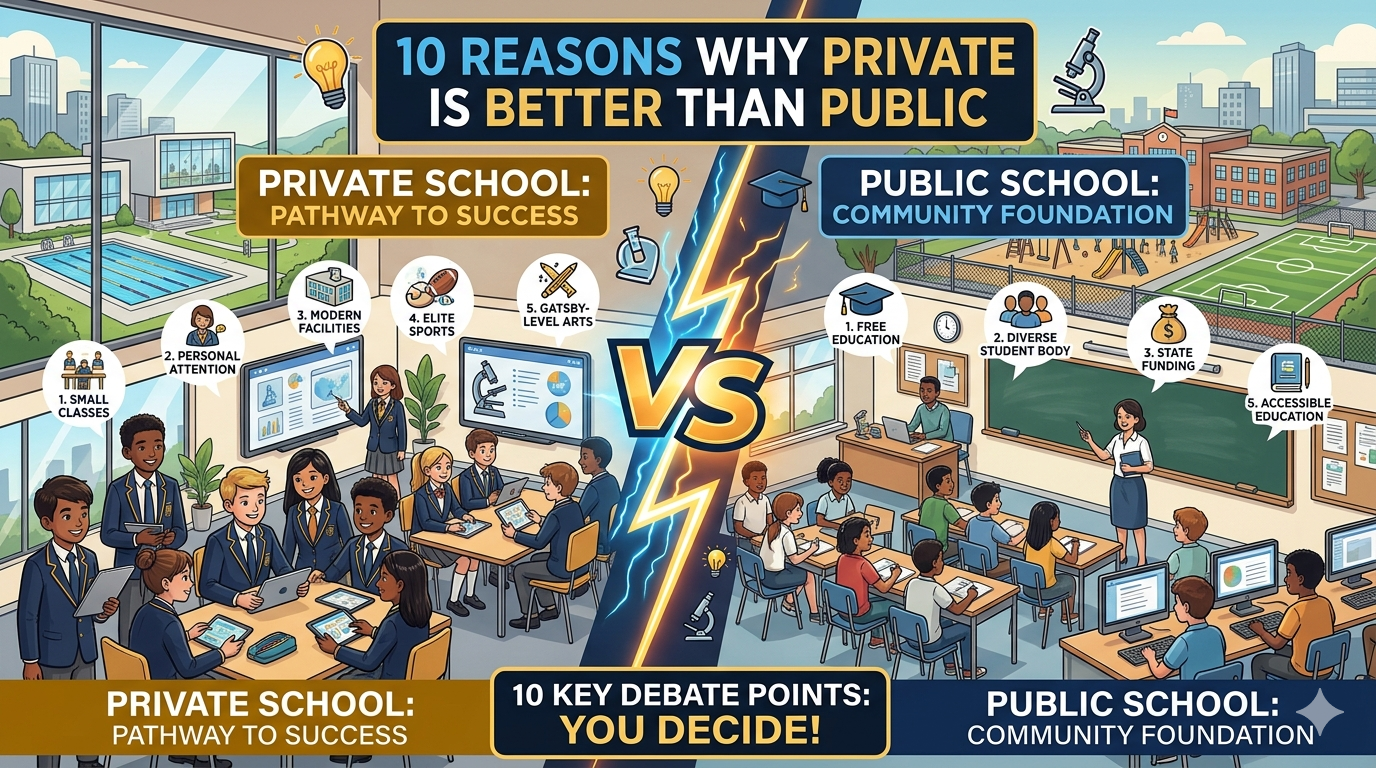
10 Reasons Why Private School Is Better Than Public School in Nigeria
A complete guide for parents, students, and debate competitors
Nigerian Education | Private vs Public School | Parents Guide | School Choice
Introduction: The School Choice That Shapes Everything
Every year, millions of Nigerian parents face one of the most consequential decisions of their child’s life: which school to enrol them in. And in that decision, the question of private school versus public school sits at the centre of the conversation. Should we stretch our budget to pay private school fees? Is public school really as bad as people say? Does it even matter which type of school a child attends, as long as they work hard?
These are real questions, and they deserve real answers. This blog post argues the case that private school, in the Nigerian context, offers significant and measurable advantages over public school — advantages that go beyond simply having cleaner toilets or nicer classrooms.
We will look at teacher quality, class sizes, academic outcomes, safety, infrastructure, character development, parental involvement, and the long-term life opportunities that each system tends to produce.
Before we begin, one important acknowledgement: this is not an argument that every Nigerian child should attend private school, or that public school is incapable of producing excellent students. Nigeria’s public school system has produced Nobel laureates, heads of state, globally distinguished professors, and some of the most brilliant professionals on the continent.
Public school students can and do excel. The argument here is not about what is possible — it is about what is typical, what is structural, and what the evidence shows when we compare the two systems honestly and at scale.
Whether you are a parent weighing school choices for your child, a student preparing for a debate on this topic, or simply someone curious about how Nigeria’s two-track education system actually works in practice, this guide gives you a comprehensive, well-reasoned, and honestly argued set of reasons why private school, for those who can access it, tends to produce better outcomes than public school in the Nigerian context.
FOR DEBATE STUDENTS: This guide argues the proposition side — private school is better than public school. A separate section at the end covers the strongest counterarguments and how to respond to them. Read both sections regardless of which side you have been assigned.
Private School vs Public School: Nigeria at a Glance
| Dimension | Private School | Public School |
| Class sizes | Typically 15–30 students per class | Often 50–80+ students per class |
| Teacher accountability | High — parents pay fees and demand results | Lower — civil service employment protections |
| Infrastructure quality | Generally good to excellent | Highly variable; often poor in public sector |
| WAEC/JAMB performance | Consistently higher pass rates | Variable; many schools struggle consistently |
| Extracurricular activities | Usually wide range available | Limited; often dependent on individual teachers |
| Parental involvement | High — fee-paying parents are engaged | Variable; often lower engagement |
| Teacher presence | High — absences are accountable | Teacher absenteeism is a documented problem |
| Safety and discipline | Usually well-managed | Variable; overcrowding creates challenges |
| Access | Requires ability to pay fees | Free; accessible to all |
| Language of instruction | Usually English medium from day one | Policy is English; practice varies by school |
Reason 1: Smaller Class Sizes Mean Every Child Gets Seen
Walk into a typical public secondary school classroom in Lagos State on any given school day, and you are likely to find fifty to eighty students crowded into a room designed for thirty.
Walk into a typical private secondary school classroom in the same city, and you are likely to find twenty to thirty students in a room with enough space for everyone to breathe, to raise their hand without being overlooked, and to receive individual attention from the teacher.
This difference — in class size — is one of the most consistently documented factors in educational research globally, and its significance cannot be overstated.
Class size affects everything: the teacher’s ability to monitor each student’s understanding in real time, the frequency with which each student can ask questions and receive individual feedback, the quality of written assignments that the teacher has time to mark in detail, and the degree to which a struggling student can receive targeted support before they fall irretrievably behind.
In a class of sixty students, a teacher who delivers a forty-minute lesson has an average of forty seconds of individual attention available for each student. In a class of twenty-five students, that average rises to nearly two minutes.
Over the course of a school year, this difference in available individual attention compounds into a massive difference in each student’s educational experience. The student in the smaller class is more likely to have their specific misunderstanding corrected, their specific question answered, and their specific learning need recognised.
In Nigeria’s private schools, smaller classes are also associated with higher teacher accountability: when each student is visible to the teacher, poor academic performance is more quickly noticed and more quickly addressed.
The child who is falling behind in mathematics in a class of twenty-five is identified and supported much earlier than the child who is falling behind in a class of sixty and can remain invisible in the crowd.
DEBATE LINE: “In a public school class of sixty, a child can fall behind for an entire term without anyone noticing. In a private school class of twenty-five, the teacher knows each student’s name, their learning style, their specific challenges. Individual attention is not a luxury — it is the engine of learning. Private school provides it. Most Nigerian public schools cannot.”
Reason 2: Teacher Quality and Accountability Are Significantly Higher
Teacher quality is, without any close competitor, the single most important determinant of student academic outcomes. Decades of educational research across countries and contexts have converged on this finding: the quality of the teacher in front of the class matters more than the curriculum, more than the textbooks, more than the school’s physical facilities, and more than the size of the education budget. A great teacher in a difficult environment produces better outcomes than a mediocre teacher in ideal conditions.
Private schools in Nigeria have structural advantages in teacher quality on two dimensions: recruitment and accountability. In recruitment, private schools are able to attract teachers who are genuinely motivated — by competitive salaries at premium institutions, by the professional environment, and by the satisfaction of teaching motivated students in manageable class sizes.
They are also able to dismiss teachers who underperform, which public school employment structures governed by civil service regulations make significantly more difficult.
In accountability, the difference is stark. The private school teacher who is regularly absent, who fails to cover the curriculum, who does not mark student work, or who cannot explain their subject clearly faces direct consequences: parental complaints, administrative scrutiny, and ultimately the possibility of dismissal. The private school’s continued revenue depends on producing satisfied parents and successful students, and teachers are evaluated accordingly.
The public school teacher operates in a very different accountability environment. Civil service employment provides significant job security that insulates teachers from direct accountability for student outcomes.
Teacher absenteeism is a documented problem in Nigerian public schools — a 2018 survey found that a significant percentage of public school teachers were absent from class on any given day. The structural incentives that drive teacher quality in private schools simply do not operate with the same force in the public system.
This is not a criticism of individual public school teachers, many of whom are dedicated professionals working heroically under difficult conditions. It is an observation about the structural incentives of the two systems. Structure shapes behaviour. Private school structures produce stronger teacher accountability.
DEBATE LINE: “The private school teacher knows that their job depends on student results. The public school teacher knows that their civil service tenure is largely secure regardless of what happens in their classroom. Which teacher has more structural incentive to prepare thoroughly, arrive consistently, teach clearly, and mark diligently? Structure answers that question. Private school structure produces better teaching.”
Reason 3: Better Infrastructure Creates Better Learning Environments
Learning does not happen in a vacuum. It happens in a physical environment — a classroom, a laboratory, a library, a computer room — whose quality directly affects the quality of the learning that takes place within it.
A student who is sitting on a broken bench, copying from a blackboard that is too faded to read clearly, in a classroom whose roof leaks during the rainy season, is not in the optimal cognitive state for learning. Discomfort, distraction, and the sheer physical difficulty of the learning environment consume cognitive resources that should be available for the lesson.
Nigerian public secondary schools face a documented infrastructure crisis. A significant proportion of public school classrooms — particularly in rural states and in less wealthy urban areas — suffer from structural disrepair, inadequate furniture, non-functional toilets, insufficient water supply, broken windows, and absent or non-functional electricity.
Science laboratories in many public schools either do not exist or contain equipment that has not been updated in decades, making practical science education impossible and leaving students to memorise theoretical knowledge about experiments they never perform. Libraries, where they exist, often contain outdated, damaged, or insufficient collections.
Private schools — particularly at the mid-range and premium levels — invest in the physical environment of learning as a direct competitive necessity. Parents paying private school fees have expectations about the learning environment they are funding, and private schools that fail to maintain adequate facilities lose students to competitors.
This market pressure produces consistently higher infrastructure standards than the public sector typically achieves, not because private school managers care more about education but because they have a direct financial incentive to maintain the environment that attracts and retains fee-paying families.
The practical educational consequences of better infrastructure are real. Students in well-equipped laboratories perform science practicals rather than simply reading about them — and the evidence that practical experience dramatically improves understanding and retention of scientific concepts is overwhelming.
Students in functioning libraries develop independent research skills and reading habits that narrow classrooms cannot cultivate. Students in comfortable, well-maintained classrooms are simply less distracted and more cognitively available for learning.
DEBATE LINE: “You cannot teach biology practicals without a functioning laboratory. You cannot develop a reading habit without a library. You cannot focus on mathematics in a leaking classroom. Nigeria’s public schools desperately lack the infrastructure that learning requires. Nigeria’s private schools, competing for fee-paying families, must provide it. Infrastructure is not a luxury — it is the foundation of teaching and learning.”
Reason 4: Examination Results Consistently Favour Private School Students
If we want to assess the educational effectiveness of the two systems in the most direct and measurable way, we can look at examination results — specifically at WAEC (West Africa Senior School Certificate Examination) and NECO (National Examinations Council) results, which are the primary gateway examinations for Nigerian secondary school graduates seeking university admission.
The data on WAEC performance in Nigeria paints a consistent and sobering picture for the public school system. Year after year, the national WAEC results show a significant gulf in five-credit pass rates — the benchmark required for university admission — between private and public school candidates.
While precise national statistics vary by year, education analysts consistently observe that private school candidates outperform public school candidates on WAEC at a national level, and that many of the schools whose students produce the strongest results are private institutions.
This gap in examination performance reflects the structural advantages of private schools discussed throughout this article: smaller classes, more accountable teachers, better infrastructure, curriculum coverage that is more consistent and more complete, and a school culture that treats examination preparation as a serious institutional priority.
In many Nigerian public schools, the curriculum is not fully covered before the examination period — particularly where teacher absenteeism is high, where strikes disrupt academic calendars, or where inadequate textbook provision slows curriculum delivery. Students arrive at WAEC examinations having been prepared for some but not all of the tested material.
Private schools, by contrast, typically maintain detailed records of curriculum coverage, conduct regular internal assessments, administer mock examinations, and provide targeted revision support in the weeks before WAEC. The examination preparation infrastructure of a well-run private school is genuinely superior, and this superiority shows up in the results.
DEBATE LINE: “WAEC results do not lie. Year after year, the schools producing the highest five-credit pass rates in Nigeria are overwhelmingly private institutions. This is not an accident of privilege — it is the measurable outcome of smaller classes, more accountable teachers, complete curriculum coverage, and systematic examination preparation. Private school students perform better because they are better prepared. That is the definition of better education.”
Reason 5: Curriculum Delivery Is More Consistent and More Complete
One of the most serious but least visible problems in Nigerian public secondary schools is the chronic incompleteness of curriculum delivery. The Nigerian secondary school curriculum — as defined by the Nigerian Educational Research and Development Council (NERDC) — is a comprehensive and reasonably well-designed document that covers the full range of subjects that students need to master for both the WAEC examination and for subsequent tertiary education. The problem is not with the curriculum on paper. The problem is with the degree to which it is actually delivered in the classroom.
In Nigerian public secondary schools, a range of factors conspire to reduce curriculum coverage below the level required for adequate examination preparation. Teacher strikes — at the state and sometimes national level — remove weeks or months of instructional time from the academic calendar without compensation.
Teacher absenteeism, which research documents at significant levels in the public sector, removes additional instructional time. Administrative disruptions, school events, and the general organisational challenges of large, under-resourced institutions further reduce the actual time that teachers spend in classrooms delivering curriculum.
The result, in many public secondary schools, is that students arrive at their WAEC examinations having studied seventy or eighty percent of the curriculum in depth and having received only superficial coverage, or no coverage at all, of the remaining twenty to thirty percent.
In WAEC examinations where comprehensive curriculum knowledge is required, this incompleteness of coverage is directly reflected in examination results.
Private schools have structural incentives to ensure complete curriculum coverage. Fee-paying parents who discover that the school has not taught significant portions of the curriculum have recourse — they can withdraw their children, withhold fees, and damage the school’s reputation.
This accountability pressure drives private schools to monitor curriculum coverage systematically, to ensure that teacher absences are covered promptly, and to prioritise classroom delivery over the administrative and organisational disruptions that affect the public sector.
DEBATE LINE: “A WAEC syllabus has a hundred topics. A public school student who has been taught eighty of them through the disruptions of strikes, absences, and administrative chaos is already twenty marks behind the student who has been taught all hundred. Private school’s accountability to fee-paying parents ensures that the curriculum is delivered. In public school, nobody is accountable for the topics the teacher never got to.”
Reason 6: Private Schools Offer Richer Extracurricular Development
Education is not only about academic instruction. The development of a well-rounded person — a person who is not just academically capable but socially skilled, physically healthy, creatively expressive, and civically aware — requires educational experiences that go beyond the classroom.
Check out:
Sports, music, drama, debate, robotics, entrepreneurship clubs, science fairs, cultural events, student government, community service, and the wide range of extracurricular activities that vibrant schools provide are not frills to be cut when budgets are tight. They are essential components of the education of a complete human being.
Nigerian public secondary schools, operating under severe resource constraints, typically provide a very limited range of extracurricular activities. Sports programmes may exist in theory but lack equipment, coaching staff, and the organisational infrastructure to deliver meaningful competitive sporting experience.
Cultural and artistic activities are often dependent on the enthusiasm of individual teachers rather than on institutional provision. Debate, science, and academic enrichment clubs rarely have the resources, the teacher support, or the physical space to operate effectively.
Private schools — particularly at the mid-range and premium levels — invest in extracurricular provision as a competitive differentiator. The private school that can demonstrate a thriving sports programme, an active drama society, a well-organised debate team, and a range of enrichment clubs has a compelling selling proposition for parents who understand that academic instruction alone does not produce the well-rounded child they want.
This market incentive drives private schools to allocate resources — teacher time, funding, physical space — to extracurricular provision in ways that the resource-constrained public sector rarely matches.
The educational value of extracurricular activities is well-documented. Sports develop physical fitness, teamwork, resilience, and the capacity to compete and cooperate — skills that are directly relevant to adult professional life.
Debate develops communication, critical thinking, and the capacity to articulate and defend positions under pressure — the foundation of advocacy in any field. Music, drama, and creative arts develop emotional intelligence, disciplined practice habits, and the confidence of public performance. These are not secondary benefits. They are primary educational outcomes.
DEBATE LINE: “The university interview panel does not only want to know your WAEC grades. They want to know who you are — what you have done, what you can do, what you care about beyond your textbooks. The private school student who captained the debate team, led the science club, played for the football team, and performed in the school drama has answers to those questions. The public school student who attended a school where none of those things existed may not.”
Reason 7: Greater Safety, Discipline, and a Positive School Culture
The learning environment of a school extends beyond the physical infrastructure of its classrooms to encompass the social environment — the quality of student-to-student relationships, the clarity and consistency of behavioural expectations, the effectiveness of discipline systems, and the overall cultural atmosphere that shapes whether students feel safe, respected, and motivated within the school community.
This social environment — what educational researchers call ‘school culture’ — is one of the strongest predictors of both academic outcomes and student wellbeing.
In many Nigerian public secondary schools, particularly those in urban areas with large and heterogeneous student populations, maintaining a positive school culture is a genuine institutional challenge. Overcrowding — which produces the physical and social friction of too many students in too little space — is associated with higher rates of conflict, bullying, and disciplinary incidents.
Overworked and underpaid teachers who are managing extremely large classes and significant administrative burdens have less emotional bandwidth for the pastoral work of building positive relationships with students and addressing the social dynamics of the school community. The result, in some public schools, is a social environment that is less safe, less structured, and less conducive to learning than students deserve.
Private schools, with smaller student populations, smaller class sizes, better teacher-to-student ratios, and the financial resources to invest in pastoral care and school culture management, typically maintain significantly more positive social environments.
Behavioural expectations are clearer and more consistently enforced. Bullying is more easily detected and more promptly addressed in smaller, more supervised environments.
The relationship between teachers and students, in a school where the teacher knows each student’s name and has time to develop genuine professional relationships, is typically warmer and more supportive than in a school where the teacher is managing sixty anonymous faces.
This difference in school culture has direct academic consequences. Students who feel safe, respected, and known in their school community are students whose psychological resources are available for learning.
See now: The Complete List of 26 Tradepreneur Subjects for WAEC: How to Choose a Profitable Skill
Students who are navigating social conflict, who feel invisible in an overcrowded system, or who exist in a school culture of low expectations and low aspiration are students whose cognitive bandwidth is partially occupied with anxiety, disengagement, or emotional management — bandwidth that should be available for education.
DEBATE LINE: “A school where students feel safe, known, and respected is a school where students can learn. Private school’s smaller populations, better ratios, and stronger pastoral investment create the social conditions for learning that overcrowded, under-resourced public schools often cannot maintain. Safety and positive culture are not nice-to-haves — they are prerequisites for education.”
Reason 8: Parental Involvement Is Higher and More Productive
The research on parental involvement and educational outcomes is one of the most consistent bodies of evidence in the entire field of educational research: parental engagement with a child’s schooling — the degree to which parents know what their child is studying, communicate with teachers, attend school events, and create a home environment supportive of learning — is among the strongest predictors of academic success. This finding holds across cultures, income levels, and educational systems. Parental involvement matters enormously.
Private schools, by their nature, attract and cultivate a higher level of parental involvement than public schools. Parents who are paying fees for their child’s education have a financial stake in the quality of that education that motivates engagement.
They are more likely to attend parent-teacher meetings — which private schools typically organise more frequently and more meaningfully than public schools. They are more likely to review their child’s progress reports, to communicate with teachers about specific academic concerns, and to arrange supplementary support when their child is struggling.
Private schools also invest more deliberately in mechanisms for parental communication. Regular detailed school reports, parent-teacher conference systems, WhatsApp groups connecting teachers with parents, school apps that allow parents to monitor attendance and academic progress, and the cultural expectation that parents are active partners in the school community — these are features of the well-managed private school that the typical public school does not replicate.
The private school that loses parental confidence loses tuition revenue; this financial incentive drives investment in the parental communication infrastructure that public schools rarely prioritise.
The child who attends a school where their parent is actively engaged, regularly informed, and in close communication with teachers has a measurably different educational experience from the child whose parents have limited engagement with the school.
The private school system tends to cultivate and sustain this engagement through its structural incentives. The public school system, with no comparable financial incentive for parental satisfaction, less frequently achieves the same level of sustained parental partnership.
DEBATE LINE: “The private school parent who receives a weekly update on their child’s progress, attends termly parent-teacher conferences, and can message the class teacher directly on WhatsApp is a partner in their child’s education. That partnership produces better outcomes than the child whose parent rarely hears from the school and does not know what their child is struggling with. Private school invests in this partnership because it must. Public school too often does not.”
Reason 9: Character Formation and Values Education Receive Deliberate Attention
The goal of education has never been simply academic instruction — the transmission of knowledge and skills for examination purposes. The goal of education, in every serious educational philosophy from Aristotle to the modern day, includes the formation of character: the development of the values, virtues, habits of mind, and ethical commitments that make a person not just knowledgeable but good.
Character formation — the intentional cultivation of honesty, responsibility, empathy, diligence, respect, and civic commitment — is as much a part of the educational mission as mathematics and English.
Many of Nigeria’s private schools — particularly those with religious or values-based foundations — take character formation as a central and explicitly stated institutional priority.
Morning assemblies that emphasise specific values, ethics and citizenship classes that are genuinely taught rather than treated as timetable filler, teacher-student relationships that include deliberate mentoring and guidance, school codes of conduct that articulate specific expected behaviours and hold students accountable to them, and the deliberate cultivation of a school ethos that models and expects particular values — these are features of many well-run Nigerian private schools that public schools, with their larger populations and heavier administrative burdens, less consistently achieve.
This investment in character formation has practical long-term consequences. The graduate of a school with a strong values ethos arrives in university and in the professional world with habits of mind — honesty in work, respect for others, personal responsibility, the expectation of ethical standards in oneself and others — that shape their professional conduct and their personal integrity throughout their lives.
Employers consistently identify character and values as among the most important qualities they seek in young professionals, and these qualities are formed in school environments that deliberately cultivate them.
DEBATE LINE: “Nigeria does not only need more educated professionals. It needs more honest, responsible, and ethically committed citizens. Character is not formed by luck — it is formed by deliberate institutional investment in the values and habits that make a person not just capable but trustworthy. Many private schools invest in this formation. It is among their most enduring contributions to the students they serve.”
Reason 10: Long-Term Life Outcomes Are Better for Private School Graduates
The ultimate measure of any school system is not its examination pass rates or its extracurricular offerings or its classroom infrastructure. The ultimate measure is what happens to its students across the full arc of their lives. Do they get into university? Which universities, and which courses? Do they enter the professions they aspired to?
Do they build careers that are satisfying and productive? Do they become the kind of citizens, professionals, and human beings that their education aimed to produce? These long-term outcomes are harder to measure than examination results, but they are the real scorecard of educational effectiveness.
The evidence on long-term outcomes for private versus public school graduates in Nigeria, while imperfect, consistently points in one direction. Graduates of well-regarded Nigerian private schools are disproportionately represented in admissions to Nigeria’s most competitive university programmes and in the top performers in JAMB Unified Tertiary Matriculation Examinations.
They are disproportionately represented in the professional graduate programmes — medicine, law, engineering, accounting — that require the strongest academic preparation. They are disproportionately represented in the cohorts of Nigerians winning competitive international scholarships, international university admissions, and professional qualifications from global institutions.
This pattern does not reflect the superiority of private school students as human beings — public school students are just as talented, just as intelligent, and just as potentially capable as private school students.
It reflects the structural advantages of private school education; smaller classes, more accountable teachers, better infrastructure, more complete curriculum coverage, stronger extracurricular development, more active parental involvement — that compound over years of schooling into a measurably superior platform for university admission and professional development.
The private school’s investment in the whole child — in academic preparation, character formation, extracurricular development, and the kind of school culture that motivates and sustains effort — produces graduates who are better prepared for the competitive demands of Nigerian university life and Nigerian professional life.
This superior preparation is not a myth. It is the measurable outcome of the structural differences between the two systems.
DEBATE LINE: “Track where Nigeria’s top JAMB scorers went to secondary school. Track where Nigeria’s competitive scholarship winners, its university gold medallists, its successful applicants to medicine and law, went to secondary school. The pattern is not universal — public schools produce brilliant students too — but the pattern is real. Better preparation produces better outcomes. Private school, at its best, provides better preparation.”
Check out: The Complete List of 26 Tradepreneur Subjects for WAEC: How to Choose a Profitable Skill
Addressing the Strongest Arguments for Public School
A complete and honest account of this debate must acknowledge the strongest arguments on the other side. Here is how to address each one.
‘Public school is free — private school excludes the poor’
This is the most powerful and most important argument for public school, and it deserves honest engagement. The equity argument is real: a society that provides genuinely excellent education only to those who can pay for it is a society that reproduces inequality across generations. This is a serious policy failure that Nigeria must address.
However, the existence of this equity problem does not make private school worse than public school for the students who attend it. It makes the underfunding of public school a social justice crisis that Nigerian governments must urgently address.
Acknowledging that private school is better for those who can access it is compatible with arguing that making that quality of education accessible to all Nigerians is a moral and political imperative.
‘Many public schools produce excellent results’
True — and this is not disputed. Nigeria’s best public schools, including Federal Government Colleges and some of the best state government schools, produce results that are genuinely competitive with private schools.
The argument here is about typical outcomes across the two systems at scale, not about the best performers in each. When we compare average outcomes across all Nigerian public and private schools, the private school advantage is real and consistent.
The existence of excellent public schools does not erase the overall pattern any more than the existence of excellent public hospitals erases the overall differences in healthcare quality between public and private health systems.
‘Hard work matters more than which school you attend’
Absolutely true — and also not disputed. A motivated, disciplined student will succeed in a challenging environment, and an unmotivated student will underperform in an excellent one. But this argument applies to individuals, not to systems.
When we ask which system, on average, supports student success more effectively, the answer involves the structures that support or undermine individual effort — smaller classes that make individual effort more visible and more rewarded, more accountable teachers who create environments that motivate effort, better resources that make individual effort more productive.
Individual effort is the engine. School quality is the vehicle. Better vehicles produce better outcomes, even with the same engine.
‘Private schools vary enormously in quality’
This is entirely accurate. Nigeria’s private school sector includes institutions ranging from genuinely excellent schools with strong teaching, good facilities, and impressive outcomes, to exploitative operators who charge significant fees while providing conditions that are not meaningfully superior to the public schools they are supposedly replacing.
Not every school with ‘private’ in its description is good. The argument for private school is an argument for the structural advantages of a well-run private school system, not for every institution that calls itself private.
Parents choosing private school must investigate the specific institution as thoroughly as we have argued parents should investigate boarding schools — and should apply the same scepticism to reputation and prospectus self-presentation.
Tips for Arguing This Debate Topic
If you are using this article to prepare for a debate competition on private school versus public school, here are the strategies that will make your arguments most effective.
1. Lead with structural arguments, not anecdotes
The strongest arguments for private school are structural — they are about how the system works, what incentives it creates, and what outcomes it produces across large numbers of students.
Avoid building your case primarily on individual examples like ‘my cousin went to a private school and got into medicine’ — these are anecdotes that the opposition can match with equal and opposite anecdotes. Build your case on structural patterns: class sizes, teacher accountability systems, curriculum coverage, and examination outcome trends.
2. Acknowledge the equity argument honestly
The strongest argument for public school is the equity argument — that education should be equally excellent and equally accessible for all Nigerian children regardless of family income. This argument is powerful, and debaters who dismiss it or pretend it does not exist will lose credibility with judges who take educational justice seriously.
Acknowledge the equity argument genuinely — then argue that acknowledging the inadequacy of public school provision is the beginning of the argument for improving it, not a reason to pretend that private school is not better for those who can access it.
3. Use Nigerian-specific data
Judges in Nigerian competitions respond strongly to Nigerian-specific evidence. Reference WAEC pass rate trends, the performance of specific categories of schools in national examinations, the documented challenges of teacher absenteeism in the public sector, and the infrastructure crisis in Nigerian public schools.
This specific, locally grounded evidence is more persuasive than generic international comparisons.
4. Define ‘better’ carefully
‘Better’ is the key word in this debate, and the strongest debaters define it precisely. ‘Private school is better in the sense that it more consistently produces the academic outcomes that enable university admission, professional qualification, and career success for the students who attend it.’
This specific definition is defensible with evidence and is more persuasive than a vague claim that private school is generally superior.
See more: How to Avoid Daydreaming/Zoning Out in the Library: A Student’s Guide to Staying Focused
Frequently Asked Questions
Is this debate topic common in Nigerian schools?
Yes, it appears with increasing frequency in Nigerian secondary school debate competitions, particularly at the secondary school level, where the topic has direct personal relevance to most students. It also appears in university debate competitions and in policy discussions about Nigerian education reform. The topic tends to generate passionate arguments because most Nigerian students have either experienced both systems or know people who have, giving them direct rather than abstract knowledge of the comparison.
Do all private schools in Nigeria provide better education than public schools?
No. Nigeria’s private school sector includes a wide range of institutions, and some private schools — particularly those charging low fees in low-income communities — provide conditions that are not significantly better than local public schools. The advantages of private school discussed in this article apply most clearly to well-managed private schools with meaningful fee levels, genuine accountability systems, and the resources to maintain smaller classes, qualified teachers, and adequate infrastructure. Parents choosing private school should investigate the specific institution thoroughly rather than assuming that any private school is automatically superior to local public alternatives.
Can public schools be as good as private schools?
Yes — and some are. Nigeria’s best Federal Government Colleges and the top state government schools in well-resourced states produce results that are competitive with good private schools. The argument in this article is about typical patterns across the two systems at scale, not about the ceiling of what public school can achieve when it is well-resourced, well-managed, and well-staffed. The argument for improving Nigerian public schools is entirely compatible with the argument that, as currently constituted and funded, the average private school provides a better educational experience than the average public school.
What should parents look for in a private school?
The most important factors to investigate when choosing a private school in Nigeria are: genuine class sizes (not advertised sizes, visit and count the students), recent WAEC and internal examination results, teacher qualifications and teacher turnover rates, the physical condition of classrooms, laboratories, and sanitary facilities, the quality and consistency of parent communication, the school’s extracurricular programme and how actively it is delivered, and the testimony of current parents and recent alumni about their actual experience. A school that is genuinely good has nothing to hide and will welcome thorough parental investigation.
Read now: How to Avoid Daydreaming/Zoning Out in the Library: A Student’s Guide to Staying Focused
Conclusion: Choose Well, Advocate Loudly, Expect More
The ten reasons in this article build a compelling case that private school, in the Nigerian context, tends to provide a better educational experience than public school for the students who attend it.
Smaller classes, more accountable teachers, better infrastructure, more consistent curriculum delivery, stronger examination performance, richer extracurricular provision, better school culture, more active parental involvement, deliberate character formation, and better long-term outcomes, these are structural advantages of the private school system that show up consistently when we compare the two systems honestly and at scale.
But this case comes with an important caveat. The fact that private school tends to be better in Nigeria is not something Nigerians should comfortably accept. It is something they should be angry about.
A country in which the quality of a child’s education is so strongly determined by their family’s ability to pay for it is a country that is failing its most fundamental obligation to its children.
The gap between Nigerian private and public school education is not a natural feature of educational systems — it is the accumulated consequence of decades of governmental underinvestment in public education, of chronic neglect of teacher training and remuneration, and of the failure to provide the resources that public schools need to compete on quality.
The honest conclusion is this: if you can access a good private school for your child, do. The structural advantages are real and they matter for your child’s outcomes. But also advocate — loudly, persistently, and politically — for public schools that are good enough that no Nigerian parent needs to choose between their child’s education and their family’s financial health. Both things are true. Both things matter. This article argues one; it does not dismiss the other.
Every Nigerian child deserves an excellent education. Private school is better now. Public school must become better too.
Education: 10 Reasons Why Private School Is Better Than Public School in Nigeria | Parents, Students & Debate Guide