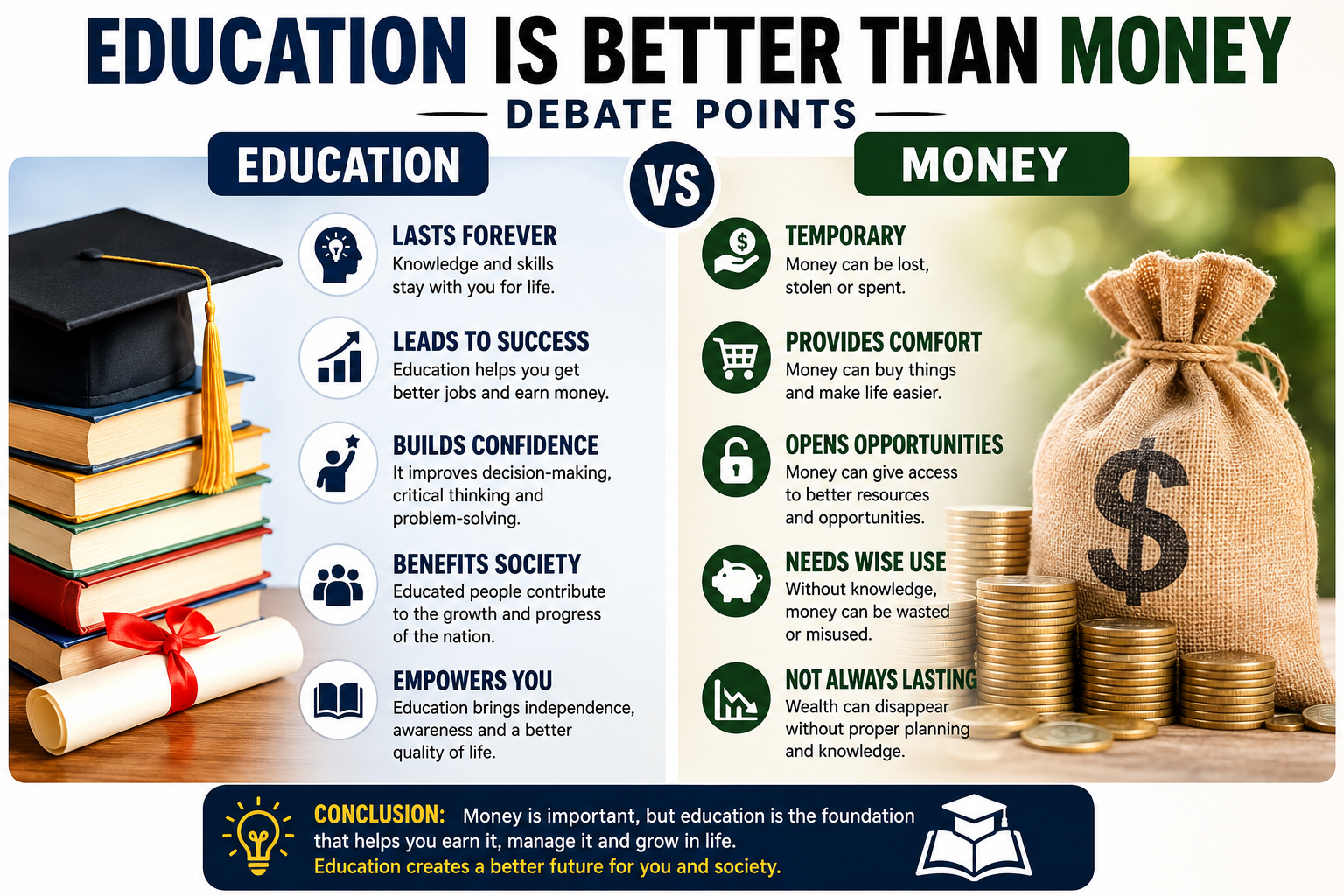
Money is important. No one can deny that. It pays bills, provides comfort, and gives people access to opportunities. But when it comes to choosing between education and money, many people argue that education is far more valuable in the long run.
Why?
Because education creates the knowledge, skills, confidence, and opportunities that can eventually lead to financial success — while money without education can disappear quickly.
This debate has been discussed in schools, public speaking competitions, and classrooms for years. Some believe wealth is everything, while others argue that education is the true foundation of success.
In this article, we’ll explore powerful debate points explaining why education is better than money, along with real-life examples, persuasive arguments, and balanced explanations that can help students, teachers, and debate participants.
What Does Education Really Mean?
See more: How to Avoid Daydreaming/Zoning Out in the Library: A Student’s Guide to Staying Focused
Education is more than attending school or earning certificates. It is the process of gaining:
- Knowledge
- Critical thinking skills
- Wisdom
- Communication abilities
- Problem-solving techniques
- Personal development
Education shapes how people think and make decisions.
Money, on the other hand, is a tool. It can buy comfort and convenience, but it cannot automatically provide wisdom, discipline, or understanding.
That’s one of the strongest reasons many people believe education is more important.
Education Creates Long-Term Success
One major debate point is that education provides lasting benefits, while money can be temporary.
A wealthy person can lose money through:
- Bad investments
- Poor decisions
- Economic problems
- Lack of financial knowledge
But education stays with a person for life.
An educated individual can rebuild wealth even after financial loss because they possess valuable skills and knowledge.
For example, a doctor, engineer, lawyer, or entrepreneur may lose money during a crisis but still have the education needed to recover financially.
This shows that education creates sustainable success.
Education Helps People Earn Money
Ironically, one of the strongest arguments for education is that it often leads to money.
Most high-paying careers require some level of education or specialized training.
Examples include:
- Medicine
- Engineering
- Technology
- Law
- Finance
- Aviation
- Architecture
Without education, accessing many of these professions becomes difficult.
Education gives people the ability to:
- Build careers
- Start businesses
- Solve problems
- Create inventions
- Increase earning potential
Money alone cannot teach these abilities.
Knowledge Cannot Be Stolen
Money can be stolen, spent, or lost.
Education cannot.
This is one of the most powerful debate points students often use.
A person may lose their bank account, property, or business, but the knowledge and skills they have gained remain in their mind forever.
That knowledge can help them recover and succeed again.
Education becomes a permanent asset that nobody can take away.
Education Builds Confidence and Decision-Making Skills
Educated people are often better equipped to:
- Analyze situations
- Make informed choices
- Communicate effectively
- Solve challenges logically
Education improves confidence because people understand the world around them better.
Money may provide temporary power, but education helps people develop wisdom and judgment.
An uneducated wealthy person may still make poor decisions because financial wealth does not automatically equal intelligence.
Education Improves Society
Another important debate point is that education benefits not just individuals, but society as a whole.
Educated citizens contribute positively through:
- Innovation
- Leadership
- Scientific discoveries
- Better healthcare
- Economic growth
- Social development
Countries with strong education systems often experience:
- Lower crime rates
- Better healthcare systems
- Improved economies
- Technological advancement
Education drives national progress.
Money alone cannot develop a country if people lack the knowledge to use resources wisely.
Education Promotes Independence
People with education are often more independent because they possess valuable skills.
They can:
- Find jobs
- Create opportunities
- Adapt to change
- Learn new technologies
- Solve problems independently
Without education, many people become overly dependent on others for survival or guidance.
Education empowers individuals to think and act for themselves.
Money Without Education Can Be Dangerous
History has shown that money without knowledge can lead to:
- Financial irresponsibility
- Fraud
- Poor investments
- Corruption
- Wasteful lifestyles
Many lottery winners and wealthy individuals have gone bankrupt because they lacked financial education and discipline.
Education teaches people how to manage money wisely.
So in many ways, education controls money — not the other way around.
Education Encourages Innovation
Most inventions and technological advancements come from educated minds.
Think about:
- Computers
- Smartphones
- Medical treatments
- Artificial intelligence
- Renewable energy
- Space exploration
These achievements were made possible through education, research, and learning.
Money can fund innovation, but education creates it.
Without educated individuals, many modern conveniences would not exist.
Education Helps Reduce Poverty
One of the biggest tools for escaping poverty is education.
When people gain access to quality education, they often improve their:
- Career opportunities
- Income levels
- Living conditions
- Financial stability
Education provides people with skills that can generate lifelong income.
This is why many governments and organizations invest heavily in schools and educational programs.
They understand that education creates economic growth and social mobility.
Education Develops Character
Education does not only teach academic subjects. It also helps shape:
- Discipline
- Patience
- Responsibility
- Leadership
- Teamwork
- Respect
These qualities are important for success in life.
Money alone cannot teach moral values or character development.
A person may be rich yet lack integrity, empathy, or wisdom.
Education helps people become more balanced individuals.
Why Is Education More Important Than Wealth?
Read also: How to Use the Pomodoro Technique to Crush WAEC and JAMB (Without Burning Out)
Education is often considered more important than wealth because it provides long-term value.
Wealth can disappear quickly, but education equips people with the skills needed to recover and succeed again.
Education also improves thinking ability, communication, and personal growth.
In many cases, education becomes the pathway to creating wealth in the first place.
Can Money Replace Education?
Money can buy access to schools, books, and opportunities, but it cannot replace actual learning.
A wealthy person who refuses to learn may still struggle with:
- Poor decisions
- Lack of critical thinking
- Financial mistakes
Education provides understanding, while money is simply a resource.
The two work best together, but education often comes first.
Is Education the Key to Success?
For many people, yes.
Education opens doors to careers, entrepreneurship, and personal development.
While success can come in different ways, education increases the chances of making informed decisions and achieving long-term goals.
It also helps people adapt in a rapidly changing world.
Why Do Students Debate Education vs Money?
This debate remains popular because both education and money are important in life.
Students discuss:
- Which one creates lasting success
- Which is more valuable
- Whether knowledge matters more than wealth
The topic encourages critical thinking and helps students understand the relationship between learning and financial success.
Can an Educated Person Become Rich?
Absolutely.
Education often improves earning potential by helping people gain specialized skills and professional qualifications.
Many wealthy individuals became successful because of the knowledge and experience they developed over time.
Even entrepreneurs who did not complete formal education usually spent years learning practical skills and business strategies.
See more: Education Is a Scam vs Education Is the Key: A Balanced Debate for Today’s World
Counterargument: Why Some People Think Money Is Better
To create a balanced debate, it’s important to understand the opposing side.
Some people argue that money is better because:
- It solves immediate problems
- It provides comfort
- It gives access to opportunities
- It can fund education
There is truth in this argument.
Without money, accessing quality education can become difficult.
However, many debate participants respond by saying that education helps people generate wealth repeatedly, while money without knowledge may not last.
Real-Life Examples Supporting Education
1. Successful Entrepreneurs
Many successful business leaders emphasize learning, research, and continuous self-improvement.
2. Professionals in High-Paying Careers
Doctors, engineers, pilots, and software developers rely heavily on education and training.
3. Countries With Strong Education Systems
Nations investing in education often achieve stronger economies and technological growth.
These examples support the idea that education drives both individual and national success.
Best Conclusion for “Education Is Better Than Money” Debate
Education is better than money because it creates knowledge, wisdom, confidence, and opportunities that last a lifetime. While money is important, it can be lost or misused without proper understanding.
Education helps people earn money, solve problems, improve society, and build a better future. It empowers individuals with skills that remain valuable regardless of financial circumstances.
In the end, money may provide comfort, but education provides the foundation for lasting success and meaningful progress.