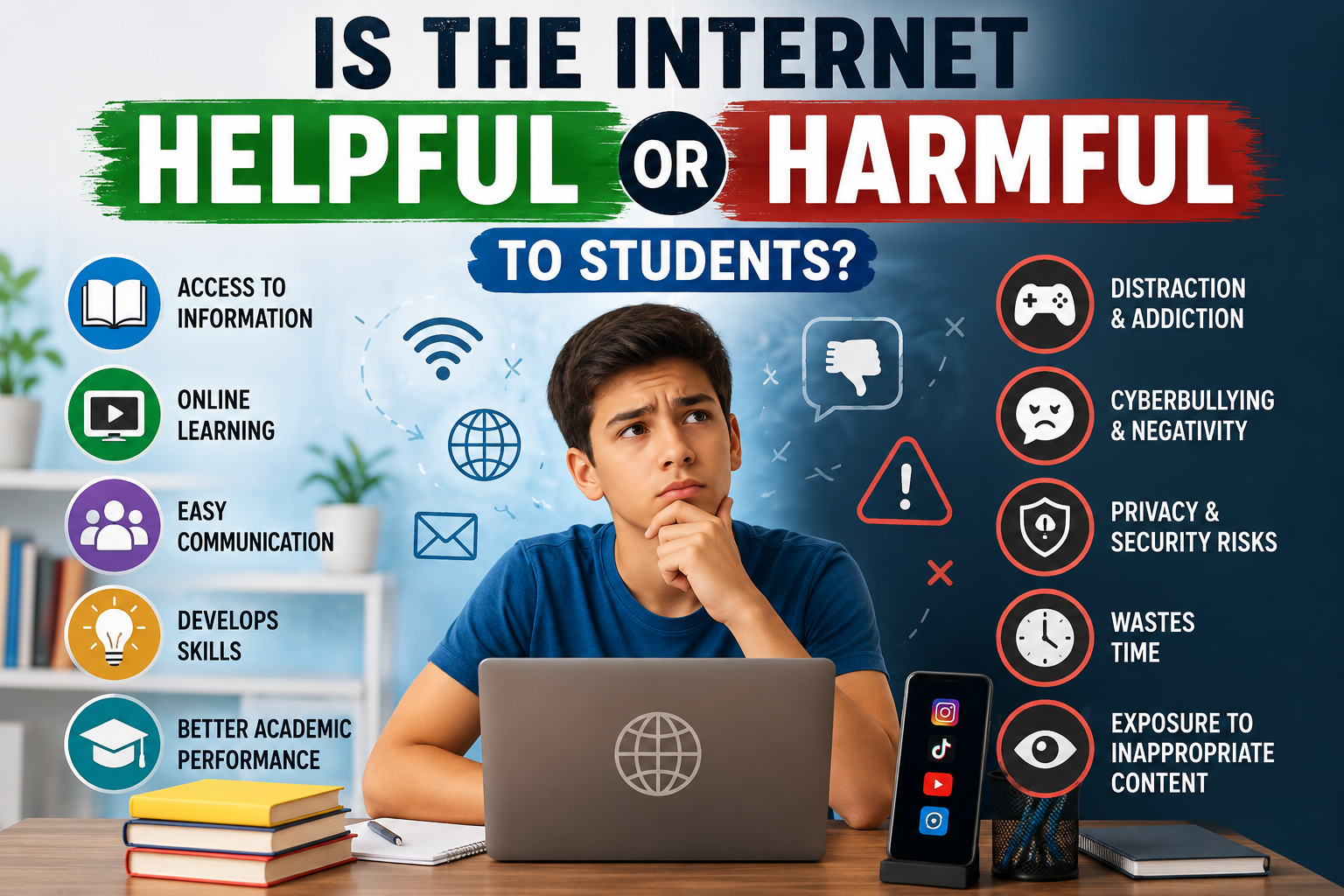
The internet has become one of the most important tools in the lives of students today.
A secondary school student can use a smartphone or computer to research homework, watch educational videos, communicate with classmates, learn a new skill, read the news, or prepare for an examination. Within seconds, students can access information that once required hours in a library.
But the internet also has another side.
Students can become distracted by social media, spend too much time playing games, come across false information, experience cyberbullying, or even develop unhealthy internet habits.
This raises an important question:
Is the internet helpful or harmful to students?
The truth is that the internet can be both helpful and harmful. What matters most is how students use it.
When used wisely, the internet can improve education, communication, creativity, and access to knowledge. When used carelessly, however, it can negatively affect academic performance, mental health, privacy, and relationships.
Let us look at both sides.
How Is the Internet Helpful to Students?
See now How to Use the Cornell Method to Take Better Lecture Notes (A Guide for Nigerian Students)
The internet offers many benefits to secondary school students.
Here are some of the most important ones.
1. The Internet Makes Research Easier
One of the biggest advantages of the internet is easy access to information.
Students can search for information about almost any school subject, including:
Mathematics,
English,
Biology,
Chemistry,
Physics,
Geography,
History,
Government,
Economics,
And literature.
Instead of depending only on one textbook, students can explore different explanations from websites, online libraries, videos, and educational platforms.
For example, a student who does not understand a topic taught in class can search for another explanation online.
This can make learning easier.
However, students must also learn to check whether the information they find is accurate.
Not every website provides correct information.
2. Students Can Learn Through Educational Videos
Sometimes reading a textbook is not enough.
A student may understand a difficult topic better by watching someone explain it.
Educational videos can help students understand topics such as:
Chemical reactions,
Mathematical equations,
Human anatomy,
Computer programming,
Essay writing,
And scientific experiments.
Visual learning can be especially useful for students who find certain subjects difficult.
A video can show a process step by step, allowing the student to pause, rewind, and watch again.
This gives students more control over how they learn.
3. The Internet Helps Students Prepare for Exams
Many students use the internet to prepare for examinations.
They can find:
Past questions,
Practice tests,
Revision notes,
Study guides,
Educational apps,
And online lessons.
Students preparing for examinations such as WAEC, NECO, JAMB, GCSE, or other school tests may use online resources to strengthen their knowledge.
For example, solving past examination questions can help a student understand the type of questions likely to appear in an exam.
The internet can therefore be a powerful study tool when used properly.
4. Students Can Learn New Skills
Education does not only happen inside a classroom.
The internet allows students to learn skills that may not be taught in school.
A student can learn:
Graphic design,
Coding,
Photography,
Video editing,
Public speaking,
Music,
Writing,
Animation,
Digital marketing,
Foreign languages,
And many other skills.
Some young people have even started businesses or careers because of skills they first learned online.
This means the internet can help students discover talents and interests beyond their normal school subjects.
5. The Internet Improves Communication
The internet makes communication faster and easier.
Students can communicate with:
Teachers,
Classmates,
Study groups,
Family members,
And educational communities.
Teachers may share assignments, notes, or announcements through online platforms.
Students can also work together on group projects without being in the same physical location.
This can make learning more convenient.
However, students should still learn how to communicate respectfully and responsibly online.
6. Students Can Access Online Libraries
Before the internet became widely available, students had to depend mostly on physical libraries.
Today, many books, articles, dictionaries, encyclopedias, and academic materials are available online.
Students can access information from different parts of the world without leaving their homes.
This can be especially helpful when a local library does not have the required book.
Online libraries can help students improve their research and reading habits.
7. The Internet Encourages Independent Learning
The internet gives students the ability to take responsibility for their own education.
A curious student does not always have to wait for a teacher to explain everything.
They can search for answers.
They can explore topics beyond the school curriculum.
They can ask questions.
They can learn at their own speed.
This helps students develop independence.
A student who learns how to find reliable information online may become a stronger problem-solver.
8. The Internet Can Make Learning More Interesting
Learning does not always have to involve reading long pages of text.
The internet provides interactive tools such as:
Educational games,
Quizzes,
Animations,
Simulations,
Videos,
And virtual experiments.
These resources can make difficult topics more interesting.
For example, instead of only reading about the solar system, a student may watch an animation showing how planets move around the sun.
This can make learning easier to remember.
9. Students Can Learn About the World
The internet connects students to information about other countries, cultures, people, and events.
Students can learn about:
Different traditions,
Historical events,
Scientific discoveries,
World geography,
International news,
And global issues.
This can help students become more informed and open-minded.
It can also help them understand that the world is much bigger than their immediate environment.
10. The Internet Can Create Future Opportunities
Students can use the internet to discover:
Scholarships,
Competitions,
Online courses,
University information,
Career opportunities,
Internships,
And educational programs.
A student may find a scholarship opportunity online that changes their future.
Another student may discover a career they had never heard of before.
The internet can therefore open doors that students may not have known existed.
Check out The Lekki Headmaster: Themes and Symbolism (Complete Literature Guide)
How Can the Internet Be Harmful to Students?
Although the internet has many benefits, it can also create serious problems.
These problems often occur when students use the internet without limits or guidance.
1. The Internet Can Distract Students From Their Studies
One of the biggest dangers of the internet is distraction.
A student may pick up a phone to research homework but quickly move to:
Social media,
Games,
Videos,
Chatting,
Or entertainment.
Before long, one hour may pass without any studying.
Too much online entertainment can reduce the amount of time students spend:
Reading,
Doing assignments,
Sleeping,
Exercising,
Or preparing for exams.
This can affect academic performance.
Students need discipline when using the internet.
2. Social Media Can Become Addictive
Social media can be enjoyable, but it can also become difficult to control.
Some students constantly check:
Messages,
Likes,
Comments,
Videos,
And notifications.
They may feel uncomfortable when they are not online.
This can affect concentration.
A student who constantly checks a phone while studying may struggle to understand or remember information.
Students should learn to create limits around social media use.
3. Students May Find False Information
The internet contains a huge amount of information.
Unfortunately, not all of it is true.
Some websites publish:
False news,
Incorrect facts,
Misleading advice,
Fake stories,
And outdated information.
Students who copy information without checking the source may include false facts in assignments.
This is why digital literacy is important.
Students should compare information from several reliable sources before accepting something as true.
4. Cyberbullying Can Harm Students
Bullying does not only happen at school.
It can also happen online.
Cyberbullying may include:
Insults,
Threats,
Embarrassing posts,
Rumours,
Fake accounts,
Sharing private photos,
Or sending hurtful messages.
Online bullying can be especially painful because the messages may reach many people very quickly.
It can affect a student’s confidence, mental health, and school performance.
Students who experience cyberbullying should speak to a trusted adult, teacher, parent, or guardian.
They should not suffer in silence.
5. The Internet Can Reduce Face-to-Face Communication
If students spend too much time online, they may spend less time talking to people in real life.
Good communication skills develop through:
Conversation,
Listening,
Eye contact,
Teamwork,
And social interaction.
Students need real-life relationships.
The internet should support communication, not replace every face-to-face interaction.
6. Students May Be Exposed to Inappropriate Content
The internet contains content that may not be suitable for young people.
Students may accidentally or intentionally come across:
Violence,
Pornographic material,
Dangerous challenges,
Hate speech,
Or harmful online communities.
Some of this content can negatively influence attitudes and behaviour.
Parents, schools, and students all have a role to play in promoting safe internet use.
7. Online Scams Can Target Students
Not everyone online is honest.
Students may encounter:
Fake giveaways,
Fraudulent job offers,
Phishing messages,
Fake online shops,
Identity theft,
And money scams.
A message may promise a free phone, scholarship, game reward, or cash prize.
Then it asks for personal information.
Students should never share sensitive information with strangers online.
This includes:
Passwords,
Bank details,
Home address,
Private photos,
Or identification information.
8. Too Much Screen Time Can Affect Health
Spending long hours on phones, tablets, or computers may affect health.
Students may experience:
Poor sleep,
Eye strain,
Headaches,
Neck pain,
Lack of exercise,
And tiredness.
Using a phone late at night can also interfere with sleep.
Poor sleep can make it harder to concentrate in class.
Students should take breaks, exercise, and avoid spending every free moment in front of a screen.
See also Art Is Better Than Science: 15 Powerful Reasons Creativity Shapes the World
9. Students May Become Too Dependent on the Internet
The internet makes finding answers easy.
Sometimes, too easy.
If students immediately search for every answer, they may stop thinking deeply.
For example, instead of solving a mathematics problem, a student may search for the answer.
Instead of writing an essay, they may copy one online.
Instead of thinking about a question, they may ask an artificial intelligence tool to do everything.
Technology should support thinking, not replace it.
Students still need to develop:
Critical thinking,
Creativity,
Problem-solving,
Writing,
And independent reasoning.
10. Cheating and Plagiarism Become Easier
The internet makes it easy to copy someone else’s work.
A student may copy an entire essay, assignment, or project.
This is called plagiarism.
It may help the student complete an assignment quickly, but it prevents real learning.
The student may receive marks without actually understanding the subject.
Schools increasingly use tools to detect copied work.
Students should use online information for research, then write answers in their own words.
Is Social Media Good or Bad for Students?
Social media can be both.
It can help students:
Communicate,
Learn,
Share ideas,
Join educational communities,
And discover useful information.
But it can also create:
Distraction,
Peer pressure,
Cyberbullying,
Unrealistic comparisons,
And addiction.
The key is balance.
Students should control social media instead of allowing social media to control them.
Does the Internet Improve Students’ Academic Performance?
The internet can improve academic performance when students use it for educational purposes.
Students may benefit from:
Online tutoring,
Research,
Past questions,
Educational videos,
Digital textbooks,
And study apps.
However, the internet can also reduce academic performance if most online time is spent on entertainment.
The same device that helps a student study can also distract them.
The difference comes down to how it is used.
Should Students Be Allowed to Use the Internet at School?
Yes, but with proper rules.
Internet access can make learning more effective.
Students can:
Research topics,
Use digital textbooks,
Watch educational materials,
Take online tests,
And access learning platforms.
However, schools should have clear rules.
Students should not use school internet access for:
Gaming during lessons,
Cyberbullying,
Cheating,
Or inappropriate websites.
Schools should teach students responsible digital behaviour.
See more Farmer vs Doctor: 10 Compelling Reasons Why the Doctor Is More Important
What Are the Advantages of the Internet for Students?
The main advantages include:
Easy access to information.
Online learning.
Exam preparation.
Skill development.
Faster communication.
Educational videos.
Digital libraries.
Career information.
Scholarship opportunities.
Independent learning.
These benefits make the internet one of the most powerful educational tools available to students today.
What Are the Disadvantages of the Internet for Students?
The main disadvantages include:
Distraction.
Social media addiction.
False information.
Cyberbullying.
Online scams.
Inappropriate content.
Poor sleep.
Too much screen time.
Reduced face-to-face interaction.
Cheating and plagiarism.
These problems do not mean students should avoid the internet completely.
They mean students need to use it responsibly.
How Can Students Use the Internet Safely?
Students can follow some simple rules.
Use strong passwords.
Do not share private information with strangers.
Avoid suspicious links.
Check whether information comes from a reliable source.
Tell a trusted adult about cyberbullying.
Limit social media time.
Do not meet online strangers without parental knowledge.
Think carefully before posting photos or personal information.
Remember that something posted online may remain there for years.
Digital safety is an important part of modern education.
How Can Students Balance Internet Use and Studying?
Students should create boundaries.
One useful method is to decide exactly what the internet will be used for before going online.
For example:
“I am going online for 30 minutes to research photosynthesis.”
After completing the task, the student can take a break.
Other helpful habits include:
Turning off unnecessary notifications.
Keeping phones away during serious study.
Using a study timetable.
Taking regular breaks.
Avoiding social media during homework.
Getting enough sleep.
Setting daily screen-time limits.
Good habits can turn the internet from a distraction into a powerful learning tool.
Is Artificial Intelligence Helpful or Harmful to Students?
Artificial intelligence is becoming an important part of the internet.
AI tools can help students:
Understand difficult topics,
Generate practice questions,
Improve grammar,
Summarize information,
And explore ideas.
However, AI can become harmful if students use it to avoid learning.
For example, asking AI to write an entire assignment and submitting it without understanding the work may damage the student’s education.
Students should use AI like a tutor.
Ask for explanations.
Ask questions.
Check answers.
Learn from the information.
Do not allow technology to do all the thinking.
See more JAMB 2026 Novel Summary: The Lekki Headmaster by Kabir Alabi Garba (Complete Guide)
Final Verdict: Is the Internet Helpful or Harmful to Students?
The internet itself is neither completely good nor completely bad.
It is a tool.
A tool can be used wisely or poorly.
When students use the internet for:
Research,
Learning,
Communication,
Skill development,
Exam preparation,
And educational opportunities,
it can be extremely helpful.
But when students spend too much time on:
Social media,
Games,
Entertainment,
Unsafe websites,
Or dishonest academic practices,
the internet can become harmful.
The best approach is balance.
Students should not be afraid of technology.
They should learn how to control it.
Use the internet to learn.
Use it to explore.
Use it to develop useful skills.
Use it to discover opportunities.
But also know when to put the phone down.
Read a book.
Talk to people.
Exercise.
Sleep.
Think independently.
And spend time in the real world.
So, is the internet helpful or harmful to students?
The best answer is:
The internet is helpful when students use it responsibly, but it can become harmful when it controls their time, attention, and behaviour.
The internet should be a tool for students.
Students should never become tools of the internet.