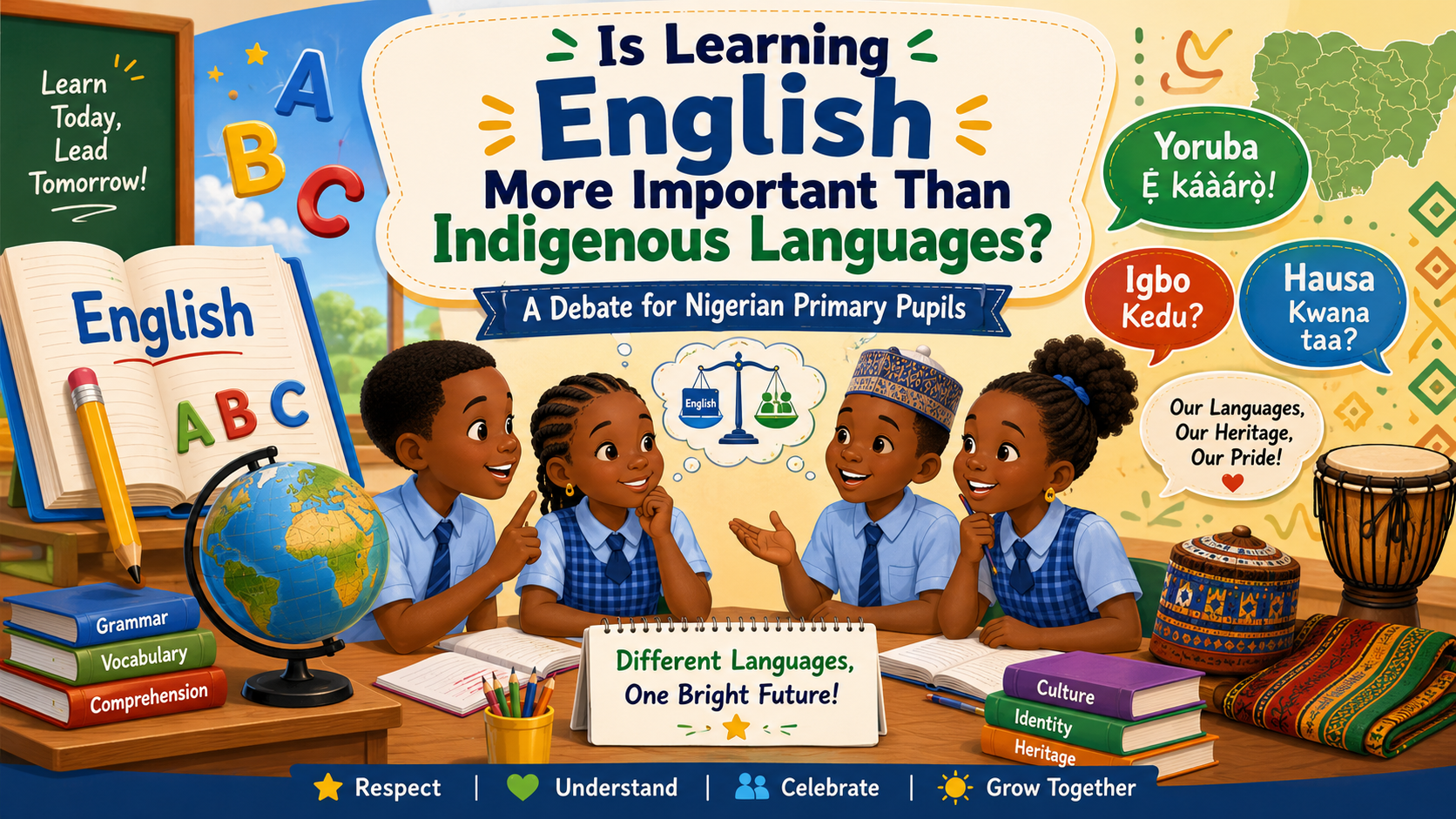
Nigeria is a country with many languages.
People speak Yoruba, Igbo, Hausa, Efik, Tiv, Urhobo, Ijaw, Fulfulde, Ibibio, Edo, Kanuri, Nupe, and many other indigenous languages. At the same time, English is the official language used in many Nigerian schools, offices, courts, banks, and government institutions.
This raises an important debate question:
Is learning English more important than learning indigenous languages?
Some people believe English is more important because it helps Nigerians communicate with people from different ethnic groups and other countries. Others believe indigenous languages are equally important because they protect our culture, history, identity, and traditions.
The best answer is that Nigerian children need both.
English is important for education, national communication, technology, and international opportunities. Indigenous languages are also important because they connect children to their families, communities, and cultural roots.
Let us examine both sides of the debate.
Meaning of English and Indigenous Languages
English is a language used in many countries around the world. In Nigeria, it is commonly used in schools, businesses, government offices, newspapers, television programmes, and official communication.
An indigenous language is a language that belongs to the original people of a particular area.
Examples of Nigerian indigenous languages include:
- Hausa
- Yoruba
- Igbo
- Tiv
- Ibibio
- Fulfulde
- Kanuri
- Edo
- Nupe
- Efik
- Ijaw
- Urhobo
These languages have been spoken by Nigerian communities for many generations.
Why Some People Believe English Is More Important
There are several reasons people believe learning English is more important than learning indigenous languages.
1. English Helps Nigerians Communicate With One Another
Nigeria has hundreds of languages.
A Yoruba-speaking child may not understand Hausa. An Igbo-speaking pupil may not understand Tiv. English provides a common language that people from different ethnic groups can use.
For example, a pupil from Lagos can use English to communicate with another pupil from Kano, Enugu, Jos, Calabar, or Port Harcourt.
Without a common language, communication across the country would be more difficult.
2. English Is Used in Many Nigerian Schools
Most subjects in Nigerian schools are taught in English, especially in the upper primary and secondary classes.
Subjects such as:
- Mathematics
- Basic Science
- Social Studies
- Civic Education
- Computer Studies
- Agricultural Science
are often taught and examined in English.
A pupil who understands English well may find it easier to read textbooks, answer examination questions, follow instructions, and express ideas clearly.
3. English Is Important for Examinations
Many school tests and national examinations are written in English.
Pupils need English to understand questions and write good answers.
Even when a child knows the correct answer, poor understanding of English may make it difficult to explain that answer properly.
Strong English skills can therefore improve a pupil’s academic performance.
4. English Is an International Language
English is spoken in many parts of the world.
It is used in countries such as:
- Nigeria
- Ghana
- South Africa
- the United Kingdom
- the United States
- Canada
- Australia
A Nigerian child who speaks English well may find it easier to communicate with people from other countries.
English can also help students who later want to study, work, travel, or do business internationally.
See more Best Universities in Nigeria for Medicine
5. English Is Useful for Technology
A large amount of information on the internet is written in English.
Many computer programs, educational websites, mobile applications, and online courses also use English.
A pupil who understands English can search for information, watch educational videos, learn digital skills, and use technology more confidently.
English can help children learn:
- Coding
- Graphic design
- Science
- Mathematics
- Writing
- Public speaking
- Foreign subjects
It opens the door to a large amount of knowledge.
6. English Can Create Career Opportunities
Many jobs in Nigeria require workers to speak, read, and write English.
Doctors, lawyers, teachers, bankers, engineers, journalists, pilots, civil servants, and businesspeople often use English at work.
A child who learns English well may have more opportunities in the future.
Good English can also help people write applications, attend interviews, prepare reports, and communicate professionally.
7. English Helps Government and Business
Nigeria is made up of many ethnic groups.
English is often used in:
- Government meetings
- Official documents
- Business agreements
- Court proceedings
- Banking
- National newspapers
- Public announcements
This helps different parts of the country work together.
Why Indigenous Languages Are Also Important
Although English is useful, indigenous languages are extremely valuable.
They should not be ignored.
1. Indigenous Languages Protect Our Culture
Language is an important part of culture.
Through indigenous languages, children learn:
- Traditional songs
- Folktales
- Proverbs
- Greetings
- Customs
- Family history
- Community values
If children stop speaking their indigenous languages, some parts of their culture may gradually disappear.
A language carries the memory of a people.
2. Indigenous Languages Give Children Identity
A child’s indigenous language can help the child understand where they come from.
It connects the child to:
- Parents
- Grandparents
- Extended family
- Community
- Ethnic group
- Ancestral history
A Yoruba child who speaks Yoruba, an Igbo child who speaks Igbo, or a Hausa child who speaks Hausa may feel a stronger connection to their heritage.
Knowing your language can give you pride in your identity.
3. Children Can Communicate With Older Family Members
Some grandparents and elderly relatives may not speak English fluently.
A child who understands only English may struggle to communicate with them.
Indigenous languages allow children to speak with older family members, listen to their stories, and learn from their experiences.
Grandparents often have valuable knowledge about family history, traditions, farming, food, festivals, and community life.
Language helps preserve this connection.
4. Indigenous Languages Preserve Proverbs and Wisdom
Nigerian languages contain many meaningful proverbs.
A proverb may teach lessons about:
- Hard work
- Honesty
- Patience
- Respect
- Unity
- Courage
- Responsibility
Some proverbs lose their full meaning when translated into English.
Learning an indigenous language allows children to understand the wisdom behind these expressions.
5. Indigenous Languages Make Learning Easier for Young Children
Young children often understand new ideas more easily when they are explained in a familiar language.
A child may understand counting, storytelling, hygiene, farming, or community rules better when the teacher first explains them in the child’s home language.
This is especially helpful in the early years of primary school.
See also The Importance of Girl Child Education in Nigeria Debate: Why It Matters More Than Ever
Learning can begin from what the child already knows.
6. Indigenous Languages Promote Respect for Communities
When children learn local languages, they become more respectful of the people and cultures around them.
They learn that no language is useless or inferior.
Every language has meaning and value.
Respecting indigenous languages can also promote unity because people feel that their identity is recognised.
7. Indigenous Languages Can Become Extinct
A language can disappear when people stop speaking and teaching it.
If parents speak only English to their children, some Nigerian languages may become weaker over time.
Future generations may know the names of their ethnic groups but be unable to speak their languages.
Teaching children indigenous languages helps prevent this loss.
Arguments Supporting the Motion
The debate motion may be stated as:
Learning English is more important than learning indigenous languages.
A pupil supporting the motion can use the following points:
- English is Nigeria’s official language.
- It helps people from different ethnic groups communicate.
- Most school subjects are taught in English.
- Many examinations are written in English.
- English is useful for technology and the internet.
- It creates opportunities for international education and employment.
- It is commonly used in government, business, and professional workplaces.
Arguments Opposing the Motion
A pupil opposing the motion can use these points:
- Indigenous languages preserve Nigerian culture.
- They help children communicate with older family members.
- They protect traditional stories, songs, and proverbs.
- They give children a sense of identity.
- Young children may learn faster in familiar languages.
- Nigerian languages should not be allowed to disappear.
- A child can learn English without abandoning their mother tongue.
Sample Debate Supporting the Motion
Good morning, Mr Chairman, panel of judges, teachers, co-debaters, and my fellow pupils.
My name is __________, and I am here to support the motion that learning English is more important than learning indigenous languages.
English is Nigeria’s official language. Since Nigeria has many ethnic groups and languages, English helps us communicate with one another.
For example, a Hausa-speaking pupil and an Igbo-speaking pupil may not understand each other’s indigenous languages. However, they can communicate in English.
English is also the main language used in many Nigerian schools. Most textbooks, examinations, and classroom instructions are written in English. A pupil who does not understand English may find it difficult to perform well in school.
Furthermore, English is an international language. It allows us to communicate with people from other countries. It is also useful for technology, business, government, and many professional careers.
For these reasons, I strongly support the motion that learning English is more important than learning indigenous languages.
Thank you.
Sample Debate Opposing the Motion
Good morning, Mr Chairman, panel of judges, teachers, co-debaters, and my fellow pupils.
My name is __________, and I am here to oppose the motion that learning English is more important than learning indigenous languages.
English is useful, but indigenous languages are also very important.
Our languages carry our culture, traditions, history, songs, and proverbs. If children stop learning their indigenous languages, important parts of Nigerian culture may disappear.
Indigenous languages also help us communicate with our parents, grandparents, and members of our communities. Some elderly people may not speak English well.
A child who understands only English may find it difficult to learn family history and traditional wisdom from older people.
We do not have to choose one language and reject the other. Nigerian children can learn English and still speak their indigenous languages.
For these reasons, I strongly oppose the motion.
Read also How to Study for Multiple Choice Questions: The Secret to Acing JAMB and WAEC
Thank you.
English Versus Indigenous Languages: Which Is More Important?
English is important for national and international communication.
Indigenous languages are important for cultural identity and community connection.
The two types of languages serve different purposes.
English helps Nigerian pupils:
- Study
- Write examinations
- Use technology
- Communicate nationally
- Access global opportunities
Indigenous languages help pupils:
- Understand their culture
- Speak with relatives
- Preserve traditions
- Learn proverbs
- Maintain their identity
Therefore, one language does not have to destroy the other.
Should Nigerian Children Learn Both?
Yes.
Nigerian children should learn both English and at least one indigenous language.
A pupil can speak good English at school and still speak Yoruba, Igbo, Hausa, Efik, Tiv, Ibibio, or another Nigerian language at home.
Being able to speak two or more languages is an advantage.
It helps a child communicate with more people and understand different cultures.
A multilingual child may also become more confident and mentally flexible.
Why Do Some Nigerian Children Not Speak Their Indigenous Languages?
Some children do not speak their indigenous languages because:
- Their parents speak only English at home.
- They live outside their ethnic communities.
- They believe speaking English makes them look more educated.
- Their schools do not teach local languages effectively.
- They are afraid of making mistakes.
- Family members mix many languages.
Parents and teachers can help by making indigenous-language learning enjoyable.
They can use:
- Songs
- Stories
- Games
- Greetings
- Proverbs
- Simple conversations
- Cultural events
Children should not be mocked when they make mistakes.
Encouragement helps them improve.
How Can Schools Promote English and Indigenous Languages?
Schools can support both by:
- Teaching English properly.
- Offering Nigerian-language subjects.
- Organising cultural days.
- Encouraging pupils to perform traditional songs and drama.
- Creating indigenous-language reading clubs.
- Inviting elders to share folktales and proverbs.
- Allowing pupils to practise greetings in different Nigerian languages.
- Teaching pupils that no Nigerian language is inferior.
Schools should prepare pupils for the modern world without separating them from their roots.
Advantages of Learning English
Check out : Education Is a Scam vs Education Is the Key: A Balanced Debate for Today’s World
The main benefits of learning English include:
- Better school performance
- Easier national communication
- Access to books and online information
- International opportunities
- Better professional communication
- Access to technology
- Improved confidence in public speaking
Advantages of Learning Indigenous Languages
The main benefits include:
- Preserving culture
- Protecting identity
- Communicating with relatives
- Understanding traditional wisdom
- Learning local history
- Strengthening family relationships
- Preventing languages from disappearing
Final Verdict
Is learning English more important than learning indigenous languages?
English may be more useful for formal education, national communication, technology, business, and international opportunities.
However, indigenous languages are equally important for culture, identity, family relationships, and the preservation of Nigerian heritage.
Therefore, Nigerian pupils should not be forced to choose between English and their mother tongues.
They should learn both.
English can connect them to Nigeria and the wider world.
Indigenous languages can connect them to their families, communities, history, and roots.
A child who speaks good English and also understands an indigenous Nigerian language has a great advantage.
The best conclusion is:
English is important for opportunity, while indigenous languages are important for identity. Nigerian children need both to become educated, confident, and culturally aware citizens.