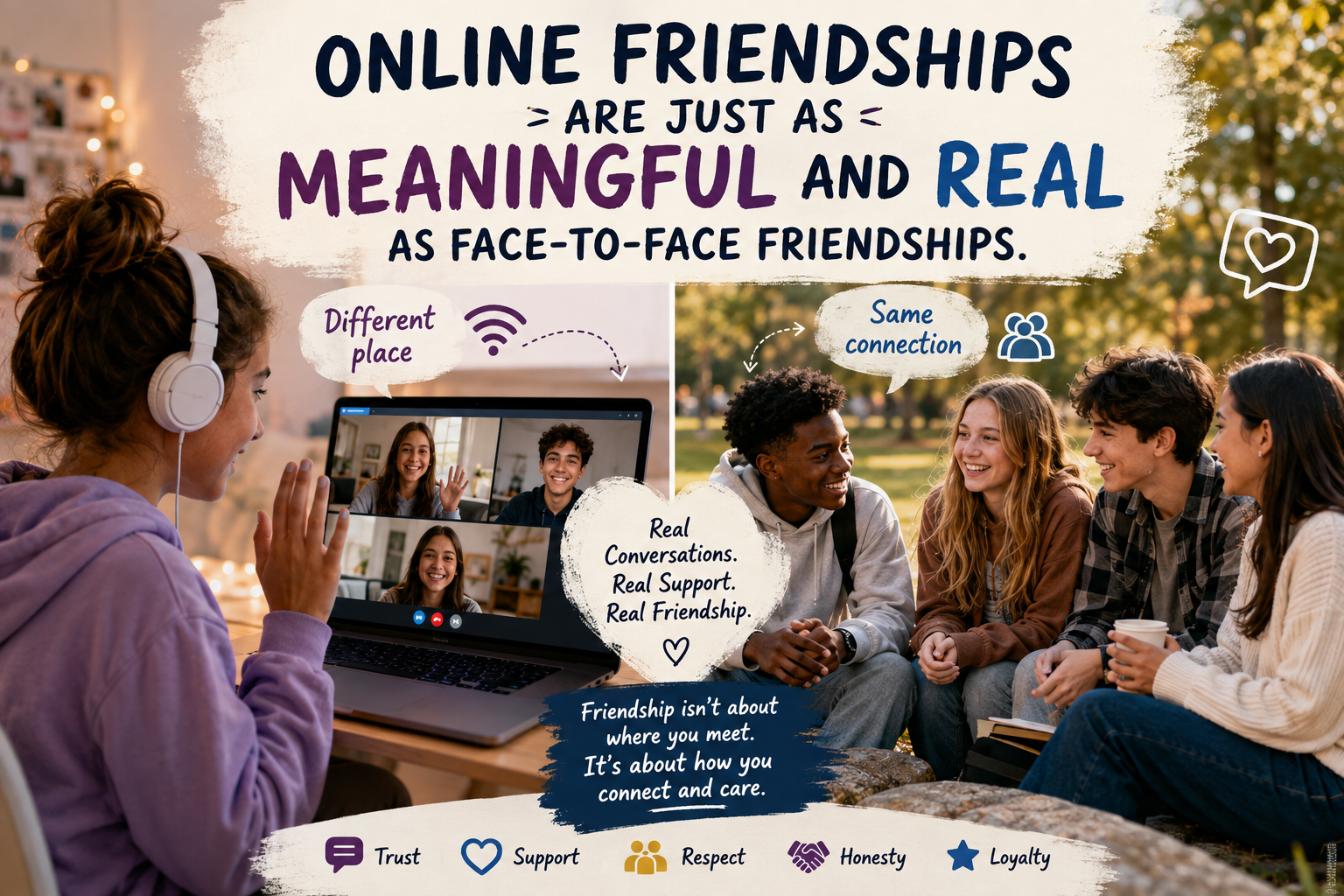
Friendship has changed greatly in the digital age. In the past, most friendships developed at school, in neighborhoods, at places of worship, through sports, or during other face-to-face activities. Today, young people can become friends through social media, online games, study groups, messaging platforms, and shared-interest communities.
This raises an important question: Are online friendships just as meaningful and real as face-to-face friendships?
Some people believe that genuine friendship depends on trust, care, communication, and emotional support, whether two people meet physically or online. Others argue that face-to-face interaction creates a deeper connection because friends can share real-life experiences, read body language, and support one another physically.
Both sides have strong arguments.
What Makes a Friendship “Real”?
Before comparing online and face-to-face friendships, it is important to understand what makes a friendship meaningful.
A real friendship usually involves trust, honesty, respect, communication, loyalty, shared interests, and emotional support. Friends listen to one another, celebrate successes, offer encouragement during difficult moments, and gradually learn about each other’s personalities.
None of these qualities automatically depends on being in the same physical location.
However, friendship also involves experiences. Spending time together, observing someone’s behavior, helping each other in practical situations, and sharing memorable moments can strengthen a relationship in ways that online communication may not always provide.
The debate therefore is not simply about whether online friendships are real. The bigger question is whether they can provide the same depth of connection as friendships developed face-to-face.
Read now Parents Are NOT Solely to Blame for the Misconduct of Their Children
Argument For: Online Friendships Can Be Genuine and Meaningful
One of the strongest arguments supporting online friendship is simple: emotional connection does not require physical closeness.
Two people may live thousands of kilometres apart and still talk every day, share personal experiences, encourage each other, and build strong trust.
For example, a student who feels misunderstood at school may join an online community based on art, coding, books, gaming, music, or another interest. There, the student may meet someone with similar interests and experiences.
Over time, regular conversations can develop into genuine friendship.
What matters in such situations is not where the conversation happens but the quality of the relationship.
A friend who listens when you are struggling, celebrates your achievements, checks on you when you are upset, and respects your feelings can have a meaningful influence on your life even if you communicate mainly through a screen.
Online Friendships Can Connect People Who Would Never Otherwise Meet
Traditional friendships are often limited by geography.
Students usually become friends with people who live nearby, attend the same school, belong to the same community, or participate in similar local activities.
The internet removes many of those geographical barriers.
A teenager in Nigeria can communicate with someone in Canada, Kenya, India, the United Kingdom, or another part of the world. They may discover that they enjoy the same books, games, academic subjects, sports, or creative activities.
This can expose young people to different cultures and perspectives.
Online friendships may also be valuable for people who have unusual hobbies or interests. A student may struggle to find classmates who enjoy astronomy, animation, robotics, poetry, or a particular type of music. Online communities can make it easier to meet others who share those interests.
Shared interests often become a strong foundation for friendship.
Some People Find It Easier to Communicate Online
Not everyone finds face-to-face conversations easy.
A shy student may need more time to organize their thoughts before speaking. Others may feel nervous in large social situations.
Online communication can reduce some of that pressure.
Text messages allow people to think before responding. Long conversations can happen gradually rather than requiring an immediate answer.
As a result, some people may feel comfortable discussing subjects online that they find difficult to discuss in person.
This does not automatically make online communication better than face-to-face conversation. However, it shows that digital communication can create opportunities for meaningful emotional connection.
For certain friendships, the online environment may even help people become more open and honest with each other.
Check out Education Is a Scam vs Education Is the Key: A Balanced Debate for Today’s World
Distance Does Not Automatically End Online Friendships
Another advantage of online friendship is that communication can continue even when people’s circumstances change.
A close school friend may move to another city or country. In earlier generations, maintaining that friendship could have been difficult.
Today, messaging apps, video calls, online games, and social media allow people to remain connected.
Interestingly, this also shows that the difference between “online” and “real-life” friendships is not always clear.
Two students may originally meet face-to-face and later maintain most of their relationship online. Likewise, two people may meet online first and eventually become friends offline.
Modern friendship often combines both forms of communication.
Argument Against: Face-to-Face Friendship Offers Something Online Communication Cannot Fully Replace
Although online friendships can be genuine, critics argue that they cannot completely reproduce the experience of spending time with someone physically.
Face-to-face communication contains information that text messages cannot always provide.
When people speak in person, they notice facial expressions, pauses, gestures, tone of voice, posture, and other forms of body language.
These details help people understand emotions.
For instance, a friend may type “I’m fine” in a message even when they are upset. In person, their facial expression or voice might immediately reveal that something is wrong.
Video calls provide some of these signals, but physical interaction still creates a fuller communication experience.
That can make face-to-face friendships easier to understand and strengthen over time.
Shared Experiences Can Build Stronger Bonds
Friendship is not only about conversation.
Friends often become closer because of experiences they share together.
Students may study for examinations, attend school events, play sports, celebrate birthdays, travel, eat together, work on projects, or simply spend time talking after school.
These experiences become memories.
They also allow people to see different sides of each other’s personalities.
You may discover how a friend behaves when they are excited, disappointed, tired, under pressure, or dealing with other people.
Online conversations reveal personality too, but they may offer a narrower picture.
Someone can choose what they reveal online much more easily than they can during regular face-to-face interaction.
For this reason, critics argue that physical friendships provide more opportunities to know someone deeply.
Face-to-Face Friends Can Offer Practical Support
There are moments when messages and video calls are not enough.
Imagine a student becomes sick at school, loses something important, struggles with a difficult assignment, or feels nervous before an examination.
A nearby friend can help physically.
They may sit with the person, carry something for them, explain a school topic, accompany them somewhere, or simply give them a reassuring hug.
Online friends can provide emotional encouragement, but distance limits the practical help they can offer.
This difference becomes especially important during emergencies or major life events.
Sometimes friendship means being physically present, and an online friend living hundreds or thousands of kilometres away may simply be unable to provide that kind of support.
Read more How to Use the Cornell Method to Take Better Lecture Notes (A Guide for Nigerian Students)
Online Identity Can Be Difficult to Verify
One of the biggest concerns about online friendship is safety.
People online are not always who they claim to be.
Someone can use fake photographs, false names, invented stories, or incorrect information about their age and identity.
This practice is sometimes called catfishing.
Young people therefore need to be especially careful about sharing private information with people they meet online.
Personal details such as home addresses, school locations, passwords, private photographs, financial information, and other sensitive information should not be given to strangers.
Face-to-face friendships are not automatically safe or trustworthy either. People can lie offline as well.
However, regularly interacting with someone in school, at home, or within a known community usually gives you more opportunities to confirm who that person is and observe their behavior.
Online Conversations Can Cause Misunderstandings
Digital communication also makes misunderstandings easier.
A short message may sound rude even when the sender did not intend it that way. Sarcasm can be misunderstood. Jokes may be taken seriously.
Even punctuation can sometimes change how a message feels.
Face-to-face conversation provides immediate clues through tone, expression, and body language.
If someone appears confused or hurt, the speaker can quickly explain what they meant.
Online disagreements may develop more quickly because those emotional signals are missing.
This does not mean online friendships cannot handle conflict. Strong online friends can learn to communicate carefully and use voice or video calls when necessary.
Still, face-to-face interaction often makes emotional meaning easier to understand.
Can an Online Friend Be as Close as Someone You See Every Day?
The answer probably depends on the friendship.
Some classmates see each other every day but barely know one another.
At the same time, two online friends may communicate for years, know one another’s fears and ambitions, support each other through difficult experiences, and develop deep trust.
Physical proximity therefore does not automatically create meaningful friendship.
However, online communication does not automatically create deep friendship either.
The strength of any friendship depends on what both people contribute to it.
Trust must develop.
Respect must be mutual.
Communication must be honest.
Both people must make an effort.
A friendship becomes meaningful because of these qualities, not simply because it happens online or offline.
See also How to Handle Panic Attacks in the Exam Hall: A Survival Guide for Nigerian Students
The Strongest Friendships May Combine Both Worlds
Perhaps the debate creates a division that does not always exist in real life.
Modern friendships frequently move between online and offline communication.
School friends message each other after school.
People who move away remain connected through video calls.
Friends share photographs, memes, voice notes, videos, and messages throughout the day, then meet physically when possible.
Similarly, people who first meet through an online hobby or community may eventually meet safely in real life with appropriate precautions.
Technology has therefore changed friendship rather than simply replacing traditional friendship.
Online communication can keep relationships active when distance would otherwise separate people, while face-to-face interaction can provide experiences and physical presence that digital communication cannot completely reproduce.
Both forms can strengthen each other.
Arguments Supporting the Statement
Those who agree that online friendships are just as meaningful and real as face-to-face friendships can argue that emotional connection is more important than physical location.
Online friends can provide genuine emotional support, communicate regularly, share interests, maintain long-distance relationships, and help people connect with others outside their immediate communities.
They may also provide valuable companionship to people who feel isolated or find face-to-face social situations difficult.
A friendship built on honesty, loyalty, respect, and consistent communication can therefore be real even when most interaction happens online.
Arguments Opposing the Statement
Those who disagree can argue that face-to-face friendships provide important experiences that screens cannot fully reproduce.
Physical friends can read body language more accurately, participate in shared activities, provide practical help, and physically support each other during difficult moments.
Meeting someone regularly in real life may also make it easier to understand their true personality and verify their identity.
Online relationships can certainly become meaningful, but critics may argue that they are not always equivalent to friendships formed through repeated face-to-face experiences.
See more Oppose the Motion: A Female Child Is Better Than a Male Child
A Balanced View
Online friendships are unquestionably capable of being real.
Calling every digital friendship “fake” ignores the genuine trust, support, companionship, and emotional connection that millions of people experience online.
At the same time, saying online and face-to-face friendships are always identical would ignore important differences.
Physical presence allows friends to share experiences, notice body language, help one another practically, and build memories together in ways digital communication cannot fully reproduce.
The fairest position is therefore that a meaningful friendship is defined more by its quality than by where it takes place.
Some online friendships may be deeper than some face-to-face friendships, while some relationships become strongest when online communication and real-world interaction are combined.
Conclusion
The statement “Online friendships are just as meaningful and real as face-to-face friendships” has convincing arguments on both sides.
Supporters can point to emotional closeness, regular communication, shared interests, long-distance connection, and genuine support as evidence that online friendship can be completely real.
Opponents can point to body language, shared physical experiences, practical support, identity concerns, and greater opportunities to observe someone’s behavior in everyday situations.
Ultimately, technology does not decide whether a friendship is genuine. People do.
Whether friends meet online, in a classroom, on a sports field, or through both digital and face-to-face interaction, meaningful friendship still depends on trust, honesty, respect, loyalty, communication, and mutual care.
That may be the strongest lesson in the debate: the place where a friendship begins matters less than the way the people within it treat each other.