
Tired of School? How to Handle “Academic Burnout” Before You Crash

How to Handle Academic Burnout

Tired of School? How to Handle “Academic Burnout” Before You Crash You wake up. Your alarm is ringing (probably that annoying default sound on your phone). You look at your Physics textbook or that massive JAMB past question pack, and you just feel… empty. You aren’t lazy. In fact, you want to pass. You know your parents are counting on you. But right now, your brain feels like fufu—heavy, stuck, and refusing to process anything. You stare at one page for 30 minutes, but nothing is entering. If this sounds like you, you aren’t just “tired.” You are likely dealing with burnout. It happens to the best students. The pressure to score 300+ in JAMB, the fear of WAEC, or the stress of a wicked lecturer in university can crush your motivation. But you don’t have to stay stuck there. In this guide, I’m going to show you exactly how to handle “Academic Burnout” when you are tired of school, get your mojo back, and pass your exams without losing your mind. Is it Laziness or Burnout? (Know the Difference) First, let’s stop the guilt trip. A lot of Nigerian parents (and even teachers) will tell you that you are just being lazy. “Go and read your book, you are pressing phone too much.” But there is a big difference. Laziness is when you are able to study, but you just don’t want to because you’d rather watch TikTok or play video games. Burnout is different. Burnout is when you want to study, but your brain and body physically refuse. It feels like your battery is at 1%. Here are the signs you are burnt out: Constant Exhaustion: You sleep for 8 hours but wake up tired. Irritability: Small things make you angry. Maybe your younger sibling asks a question and you snap at them. Detachment: You stop caring about the grades you used to obsess over. Brain Fog: You read a sentence five times and still don’t understand it. If you are nodding your head right now, keep reading. Why Nigerian Students Burn Out Faster Let’s be honest, schooling in Nigeria is an extreme sport. It’s not just the books. It’s the environment. You are dealing with NEPA taking light when you want to read overnight. You are stressing about ASUU strike rumors. You are sitting in a jammed lecture hall with 500 other students and no fan. That extra layer of stress drains your mental energy faster than you realize. So, don’t beat yourself up. The system is tough. But you have to be tougher. Practical Steps to Fix Academic Burnout So, how do you fix it? You can’t just “drop out” (unless you want your African mother to disown you). You need a strategy to recharge while still moving forward. 1. The “Do Nothing” Strategy This sounds counter-productive, right? You have an exam in two weeks, and I’m telling you to do nothing. Yes. There is a law in Economics called the Law of Diminishing Returns. At a certain point, putting in more effort yields less result. If you study for 12 hours straight but only remember 10% of it, you have wasted your time. Take one full day off. No books. No past questions. No guilt. Sleep, eat, or watch a movie. You need to reset your brain’s dopamine levels. As we discussed in our article on health is better than wealth, your physical state dictates your mental performance. If the machine (your body) is broken, the work won’t get done. 2. Stop the “Marathon Reading” A common mistake students make is trying to cover the entire Chemistry syllabus in one night. That is a one-way ticket to burnout city. Break it down. Don’t write “Read Biology” on your to-do list. That is too big. Instead, write: “Read Chapter 3: Photosynthesis.” When you complete that small task, your brain releases a chemical reward. You feel good. You feel capable. This builds momentum. If you are struggling with how to structure this, check out our guide on how to prepare for an exam in a short time. It breaks down the process into manageable chunks. 3. Change Your Environment If you always study in your room, your brain associates that room with stress. Switch it up. Go to the school library. Stay back in class after school. Go to a friend’s house (a serious friend, not the one that will distract you with gist). Sometimes, a change of scenery is all you need to trick your brain into focusing again. 4. Fuel Your Body Correctly You cannot run a generator without fuel. You cannot run your brain on just Garri and sugar. When you are burnt out, you tend to eat junk or skip meals. This makes the brain fog worse. Try to drink more water. Dehydration causes fatigue. Eat fruits if you can. According to the Cleveland Clinic, diet plays a massive role in how we handle stress and recover from mental exhaustion. 5. Stop Comparing Yourself to Others This is a major killer. You see your classmate posting on WhatsApp about how they finished the syllabus twice. You panic. You feel you aren’t doing enough. Stop it. You don’t know if they actually understood what they read. Focus on your own race. If you can only handle 2 hours of study today, do a quality 2 hours. That is better than 10 hours of pretending to read while staring at the ceiling. Adopting effective study habits that work for you specifically is better than copying what the class scholar is doing. When to Ask for Help If you try all these tips and you still feel hopeless, depressed, or unable to get out of bed, please talk to someone. Talk to a school counsellor, a trusted teacher, or your parents. Burnout can sometimes lead to depression, and that is a serious health issue. There is no shame in saying, “I am struggling.” Resources like Verywell Mind offer great advice on recognizing when stress has … Read more

How to Use the Pomodoro Technique to Smash Your WAEC and JAMB Exams

How to Use the Pomodoro Technique

How to Use the Pomodoro Technique to Smash Your WAEC and JAMB Exams Let’s be honest. Studying in Nigeria is an extreme sport. You sit down to read for your Post-UTME or JAMB, and suddenly, your phone buzzes. It’s a WhatsApp message. You check it. Then you check TikTok. Then you check Twitter to see what’s trending. Before you know it, NEPA (or the disco) has taken the light, three hours have passed, and you haven’t read a single page of your Chemistry textbook. It’s frustrating. I’ve been there. The pressure from parents to pass is high, but the distractions are higher. If you are struggling to focus, you don’t need “more willpower.” You need a system. That is where the Pomodoro Technique comes in. It is one of the most effective ways to trick your brain into focusing, even when you don’t feel like it. If you want to know how to use the Pomodoro Technique to clear your grades, keep reading. What is this “Pomodoro” anyway? First off, “Pomodoro” is Italian for tomato. A guy named Francesco Cirillo invented this method in the late 1980s using a kitchen timer shaped like a tomato. But don’t worry, you don’t need a tomato timer. You just need your phone (on Do Not Disturb mode) or a wristwatch. The idea is simple: You can’t focus for 3 hours straight. Your brain isn’t wired for that. Instead of forcing it, you break your study time into short, intense bursts of focus followed by short breaks. Step-by-Step: How to use the Pomodoro Technique You don’t need to overcomplicate this. Here is the practical way to apply it to your WAEC or university revisions. 1. Pick a specific task. Don’t just say “I want to study Biology.” That’s too vague. Be specific. Say, “I want to read Chapter 3: Genetics” or “I want to solve 20 JAMB past questions on Electrolysis.” 2. Set a timer for 25 minutes. This is your “Pomodoro.” For the next 25 minutes, you are a soldier. No phone. No checking the pot on the fire. No talking to your roommate. You focus only on that task. 3. Work until the alarm rings. If a distraction pops into your head (like “I need to buy airtime”), write it down on a piece of paper and get back to work immediately. 4. Take a 5-minute break. When the timer rings, stop. Even if you are in the middle of a sentence, stop. This break is crucial. Stand up. Stretch. 5. Repeat. After four “Pomodoros” (that’s about 2 hours of work), take a longer break of 15-30 minutes. This method helps you manage your energy, not just your time. It’s a key part of developing 10 effective study habits every student should develop because it builds discipline. Why this actually works for Nigerian Students You might be thinking, “25 minutes is too small.” But here is the secret: Urgency. When you know you only have 25 minutes, you read faster. You stop daydreaming. It turns studying into a game against the clock. Also, it prevents burnout. Many students try to “crash read” for 8 hours straight a day before the exam. That is a disaster waiting to happen. As I explained in my guide on how to prepare for an exam in short time, your brain needs rest to encode memory. The Pomodoro technique forces you to rest before you get tired. According to research by the University of North Carolina, distributed practice (spacing out your study) is far more effective than massed practice (cramming). The “Naija” Twist: Adjusting the Time Now, let’s be realistic. The standard 25-minute rule isn’t perfect for every subject. If you are a science student solving complex calculation questions in Further Maths or Physics, 25 minutes might not be enough. You might just be getting into the “zone” when the alarm rings. That can be annoying. Here is how to tweak it: For Reading subjects (Government, Literature, Biology): Stick to 25 minutes work / 5 minutes rest. For Calculation subjects (Maths, Accounting, Physics): Try 50 minutes work / 10 minutes rest. Find what works for your brain. The goal is to focus, not to be a slave to the timer. The Danger Zone: What NOT to do during breaks This is where most students fail. When the 5-minute break starts, DO NOT open TikTok or Instagram. If you open social media, 5 minutes will turn into 45 minutes. I promise you. Your brain will get sucked into the dopamine loop, and it will be hard to start studying again. Instead, do this: Drink water (stay hydrated). Walk around the room. Do some pushups or jumping jacks. Close your eyes and breathe. Remember, health is better than wealth. If your eyes are straining or your back is hurting, you can’t pass that exam. Use the break to reset your body. For more insights on managing stress and staying healthy during exams, major health organizations like the Mayo Clinic often emphasize the importance of short breaks for mental clarity. Final Thoughts The Pomodoro Technique isn’t magic. It won’t write the exam for you. But it will stop you from wasting time. The next time you have a pile of notes to read and you feel overwhelmed, don’t panic. Just set a timer for 25 minutes. Anyone can focus for 25 minutes, right? Start small. Be consistent. You’ve got this.

How to Study When You Are Feeling Depressed or Unmotivated (A Realistic Guide)

How to Study When You Are Feeling Depressed or Unmotivated

How to Study When You Are Feeling Depressed or Unmotivated We have all been there. You have a MTH 101 exam or WAEC Chemistry coming up in two weeks. You know you should be reading. Your textbook is open on the table, staring at you. But you are just lying on your bed, scrolling through TikTok or staring at the ceiling fan, feeling absolutely empty. It feels like there is a heavy weight on your chest. The motivation is gone, and even opening a book feels like lifting a bag of cement. If this is you, don’t beat yourself up. Learning how to study when you are feeling depressed or unmotivated is a skill that many Nigerian students struggle with but rarely talk about. It’s hard to explain to your parents that you aren’t just “lazy,” but that your brain literally refuses to cooperate. Whether it’s the stress of an ASUU strike, personal issues, or just overwhelming burnout, here is how you can still get some work done without breaking down. First Things First: Is It Burnout or Something Else? Before we dive into the tactics, let’s be real. There is a difference between being tired and being depressed. If you have been feeling hopeless, empty, or unable to sleep for weeks, this might be more than just “exam fever.” As we often say in our debates, health is better than wealth, and that includes your mental health. Please speak to a school counselor or a trusted adult if it feels too heavy. But if you are just in a funk and need to pass that test, let’s look at how to move forward. Strategy 1: The “Two-Minute” Trick (How to Trick Your Brain) The hardest part of studying isn’t the reading; it is the starting. When you look at a whole textbook, your brain screams, “No! That is too much work!” So, lie to your brain. Tell yourself, “I will just read for two minutes. Just one definition. After that, I can stop.” Most of the time, once you start, the friction disappears. You might end up reading for 20 minutes. But even if you only do two minutes, that is still better than zero. This is a crucial part of building effective study habits—starting small is always better than not starting at all. Strategy 2: Switch to “Low-Energy” Study Modes You don’t always have to sit at a desk with a highlighter and solve complex calculation problems. That requires “high energy.” When you are feeling down, your energy is low. Match your study method to your energy level. Watch a Video: Go on YouTube. Search for the topic. Lie on your bed and just watch. Channels like Khan Academy or local Nigerian tutors break things down simply. Listen to Audio: Record yourself reading your notes when you have energy, then just listen to the recording when you feel down. Discuss with a Friend: Sometimes, just gisting about the topic with a coursemate helps. This is “passive studying.” It’s not as perfect as deep work, but on bad days, it keeps the engine running. Strategy 3: Change Your Environment (Escape the Bedroom) Your room is where you sleep. If you are depressed, your bed is like a magnet. It calls you. You need to break that association. Pack your bag and leave. Go to the school library, a quiet empty classroom, or even a friend’s house (a serious friend, not the one that will distract you). I remember during my university days, my hostel room was too noisy and depressing. Moving to a different location forced my brain to switch into “work mode.” We discussed how environment affects learning in our guide on boarding school vs day school, and the same logic applies here. A change of scenery can reset your mood. Strategy 4: The “Bare Minimum” Syllabus Strategy When you are unmotivated, you cannot cover everything. If you try to read the whole syllabus, you will panic and quit. Be strategic. Look at the WAEC or JAMB syllabus (or your course outline). Ask yourself: “What are the 3 topics that always come out?” Focus only on those. Forget the rest for now. If you are studying Biology, maybe just focus on Genetics and Ecology today. If it’s Government, just read up on the 1999 Constitution. By narrowing your focus, the mountain looks smaller. This is a key technique we recommend when you need to prepare for an exam in a short time. It’s not about knowing everything; it’s about knowing enough to pass. Final Words: Be Kind to Yourself School in Nigeria is stressful enough without you being your own enemy. Some days, you will fail to study. You will spend 5 hours on Instagram. It happens. Forgive yourself and try again tomorrow. Beating yourself up only drains the little energy you have left. Remember, one bad day does not mean you will fail. Just try to do a little bit today. Even one paragraph is a victory. You’ve got this.

How to Overcome Social Media Addiction During Exam Periods: A Student’s Survival Guide

How to Overcome Social Media Addiction During Exam Periods

How to Overcome Social Media Addiction During Exam Periods It starts innocently enough. You sit down to read for your JAMB or semester exams. You open your textbook. Then, you tell yourself, “Let me just check WhatsApp for 5 minutes.” Two hours later, you are deep in the comments section of a blog, arguing about Wizkid and Davido, or watching endless TikTok videos. Your book is still open to page one. Sound familiar? You are not alone. We have all been there. The panic of the exam date getting closer versus the sweet dopamine hit of a notification. But here is the hard truth: Instagram won’t give you a degree, and Twitter won’t write your WAEC for you. If you are struggling to focus, you need a plan. In this guide, I’m going to show you exactly how to overcome Social Media addiction during exam periods without throwing your phone into the lagoon. Why You Can’t Put the Phone Down (It’s Not Just You) First, stop beating yourself up. You aren’t “lazy.” These apps are literally designed by engineers in Silicon Valley to keep you addicted. They use the same psychology as gambling machines. Every time you pull down to refresh, your brain gets a little hit of excitement. Comparing that to reading Chemistry or Economics? It’s no contest. Your brain wants the easy fun. But you have to be smarter than your phone. As we discussed in our guide on 10 effective study habits every student should develop, discipline isn’t about willpower; it’s about removing distractions. Step 1: The “Nuclear” Option (Delete the Apps) I know, this sounds painful. But desperate times call for desperate measures. If you have an exam in two weeks, you do not need Snapchat. You don’t need TikTok. I’m not saying delete your account. Just delete the app from your phone. This adds a layer of friction. If you want to check Facebook, you have to open a browser, type in the password, and wait for it to load. Most times, you won’t bother. This small barrier can save you hours of study time. Step 2: The “Kpalasa” Phone Strategy If you really want to know how to overcome Social Media addiction during exam periods, this is the most effective method I’ve seen work for Nigerian students. Swap your smartphone for a “torchlight” phone (or a kpalasa) during study hours. Give your smartphone to your mom, dad, or a disciplined sibling. Tell them, “Do not give this back to me until 8 PM.” Take the button phone with you to the library or your study corner. You can still make calls for emergencies, but you can’t scroll. It’s boring, yes. But boredom is good. Boredom makes studying look interesting. Step 3: Use “Focus Mode” or Blocking Apps If you can’t part with your smartphone (maybe you use it to read PDFs), then you need to lock it down. Most phones now have a “Digital Wellbeing” or “Focus Mode” setting. Set it to block all social apps from 8 AM to 4 PM. If you need something stronger, download apps like Forest or Freedom. These apps gamify the experience. For example, in Forest, a digital tree grows while you study. If you exit the app to check Instagram, your tree dies. It sounds silly, but you’d be surprised how much you won’t want to kill that virtual tree. You can read more about how digital addiction affects students on Common Sense Media, which breaks down the impact of screen time on focus. Step 4: The “Grandma” Rule (Work First, Play Later) My grandma used to say, “You can’t eat meat if you haven’t finished your eba.” Apply that to your phone. Use social media as a reward, not a break. Tell yourself: “I will finish this chapter on Organic Chemistry. Once I am done, I get 15 minutes of TikTok.” This is similar to the strategy we suggest when learning how to prepare for an exam in a short time. You must earn your leisure time. If you scroll before you study, you deplete your brain’s energy. Save the “cruise” for when the work is done. Final Thoughts: Your Grades vs. The Algorithm Look, exams are stressful. Sometimes we scroll just to escape the anxiety. But avoiding the work only increases the stress later. Remember, the exam period is temporary. It’s just a few weeks. The internet will still be there when you finish. The memes will still be there. But you only get one shot at this particular exam (unless you want to pay for a resit, which nobody wants). Prioritize your mental energy. Health is better than wealth, and a sound mind is better than a viral tweet. Put the phone down. Pick up the pen. You’ve got this. Which social media app is your biggest distraction right now? Be honest in the comments!

How to Visualize Concepts to Make Them Stick: A Guide for Nigerian Students

How to Visualize Concepts to Make Them Stick

How to Visualize Concepts to Make Them Stick: A Guide for Nigerian Students You know that sinking feeling. You are sitting in the exam hall. The invigilator has just dropped the question paper on your desk. You look at Question 2, and you know you read this topic. You remember the exact page in your textbook. You can even remember the color of the highlighter you used. But you cannot remember the answer. Your mind goes blank. It’s like the signal cut on your TV. This happens to thousands of students every year during WAEC, JAMB, and university semester exams. The problem isn’t that you didn’t read; the problem is how you read. You were probably “cramming and pouring,” which works until the pressure hits. If you really want to pass with flying colors, you need to learn how to visualize concepts to make them stick. I’ve been a student, and I’ve been a tutor. I can tell you for free that the students who get A’s aren’t always the ones who read for 12 hours. They are the ones who turn their textbooks into mental pictures. Here is how you can do it too. 1. Stop Memorizing, Start Seeing Let’s be honest. The human brain is not a hard drive designed to store boring text. It is designed to remember images, emotions, and survival scenarios. If I ask you to memorize the definition of “Osmosis,” you might struggle to recall it word-for-word in two weeks. But if I ask you to describe a scene from your favorite Wizkid music video or a crazy fight you saw at the bus stop, you will remember every detail. Why? Because you saw it. To learn how to visualize concepts to make them stick, you have to trick your brain. You must convert that boring Physics definition or Government date into a vivid, colorful picture. According to research cited by Verywell Mind, using imagery can significantly improve recall because it engages more areas of the brain than simple reading does. 2. The “Nollywood” Method (Mental Movies) This is my favorite technique for Art and Commercial students, especially for subjects like Government, History, or Literature. Don’t just read about the Aba Women’s Riot of 1929. Direct a movie about it in your head. How to do it: Close your eyes. Imagine the women. Are they angry? What are they wearing? Hear the noise. Imagine them shouting at the Warrant Chiefs. Feel the heat of the sun. When you sit in the exam hall and see a question about the riot, you won’t be searching for words in a textbook. You will be replaying a scene from a movie you created. This method also helps when you need to articulate points in an essay or a speech. We talked about structuring your thoughts in our guide on how to start a debate, and the same logic applies here: if you can see it, you can say it. 3. The “Danfo” Analogy (Connecting Science to Street Life) Science students, this one is for you. Concepts in Physics and Chemistry can be abstract. “Electron flow,” “Valency,” “Photosynthesis”—these things are invisible. So, make them visible by using what you see every day. Example: Let’s look at Electric Current and Resistance. Current: Imagine a crowd of passengers (electrons) trying to rush into a Danfo bus. Voltage: That’s the conductor shouting and pushing them to move faster. Resistance: That’s the narrow door of the bus that makes it hard for everyone to enter at once. If the door (resistance) is smaller, fewer people (current) can get in, no matter how much the conductor (voltage) shouts. Suddenly, Ohm’s Law ($V = IR$) isn’t just a formula. It’s a scene at Ojuelegba. When you link a concept to a real-life scenario, it becomes almost impossible to forget. This is one of the 10 effective study habits every student should develop if you want to stop retaking exams. 4. The Doodle Strategy (Draw It to Know It) You don’t need to be an artist. In fact, the uglier your drawing, the better. When you are reading a complex topic, stop writing notes for a second. Try to draw the concept. If you are studying Biology and looking at the digestive system, draw a funny-looking stomach. Give the enzymes faces. Maybe “Pepsin” is a guy with a hammer breaking down proteins. When you draw, you are forcing your brain to process the information deeply. You are translating text into a visual format. Official bodies like WAEC often require labeled diagrams in their marking schemes because they know that a student who can draw it, understands it. 5. Why “La Cram, La Pour” Fails We have all done it. You memorize a definition five minutes before the paper starts. You enter the hall, you write it down, and you pass. But two days later? It’s gone. The problem with cramming is that it stores information in your short-term memory. It’s like writing on sand near the beach. One wave (or one stressful moment in the exam hall), and it’s washed away. Learning how to visualize concepts to make them stick moves that information to your long-term memory. It’s like carving your name into a rock. It stays there. Conclusion Visualization isn’t magic, and it isn’t childish. It is a powerful tool used by memory champions and top-performing students worldwide. Next time you pick up your textbook, don’t just stare at the words until your eyes pain you. Close your eyes. Direct a movie. Draw a funny picture. Connect the topic to something you saw on the street. It might feel weird at first, but when you are the only one smiling in the exam hall because you are “watching a movie” in your head while others are sweating, you will be glad you started. Have you ever used a funny song or picture to remember a topic? Tell me about it in the comments!

How to Remember Chemical Formulas and Equations Easily (Chemistry Cheat Code)

How to Remember Chemical Formulas and Equations Easily

You are sitting in the exam hall, your pen is hovering over the paper, and you are staring at a question asking for the reaction between Sodium Hydroxide and Sulfuric Acid. You studied this. You know you did. But suddenly, your brain goes blank. Is it NaSO4? Or Na2SO4? It is frustrating. It feels like your village people are at work. But here is the truth: Chemistry isn’t magic, and it isn’t just for “gurus.” The problem isn’t your brain; it’s your method. Most students try to cram formulas the same way they cram definitions for Government or CRK. That doesn’t work for Science. If you are looking for how to remember chemical formulas and equations easily, you need a system, not just a photogenic memory. I’ve tutored hundreds of students for WAEC and JAMB, and I’ve seen what works. It’s not about “la cram, la pour.” It’s about understanding the code. Here is how you can hack the system. 1. Stop Cramming, Start with Valency This is where 80% of students mess up. They try to memorize that water is H2O and Carbon Dioxide is CO2 as separate facts. That’s a waste of brain space. You need to learn the Valency of the first 20 elements and common radicals (like Sulfate, Nitrate, Carbonate). Think of valency as the number of hands an element has to hold onto another element. Sodium (Na) has a valency of +1 (One hand). Oxygen (O) has a valency of -2 (Two hands). To combine them, they swap numbers. Sodium gives its “1” to Oxygen, and Oxygen gives its “2” to Sodium. Result? Na2O. Once you master this exchange, you don’t need to memorize thousands of formulas; you can just build them on the spot. It’s a foundational skill, much like the discipline required in developing 10 effective study habits every student should develop. If you skip the basics, you struggle. 2. Use Mnemonics (The Naija Style) Let’s be honest, dry textbooks are boring. Our brains remember funny, weird, or rhythmic things much better. For the Reactivity Series (which tells you which metal will displace another in an equation), don’t just stare at the list. Use a sentence. I teach my students this one: “Popular Scientists Can Make A Zoo In The Low Humid Country More Satisfactory.” Popular – Potassium (K) Scientists – Sodium (Na) Can – Calcium (Ca) Make – Magnesium (Mg) A – Aluminium (Al) Zoo – Zinc (Zn) In – Iron (Fe) The – Tin (Sn) Low – Lead (Pb) Humid – Hydrogen (H) Country – Copper (Cu) More – Mercury (Hg) Satisfactory – Silver (Ag) Create your own. Use slang. Use names of your friends. If it makes you laugh, it sticks. This is a creative way to learn, similar to how we use proverbs in debate greetings and proverbs to catch the audience’s attention. 3. The “Table Tennis” Method for Balancing Equations Balancing equations scares people. It looks like advanced calculus. But it’s actually just a game of keeping scores equal. Don’t try to do it all in your head. That’s a recipe for a headache. Try this steps: Draw a line down the middle of the equation (under the arrow). List the atoms on the Left (Reactants) and the Right (Products). Count them. Left: 2 Hydrogen. Right: 2 Hydrogen. Good. If they don’t match, change the big number in front (the coefficient). Never change the small number (the subscript). Treat it like a game of table tennis. Ping pong back and forth until the numbers are equal. For a visual guide on this, resources like Khan Academy’s Balancing Equations guide can be incredibly helpful. 4. Active Recall: Stop Reading, Start Writing I see this mistake all the time. A student sits with a notebook, reading the same page over and over for three hours. They feel productive. But they aren’t learning. They are just recognizing the words. To really know how to remember chemical formulas and equations easily, you must test yourself. Look at a formula. Cover it. Write it down from memory. Check it. If you got it wrong, write it five times. This forces your brain to create a pathway for that information. It’s hard work, but it’s fast work. If you are short on time before WAEC, this is exactly how to prepare for an exam in a short time. Common Mistakes That Cost You Marks Even if you memorize the formula, you can still lose marks if you aren’t careful. Here is what to watch out for: Case Sensitivity: CO is Carbon Monoxide. Co is Cobalt. If you write your letters carelessly, you change the chemical meaning entirely. State Symbols: Don’t ignore the (s), (l), (g), and (aq). In WAEC marking schemes, writing H2O(g) instead of H2O(l) can sometimes cost you the full mark. Subscripts vs Coefficients: Writing 2O is totally different from O2. One is two separate atoms; the other is a molecule. Conclusion Chemistry doesn’t have to be the subject that ruins your WAEC result. It’s not about being a genius; it’s about consistency. Start with the valencies today. Make up a funny song for the periodic table tonight. Before you know it, writing $H_2SO_4 + 2NaOH \rightarrow Na_2SO_4 + 2H_2O$ will feel as natural as writing your own name. You’ve got this. For more in-depth science resources, checking out the syllabus on the West African Examinations Council (WAEC) official website keeps you aligned with what examiners actually want. What’s the hardest formula you’ve tried to memorize? Let me know in the comments
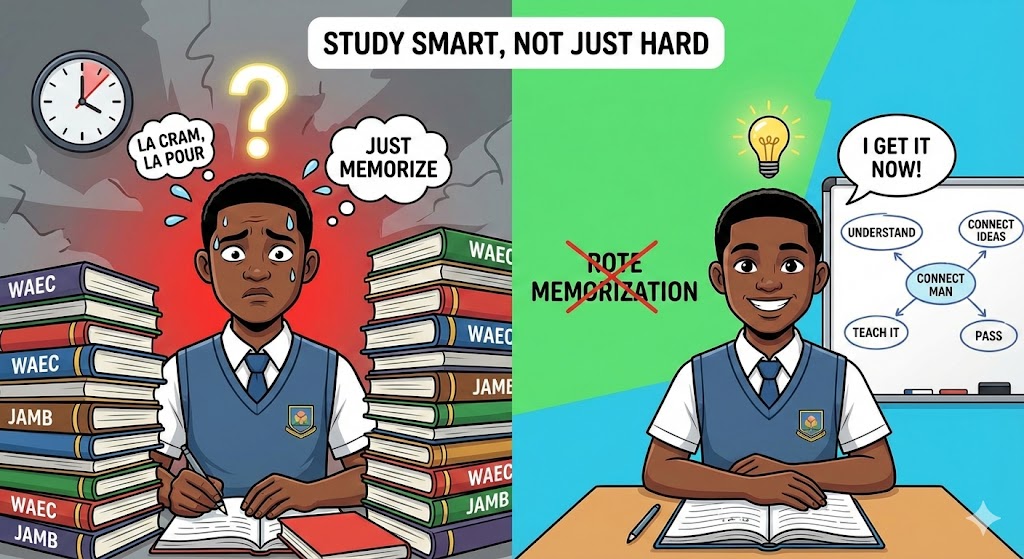
Rote Memorization: Why “La Cram, La Pour” Will Fail You in WAEC & JAMB (And What to Do Instead)

Rote Memorization

Rote Memorization: Why “La Cram, La Pour” Will Fail You in WAEC & JAMB (And What to Do Instead) We’ve all been there. The exam timetable is out, the pressure is mounting, and you realize you have ten topics to cover in two days. Panic sets in. So, what do you do? You grab your textbook, start chanting definitions like a song, and try to force every single word into your brain. This is the classic “La Cram, La Pour” strategy. In academic terms, it’s called rote memorization. You might think you are studying, but you are really just holding water in a basket. It feels full for a minute, but by the time you reach the exam hall? Empty. I see this happen every year during WAEC and JAMB. Students who “read” all night come out crying because the questions were slightly twisted. If you want to stop scraping by and start smashing those A’s, you need to understand why rote memorization is your enemy and learn how to actually study. What Exactly is Rote Memorization? Let’s break it down. Rote memorization is simply repeating information over and over until it sticks, without actually understanding what it means. It’s like memorizing the lyrics to a Burna Boy song in a language you don’t speak. You can sing it, sure. But if someone asks you, “What does that line mean?”, you’re stuck. In school, it looks like this: Memorizing the definition of “Osmosis” word-for-word but failing to explain it in your own English. Cramming chemistry formulas without knowing when to apply them. Reciting history dates but not knowing why the event happened. It works for reciting the alphabet. It does not work for passing Physics. Why “Chew and Pour” is Dangerous for Nigerian Students You might be thinking, “But sir, it worked for me in JSS 3.” Maybe. But the higher you go, the harder the questions get. WAEC, NECO, and JAMB are not designed to test your ability to photocopy a textbook with your brain. They are designed to test your understanding. When you rely on rote memorization, your knowledge is brittle. It breaks easily. Imagine you memorized a specific answer for a Biology question. Then, in the exam, WAEC changes the phrasing of the question just a little bit. A student who understands the concept will smile and write the answer. The student who crammed? They will panic because the “trigger words” they memorized aren’t there. This is why we emphasize building effective study habits you should develop rather than just looking for shortcuts. The “Blank Out” Effect in the Exam Hall Have you ever walked into an exam hall feeling confident, sat down, opened the paper, and suddenly… your mind goes blank? That is the biggest side effect of rote memorization. Because you didn’t build connections between the ideas, your brain can’t find the information when you are stressed. Anxiety blocks your memory recall. If you had understood the topic, you could derive the answer or explain it in your own words. But because you only memorized a script, once you lose one word, you lose everything. It’s painful. And honestly, it’s a waste of your time. You don’t want to be the student who “knows book” but fails exams. Better Alternatives: How to Actually Understand So, if cramming is bad, what should you do? You need methods that force your brain to work. 1. The “Teach It” Method (Feynman Technique) This is my favorite trick. It’s simple: Read a topic, close the book, and try to explain it to a 6-year-old (or your empty room). If you can’t explain it simply, you don’t understand it. Don’t use big grammar. Break it down. If you are reading about “Demand and Supply,” try to explain it using the price of gala or pure water. If you get stuck, open the book, re-read that part, and try again. This helps you retain information 10x better than staring at a page. 2. Use Past Questions the Right Way Don’t just memorize the answers to past questions (that’s still rote learning!). Use them to test your gaps. Pick a year, solve it without looking at the answers, and mark yourself. For the ones you failed, go back to your textbook and read that specific topic. This is exactly how to prepare for an exam in a short time without burning out. Also, utilize resources like the WAEC e-Learning portal. They literally show you what examiners are looking for and where students usually fail. It’s a cheat code that too many Nigerian students ignore. Conclusion: Study Smart, Not Just Hard School in Nigeria is stressful enough without making it harder for yourself. Stop trying to be a photocopier. Be a student. Rote memorization might get you through a class test, but it won’t help you defend your project in university or pass a tough professional exam later in life. Start small. Pick one difficult topic today and try to understand the “why” and “how” instead of just the “what.” Your grades (and your sanity) will thank you. For more tips on navigating school life, you can check out reliable educational psychology resources like Verywell Mind’s guide on study techniques to see how memory really works.
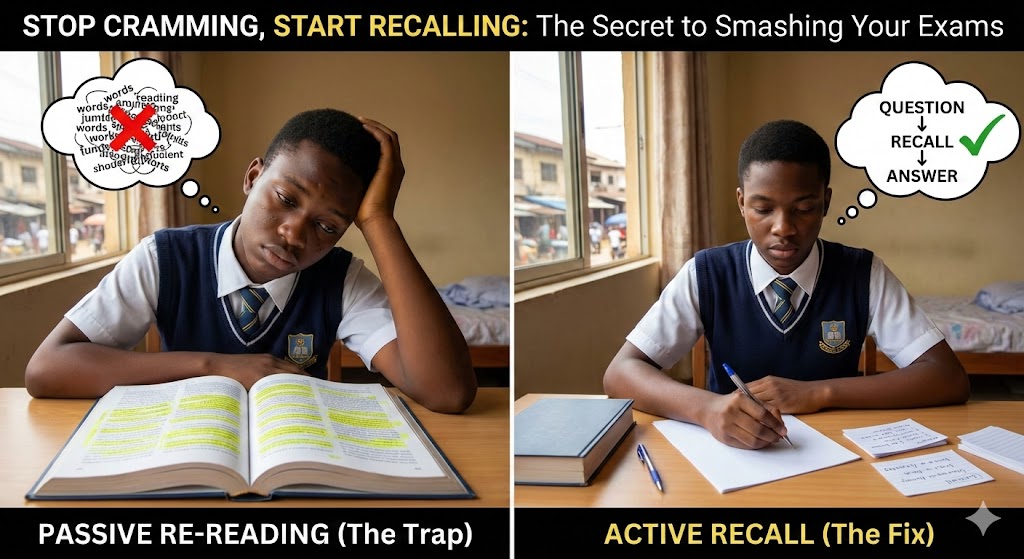
How to Use Active Recall Instead of Just Re-reading Notes (Stop Cramming!)

How to Use Active Recall Instead of Just Re-reading Notes

Ever read a textbook for three hours, feel like a genius, and then forget everything the moment you step into the exam hall? It’s a painful experience. You put in the time. You skipped the party. You sat in the library while others were gisting. Yet, when the results come out, the grades don’t match your effort. If this sounds like you, stop beating yourself up. You aren’t “dull.” You’re just studying the wrong way. Most Nigerian students rely on passive review—highlighting lines and reading the same page five times. It feels productive, but it’s actually a waste of time. If you want to smash your WAEC, JAMB, or university semester exams, you need to learn how to use Active Recall instead of just re-reading notes. The Trap: Why Re-reading Is a Lie Here is the problem. When you read your notes over and over, your brain recognizes the words. You think, “Oh yeah, I know this.” But that isn’t knowledge. That is just familiarity. Imagine watching Messi play football on TV. You watch him dribble every weekend. Does that mean you can go to the pitch and dribble like him? No. Because watching is passive. Playing is active. Re-reading is just watching the information. Active Recall is playing the match. What is Active Recall? Active Recall is simple. It means retrieving information from your brain without looking at the answer. It’s the difference between reading “The capital of Nigeria is Abuja” (passive) and asking yourself “What is the capital of Nigeria?” and forcing your brain to answer “Abuja” (active). That tiny struggle? That moment where you frown and try to remember? That is where the actual learning happens. If you are serious about boosting your grades, this is how to use Active Recall instead of just re-reading notes effectively. 3 Ways to Use Active Recall (The Practical Steps) You don’t need fancy apps or an iPad. You just need your brain and a piece of paper. Here are the three best methods I’ve seen work for students from Lagos to Kano. 1. The “Blurt” Method (Best for Theory) This is my personal favorite. It’s brutal, but it works like magic. Step 1: Read a section of your textbook or notebook. Keep it short—maybe one page. Step 2: Close the book. Hide it. Step 3: Take a blank sheet of paper and write down everything you can remember. Scribble diagrams, definitions, dates. Do not peek! Step 4: Open the book and compare. What did you miss? Did you forget the third law of motion? Did you mix up the dates for the amalgamation of Nigeria? Pick up a red pen and fill in the gaps. This method exposes exactly what you don’t know. It saves you from that false confidence that leads to exam failure. For more strategies on managing your revision time, check out our guide on how to prepare for an exam in a short time. 2. The Question-Book Method Stop writing summaries. Summaries are often just copying text from one place to another. Instead, as you read, write questions for yourself. If your biology note says: “Mitochondria is the powerhouse of the cell,” don’t write that down. Write: “What is the function of the mitochondria?” When you revise later, don’t read the notes. Read the questions. Force yourself to answer them before you flip the page to check. This turns your notebook into a quiz. 3. The “Past Question” Hack In Nigeria, Past Questions (PQ) are gold. But most students use them wrong. They look at the question, look at the answer at the back, and nod. That’s useless. To use how to use Active Recall instead of just re-reading notes with PQs, you must simulate the exam environment. Pick a year (e.g., JAMB 2021 Physics). Set a timer. Answer the questions without looking at the answer key. Only check your answers after you are done. This forces your brain to recall information under pressure. If you are preparing for common entrance, we have resources like common entrance questions for primary six that you can use to practice this method today. Why This Feels So Hard Let me be honest with you. Active Recall is hard. It is tiring. When you just re-read, your brain is relaxing. When you use Active Recall, your brain is sweating. You might get a headache. You might feel frustrated because you can’t remember simple things. That frustration is good. According to research from major institutions like Cornell University’s Learning Strategies center, that struggle strengthens the neural pathways in your brain. The harder it is to remember now, the easier it will be to remember in the exam hall. Common Mistakes to Avoid Even smart students mess this up. Here are two traps to watch out for: Peeking too soon: You ask yourself a question, struggle for 2 seconds, and then flip the page to see the answer. Don’t do that. Give your brain at least 20-30 seconds to fight for the answer. Only doing it once: Active recall works best with Spaced Repetition. Don’t just recall the topic today and forget it. Test yourself again in 3 days, then in a week. This is one of the 10 effective study habits every student should develop. Conclusion Changing your study habit is scary. It feels safer to just sit and read your notes for hours. But “safe” doesn’t get you a First Class or a 300+ in JAMB. You have to be willing to test yourself. You have to be willing to get things wrong in your room so you can get them right in the exam hall. So, tonight, close the textbook. Take a blank sheet of paper. And ask yourself: “What did I actually learn today?” Mastering how to use Active Recall instead of just re-reading notes is the fastest way to turn your grades around. For more tips on effective learning, you can also read about the benefits of retrieval practice on BBC Bitesize. It’s a game-changer. Ready … Read more

How to Memorize Dates and Historical Events: A Student’s Guide to Acing Government and History

How to Memorize Dates and Historical Events

Ever walked into an exam hall feeling ready, only to stare at question number 4 and go completely blank? You know the story of the Aba Women’s Riot. You know who was involved. But for the life of you, you can’t remember if it was 1929 or 1939. It’s painful. For many Nigerian students, dates are the enemy. Whether you are studying for Government, History, or Current Affairs in JAMB, keeping track of numbers is tough. But here is the truth: knowing how to memorize dates and historical events is often the difference between a C and an A. I’ve been there. I used to hate History class because of the dates. But over time, I realized that brute force—trying to force the numbers into your brain—doesn’t work. You need a strategy. Here is how you can master dates without losing your mind. 1. Stop Reading, Start Drawing (The Timeline) A lot of students just read their textbooks from page one to page one hundred. Let me be honest, that’s a waste of time if you want to remember dates. Your brain isn’t a filing cabinet; it’s a visual machine. Instead of reading paragraphs, create a timeline. Get a big sheet of paper. Draw a long line across it. Mark the beginning and the end of the period you are studying (e.g., “Pre-Colonial Nigeria” to “Independence”). Plot the events physically on that line. When you see that the Berlin Conference (1884-1885) happened before the Amalgamation (1914), your brain creates a map. You aren’t just memorizing a random number; you are memorizing a position on a map. This helps you understand the flow of events, which is crucial for answering essay questions, a topic we touched on in our guide on 10 effective study habits every student should develop. 2. The “Amebo” Strategy (Turn It Into a Story) We hardly forget gossip, right? If I told you a juicy story about what happened in the hostel last night, you’d remember every detail. History is just old gossip. To master how to memorize dates and historical events, stop treating them like dry facts. Turn them into a movie script or a gist. Take the 1914 Amalgamation. Don’t just say “Lord Lugard amalgamated the protectorates.” No. Imagine Lord Lugard as a businessman trying to cut costs. He married the “rich” Southern wife to the “poor” Northern husband to balance the budget. When you emotionalize the event, the date sticks. If you make the historical figures into real characters with motives (greed, anger, power), the dates become the “scenes” of the movie. 3. Use Mnemonics and Acronyms Sometimes, the story method takes too long. You just need to remember the date for a multiple-choice question in JAMB. This is where Mnemonics come in. You create a funny phrase or a word where the letters stand for the event or the numbers resemble the letters. For example, look at the word “J-U-N-E”. It has 4 letters. The Nigerian Civil War ended in January 1970. Okay, that’s a bad example. Let’s look at something simpler. Link dates to personal things. Nigeria became a Republic in 1963. That is exactly 3 years after Independence (1960). If you can remember 1960, just do the math (+3) to get the Republic date. Chain these dates together. If you treat every date as an island, you will drown. Connect them. 4. Spaced Repetition (Why “Cram and Pour” Fails) We all know that student who waits until the night before the exam to read everything. We call them the “Fire Brigade.” If you try to memorize 50 dates in one night, you might remember them for the exam morning, but by the time you reach Section B, they are gone. This is why “la cram, la pour” is dangerous. The scientific way to handle this is Spaced Repetition. Day 1: Read the date and the event. Day 2: Test yourself without looking. Day 7: Test yourself again. You need to force your brain to recall the information just as it’s about to forget it. You can use flashcards for this. Write the date on one side and the event on the other. Carry them in your pocket. When you’re on the bus or waiting for a lecture, flip through them. According to resources from the West African Examinations Council (WAEC) e-learning portal, students who consistently revise key points over time perform significantly better in objective questions than those who binge-read. 5. Sticky Notes Everywhere This sounds funny, but it works. Write your most difficult dates on sticky notes or small pieces of paper. Paste them where you look every day. The bathroom mirror, the wall beside your bed, or even the back of the toilet door. You don’t even have to “study” them. Just seeing “Murtala Mohammed Assassination – 1976” every time you brush your teeth forces it into your subconscious. This technique is part of maximizing your preparation time, which is essential if you want to know how to prepare for an exam in short time. Common Mistakes to Avoid Even with these tips, you can mess up if you aren’t careful. Here are a few traps: Memorizing dates without context: Knowing “1861” means nothing if you don’t know why Lagos was annexed. Understand the “why” first. Ignoring the timeline: Don’t memorize 1950 before you memorize 1945. It confuses your brain. Overloading: You don’t need to know the date of every minor protest. Focus on the landmark events first. Check the JAMB IBASS syllabus to know exactly which historical periods are required for your year. Conclusion History isn’t meant to be boring. It only becomes boring when we strip away the stories and just stare at numbers. Learning how to memorize dates and historical events takes a bit of patience. You won’t get it perfectly on the first try. But if you stop cramming and start visualizing, telling stories, and using flashcards, those dates will stick. You have the capacity to pass this exam. Don’t let a few numbers … Read more
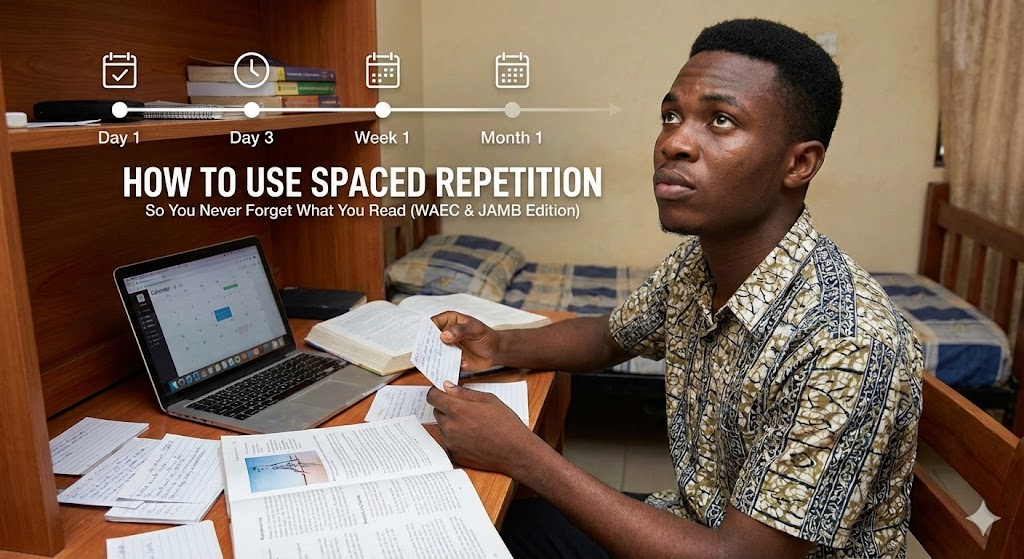
How to Use Spaced Repetition So You Never Forget What You Read (The Secret to Acing WAEC & JAMB)

How to Use Spaced Repetition So You Never Forget What You Read

How to Use Spaced Repetition So You Never Forget What You Read (The Secret to Acing WAEC & JAMB) Ever felt like your brain is a sieve? You spend hours reading for Biology or Government, you think you’ve mastered it, but two days later? Blank. It’s painful. It makes you feel like maybe you aren’t “smart enough.” But here is the truth: your brain isn’t broken. You just haven’t been taught how to store information correctly. Most Nigerian students rely on “cramming” (or la cram, la pour). It works for a day, maybe. But if you want to crush WAEC, JAMB, or those 400-level law exams, you need a better strategy. Learning how to use Spaced Repetition so you never forget what you read is that strategy. It’s the closest thing to a memory cheat code I’ve found. Here is how to stop wasting your study time and start remembering everything. The “Forgetting Curve” (Why You Forget) Before we fix the problem, you need to know why it happens. In the late 1800s, a psychologist named Hermann Ebbinghaus discovered something scary called the “Forgetting Curve.” He found that if you learn something today, you will forget about 50% of it by tomorrow. By next week? You might remember less than 10%. That is why reading a textbook once is a waste of time. Your brain thinks that information isn’t important, so it deletes it to save space. Spaced Repetition hacks this system. instead of reading a topic for 5 hours straight (which leads to burnout), you review it at specific intervals just as you are about to forget it. Step 1: Create a Review Timetable You don’t need to be a genius to do this. You just need discipline. When you finish a topic—let’s say, “Cell Biology”—don’t just close the book and move on forever. You need to schedule reviews. Here is a schedule that works wonders for most students: Review 1: Immediately after reading (summarize what you just read). Review 2: 1 day later (24 hours). Review 3: 3 days later. Review 4: 1 week later. Review 5: 1 month later. It sounds like a lot of work, but these reviews only take 10-15 minutes. It is far better than relearning the whole topic from scratch a week before exams. This consistency is one of the 10 effective study habits every student should develop if they want to stop struggling with grades. Step 2: Stop Rereading, Start “Active Recall” This is where most people get it wrong. They think “reviewing” means opening the textbook and reading the highlighted parts again. That is lazy studying. It feels good because the words look familiar, so you tell yourself, “Yes, I know this.” But you don’t. You just recognize it. To really learn how to use Spaced Repetition so you never forget what you read, you must combine it with Active Recall. Don’t read the page. Close the book. Ask yourself: “What are the functions of the Executive arm of government?” Force your brain to dig up the answer. If you struggle to remember, good. That struggle is actually your brain building stronger connections. It’s like lifting weights; if it’s too easy, muscles won’t grow. Step 3: Use Flashcards (The Secret Weapon) You can’t carry your big textbooks everywhere. Flashcards are the best tool for Spaced Repetition. You can use physical paper cards or apps. Personally, I recommend digital apps because they automate the timing for you. Anki: This is the king of memory apps. It uses an algorithm to show you cards you struggle with more often and hides the ones you already know. Quizlet: Very popular and easier to use than Anki, though the spaced repetition features are sometimes paid. If you prefer paper, that’s fine too. Just keep two piles: “Hard” and “Easy.” Review the “Hard” pile every day, and the “Easy” pile every 3 days. Using tools like this is crucial when you are trying to figure out how to prepare for an exam in a short time. You don’t have time to waste on what you already know. Common Mistakes Students Make Even with this method, you can mess up. Here are the traps to avoid: 1. Being Dishonest with Yourself When you flip a flashcard and see the answer, don’t say, “Oh yeah, I knew that.” If you didn’t say it before flipping the card, you didn’t know it. Mark it as “Failed” and review it again sooner. 2. Breaking the Chain Spaced Repetition relies on consistency. If you skip your reviews for a week, the “Forgetting Curve” will catch up with you, and you’ll have to start over. 3. Cramming the Night Before This method is the opposite of cramming. It takes pressure off you during exam week. But if you wait until the night before to start, Spaced Repetition can’t save you. You can read more about why this is dangerous in this guide by Harvard University’s Academic Resource Center. Does It Actually Work for Nigerian Exams? Absolutely. Whether it’s objective questions in JAMB or theory in WAEC, the exams test your retrieval strength. Imagine sitting in the exam hall. You see a question. If you used how to use Spaced Repetition so you never forget what you read, the answer pops up instantly because you’ve retrieved it 5 or 6 times over the last month. If you only crammed it once? You’ll likely experience that terrible “it’s on the tip of my tongue” feeling. Also, for students engaging in extracurriculars like debates, memorizing points is key. You can apply this same technique when learning how to start a debate greeting in secondary school. Conclusion School is hard enough without having to relearn the same thing five times. Spaced Repetition isn’t magic, but it feels like it. It buys you freedom. You spend less time staring at books and more time actually understanding the material (or sleeping!). Try it for just one subject this week. Download Anki, or cut up some paper for … Read more