The ultimate debate preparation guide for Nigerian school students on 10 reasons why doctor is better than teacher debate
Topic: A Doctor Is More Valuable to Society Than a Teacher | Proposition | Nigerian Schools
Getting Started: What This Debate Is Really About
Picture this: it is inter-house debate day at your school. The hall is packed. The judges are seated. Your team has been handed the proposition side of this motion: “A doctor is more important to society than a teacher.” Your heart is pounding. You know the topic is strong — but do you have enough ammunition to walk away with the trophy?
This guide is written specifically to give you that ammunition. Whether you are preparing for an inter-house speech and debate competition, a zonal contest, an interschool championship, or simply a classroom debate exercise, every argument you need is right here — explained thoroughly, illustrated with examples from Nigerian life, and packaged with ready-to-use debate lines that will resonate with any panel of judges.
Let us be upfront about one thing before we begin: teachers are extraordinary professionals. Ask any successful Nigerian — any senator, any professor, any business mogul, any doctor — and they will tell you about a teacher who made a difference in their life. We are not in the business of pulling down teachers. Teaching is a calling, and Nigerians who have chosen that calling deserve deep respect and far better compensation and recognition than they currently receive.
But in a debate, the question on the table is not “who do we appreciate more?” The question is “who is MORE IMPORTANT?” That is a different question — a logical and analytical question — and answering it well requires looking at the evidence clearly and arguing your case without flinching. That is exactly what we are going to help you do.
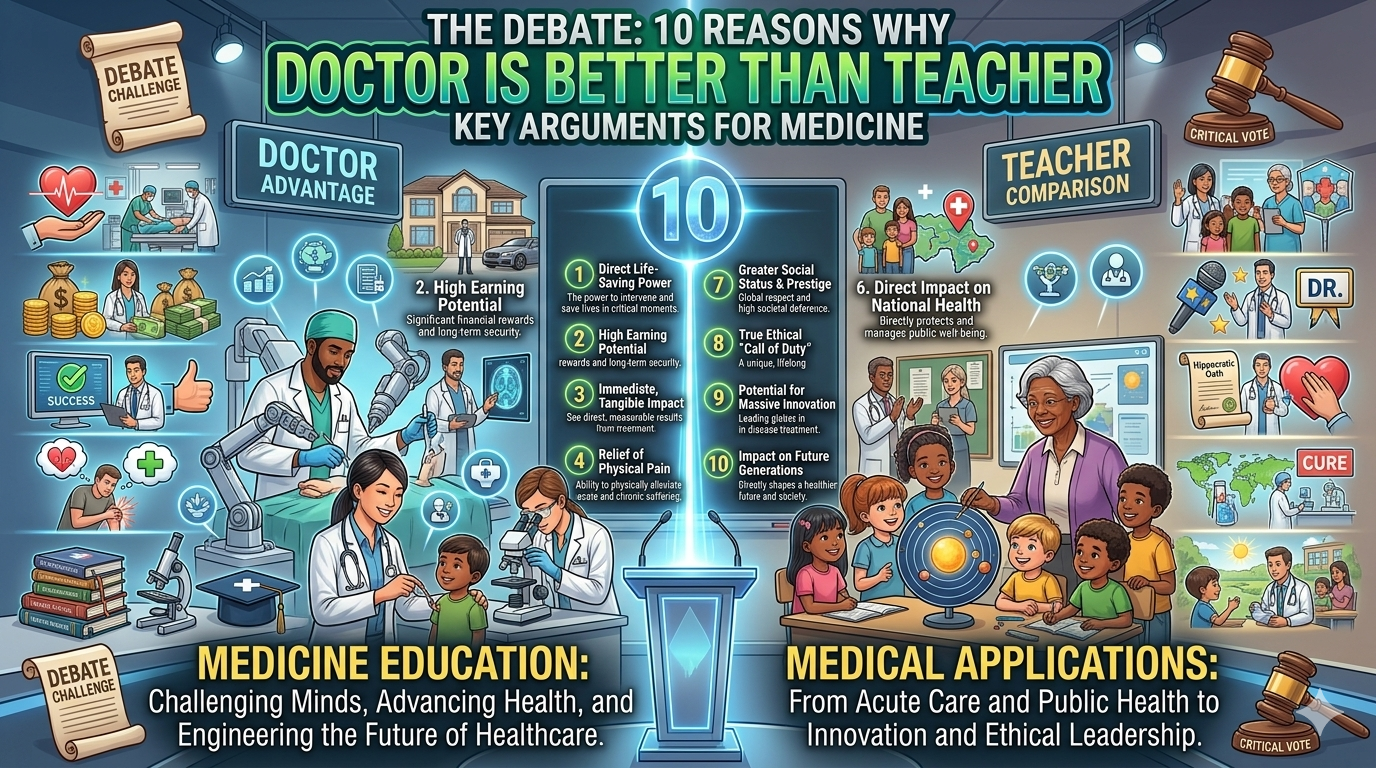
10 reasons why doctor is better than teacher debate
There are ten points in this guide. Each one is developed with full explanations, real-world Nigerian context, and a powerful concluding line you can quote directly in your speech. There is also a section on handling the opposition’s best counterarguments, two full sample speeches, performance coaching tips, and answers to the questions students ask most about this debate topic. By the time you finish reading, you will be ready.
DEBATE REMINDER: In formal school debating, you argue the position you are assigned — not necessarily your personal opinion. Debating a position you did not choose is one of the most valuable intellectual skills the activity builds. The best lawyers, politicians, and negotiators in Nigeria all developed this skill in exactly the same way you are developing it now.
Point 1: Doctors Guard the One Thing That Makes Everything Else Possible — Life Itself
Strip away every other consideration in this debate and you are left with one fundamental truth: human life is the precondition for every human activity, including learning. Education, career, family, community, national progress — none of these things can happen without living people to participate in them. And the professional whose primary mission is to keep human beings alive is the doctor.
Read also: How to Handle Panic Attacks in the Exam Hall: A Survival Guide for Nigerian Students
This is not an abstract point. Every morning, across Nigeria’s network of federal and state teaching hospitals, general hospitals, primary healthcare centres, and private clinics, doctors are making decisions that determine whether individual human beings live or die. The consultant surgeon at Lagos Island General Hospital who operates through the night on a stabbing victim.
The paediatrician at University College Hospital Ibadan who identifies the early signs of bacterial meningitis in a toddler and begins treatment before the infection reaches the brain. The obstetrician at the National Hospital Abuja who manages a complicated delivery that could easily become a maternal death statistic without skilled intervention.
Each of these scenarios represents the doctor doing what no other professional can do: standing at the boundary between life and death and using specialised knowledge to push the outcome toward life.
Think about what that means. Without that doctor, that surgeon, that paediatrician, that obstetrician — the person they saved would be gone. Gone from their family. Gone from their community. Gone from the classrooms they would have sat in, the work they would have done, the children they would have raised.
Teaching shapes the quality of life. Medicine preserves the existence of life. Both matter — but existence comes before quality. The foundation must be laid before the building can be raised.
DEBATE LINE TO USE: “Every lesson a teacher has ever taught was taught to a living student. It is the doctor who ensures that students stay alive long enough to sit in those classrooms. Life is the canvas on which education paints. Without the doctor, the canvas does not exist.”
Point 2: Medical Crises Demand Immediate Response — There Is No Time to Wait
One of the clearest ways to measure the importance of any profession is to ask: what happens in its absence when the need is most acute? For the teaching profession, a teacher’s absence from the classroom is a serious problem students miss instruction, learning is disrupted, and progress is slowed.
That is genuinely harmful, and we do not minimise it. But the harm unfolds over days, weeks, and terms. There is time to respond. Supply teachers can be arranged. Lessons can be rescheduled. Students can catch up.
Now consider the absence of a doctor when a medical emergency strikes. A young man brought to a health centre after a road accident on the Enugu-Onitsha expressway, bleeding internally from a ruptured organ — he does not have days for a replacement doctor to be arranged. He has hours, possibly less.
See more: The Complete List of 26 Tradepreneur Subjects for WAEC: How to Choose a Profitable Skill
A mother in a rural health post in Sokoto State experiencing severe postpartum haemorrhage does not have the luxury of waiting. A child in Bayelsa who has swallowed a toxic substance and is going into respiratory arrest needs a doctor at that exact moment, not tomorrow.
This is the defining characteristic of medical practice that separates it from almost every other profession: the consequences of absence are immediate, irreversible, and fatal. A missed school term can be repeated. A missed surgical intervention cannot be undone. The irreversibility of death — and the doctor’s unique ability to prevent it in real time — is what gives the medical profession a level of urgency that no other occupation can match.
Check out: Health Is Better Than Wealth: Why Good Health Matters More Than Money
Nigerian doctors understand this urgency intimately. Many of them work in conditions of severe resource constraint — inadequate equipment, unreliable power supply, drug shortages — and yet they continue to show up and respond, because they know that in their absence, people die. That commitment to immediate, life-critical response is the hallmark of a profession whose importance is without parallel.
DEBATE LINE TO USE: “A student who misses school this term can repeat the class next term. A patient who misses medical care at the moment of crisis cannot repeat their life. The urgency, the irreversibility, and the immediacy of the doctor’s work is what places it above all others.”
Point 3: Epidemic Control and Disease Prevention Are Uniquely Medical Responsibilities
Nigeria has faced some of the most severe infectious disease challenges in the world. Malaria remains the leading cause of outpatient visits and a major cause of child and maternal deaths. Tuberculosis, a disease eradicated in many wealthier countries, still kills tens of thousands of Nigerians annually.
Meningococcal meningitis outbreaks sweep through the north every dry season. Lassa fever, a viral haemorrhagic fever endemic to West Africa, claims lives in states like Edo, Ondo, and Bauchi year after year. Cholera outbreaks triggered by contaminated water sources periodically affect communities across the country.
And the world watched as Nigeria — through the exceptional work of its doctors and public health officials — contained an Ebola outbreak in 2014 that the WHO declared a public health emergency of international concern.
The management of all these threats is fundamentally a medical responsibility. Doctors diagnose cases, prescribe treatment, organise isolation of infectious patients, lead vaccination campaigns, advise government agencies on appropriate public health responses, and conduct the epidemiological investigations that determine how diseases are spreading and where they will strike next.
Without this medical infrastructure and expertise, infectious diseases would spread unchecked and destroy the social fabric — including the educational system — of communities and nations.
The COVID-19 pandemic provided the clearest possible demonstration of this truth in living memory. When the virus arrived in Nigeria in February 2020, schools across the country closed within weeks. Teachers could not teach. Pupils could not learn. The entire educational enterprise was suspended — not because of any failure of the education system, but because of a public health emergency. And who led the response?
The Nigeria Centre for Disease Control, the Presidential Task Force on COVID-19, and the frontline doctors, nurses, and public health workers who tested, traced, treated, and eventually vaccinated the population. It was medical professionals who made it safe for schools to reopen. Without them, classrooms would have remained empty indefinitely.
DEBATE LINE TO USE: “When disease shuts Nigeria down, it is not teachers who reopen the country — it is doctors. The COVID-19 pandemic showed the whole world that no school can function, no economy can move, and no society can breathe until the medical professionals have done their work. That is the definition of foundational importance.”
Check out: How to Use Mnemonics to Remember Long Lists: A Guide for Nigerian Students
Point 4: The Results of a Doctor’s Work Are Visible, Immediate, and Measurable
Consider the following scenes. A woman arrives at a hospital in Owerri unable to walk, her knee destroyed by advanced arthritis. An orthopaedic surgeon operates, replacing the damaged joint with a prosthetic one. Three months later, she walks out of physiotherapy unaided for the first time in years.
A child in Port Harcourt is brought to the emergency department with severe dehydration from cholera. The doctor administers intravenous fluids and oral rehydration therapy. Within 24 hours, the child who was limp and unresponsive is sitting up and asking for food. A man in Kano presents with a rapidly growing tumour in his neck. A head and neck surgeon operates, removes the mass, and confirms it was caught before it spread. The man goes home to his wife and children.
These stories repeat themselves thousands of times every day in Nigerian hospitals and clinics. And in each case, the impact of the doctor’s intervention is direct, observable, and immediate. The patient came in suffering. The doctor intervened.
The patient’s condition improved. The link between cause and effect is clear, traceable, and measurable — in vital signs, in laboratory results, in the patient’s own testimony, in the statistics that track survival rates and outcomes.
A teacher’s impact, while enormously important and deeply real, typically plays out over years and decades. The brilliant student inspired by a passionate geography teacher may not show the world the full fruits of that inspiration until they are thirty, forty, or fifty years old.
That long-term investment in human potential is beautiful and essential. But in a debate about whose contribution to society is more critical, the immediacy and measurability of the doctor’s impact is a powerful point. You can count the lives saved.
You can measure the suffering reduced. You can track the diseases cured. The doctor’s importance is written in statistics that are updated every single day.
DEBATE LINE TO USE: “You can measure the doctor’s importance today. You can count the surgeries performed, the epidemics contained, the lives saved this morning before most people have finished breakfast. The doctor’s contribution to society is not a theory or a hope — it is a documented, daily, measurable reality.”
Point 5: The Length and Depth of Medical Training Reflects the Weight of the Responsibility
Becoming a doctor in Nigeria is one of the most demanding educational journeys a young person can undertake. After scoring among the highest marks in WAEC and JAMB — medicine and surgery consistently require some of the highest JAMB cut-off scores of any university programme — the student enters a six-year MBBS programme.
Those six years are filled with preclinical studies (anatomy, physiology, biochemistry, pharmacology, pathology, microbiology) followed by intensive clinical rotations through all the major medical specialties: internal medicine, surgery, paediatrics, obstetrics and gynaecology, psychiatry, community health, and others.
After graduation, the newly qualified doctor does not yet practise independently. One year of compulsory housemanship follows — a closely supervised internship during which the doctor rotates through hospital departments under the guidance of senior consultants, building practical skills and clinical judgement.
Read more: How to Register for NYSC Mobilization: The Complete Guide for Fresh Graduates
Then comes the National Youth Service Corps year. Only after all of this is the doctor licensed to practise fully. And if they choose to specialise — becoming a cardiologist, a neurosurgeon, a plastic surgeon, a gynaecological oncologist — they enter a residency programme that adds another four to seven years of training and multiple high-stakes professional examinations.
In total, a fully trained specialist doctor in Nigeria will have spent between twelve and sixteen years in medical education and supervised training before reaching independent practice. This extraordinary investment of time and intellectual effort is not made out of tradition or bureaucratic inertia.
It is made because the consequences of inadequate medical training can be fatal, and society rightly demands that anyone practising medicine is prepared to the highest possible standard.
No disrespect to the teaching profession is intended in observing that teacher training, while rigorous and important, does not require this same duration or this same intensity of preparation.
The difference in training requirements reflects a difference in the nature of the stakes involved. A doctor who makes an error in clinical judgement can kill a patient. Society’s investment in ensuring this does not happen is a direct measure of the doctor’s importance.
DEBATE LINE TO USE: “Society requires a doctor to spend up to sixteen years in training before practising independently. That extraordinary investment is not made for any other profession. It tells you, in the clearest possible terms, exactly how important and how irreplaceable the doctor’s role is judged to be.”
Read now: How to Use the Pomodoro Technique to Smash Your WAEC and JAMB Exams
Point 6: You Must Be Healthy Before You Can Learn — Health Comes Before Education
The opposition in this debate will almost certainly make the following argument: without teachers, there would be no doctors. Teachers train the students who become the medical professionals who save lives. Therefore the teacher is more foundational than the doctor. It is a clever argument. It is also a genuinely true argument. And yet it misses something critical.
Yes, teachers produce doctors. But doctors produce the conditions under which teachers can do their work. This is not a circular argument — it is a recognition of the hierarchy of human needs.
The developmental psychologist Abraham Maslow described a pyramid of human needs in which physiological needs (food, water, warmth, health) must be met before higher-order needs (including education and self-development) can be meaningfully pursued. Health sits at the foundation of that pyramid. Education sits higher up. Both are essential, but the foundation must be secure before the higher floors can be built.
In practical Nigerian terms, this means the following. A child who is suffering from severe malaria cannot go to school. A child weakened by chronic intestinal parasitic infections — schistosomiasis, hookworm, roundworm, conditions affecting millions of Nigerian children — cannot concentrate in class.
A child with untreated childhood tuberculosis cannot sit through lessons. A child blinded by vitamin A deficiency or river blindness cannot read the textbooks their teacher has assigned. In each of these cases, it is a doctor — not a teacher — who removes the obstacle between the child and education.
This is why global development organisations consistently identify healthcare investment as the prerequisite for educational development in low-income settings. Healthy children go to school. Healthy children learn.
Healthy adults participate in the workforce and in civic life. The doctor’s work is not parallel to the teacher’s — it is the preparation for it. Without the foundation of health that doctors provide, the educational system that teachers operate has far fewer children who are well enough and present enough to benefit from it.
DEBATE LINE TO USE: “The opposition says teachers create doctors. We agree entirely. But doctors create the healthy children who can actually sit in classrooms and be taught. Health comes before learning in the order of human needs. The doctor lays the groundwork on which the teacher builds.”
Point 7: Hospitals Run Every Hour of Every Day — Schools Do Not
There is a simple factual observation that carries enormous weight in this debate: medical care never stops. The hospital does not observe school holidays. The emergency room does not close for Christmas, for Sallah, for mid-term break, or for the long vacation.
See now: How to Create Flashcards for Quick Revision: The Ultimate Guide for Nigerian Students
A doctor can be called in the middle of the night, on a Sunday morning, on the first day of a public holiday, in the middle of a national celebration. When a patient deteriorates at three in the morning, the on-call doctor must respond. When a woman goes into labour during a fuel scarcity and the roads are difficult, the doctor at the nearest health facility must be ready.
This round-the-clock, round-the-year availability is a direct expression of the continuous, uninterrupted nature of medical need. Human bodies do not schedule their crises conveniently.
Disease does not take weekends off. Accidents do not happen only during business hours. And so the medical profession must be available at all times, because the need it serves is constant.
Teaching, by contrast, operates within defined and bounded hours. Schools open and close. Terms begin and end. Teachers have holidays and weekends. This is not a criticism — it is simply the nature of the profession and the service it provides.
Learning is important and urgent, but it can be deferred. A missed Friday lesson can be covered on Monday. A school term missed due to illness can in many cases be repeated or supplemented. Death cannot be deferred, and life-threatening medical emergencies cannot be rescheduled.
In communities across Nigeria’s rural areas — where a single doctor may serve thousands of patients spread across multiple villages — the sheer reach and relentlessness of medical responsibility is staggering. That doctor is the community’s lifeline at every hour of every day. Their importance to the survival and wellbeing of that community is beyond any reasonable dispute.
DEBATE LINE TO USE: “A school closes at three o’clock and reopens on Monday morning. A hospital never closes. Medical need does not respect timetables, and the doctor who responds to that need at any hour of any day is serving society in a way that no other professional is called upon to do.”
Point 8: Medical Research Has Produced Discoveries That Changed the Course of Human History
The doctor’s contribution to society extends far beyond the consultation room and the operating theatre.
Doctors and medical scientists have been responsible for some of the most consequential discoveries in the history of human civilisation — discoveries that have saved hundreds of millions of lives and transformed the conditions of human existence on a scale that is genuinely difficult to comprehend.
Consider the following: before the discovery and mass production of antibiotics in the twentieth century, bacterial infections like pneumonia, typhoid, tuberculosis, and sepsis were among the leading causes of death worldwide.
A cut that became infected could kill a healthy young adult within days. Today, in most cases, these conditions are treated with a short course of inexpensive medication.
The discovery of penicillin by Alexander Fleming and its subsequent development into a usable treatment by Howard Florey and Ernst Chain is estimated to have saved over 200 million lives since the 1940s. This was a medical discovery made by a doctor-scientist.
The development of vaccines for smallpox, polio, measles, diphtheria, tetanus, and whooping cough eliminated or dramatically reduced diseases that had killed and disabled children for thousands of years. The global eradication of smallpox — the only human infectious disease ever to be deliberately eradicated — was achieved through a worldwide vaccination campaign led by doctors and public health workers.
In Nigeria specifically, the near-eradication of polio — a disease that paralysed thousands of Nigerian children annually — is the direct result of decades of sustained medical effort including vaccination campaigns largely designed and implemented by doctors.
Medical research continues today at a pace that is accelerating. New cancer treatments, new approaches to managing diabetes, new surgical techniques, new understanding of the human genome and how genetic factors influence disease — all of these advances are being driven by doctors and medical scientists. Each breakthrough extends and improves human life.
The cumulative impact of medical research on the quality and length of human life is the single greatest contribution to human welfare in recorded history.
DEBATE LINE TO USE: “The doctor does not only save the patient in front of them today — through research and discovery, the doctor saves the patients of tomorrow and the day after that. Every life extended by a vaccine, every death prevented by an antibiotic, every cancer survived because of a new treatment protocol, is a monument to what doctors have given humanity.”
Check out: How to Read for 10 Hours a Day Without Getting Tired: The Ultimate Guide for Nigerian Students
Point 9: Nigeria’s Doctor Crisis Proves Beyond Doubt How Essential Doctors Are
One of the most persuasive arguments you can make in any debate is an argument from observable reality — from facts so clear and so present in the everyday experience of the audience that they are impossible to deny. And in Nigeria right now, the observable reality of the doctor shortage makes the strongest possible argument for the doctor’s indispensable importance.
Nigeria currently has one of the lowest ratios of doctors to population in the world. The World Health Organisation recommends a minimum of one doctor for every 1,000 citizens. Nigeria, with a population now exceeding 220 million people, has an estimated 35,000 to 50,000 practising doctors within the country — a ratio catastrophically below the WHO benchmark.
The result is overcrowded hospitals, hours-long queues at government health facilities, patients dying of conditions that would be immediately and successfully treated in countries with adequate medical staffing, and a maternal mortality rate that places Nigeria among the worst-performing nations on earth for safe childbirth.
The situation is made worse by the brain drain — the Japa phenomenon that has accelerated dramatically in recent years. Nigerian doctors, often trained at enormous cost to themselves and to the public university system, are leaving for the United Kingdom, Canada, the United States, Saudi Arabia, and other countries where salaries are higher, working conditions are better, and professional development is more accessible.
The Nigerian Medical Association has raised the alarm repeatedly. The Federal Government has convened emergency summits. Entire hospital wards have been shut down because there are not enough doctors to staff them. This is a national crisis, and it is recognised as such at the highest levels of government.
Now ask yourself: is there an equivalent national crisis over teacher numbers? Are emergency summits being convened because Nigeria does not have enough teachers? While teacher shortages are real and serious in some areas, the societal panic, the scale of the emergency, and the life-or-death consequences of the doctor shortage are in a different category entirely. The depth of the crisis tells you the depth of the need. And the depth of the need tells you the depth of the importance.
DEBATE LINE TO USE: “Nigeria is in a declared national emergency over its shortage of doctors. Government committees are sitting. Hospital wards are closing. People are dying from preventable conditions. That emergency, playing out in real time, is the most honest and direct answer to the question of who is more important to Nigerian society.”
Point 10: Doctors Serve Every Nigerian Equally — at the Moments of Greatest Need
Our tenth and final point is perhaps the most humanly resonant, and it is the one that will linger longest in the minds of judges after the debate is over. Teaching, as essential as it is, primarily serves people who are well enough to attend school, young enough to be in formal education, and in circumstances that allow them to participate in structured learning.
These are significant preconditions. Many Nigerians, for reasons of poverty, disability, geography, conflict, or family circumstance, cannot meet all of them.
But medical need respects none of these boundaries. The newborn taking her very first breath needs the skills of a midwife or doctor just as much as the professor emeritus. The subsistence farmer in rural Zamfara who has never attended a day of formal school needs the doctor’s knowledge and care just as much as the governor of a state.
The woman with no education giving birth in a village health post needs skilled obstetric care just as urgently as the corporate executive delivering in a private Lagos hospital. The beggar on the street who collapses from heat stroke has just as much claim on the doctor’s attention as the wealthy businessman who arrives in a private car.
This universality — the doctor’s commitment to serve anyone who presents in need, regardless of status, education, wealth, or background — is expressed in the Hippocratic tradition that has guided medicine for over two thousand years and in the modern oaths that Nigerian doctors take upon qualification.
The commitment to do no harm, to treat every patient with equal care and dignity, to serve the sick and suffering regardless of who they are, is one of the most ethically powerful aspects of the medical profession.
In a country as economically unequal and as diverse as Nigeria 250 ethnic groups, enormous wealth gaps between states and between households, a rural majority with limited access to services the doctor’s universal service obligation represents something profound.
The doctor goes where the need is greatest, serves the most vulnerable, and asks no qualification of the person who comes for help except that they are sick and in need of care. That universality, that radical inclusivity of service, is one of the clearest expressions of what it truly means to be important to a society.
DEBATE LINE TO USE: “The teacher serves those who are able to come to the classroom. The doctor serves everyone who is human and in need — from the very first breath to the very last. That universal commitment, to every Nigerian regardless of education, wealth, or status, is the fullest possible expression of professional importance.”
Check out: Fully funded scholarships in Europe for international students 2025 & 2026
Responding to the Opposition: Turning Their Arguments Around
Every experienced debater knows that winning is not only about your own arguments — it is also about calmly and confidently dismantling the other team’s best points. Here are the three arguments the opposition is most likely to make, and how to respond to each one effectively.
Opposition Claim: “Teachers Are Responsible for Training Every Doctor”
This is the argument the opposition will lead with, and it deserves a thoughtful response rather than a dismissal.
How to respond: “We are genuinely grateful to the opposition for making this point, because it actually strengthens our case. If teachers are most important because they produce doctors, then the product they are most proud of creating — the doctor — is more important than the creator. By the opposition’s own logic, the most important output of the educational system is the medical profession.
We agree. The teacher’s greatest contribution to society is the doctor. That is our argument, not the opposition’s.
Furthermore, while it is true that medical school lecturers teach medical students, the knowledge base of medicine is developed and advanced by practising doctors and medical researchers — not by classroom teachers.
The doctor is both the product of education and the engine of medical science’s continued progress. The teacher transmits knowledge; the doctor generates new knowledge in the most critical domain of human welfare.”
Opposition Claim: “Teachers Build the Moral Character and Values of the Nation”
The opposition will argue that teachers do something beyond academic instruction — they instil values, shape character, and produce the ethical citizens that a healthy democracy needs. This is true and important.
How to respond: “We do not dispute that teachers play a crucial role in character formation. But we ask the panel to consider: what is the precondition for character? What is the precondition for citizenship? It is life. It is health. It is a functioning body and mind. The child who dies of a preventable disease at age six never develops the character the teacher would have shaped.
The young woman who loses her life in childbirth because there was no skilled medical attendant never becomes the citizen the teacher was preparing. Before character can be built, life must be sustained. Before citizenship can be developed, health must be secured. The doctor provides that foundation.”
Check out: How to Cram for an Exam in 24 Hours: The “Emergency” Guide to Passing (Without Fainting)
Opposition Claim: “Society Would Collapse Without Teachers More Quickly Than Without Doctors”
Some opposition teams argue that without teachers, within one or two generations, there would be no educated workforce, no doctors, and no functioning society — therefore teachers are more fundamental.
How to respond: “This is an interesting theoretical argument, but it ignores practical reality. Without doctors, society does not have the luxury of waiting one or two generations to feel the impact. People start dying today. This week. This month. Maternal deaths begin immediately. Epidemic outbreaks go uncontrolled immediately. Injuries and acute illnesses become fatal immediately. The opposition’s argument asks us to think in generations. Medicine operates in minutes and hours. In the real, present Nigeria — where people need healthcare right now — the doctor’s absence is felt instantly and fatally. That immediacy is the decisive factor.”
Sample Opening Speech — Adapt This for Your Competition
Study the structure and the key phrases in this sample speech, then rewrite it in your own voice. A speech that sounds natural and personal is always more convincing than one that sounds memorised.
“Good morning to our distinguished panel of judges, our respected timekeeper, our honourable opponents, and all gathered here today. My name is [your name], and I rise on behalf of the proposition to argue that a doctor is more important to society than a teacher.
Allow me to begin with a question. Imagine two communities. The first community has outstanding schools, dedicated teachers, a wonderful curriculum — but no doctors. The second community has excellent healthcare, skilled physicians, and fully staffed hospitals — but no schools. In which community would you rather raise your child?
In the first community, children will die of fever, of infected wounds, of childbirth complications, of epidemics that sweep unchecked through the population. Whatever their teachers have taught them, they will not survive long enough to use it. In the second community, children will be healthy, strong, and alive. They may learn to read late. They may not have formal schooling. But they will be alive to learn eventually, to grow, to contribute, to build.
This thought experiment reveals the hierarchy of human needs. Life precedes learning. Health precedes education. And the guardian of life and health — the professional who stands between us and the preventable deaths that claim too many Nigerians every year — is the doctor.
Over the course of this debate, my team will demonstrate clearly and with evidence drawn from Nigerian reality why the doctor’s role is more critical, more urgent, and more foundational than any other profession — including the honourable teaching profession. We will show you that without doctors, no school can function, no economy can grow, and no society can sustain itself. I invite the panel to listen carefully, weigh the evidence, and at the end of this debate, award the victory to the truth. I thank you.”
Check out: JAMB 2026 Novel Summary: The Lekki Headmaster by Kabir Alabi Garba (Complete Guide)
Sample Summary and Closing Speech
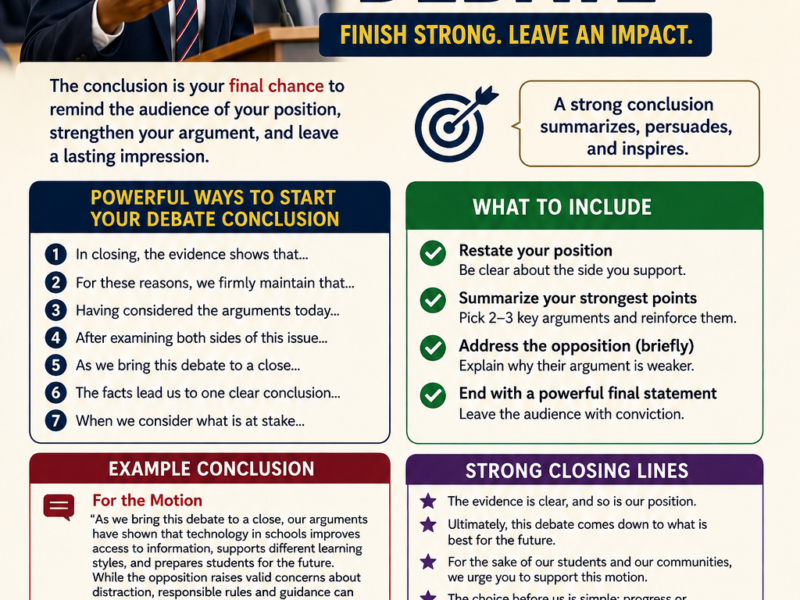
The last speaker on the proposition team closes the debate. This speech should briefly summarise the key arguments, respond to the opposition’s best points, and end memorably. Here is a sample to adapt:
“Distinguished judges, as we draw this debate to a close, let me remind this honourable panel of what the proposition has established today.
We have established that life is the precondition for all other human activity — and that the doctor is its guardian. We have established that medical emergencies cannot wait while educational shortcomings can be addressed over time. We have established that epidemic diseases shut down schools and societies, and that it is doctors who reopen them. We have established that Nigeria is in a declared medical emergency because of doctor shortages — a level of national alarm that reflects the depth of the need.
The opposition has argued, with sincerity, that teachers produce doctors. We honour that truth. But we remind the panel that the doctor is the greatest product of the educational system — the professional whose absence is felt most immediately, most fatally, and most universally. If teachers are important because they produce doctors, then doctors are the measure of that importance.
I leave the panel with one final image. Somewhere in Nigeria right now, a doctor is making a decision. The patient before them is in crisis. The family outside the door is praying. The outcome of the next few minutes will determine whether that patient goes home or does not. In that moment, no other professional on earth can do what the doctor is doing. No other training, no other qualification, no other calling prepares a human being for that moment.
That moment — repeated thousands of times every day across every state of Nigeria — is why we say, with evidence, with conviction, and with respect for all who have spoken today: the doctor is more important. The proposition rests its case. Thank you.”
See more: How to Avoid Daydreaming/Zoning Out in the Library: A Student’s Guide to Staying Focused
Seven Performance Tips to Win on the Day
Arguments alone do not win debates delivery does. Here are seven coaching tips that will help you perform at your best when it matters most.
- Slow down when you make your best point. Most students speed up when they are nervous. Train yourself to do the opposite. When you reach a powerful argument especially your strongest debate line — slow down, pause briefly before it, and deliver it clearly and calmly. Pausing before a key line signals its importance and gives judges time to register it.
- Direct your eye contact at the judges. The judges are the people you are convincing. Look at them, not at your paper. Hold a judge’s gaze for two or three seconds as you make a key point, then move to another judge. This builds rapport and communicates confidence more effectively than any technique.
- Anchor every argument in Nigerian reality. General arguments are good. Nigerian arguments are better. When you talk about doctor shortages, mention the WHO ratio and Nigeria’s numbers. When you discuss emergency medicine, describe the Lagos-Ibadan expressway accident scenario. When you talk about epidemic control, mention Lassa fever or the 2014 Ebola containment success. Specific, local examples show the judges that you have thought carefully rather than recited generic material.
- Acknowledge the opposition before you rebut. Opening a rebuttal with “My distinguished opponents raise a fair point — let us examine it more carefully” sounds mature, confident, and intellectually honest. It also signals to the judges that you are engaging with the argument rather than ignoring it, which is far more persuasive.
- Use triads — groups of three. The human mind responds powerfully to things grouped in threes. “The doctor saves lives, controls disease, and protects the vulnerable.” “Life before learning, health before education, doctor before teacher.” Triads are memorable, rhythmically satisfying, and they stick in the judges’ minds long after the debate ends.
- Prepare for the clock. Know exactly how long your speech is. Practice it until you can deliver it in the allotted time without rushing and without going over. Running out of time before finishing your argument is one of the most avoidable ways to lose marks. Finishing significantly under time wastes your opportunity. Aim to complete your speech with about fifteen to thirty seconds remaining.
- Stand tall and breathe. Your posture communicates your confidence before you say a single word. Stand upright, feet shoulder-width apart, hands still or using purposeful gestures. Take a slow breath before you begin. Look up before you start speaking, not down at your paper. The first five seconds of your speech set the tone for everything that follows.
Read now: Best Trade Subjects for Science Students in WAEC 2026: A Complete Guide
Questions Students Ask About This Debate Topic
Does arguing this topic mean I am saying teachers do not matter?
Absolutely not. Competitive debating is an intellectual exercise, not a personal values declaration. When a lawyer argues a client’s case in court, it does not mean they personally believe every element of that argument — it means they are doing their professional duty to represent a position as effectively as possible.
Debate training does exactly the same thing. You are developing the skills of argumentation, critical thinking, and public communication. Arguing that doctors are more important is an exercise in intellectual strength, not a statement of disrespect toward teachers.
What if I am assigned to argue the opposition side instead?
If you are arguing that the teacher is more important than the doctor, your strongest points are: teachers produce every other professional including doctors; teachers shape moral character and civic values; the long-term impact of education on national development exceeds any single profession’s contribution; and without the knowledge that teachers transmit across generations, medical science itself would not exist. Both sides of this debate have genuinely strong arguments that is what makes it such a good topic.
Can I use this content for a written essay or assignment?
Yes. Each of the ten points in this guide can be expanded into a paragraph of an argumentative essay. Write an introduction that states your position clearly (a doctor is more important than a teacher), develop each point as a separate body paragraph with evidence and explanation, address the opposing view briefly in a paragraph that acknowledges and responds to it, and conclude by restating your position and summarising your strongest evidence. The sample speeches can also serve as models for the essay’s introduction and conclusion.
Which three points should I prioritise if I have limited preparation time?
If you can only prepare three points thoroughly, focus on these: first, life precedes learning the doctor preserves the existence that makes education possible; second, medical emergencies cannot wait while educational shortfalls can be addressed over time; and third, Nigeria’s own national alarm over doctor shortages is real-world evidence of the medical profession’s indispensable importance.
These three points are the hardest for the opposition to defeat and the most memorable for judges.
Final Words: Prepare Well, Argue Boldly, Respect Both Professions
You are now equipped with everything you need to argue the proposition side of this debate convincingly and with confidence. Ten fully developed points. Ready-to-use debate lines for each. Responses to the opposition’s strongest arguments. Two complete sample speeches. Seven performance coaching tips. And answers to the questions that trip students up most.
Now the work is yours to do. Read through this guide a second time and make sure you understand every argument — not just the words, but the logic behind them.
The debater who understands their arguments can handle any challenge from the floor, any unexpected question from a judge, any surprising point from the opposition. The debater who has only memorised lines is vulnerable the moment things do not go exactly as planned.
Practice out loud. Record yourself and listen back. Notice where you hesitate, where you rush, where your voice drops. Work on those sections specifically. Time yourself against the clock and adjust.
Ask a classmate, a sibling, or a parent to play the opposition and challenge your points. The more you practise under pressure, the more natural and confident you will feel on the actual day.
And remember, through all the preparation: both the doctor and the teacher are heroes of Nigerian society. The overworked, underpaid teacher who stays after school to give extra lessons to struggling students.
The exhausted doctor who has worked a double shift and still responds with care and precision to the patient in front of them. Both of these people are extraordinary. Both of them deserve Nigeria’s deepest gratitude and far better support than they currently receive.
But in the debate hall, on the day of your competition, your task is clear and your arguments are strong. Walk in with confidence. Speak with clarity. Argue with conviction.
The hall is yours. Go and win it.