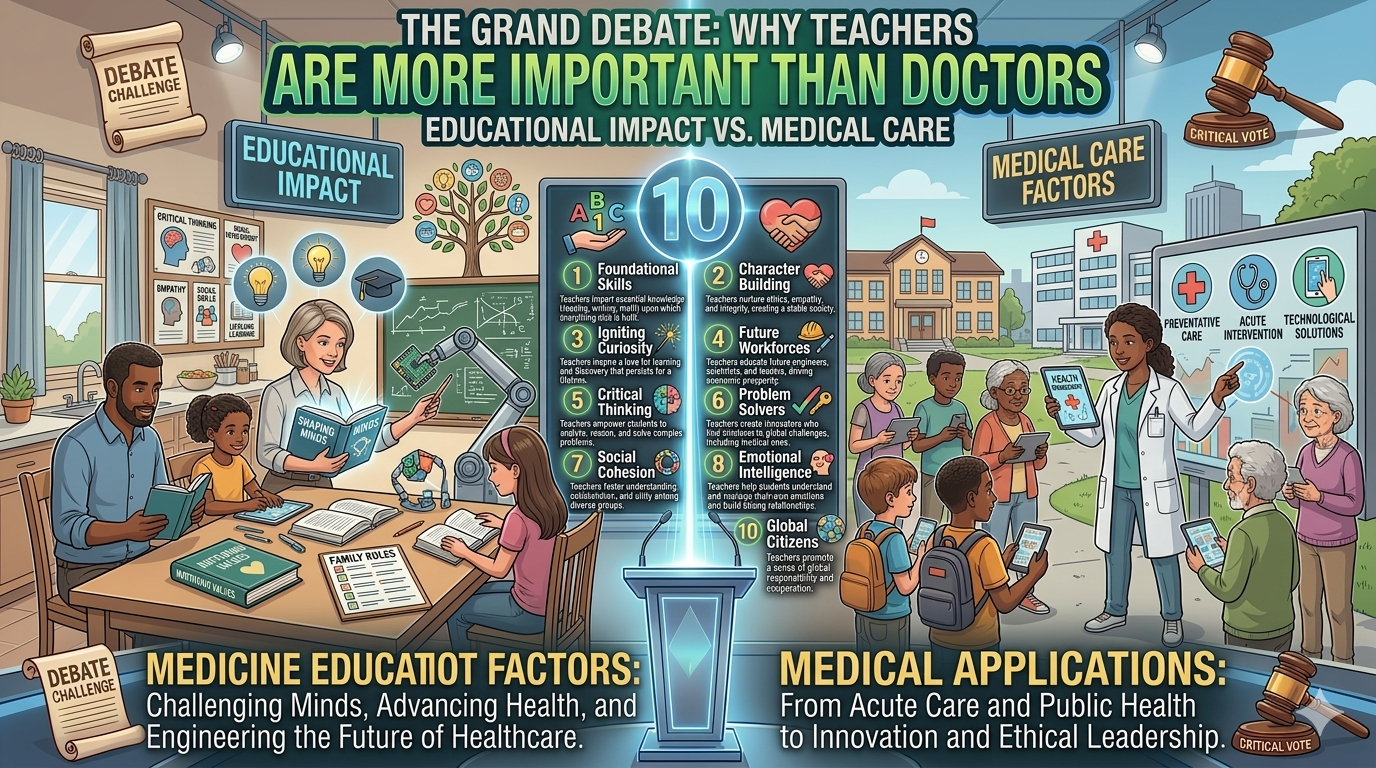
Why the Teacher Stands Above the Doctor: 10 Compelling Arguments
The definitive debate preparation guide for Nigerian school students on 10 Reasons Why Teachers Are More Important Than Doctors
Motion: A Teacher Is More Important Than a Doctor | Proposition | Nigerian Primary & Secondary Schools
Introduction: The Debate That Divides Schools Across Nigeria
There is a debate topic that Nigerian students encounter so frequently in inter-house competitions, interschool championships, and classroom discussions that it has almost become a rite of passage: which is more important to society — the teacher or the doctor?
It is a question that sparks genuine disagreement, passionate argument, and — when both sides argue it well — some of the most intellectually stimulating debate that school competitions produce.
If you have been handed the task of arguing that the teacher is more important, you may be feeling a mixture of excitement and uncertainty.
Excitement because the teacher’s case is genuinely strong, rich with compelling arguments, and deeply rooted in truths about how civilisations grow and flourish.
Uncertainty because you know the other side will come with powerful ammunition of their own — life, death, emergency medicine, the irreplaceable nature of the doctor’s work.
This guide is your answer to that uncertainty. By the time you finish reading it, you will not only have ten well-developed, logically rigorous arguments for the teacher’s greater importance — you will understand each one deeply enough to explain it, defend it under questioning, and adapt it on the fly when the debate takes an unexpected turn.
You will have two complete sample speeches, detailed guidance on defeating the opposition’s best points, and practical coaching tips that will help your delivery match the quality of your arguments.
One thing to say clearly from the start: doctors are among the most admired and most important professionals in any society, and Nigeria’s doctors who work under conditions of enormous pressure, inadequate resources, and unreliable infrastructure deserve immense respect and far better support than they receive.
Nothing in this guide diminishes that. But this debate is not about respect. It is about a logical question: which profession is more important to society? And when we examine the evidence honestly and fully, the teacher’s claim to that title is remarkably powerful.
10 Reasons Why Teachers Are More Important Than Doctors
Let us build that case together, argument by argument, example by example, until you are ready to walk into that debate hall with the confidence of someone who knows not just what they are arguing, but why it is true.
FOR STUDENTS: In formal debate, you argue the position you are assigned with your full intellectual effort — regardless of your personal opinion. This practice of arguing a position rigorously is one of the most valuable skills a student can develop. It builds empathy, critical thinking, and the kind of persuasive communication that serves you in every area of adult life.
Point 1: The Teacher Is the Architect of Every Other Profession — Including Medicine
When we speak of the teacher’s importance relative to the doctor, we must begin with the most foundational question available: which came first? And the answer, without any possibility of dispute, is the teacher.
Long before there was a trained doctor in any community, there was someone transmitting knowledge — explaining, demonstrating, correcting, guiding the next generation in the skills and understanding needed to function and contribute.
See also: The Complete List of 26 Tradepreneur Subjects for WAEC: How to Choose a Profitable Skill
Teaching is the oldest profession of knowledge transmission in human history. Medicine, as a systematic discipline, came after — built on the foundations of accumulated, transmitted knowledge.
In the Nigerian context, consider what actually has to happen before a young person becomes a qualified medical doctor. They must complete six years of primary education. Six years of secondary education. Six years of medical school. One year of housemanship.
The National Youth Service year. At every stage of this fourteen-to-fifteen-year journey, they are surrounded by teachers — primary school teachers who taught them to read and count, secondary school teachers who built their science foundation, university professors who delivered medical knowledge, and clinical supervisors who guided their practical training. Take away any of those teachers at any stage, and the doctor does not emerge.
But the teacher’s generative power does not stop at producing doctors. In any given year, a dedicated secondary school teacher in Nigeria sends students into nursing, pharmacy, physiotherapy, dentistry, public health, and biomedical research — as well as into law, engineering, architecture, journalism, politics, business, and every other field that constitutes a functioning modern society.
The teacher is not a specialist who produces one kind of professional. The teacher is the universal producer — the professional whose output is all other professionals.
This generative universality is what makes the teacher’s importance uniquely foundational. You can measure the doctor’s importance in lives saved per year.
You can measure the teacher’s importance only by looking at the entire sweep of human civilisation every profession, every institution, every advancement, every discovery — and recognising that each one carries within it the invisible fingerprints of the teachers who made it possible.
KEY DEBATE LINE: “The doctor saves the patient who lies before them. The teacher produces the doctor, the nurse, the pharmacist, and every other person who will ever work in that hospital. One profession fills the ward; the other built every professional working in it. Ask yourself which is more foundational, and the answer is clear.”
Point 2: Teaching Is the Only Profession That Reaches Human Beings Before Anyone Else Can
There is something uniquely significant about the timing of the teacher’s influence. A child’s first contact with a doctor typically occurs during illness or routine vaccination — reactive, occasional, and brief.
A child’s first contact with a formal teacher typically begins at age five or six and does not end until the child is a young adult in their mid-twenties. For two decades of the most formative years of human life, the teacher is a consistent, shaping presence.
Developmental science is unambiguous about the importance of early and middle childhood in shaping cognition, character, and behavioural patterns. The experiences, relationships, and lessons absorbed between the ages of five and eighteen have a disproportionate influence on who a person becomes.
Neural pathways formed during these years are among the most durable in the human brain. Values and habits established during childhood and adolescence resist change far more powerfully than those formed in adulthood.
This means that the teacher is not simply one of many influences on a child’s development — the teacher is the most systematic, the most consistent, and the most professionally intentional influence operating during the most critical developmental window of human life.
A child who has a teacher who nurtures their curiosity, affirms their dignity, challenges their thinking, and models intellectual integrity is a child whose life trajectory is fundamentally shaped by that experience. A child who does not has a different trajectory.
Check out: Scholarships for International Students: What You Need to Know!
In Nigerian schools, we see this every day. The teacher who notices that a quiet child in the back row has an extraordinary gift for mathematics and takes time to encourage and challenge that child may be redirecting an entire life.
The teacher who creates a safe, respectful classroom environment where children learn that their voices matter may be building the civic confidence that eventually produces a community leader or a principled public servant.
These influences are not incidental to teaching. They are the work itself — and no other professional is positioned to do this work in the way, at the time, and with the reach that the teacher operates.
KEY DEBATE LINE: “The teacher arrives in a child’s life before sickness does, before ambition does, before any of the forces that will compete for that child’s future. During the years when the human being is most impressionable and most powerfully shaped, it is the teacher — not the doctor — who is present, consistent, and intentional. First is not always most important. But in this case, it is.”
Point 3: Education Is the Most Proven Pathway Out of Poverty — Teachers Deliver It
Nigeria has one of the youngest populations in the world and one of the highest rates of youth poverty. Millions of young Nigerians are growing up in conditions of material deprivation that constrain their opportunities, damage their health, and limit their life prospects.
The question of how to break the cycle of poverty for these young people is one of the most urgent and consequential questions in Nigerian public life. And the answer, supported by decades of research and decades of developmental experience across the globe, is education.
The relationship between educational attainment and lifetime earnings is one of the most robust findings in all of economics. Each additional year of quality education increases a person’s earning potential substantially. Education equips people with skills that are valued in the labour market. It builds the entrepreneurial capacity and financial literacy that enables people to start and sustain businesses.
It develops the problem-solving ability and adaptability that allows people to navigate an economy that is constantly changing. In practical Nigerian terms, it is the difference between a young person who enters the labour market with qualifications and one who does not.
More than individual earnings, education drives community-level economic development. Communities with higher average educational attainment have stronger local economies, lower rates of crime, better public health outcomes, and more effective civic institutions. The investment that a teacher makes in thirty students a year compounds across entire communities and across entire generations in ways that measurably improve the material conditions of life for thousands of people.
A doctor contributes to this developmental picture by keeping people healthy enough to work and to learn. That contribution is real and valuable. But the doctor addresses poverty’s consequences — illness, diminished capacity, shortened lives. The teacher addresses poverty’s root — lack of skills, lack of knowledge, lack of the human capital that enables genuine economic participation. Addressing roots is always more powerful than treating symptoms. The teacher is the profession that addresses the root.
KEY DEBATE LINE: “A doctor treats the illness that poverty causes. A teacher builds the education that poverty cannot survive. One profession manages the consequences of underdevelopment. The other dismantles its foundations. Nigeria does not need to manage poverty — Nigeria needs to end it. And that work belongs, first and foremost, to the teacher.”
Point 4: Teachers Transmit the Entire Inheritance of Human Knowledge Across Time
Human beings are unique among all living creatures in our capacity to accumulate knowledge across generations. A dog does not benefit from the experiences of dogs that lived a thousand years ago.
A lion cannot draw on the discoveries of lions from previous centuries. But a human being born today inherits the entire accumulated knowledge of all the human generations that came before — mathematics, science, history, philosophy, art, medicine, law, engineering, and much more besides. This extraordinary inheritance is what allows each generation to begin where the previous one left off, rather than starting from scratch.
The profession that makes this inheritance possible is teaching. Teachers are the transmission mechanism through which the accumulated wisdom and knowledge of humanity flows from one generation to the next.
Without teachers, each generation would have to rediscover everything — fire, the wheel, writing, arithmetic, the germ theory of disease, the structure of the atom, the principles of engineering, the rules of justice.
The idea is almost impossible to contemplate. But it illustrates exactly why teaching is so fundamentally important: it is the mechanism that makes human civilisation cumulative rather than cyclical.
In the Nigerian context, this transmission role has enormous cultural as well as intellectual significance. Teachers transmit not only academic knowledge but cultural heritage — Nigerian history, literature, music, art, and social values.
Read on: How to Cram for an Exam in 24 Hours: The “Emergency” Guide to Passing (Without Fainting)
The teacher who introduces students to Chinua Achebe’s Things Fall Apart is transmitting not just a story but a framework for understanding the collision of cultures, the complexity of colonial history, and the depth of Igbo civilisation.
The teacher who teaches Nigerian history is connecting the next generation to the struggles and achievements that shaped the country they inhabit. These transmissions matter. They build the shared identity and collective memory without which a diverse nation like Nigeria cannot cohere.
Medicine benefits enormously from this knowledge transmission — every medical advance builds on previous ones, and medical students learning today are learning knowledge that was accumulated and transmitted across centuries of medical tradition.
But the transmission mechanism itself — the educational system animated by teachers — belongs not to medicine but to the profession that makes all other knowledge transmission possible.
KEY DEBATE LINE: “Strip away the teacher, and in a single generation, humanity forgets everything it has learned. Every medical discovery. Every scientific principle. Every mathematical formula. Every cultural achievement. The teacher is not merely one contributor to human knowledge — the teacher is the guardian of all of it. Without that guardian, there is nothing left to protect.”
Point 5: Teachers Serve Their Students During Every Stage of Life, Not Only in Crisis
One of the most revealing ways to compare any two professions is to ask: when are their services most needed, and how frequently does that need arise? For the doctor, the answer is clear: the doctor’s services are most needed during illness, injury, or medical emergency. For the majority of Nigerians on the majority of days, those conditions do not apply.
A healthy young person of twenty who has never had a serious illness, who has never been in an accident, may have had very limited contact with doctors beyond routine childhood vaccinations. That is a good thing — it means they have been healthy.
The teacher, by contrast, is not waiting for something to go wrong. The teacher’s work is woven into the fabric of normal, everyday life during the most active, most engaged years of human existence.
The student does not need to be sick to benefit from a teacher’s guidance. They need to be alive, curious, and ready to grow — and those conditions apply every day of every school year. The teacher’s services are not an emergency response. They are a daily investment in human potential.
This distinction matters enormously when we are assessing importance to society. A professional whose services are needed only occasionally, under specific crisis conditions, is valuable — but differently valuable from a professional whose services are woven into the daily development of the entire next generation.
The teacher’s importance is not concentrated at moments of acute need. It is distributed across years of continuous, steady, compounding development. And that continuous, compounding development is what produces the people who will run Nigeria’s hospitals, schools, courts, businesses, and government in twenty years.
Consider too that the teacher’s influence does not end when the student leaves school. The critical thinking skills built in a classroom are used every day for a lifetime. The reading habit developed under a teacher’s encouragement provides pleasure, learning, and stimulation across an entire life.
The values formed in part through a teacher’s modelling guide decisions across decades. The doctor heals a condition. The teacher shapes a life. One is essential at specific moments; the other is present in every moment.
KEY DEBATE LINE: “You need a doctor when something goes wrong. You need a teacher every single day of your formation as a human being. The doctor treats the exception. The teacher shapes the rule. And the rule — the educated, capable, thoughtful person who navigates life well — is worth more to society than any number of emergency interventions.”
Point 6: Teachers Are the Primary Builders of Social Cohesion and National Unity
Nigeria is a country of extraordinary diversity. Over 250 ethnic groups. Three major religions and countless smaller ones.
A geography that ranges from the Sahel in the north to the tropical rainforest in the south. Languages, cultures, traditions, and historical experiences that differ profoundly across regions and communities. This diversity is one of Nigeria’s greatest sources of richness and potential. It is also, as Nigerians know well, one of the most significant challenges to building a cohesive, stable, and united nation.
The institution that, more than any other, is responsible for building and sustaining national unity across this diversity is the educational system. And the human beings who animate that system are teachers.
When a teacher in a primary school in Borno State teaches her pupils about the contributions of people from Yoruba, Igbo, Hausa, Ijaw, and Tiv communities to Nigerian history, she is doing nation-building work.
When a secondary school teacher in Lagos leads a classroom discussion about the meaning of Nigerian citizenship across different religious and ethnic backgrounds, she is actively weaving the social fabric that holds the country together.
The national curriculum, delivered by teachers in every state and local government area, is one of the very few experiences that Nigerian children across all of their diversity share. The national anthem is learned in school.
Nigerian history is studied in school. Civic education, which explains how the Nigerian state works and what citizens owe to each other and to their country, is taught in school. These shared educational experiences are the foundation of a shared national identity — and without teachers to deliver them, that identity has no mechanism of formation.
No doctor, however excellent and however dedicated, builds this kind of social cohesion. Medicine serves individual patients. Education builds collective national identity.
In a country where ethnic and religious tensions periodically threaten stability, the long-term work of building a generation of Nigerians who see themselves as Nigerians first — who have enough shared knowledge, shared values, and shared experience to build on — is among the most critical work being done. It is the teacher’s work.
KEY DEBATE LINE: “The doctor saves individual Nigerians. The teacher builds Nigeria. Citizenship is not inherited in the blood — it is taught. National identity does not arise spontaneously — it is cultivated. The teacher is the professional whose daily work constructs the shared sense of who we are as a people, without which no nation can hold together.”
Point 7: The World’s Most Transformative Societies Were Built by Investing in Teachers
If we want to understand the relative importance of the teaching profession, one of the most useful things we can do is look at the historical evidence. Which societies have achieved the most remarkable transformations in the quality of human life within the shortest time? And what did they invest in to make those transformations happen?
The answer, across every case study that development economists have examined, points consistently to education. South Korea in the 1950s was one of the poorest countries in the world, devastated by war, with a largely agrarian economy and widespread illiteracy. Within four decades, it had become a global leader in technology, manufacturing, and innovation.
The engine of that transformation was not a healthcare investment — it was a massive, sustained, and serious investment in building a high-quality educational system with well-trained, well-respected, well-compensated teachers at its centre.
Singapore, Finland, Japan — the same pattern repeats itself. Nations that decide to make the education of their children a genuine national priority, that invest in teacher training, teacher status, and the conditions of effective teaching, produce within a generation a population capable of driving economic and social development that would have seemed impossible at the starting point. The causal mechanism is the teacher: well-prepared teachers deliver well-prepared students who become capable adults who build capable societies.
In Nigeria, the echoes of this truth are visible in our own history. The Western Region’s free primary education programme in the 1950s, driven by Chief Awolowo’s conviction that education was the master key to development, produced within twenty years a generation of professionals who shaped modern Nigeria out of all proportion to the region’s size.
Check out: JAMB Subjects Required for Cosmetology in Nigeria (Complete Admission Guide)
That investment was an investment in teachers — in building schools, training teachers, and making education accessible to every child regardless of family wealth.
History does not show us a single case of a society that transformed itself by investing primarily in healthcare while neglecting education. It shows us many cases of societies that transformed themselves by investing in education. That historical evidence is among the most powerful arguments available for the teacher’s greater importance.
KEY DEBATE LINE: “History has run the experiment for us. Every society that has risen from poverty to prosperity in the modern era invested first and most heavily in education — not in healthcare. The doctor is essential to maintaining what education builds. But the building itself is the teacher’s work. History knows the answer to this debate question, and it answers in favour of the teacher.”
Point 8: Teachers Develop Emotional Intelligence and Mental Health — Which Medicine Struggles to Treat
The conversation about health in Nigeria and globally has expanded significantly in recent years beyond physical health to encompass mental and emotional wellbeing.
Depression, anxiety, trauma, low self-esteem, poor emotional regulation, and the inability to build healthy relationships are among the most significant contributors to human suffering and social dysfunction in the modern world. And they are conditions that medical treatment alone is poorly equipped to address.
The teacher’s role in supporting children’s emotional and psychological development is not a secondary part of the job — it is woven into everything a good teacher does. The classroom environment that a teacher creates whether it is safe or frightening, affirming or undermining, intellectually stimulating or deadening shapes the emotional development of every child who passes through it.
A teacher who creates a classroom where every student feels seen, valued, and capable of growth is providing a form of emotional support that has lifetime consequences.
Specifically, teachers build emotional intelligence — the ability to recognise, understand, and manage one’s own emotions and to relate effectively to the emotions of others.
This capacity, which is built in part through the social dynamics of classroom life, through the way teachers model emotional regulation, and through the interpersonal challenges and collaborations that school provides, is one of the strongest predictors of success and wellbeing in adult life.
People with high emotional intelligence have better relationships, perform better professionally, manage stress more effectively, and contribute more constructively to their communities.
Mental health challenges that originate in childhood experiences of neglect, shame, or failure — experiences that a caring teacher can mitigate enormously — are among the most costly and the most resistant to medical treatment.
A child who grows up in a classroom environment where their dignity is consistently affirmed, where they develop confidence in their own capacity to learn and contribute, where they build genuine friendships and learn to navigate conflict constructively, is a child who is far less likely to need mental health treatment as an adult.
The teacher is, in this important sense, a mental health professional — working preventively, upstream, where intervention is cheapest and most effective.
KEY DEBATE LINE: “The psychiatrist treats the adult who never learned to feel worthy of love or capable of achievement. The teacher builds the child who grows into an adult who never needs that treatment. Mental and emotional health is built in classrooms long before it is treated in consulting rooms. The teacher is the upstream professional. The doctor is the downstream one. Upstream always wins.”
Point 9: Teachers Have Always Been the Catalyst of Every Social Reform Movement
Look at every great reform movement in Nigerian history and in global history, and you will find teachers at the root of it. The struggle for Nigerian independence was led by educated men and women — Nnamdi Azikiwe, Obafemi Awolowo, Aminu Kano, Herbert Macaulay — whose capacity for political vision, rhetorical persuasion, and organisational leadership was built in classrooms.
Behind each of them were teachers who gave them the tools of literacy, critical analysis, and historical consciousness that made political leadership possible.
The abolition of the transatlantic slave trade was driven by men and women whose moral arguments were forged in educational traditions — Olaudah Equiano, whose writings helped build the abolitionist case, was an educated man; the Quaker abolitionists who led the British campaign were steeped in an educational tradition that took moral reasoning seriously.
See more: How to Use Spaced Repetition So You Never Forget What You Read (The Secret to Acing WAEC & JAMB)
The civil rights movement in the United States produced leaders like Martin Luther King Jr, who had teachers. Nelson Mandela, who transformed South Africa, had teachers. Malala Yousafzai, who became the youngest Nobel Peace Prize laureate by fighting for girls’ education, is herself a product of teachers who refused to stop educating her even under threat.
Social reform requires people who can think critically about the world as it is, imagine the world as it ought to be, articulate that vision compellingly, and mobilise others around it. Every one of those capacities is built by education.
Every reformer, every activist, every person who has ever improved the conditions of human life by changing the social structures that produced injustice — each one carries within them the education that made that reform possible. And education is delivered by teachers.
A doctor can heal the wounds that injustice creates. But a teacher produces the thinkers who identify the injustice, who build the arguments against it, who organise the resistance to it, and who eventually change the systems that perpetuate it. In the long arc of human progress, it is the teacher’s work that bends the arc.
KEY DEBATE LINE: “Every person who has ever made the world more just and more free was educated by teachers. The doctor heals the body that injustice has broken. The teacher builds the mind that refuses to accept the injustice in the first place. Between these two responses to human suffering, the one that changes the world is the teacher’s.”
Point 10: Without the Teacher, Medicine Itself Would Not Exist
We have arrived at our final and perhaps most unassailable argument. It is not simply that teachers are more important than doctors in some general or comparative sense. It is that the entire institution of medicine — every drug, every surgical technique, every diagnostic protocol, every piece of medical knowledge that doctors use to save lives — exists because of teachers.
Not because of any one teacher, but because of the entire tradition of systematic knowledge transmission that teachers represent and sustain.
Medical knowledge is not discovered spontaneously by individuals working in isolation. It is built cumulatively — each generation of medical scientists and practitioners building on the knowledge of the previous generation, correcting errors, adding new discoveries, refining techniques, and expanding the boundaries of what medicine can do.
This cumulative process is possible only because knowledge is transmitted reliably from one generation to the next. And the mechanism of that transmission is teaching.
Hippocrates, whose ethical framework still underpins medical practice today, was a teacher. Avicenna, the eleventh-century physician whose Canon of Medicine taught generations of doctors across the Islamic world and Europe, was a teacher. Andreas Vesalius, who revolutionised the understanding of human anatomy, taught in universities.
Every major medical advance of the modern era was built in academic institutions where researchers were simultaneously teachers, transmitting and advancing knowledge within the same professional practice.
The medical schools that train Nigerian doctors today — in Lagos, Ibadan, Nsukka, Zaria, Benin, and across the country — are staffed by teachers. The clinical supervisors who oversee housemanship are teachers.
The professors who teach pharmacology and pathology are teachers. Medicine, at every stage of its creation and its transmission, depends on teaching. Remove teaching and you do not just remove the teacher — you remove the entire structure within which medical knowledge is created, preserved, and passed on.
This is the deepest and most complete version of the teacher’s claim to greater importance: the teacher does not just produce doctors as one output among many. The teacher is the foundation without which the medical profession itself cannot exist, cannot function, and cannot grow. To honour the doctor while overlooking the teacher is to admire the building while ignoring the ground on which it stands.
KEY DEBATE LINE: “Medicine is built on knowledge. Knowledge is built by teaching. Teaching is done by teachers. Every life that medicine has ever saved is therefore, at its most fundamental level, a testament to the importance of the teacher. You cannot separate the doctor from the education that made the doctor possible. And the teacher is that education. The teacher is where it all begins.”
Check out: The Complete List of 26 Tradepreneur Subjects for WAEC: How to Choose a Profitable Skill
Defeating the Opposition: Three Powerful Responses
The opposition will come to this debate with strong arguments. Here is how to address their three most likely attacks with clarity and confidence.
“Doctors save lives — teachers cannot do that”
Acknowledge and redirect: “We deeply respect the life-saving work of doctors, and we do not minimise it for a moment. But let us think carefully about what ‘saving lives’ means at the broadest level. The doctor saves the life of the patient in the bed before them. The teacher, by building health literacy in an entire generation, prevents the illnesses that would fill those beds.
The teacher who educates a community in hygiene, nutrition, and preventive health practices saves more lives — statistically — than any individual doctor treats in a career. Prevention at scale is more powerful than cure at the individual level. The teacher is Nigeria’s most powerful life-saving professional when we measure at the right scale.”
“Without a living person, education is irrelevant”
Turn the logic: “The opposition tells us that life precedes education, and they are right. But what follows from that? It follows that we need the doctor to keep people alive so that the teacher can educate them.
The doctor and the teacher are interdependent. But when we ask which is more important to society broadly, we ask: which produces the other? And the answer is unambiguous — the teacher produces the doctor. The doctor does not produce the teacher. In a chain of dependency, the one at the origin of the chain is the more fundamental. The teacher is at the origin.”
“The doctor’s training is longer and more demanding, proving greater importance”
Reframe the comparison: “The opposition argues that because medical training is longer and more demanding, medicine is more important. But length of training reflects the complexity of the skill required, not the importance of the role. The teacher’s work — shaping minds, building character, sustaining knowledge transmission across an entire civilisation — is not less complex than medical practice.
It is differently complex. And if we are measuring importance by the consequences of absence, consider this: remove all doctors from Nigeria and the consequences, while terrible, are survivable in the long run as the educational system trains new healers.
Remove all teachers from Nigeria and within one generation there are no new doctors — or engineers, or scientists, or any other trained professional. The teacher’s absence is the more catastrophic.”
Read now: How to Use the Feynman Technique to Understand Difficult Topics (Stop Cramming, Start Passing)
Sample Opening Speech — Study and Adapt
Read this speech to understand the structure, arguments, and rhetorical approach. Then rewrite it completely in your own natural voice. The most persuasive speeches sound like the person giving them — not like a borrowed script.
“Good morning, distinguished judges, respected timekeeper, honourable opponents, and all present. I stand today on behalf of the proposition to argue a case that is supported by history, by logic, by the lived experience of every person in this room, and by the evidence of how human civilisations are built and sustained. I stand to argue that the teacher is more important to society than the doctor.
I want to begin with something personal. Think about the adult you are becoming. Think about the ambitions you carry, the ideas you find interesting, the skills you are developing. Now ask yourself: who gave you those? Your parents, yes. Your community, yes. But also — and I believe each of you will recognise this when you think about it honestly — your teachers.
A teacher taught you to read the question on this debate card. A teacher taught you the critical thinking you will use to evaluate what we say today. A teacher built the confidence that allows you to sit in this room and engage with ideas. These are not small gifts. These are the foundations of everything you will ever do or achieve.
Now think about the doctors in Nigerian hospitals today. Every one of them was taught to read by a teacher. Every one of them was taught the biology and chemistry that underpins their medical knowledge by a teacher. Every one of them sat examinations that teachers prepared them for. The doctor stands on an educational foundation built entirely by teachers. Remove that foundation, and the doctor does not exist.
The proposition will show today that teachers are the architects of every other profession; that they reach every person in society, not only the sick; that education is the proven driver of national development; that the transmission of all human knowledge depends on teaching; and that without teachers, not just medicine but every institution of modern Nigerian life would collapse within a generation.
Distinguished judges — the teacher is not merely as important as the doctor. The teacher is the reason the doctor exists. Vote for the proposition. Vote for the profession that makes all others possible. I thank you.”
Read more: How to Handle Panic Attacks in the Exam Hall: A Survival Guide for Nigerian Students
Sample Closing Speech — For the Final Proposition Speaker
The closing speech should summarise the debate, respond to the opposition’s strongest points, and end on an emotionally resonant, memorable note. Here is a sample to adapt:
“Distinguished judges, as we reach the conclusion of this debate, let me remind this panel of what the proposition has demonstrated.
We have shown that the teacher is the architect of the doctor — that no medical professional in Nigeria or anywhere in the world came to their role without passing through years of education delivered by teachers. We have shown that teachers operate during the most formative years of human development, shaping minds and characters at the point when shaping is most powerful and most lasting. We have shown that education is the proven engine of national development, that every society that has risen from poverty to prosperity did so by investing in its teachers. We have shown that teachers build social cohesion, transmit cultural heritage, cultivate democratic citizenship, and develop the emotional intelligence that medicine struggles to treat. And we have shown that without teachers, medical knowledge itself cannot be created, preserved, or transmitted.
The opposition has argued passionately for the life-saving importance of the doctor. We have not disputed it — we have contextualised it. The doctor saves lives in the short run. The teacher builds the society that produces, sustains, and multiplies life-saving capacity across generations. Both matter. But one is the foundation. And the foundation is always more important than what is built upon it.
I leave the panel with a single question. If you could choose between a Nigeria with excellent hospitals and poor schools, or a Nigeria with excellent schools and poor hospitals — which would you choose for your children? If your answer is excellent schools, then you have already given the verdict that this debate is asking for. The proposition rests its case. Thank you.”
Read more: How to Apply for NYSC Relocation: The Complete & No Stress Guide for PCMs
Eight Tips for an Outstanding Debate Performance
- Open with a personal invitation. Beginning your speech with ‘think about the adult you are becoming’ or a similar personal prompt draws the judges into your argument immediately. Personal invitations are more engaging than general statements.
- Use Georgia font language — elevated, precise, confident. Choose your vocabulary carefully. Words like ‘foundational’, ‘cumulative’, ‘generative’, ‘architectural’, and ‘upstream’ give your speech an intellectual register that impresses judges and signals serious preparation.
- The ‘closing question’ technique. End your speech with a rhetorical question that encapsulates your entire argument — like the hospitals-versus-schools question in the sample closing speech. A good rhetorical question does the work of a paragraph in a single sentence, and it is more memorable than any statement.
- Use historical references confidently. Mentioning South Korea, Singapore, and Awolowo’s free education policy shows that you have done genuine research and that your arguments are grounded in evidence, not just assertion. Historical references give your argument authority.
- Practise the pivot. A pivot is the move where you acknowledge the opposition’s point and then redirect it to support your argument. ‘We agree that the doctor saves lives — and that is exactly why we are grateful to the teachers who trained them.’ Mastering the pivot allows you to turn the opposition’s best arguments into support for your own case.
- Vary your pace deliberately. Speak at a steady, clear pace for most of your speech. When you reach your key debate line — the punchy summary at the end of each argument — slow down noticeably. The change in pace signals importance and gives judges time to register and appreciate your best points.
- Know your three non-negotiable points. If nerves or time pressure cause you to lose track of some of your material, there are three points you must not let go: the teacher produces the doctor; the teacher reaches everyone while the doctor reaches only the sick; and removing teachers collapses civilisation while removing doctors allows education to produce new healers. These three points alone can win this debate if argued clearly and confidently.
- End every argument with a link to the motion. Never let an argument float without explicitly connecting it back to the debate question. ‘And this is why the teacher is more important to society than the doctor.’ Say it out loud, at the end of each major point. Repetition of the link between your evidence and your conclusion builds a cumulative case that is very persuasive to judges who are keeping track.
See now: How to Use the Cornell Method to Take Better Lecture Notes (And Stop Cramming)
Questions Students Ask About This Debate
Is it disrespectful to doctors to argue this position?
No. Debating is an intellectual exercise in argumentation, not a personal opinion survey. When lawyers argue cases in court, they argue positions they are assigned to defend regardless of personal belief. When students debate, they develop exactly the same skill.
Arguing that teachers are more important is not disrespecting doctors — it is making a logical case for a position. The most skilled debaters understand and genuinely respect both sides of every argument they make.
Which single argument is most likely to win the debate on its own?
The argument that the teacher produces the doctor — and that without teachers the medical profession would not exist — is widely considered the most structurally powerful argument in this debate.
It is difficult for the opposition to defeat because it is logically true and historically demonstrable. If you have time to prepare only one argument deeply, make it this one. Understand it thoroughly, have examples ready, and know how to defend it against every attack the opposition can mount.
What if the opposition argues that both professions are equally important?
The opposition may try to blur the debate by arguing that teachers and doctors are both important and that comparing them is unfair. Your response: ‘The motion does not ask us whether both professions are important — we agree that they are. The motion asks which is more important.
That is a comparative question, and comparative questions require comparative answers. We are answering the question that was asked, and the answer is the teacher.’ Stay on the motion. Do not let the opposition escape into a comfortable both-are-important middle ground.
How should I handle audience reactions during my speech?
If the audience reacts positively, with murmurs of agreement, nodding, or quiet appreciation — continue at your current pace and do not lose your thread by trying to play to the reaction. If the audience reacts negatively or with disagreement, do not speed up out of nervousness. Maintain your pace and your composure.
Audiences at debates sometimes react to both sides — judges are watching how you handle pressure, not just what you say. Calm, steady delivery under any audience reaction is a sign of genuine confidence.
Read more: How to Use the Pomodoro Technique to Crush WAEC and JAMB (Without Burning Out)
Conclusion: Argue with Truth, Clarity, and Genuine Conviction
You are now fully equipped to argue one of the most important and most contested debate topics in Nigerian schools. Ten complete arguments, each with a strong debate line. Two full sample speeches.
Detailed guidance on defeating the opposition. Eight performance coaching tips. Four FAQ answers. That is everything you need to walk into a debate competition and make the proposition’s case at the highest level.
But equipment alone is not enough. You must now do the work of truly understanding these arguments — turning them over in your mind, discussing them with classmates, practising them aloud until they feel like your own thoughts rather than borrowed ones.
The debater who argues from genuine understanding is always more persuasive than the debater who performs a memorised routine. Judges can feel the difference between authentic conviction and rehearsed delivery, and they reward the former.
Remember too, as you prepare, that this debate topic touches real and important questions about how Nigerian society values its teachers.
In a country where teachers are often underpaid, underresourced, and underappreciated relative to the extraordinary importance of the work they do, arguing publicly and passionately for the teacher’s place as the most important professional in society is not just a competitive exercise. It is a contribution to a conversation that Nigeria needs to be having much more loudly and much more urgently.
Argue well. Argue with evidence. Argue with respect for both professions. And argue with the confidence that comes from knowing your case is built on solid ground — the ground of history, logic, and the daily observable reality of how education shapes, sustains, and advances human civilisation.
The teacher made you the debater you are. Go honour that gift in the hall.
Debate Guide: Teachers vs Doctors | Proposition Side | Nigerian Primary and Secondary Schools