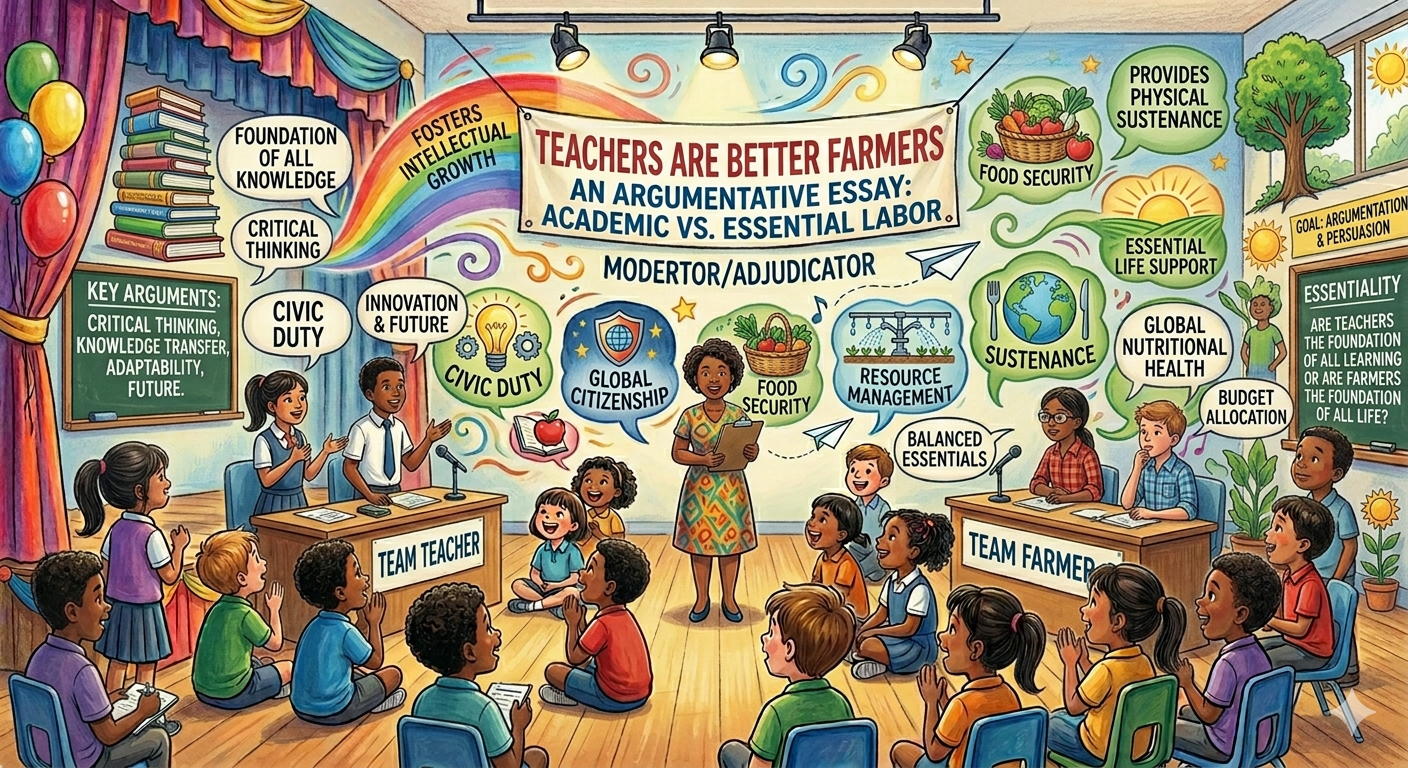
Teachers Are Better Than Farmers: Argumentative Essay
Complete essays, debate points, counterarguments, and tips for Nigerian students
Argumentative Essay | Teachers vs Farmers | Nigerian Schools | Both Sides Covered
Introduction: Two Professions, One Timeless Debate
Few debate topics generate as much passion in Nigerian secondary school competitions as the question of which profession is more important: the teacher or the farmer. Both professions are deeply woven into Nigerian life.
The farmer feeds the body — rising before dawn to tend crops, raising livestock, battling drought and pests to ensure that food reaches Nigerian tables. The teacher feeds the mind — preparing lessons, marking books, patiently explaining concepts, shaping the character and expanding the knowledge of the next generation.
This blog post covers the debate topic ‘Teachers are better than farmers’ in full. It includes a complete argumentative essay arguing the teacher’s case, a complete argumentative essay arguing the farmer’s case, ten debate points for each side, two sample debate speeches, a rebuttal guide, tips for essay writing on this topic, and a FAQ section. Whether you are writing an argumentative essay for school, preparing for a debate competition, or simply exploring this rich topic, everything you need is here.
One important framing note before we begin: this debate does not argue that either profession is worthless or that either group of professionals deserves contempt. Both teachers and farmers are indispensable to Nigerian society.
The debate, properly understood, is about which profession makes the more important contribution when both are considered honestly and fully. The arguments on both sides are genuine, the evidence is real, and the best debaters and essay writers will engage with the strongest version of both cases before defending their assigned position.
HOW TO USE THIS GUIDE: For an argumentative essay assignment: go directly to the full essay section for whichever side you have been assigned. For debate preparation: use the ten debate points for your side plus the counterarguments section to prepare your rebuttals. For comprehensive understanding: read everything.
Teacher vs Farmer: The Nigerian Context at a Glance
| Dimension | Teacher | Farmer |
| Primary contribution | Knowledge, skills, values — shapes human minds | Food — sustains human bodies |
| Direct beneficiaries | Students who become every other professional | Every person who eats — which is everyone |
| Training required | NCE (3 years), B.Ed (4 years) minimum | Varies; traditional learning to agricultural degrees |
| Nigerian employment | ~700,000+ active teachers in public schools | ~36–40% of Nigeria’s workforce (largest sector) |
| Economic contribution | Human capital formation — enables all other sectors | Agriculture = ~25% of Nigeria’s GDP |
| What fails without them | Illiteracy, no other profession survives | Hunger, starvation, economic collapse |
| Famous Nigerian example | Adeyemi College of Education; ASUU advocacy | Kebbi rice farmers; Benue food bowl; cocoa farming |
| Strongest argument for | Teachers produce farmers — upstream of everything | Farmers feed teachers — body before mind |
| Weakest point | Cannot feed physical hunger directly | Cannot build next generation’s capability |
Full Argumentative Essay One: Teachers Are Better Than Farmers
This is a complete, well-structured argumentative essay arguing that teachers are more important than farmers. It is written to the standard expected of Nigerian secondary school and junior tertiary students. Read it, understand the arguments, and then adapt it in your own words for your assignment.
Check out: How to Create Flashcards for Quick Revision: The Ultimate Guide for Nigerian Students
Teachers Are More Important Than Farmers
An Argumentative Essay
In every functioning society, two professions stand as pillars of human survival and progress: the farmer who feeds the body and the teacher who feeds the mind. Both are noble, both are necessary, and both deserve the deepest respect of every Nigerian.
However, when we examine the full scope of what each profession contributes to human society — not merely to individual survival but to collective development, to the building of institutions, to the formation of the capable citizens that every nation requires — the teacher’s contribution emerges as the more foundational and the more broadly consequential of the two.
This essay argues that teachers are more important than farmers because teachers produce the human capability on which every other form of progress, including agricultural progress, depends.
Body Paragraph 1: Teachers Are the Producers of Every Other Profession
The most fundamental argument for the teacher’s greater importance is that teachers produce every other professional in society — including the farmers who grow our food. Every Nigerian farmer who uses modern agricultural techniques, who selects improved seed varieties, who understands soil chemistry, who manages irrigation systems, and who applies scientific knowledge to improve crop yields was taught these things by a teacher.
The illiterate subsistence farmer who has never attended school is an important and admirable person, but the modern, productive agricultural scientist who feeds thousands rather than dozens was formed by education. Remove the teacher, and within one generation Nigeria has no modern farmers, no engineers, no doctors, no accountants, no lawyers, and no professionals of any kind. The teacher is upstream of every other profession, including the farming profession itself.
Furthermore, the teacher’s influence extends across all dimensions of human development simultaneously. A single teacher who teaches for thirty years may directly educate over a thousand students. Those thousand students, equipped with literacy, numeracy, critical thinking, and vocational knowledge, go on to contribute across every sector of society — in agriculture, in healthcare, in governance, in business, and in culture.
The multiplier effect of a single teacher’s work across the generations of students they educate is genuinely incalculable. A farmer who farms productively for thirty years feeds a community. A teacher who teaches productively for thirty years equips a generation.
Body Paragraph 2: Education Is the Foundation of National Development
The relationship between educational attainment and national development is one of the most consistently documented findings in all of development economics.
Every country that has successfully transformed from a low-income to a middle-income or high-income economy has done so while simultaneously making dramatic improvements in the proportion of its population with secondary and tertiary education. South Korea in 1950 had literacy rates and per-capita income comparable to Nigeria’s.
Read now: How to Create Flashcards for Quick Revision: The Ultimate Guide for Nigerian Students
By investing massively in education — in training teachers, building schools, and insisting on universal enrollment — South Korea achieved a per-capita income by 2000 that was approximately thirty times Nigeria’s.
The Korean farmer who today uses precision agriculture technology, who sells into international commodity markets, and who generates income that would have been unimaginable to their grandparents is the product of an educational transformation that teachers made possible.
In Nigeria, the communities that have consistently produced the most professionals, the most business leaders, the most effective civil servants, and the most innovative entrepreneurs are the communities with the strongest educational traditions — communities where teachers were valued, where schools were maintained, and where education was treated as a family and community priority rather than an optional luxury.
The relative economic prosperity of states with strong educational traditions compared to states with weaker ones is not a coincidence. It is the measurable legacy of generations of teachers who did their work well.
Body Paragraph 3: Teachers Shape Character, Values, and Civic Life
Beyond academic knowledge and vocational skills, teachers perform a third function that is perhaps the most important of all: the formation of character, values, and civic commitment. The teacher who models intellectual integrity — who acknowledges when they are wrong, who treats every student with equal dignity, who demonstrates through daily behaviour that honesty and effort are more valuable than shortcuts — is transmitting values that shape how their students will behave as adults in every dimension of their lives.
The teacher who teaches civic education and helps students understand their rights and responsibilities as Nigerian citizens is building the civic foundation that democracy requires.
Nigeria’s most serious governance failures — corruption, ethnic and religious division, the erosion of institutional integrity — are not primarily technical failures. They are moral and civic failures that reflect inadequate character formation and insufficient civic education.
The teacher is the professional most directly positioned to address these failures at the source — in the young people who will become tomorrow’s leaders, civil servants, and voters. The farmer feeds the bodies of Nigerian citizens. The teacher forms the civic and moral character that determines whether those citizens build or destroy the institutions on which Nigeria’s future depends.
Addressing the Counterargument: The Farmer’s Claim to Greater Importance
The most powerful argument for the farmer’s greater importance is that food is more basic than education — that a person who is starving cannot attend school, and that therefore the farmer’s provision of food is the precondition for the teacher’s work. This argument is compelling, and it deserves honest engagement.
It is true that basic biological survival requires food before it requires education, and that in communities where food insecurity is severe, the practical priority is ensuring adequate nutrition before pursuing educational enrollment.
However, this argument, while valid in the context of extreme poverty and acute food insecurity, does not establish that farmers are more important than teachers in a developmental, civilisational, or long-term sense.
The relationship between farming and teaching is better understood as mutually dependent than as hierarchical: food enables the body that learns, and learning enables the mind that improves farming. In this relationship, the teacher’s contribution — while dependent on the farmer’s prior provision of food — generates the knowledge and the innovation that makes farming itself more productive, more sustainable, and more capable of feeding more people.
Modern agriculture, which has expanded the food supply far beyond what traditional farming alone could provide, is entirely a product of applied scientific knowledge — knowledge that teachers transmitted, researchers developed, and educational institutions housed. The farmer feeds today. The teacher enables the agricultural knowledge that will feed tomorrow.
Conclusion: The Teacher Produces the World That the Farmer Feeds
In conclusion, while both teachers and farmers make contributions that are genuinely essential to human society, the teacher’s contribution is more broadly foundational, more generationally compounding, and more directly connected to Nigeria’s most urgent development challenges. The teacher produces every other professional, including the modern agricultural scientist who grows food with the knowledge the teacher transmitted.
The teacher builds the civic character that makes governance honest and institutions effective. The teacher transmits the scientific knowledge that enables agricultural productivity to expand beyond what traditional farming alone could achieve. The farmer feeds the present. The teacher builds the future. And between feeding the present and building the future, the more important contribution — the one without which no sustainable future is possible — belongs to the teacher.
Read now: Farmer vs Doctor: 10 Compelling Reasons Why the Doctor Is More Important
Full Argumentative Essay Two: Farmers Are More Important Than Teachers
This is a complete argumentative essay arguing the farmer’s case. Read it to understand the strongest version of the opposing argument — essential for debate preparation and for writing a balanced essay that acknowledges and refutes the other side.
See more: How to Use Spaced Repetition So You Never Forget What You Read (The Secret to Acing WAEC & JAMB)
Farmers Are More Important Than Teachers
An Argumentative Essay
When we ask which profession is more important — the teacher who educates or the farmer who feeds — we are really asking which human need is more fundamental. The answer, when examined honestly and without sentiment, is clear: the need for food precedes every other human need. Before a child can sit in a classroom and learn, they must have eaten. Before a teacher can stand at the blackboard and teach, they must have had breakfast.
Before a community can build schools and support education, it must have food surpluses sufficient to release some members from the work of food production. The farmer, who provides the foundational physical sustenance on which every other human activity depends, is more important to human society than the teacher — not because teachers are unimportant, but because farmers provide what must come first.
Body Paragraph 1: Food Is the Most Fundamental Human Need — Only the Farmer Provides It
Abraham Maslow’s famous hierarchy of human needs, taught in every psychology classroom in Nigeria, places physiological needs — food, water, shelter — at the very foundation of the pyramid, below safety, below belonging, and far below the self-actualisation that education enables. This is not a mere theoretical hierarchy.
It describes a biological and practical reality: a human being without food dies within weeks. A human being without formal education can live a long, productive, and meaningful life. This asymmetry — the absolute necessity of food versus the relative necessity of formal education — is the foundation of the farmer’s claim to greater importance.
Read now: Science Is Better Than Art? A Deep Dive Into Logic, Creativity, and Real-World Impact
In Nigeria, the relationship between food security and human capability is visible in the most devastating terms in communities experiencing food insecurity. When the rains fail in Kebbi State and the millet harvest is poor, children withdraw from school not because education is no longer valued but because the family’s daily energy must be redirected to survival.
When flooding destroys the cassava and yam harvest in Benue State, school enrollment falls as children contribute to household food gathering. The teacher’s work becomes impossible when the farmer’s work has failed. This demonstrates, in the most practical way possible, that the farmer’s contribution is the precondition for the teacher’s work — not the other way around.
Body Paragraph 2: The Farmer Feeds the Teacher — Making All Education Possible
Every teacher who has ever stood in front of a class ate breakfast this morning. The energy that sustained their thought, their attention, their patience, and their professional engagement throughout the teaching day was produced by a farmer. This simple biological fact points to a deeper truth: the teacher’s work is dependent on the farmer’s prior provision of food in a way that is more fundamental than the reverse dependency.
A farmer who has never attended school can still plant, tend, and harvest crops. A teacher who has not eaten cannot function. In the hierarchy of dependency between these two professions, the farmer is upstream — they provide what the teacher requires to exist and to work.
More broadly, the entire institutional infrastructure of education — the school buildings, the textbooks, the teachers’ salaries, the examination boards, the universities where teachers are trained — is funded from economic activity. And in Nigeria, agriculture has historically been and remains one of the most significant contributors to that economic activity.
Nigeria’s pre-oil economy was built on agricultural exports: the groundnut pyramids of Kano, the cocoa wealth of the West, the palm oil production of the South. These agricultural industries funded the colonial and post-colonial infrastructure investments — including schools and universities — that built the Nigerian education system. The farmer did not merely provide food for the teacher. The farmer provided the economic foundation that made the educational system financially possible.
Body Paragraph 3: Farmers Preserve Cultural Heritage and Sustain Communities That Teachers Serve
In many Nigerian communities — particularly in rural areas, where the majority of Nigerians still live — the farmer is not merely an economic producer. The farmer is the community anchor: the person whose work organises the seasons, whose harvests mark the festivals, whose land is the material expression of the family’s identity across generations.
The New Yam Festival celebrated by Igbo communities, the harvest celebrations of the Tiv people of Benue State, the planting ceremonies maintained across Nigeria’s agricultural communities — all of these cultural traditions are organised around farming’s seasonal rhythms. The farmer maintains the living connection between the Nigerian community and the land that sustains it.
Furthermore, agricultural communities in Nigeria employ far more people than any other sector of the economy. Approximately 36 to 40 percent of Nigeria’s workforce is employed in agriculture — a proportion that exceeds the number employed in manufacturing, services, and government combined.
The farmer supports not only their own family but the entire network of agricultural supply chains, processing industries, transport workers, traders, and market vendors whose livelihoods depend on agricultural production. When the farmer prospers, the Nigerian economy prospers.
When agriculture fails, the entire economy feels the shock — as the relationship between oil price fluctuations and agricultural investment cycles has repeatedly demonstrated.
Addressing the Counterargument: The Teacher’s Claim to Greater Importance
Check out: Top Debate Points on Why Mother Is Better Than Father
The teacher’s strongest argument is that they produce every other professional in society — including the modern farmer who uses scientific methods. This argument correctly identifies a genuine and important contribution: education is essential for agricultural modernisation, and the knowledge that improves farming productivity is transmitted through educational institutions.
However, this argument, while true, does not establish that the teacher is more important than the farmer. It establishes that education and farming are complementary rather than hierarchical — that each depends on and enhances the other.
The teacher who produced the agricultural scientist did so in a school that was built with economic resources that ultimately derived from agricultural productivity. The agricultural scientist who applies knowledge to improve farming is enhancing a food production system that has existed and sustained human life for ten thousand years before formal education existed at all.
Moreover, the traditional farmer who has never attended school — who plants by the seasons, who knows the soil through generations of accumulated practical knowledge, who has fed families and communities for centuries without the benefit of formal education — demonstrates that farming does not require teachers to be fundamentally effective. The modern, educated farmer is more productive than the traditional farmer. But the traditional farmer’s uneducated productivity has sustained human life throughout history.
There is no equivalent demonstration that teachers are able to do their fundamental work without the food that farmers provide. The dependency runs in one direction more fundamentally than the other: farming preceded education in human history, farming sustains education biologically, and farming would continue without teachers in a way that teaching could not continue without farmers.
Conclusion: The Farmer Feeds the World That Teachers Teach In
In conclusion, while teachers perform an enormously important function in developing the human capital that modern society requires, the farmer’s contribution is more fundamental because it is more necessary: more biologically necessary, more historically prior, and more immediately consequential when it fails.
The teacher produces professionals who improve the world. The farmer sustains the world in which those improvements are possible. Before the student can learn, they must eat. Before the teacher can teach, they must eat. Before the school can be built and maintained, the community must generate the economic surplus that agriculture makes possible.
The farmer is not more important because farming is a more noble profession. The farmer is more important because food is the more fundamental need. A world without teachers is a world that develops more slowly. A world without farmers is a world that does not survive. That distinction — between slower development and non-survival — is the measure of the farmer’s greater importance.
See now: Parents Are NOT Solely to Blame for the Misconduct of Their Children
Ten Debate Points: Teachers Are Better Than Farmers
Use these points for debate competitions arguing that teachers are more important than farmers. Each point is a fully developed argument with a ready-to-use debate line.
Point 1: Teachers Produce Every Other Profession — Including Farmers
Every modern agricultural scientist, every extension worker who helps traditional farmers improve their yields, every researcher who develops improved seed varieties, and every policy maker who designs agricultural programmes was taught by teachers. Remove teachers for one generation and within thirty years there are no qualified farmers, no agronomists, no soil scientists, and no agricultural engineers. The teacher is the most upstream professional in the chain of professional production.
DEBATE LINE: “Remove farmers and people go hungry. Remove teachers and within one generation people have no doctors, no engineers, no lawyers — and no modern farmers who know how to grow enough food for everyone. Teachers produce the world. Farmers feed it. The producer of the world is more important than any single component of what the world produces.”
Point 2: Education Is the Primary Driver of Agricultural Modernisation
Traditional subsistence farming can sustain small communities. Feeding Nigeria’s 220 million people — and the 400 million projected by 2050 — requires modern, science-based agriculture: improved varieties, precision irrigation, soil management, mechanisation, supply chain optimisation, and market access. Every one of these improvements is a product of scientific knowledge transmitted by teachers. The Green Revolution that saved a billion people from famine in the twentieth century was an educational product.
DEBATE LINE: “Traditional farming with hoes and rain-dependent planting fed a few million Nigerians. Scientific farming fed hundreds of millions. The difference between the two is education — the knowledge that teachers transmitted to the agricultural scientists who developed improved seeds, irrigation, and soil management. The teacher made modern food security possible.”
Point 3: The Teacher’s Impact Is Generational — the Farmer’s Is Seasonal
A farmer’s harvest feeds a community for one season. A teacher’s instruction equips a student for a lifetime. The teacher who taught a student to read has given that student access to every book ever written, every skill ever documented, every piece of knowledge ever recorded. This gift does not expire at the end of the growing season. It compounds across a lifetime and is transmitted, partially, to the next generation through the parenting and mentoring of the educated person.
DEBATE LINE: “The farmer’s harvest lasts one season. The teacher’s lesson lasts a lifetime. The farmer feeds a community for months. The teacher equips an individual for sixty years of productive professional life. Between seasonal feeding and lifetime formation, the more important contribution is the lifetime formation.”
Point 4: Teachers Shape the Civic Character That Makes Democracy Function
Nigeria’s governance failures — corruption, institutional dysfunction, poor policy making — are not primarily failures of technical knowledge. They are failures of civic character and democratic culture that education shapes. The teacher who teaches Government and History, who models intellectual integrity, who engages students seriously with questions of rights and responsibilities, is building the civic foundation of Nigerian democracy. No agricultural training addresses this challenge.
DEBATE LINE: “The farmer grows the food that feeds Nigerian citizens. The teacher shapes the character of the citizens who will either build or destroy Nigeria’s institutions. In a country where governance failures cost Nigeria billions annually, the profession that forms citizens of integrity — the teacher — is performing the work that Nigeria’s future most urgently requires.”
Point 5: The Teacher Builds Human Capital — Nigeria’s Most Valuable Resource
Oil is depleting. Land has limits. But human capital — the knowledge, skills, creativity, and professional capability of Nigeria’s people — can grow without limit as long as each generation is educated more thoroughly than the previous one.
The teacher is the primary builder of this most valuable and most sustainable of Nigeria’s resources. Every investment in teacher quality and educational access produces returns that compound across generations in ways that agricultural investment, however important, cannot match.
DEBATE LINE: “Nigeria’s oil will run out. Nigeria’s land is fixed. Nigeria’s human capital — the knowledge and skills of its people — can grow indefinitely as long as each generation is better educated than the last. The teacher builds the one resource Nigeria has in unlimited supply: human intelligence, well-developed. That is why the teacher is more important.”
Point 6: Literacy Opens Every Door — Illiteracy Closes All of Them
The ability to read — the most fundamental gift a teacher gives — is not merely academic. It is the key to every other form of knowledge and capability. The literate farmer can read the instructions on a fertiliser bag and apply the correct quantity. They can read the market price on a smartphone and sell at the right time. They can read the legal title to their land and defend it against appropriation. Literacy, the teacher’s most basic gift, multiplies the effectiveness of every other resource and capability the person possesses.
DEBATE LINE: “The farmer who can read accesses knowledge worth a thousand agricultural extension visits. The farmer who cannot read is dependent on word of mouth for every piece of information that could improve their farm. The teacher who gave a farmer the ability to read gave them a tool that multiplies the value of every resource they subsequently encounter. Literacy is the ultimate force multiplier.”
Point 7: The Best Farmers Are Products of Agricultural Education
The farmers who produce the most, earn the most, and contribute most to Nigerian food security are not the farmers who relied solely on traditional knowledge. They are the farmers who received agricultural education — who attended school, who studied agricultural science, who accessed extension services, or who learned from demonstration farms. Agricultural education, which teachers provide, is the primary driver of the productivity gains that have allowed Nigerian agriculture to feed a growing population.
DEBATE LINE: “The smallholder who plants traditional yam varieties and depends on rainfall produces for survival. The graduate farmer who uses improved varieties, drip irrigation, and scientific soil management produces for a market. The difference between survival farming and commercial farming is education. Teachers made the commercial farmer possible.”
Point 8: Teachers Enable Economic Diversification Beyond Agriculture
Nigeria’s most serious economic vulnerability is its dependence on oil and agriculture — two sectors highly exposed to price volatility, climate risk, and resource depletion. The path to economic diversification — to a Nigeria with strong manufacturing, technology, financial services, and creative industries — runs through education. The teacher who equips students for careers in technology, finance, and the creative economy is building the diversified economic foundation that agriculture alone cannot provide.
DEBATE LINE: “Nigeria’s future cannot rest on oil and farming alone. The technology companies, the financial services sector, the creative economy — the industries that will make Nigeria economically resilient — were built by educated people. Teachers built those industries. Without teachers, Nigeria has only primary commodities and the vulnerability that comes with depending on them.”
Point 9: Teachers Reduce Nigeria’s Rate of Dependence on Traditional Subsistence
Traditional subsistence farming — planting just enough to eat — is associated with chronic poverty, food insecurity, and vulnerability to seasonal shocks. Education is the primary mechanism by which communities transition from subsistence to commercial activity, from dependence to economic participation, from isolation to integration into the broader economy. The teacher enables this transition by equipping students with the literacy, numeracy, and knowledge of markets and opportunities that make commercial activity possible.
DEBATE LINE: “The subsistence farmer plants to survive. The educated community member plants to sell, to invest, to expand, and to build wealth. The transition from survival to prosperity runs through the classroom. Teachers enable the economic participation that transforms farming from a subsistence activity into a vehicle for wealth creation.”
Point 10: Without Teachers, Within One Generation, No Profession Survives
This is the definitive argument: remove all teachers from Nigeria for one generation. Within thirty years, there are no new doctors, no new engineers, no new lawyers, no new accountants, no new agricultural scientists, and no new teachers. Every trained professional retires or dies, and there is no one to replace them.
The professions that sustain Nigerian civilisation — including the commercial agriculture that feeds Nigerian cities — simply cease to exist within the span of a single human generation. No other profession’s removal would cause this scale of civilisational collapse in the same timeframe.
DEBATE LINE: “Remove all farmers and Nigerians go hungry. This is a catastrophe. Remove all teachers and within thirty years Nigerians have no doctors, no engineers, no lawyers, no modern farmers, and no teachers to produce the next generation of professionals. The catastrophe of a generation without teachers is not merely hunger — it is civilisational collapse. That is the measure of the teacher’s foundational importance.”
Read now: How to Use the Pomodoro Technique to Smash Your WAEC and JAMB Exams
Ten Debate Points: Farmers Are More Important Than Teachers
Use these points for debate competitions arguing that farmers are more important than teachers. Each point ends with a debate-ready line.
Point 1: Food Is the Most Fundamental Human Need — It Must Come Before Education
Maslow’s hierarchy places physiological needs at the very base of human development — below safety, below belonging, below esteem, and far below the self-actualisation that education enables. A person without food dies within weeks. A person without formal education can survive and live meaningfully. This asymmetry — absolute biological necessity versus relative developmental benefit — establishes food, and therefore the farmer, as more fundamentally important.
DEBATE LINE: “You cannot teach a starving child. You cannot run a school in a community that cannot feed itself. Food is not one need among many — it is the need that makes all other needs possible to address. The farmer provides this most fundamental of all necessities. That makes the farmer the most important professional in any society.”
Point 2: The Farmer Feeds the Teacher — Not the Other Way Around
Every teacher who has ever taught a lesson ate food grown by a farmer this morning. The biological energy that fuels thought, patience, and professional effectiveness was produced by a farmer. This is the direction of the dependency: the teacher needs the farmer to exist and function. The farmer does not need the teacher to plant, grow, and harvest. In the chain of dependency, the farmer is upstream of the teacher.
DEBATE LINE: “Every brilliant lesson a teacher has ever taught was powered by the breakfast a farmer grew. The teacher depends on the farmer for the physical energy to teach. The farmer does not depend on the teacher for the physical ability to farm. Between the provider and the dependent, the provider is always more important.”
Point 3: Farming Has Sustained Human Civilisation for Ten Thousand Years
The Agricultural Revolution — the transition from nomadic hunter-gathering to settled farming — is the single most transformative development in human history. It preceded formal education by millennia. The surplus food that agriculture produced created the conditions for civilisation: for specialisation of labour, for the development of cities, for the emergence of literacy, and for the formal educational institutions that teachers eventually staffed. Farming created the conditions within which teaching became possible.
DEBATE LINE: “Farming is ten thousand years old. Formal schooling is a few thousand years old at most. For most of human history, farming sustained civilisation without schooling. Schooling has never sustained civilisation without farming. The profession that came first — that created the conditions for every other profession — is the more foundational one.”
Point 4: Agriculture Employs More Nigerians Than Any Other Sector
Approximately 36 to 40 percent of Nigeria’s workforce is employed in agriculture — the largest single employment sector in the country. When we ask which profession is more important to more Nigerians in terms of providing their livelihood, the farmer wins decisively. The agricultural sector is the most broadly distributed economic activity in Nigeria, reaching into every state, every local government, and most communities, providing income to tens of millions of Nigerians who have no other formal employment option.
Check out: How to Handle Panic Attacks in the Exam Hall: A Survival Guide for Nigerian Students
DEBATE LINE: “One in three Nigerians earns their living from farming. No other profession comes close to this scale of direct economic participation. The importance of a profession is partly measured by how many lives depend on it. By this measure, farming is Nigeria’s most important profession by a considerable margin.”
Point 5: Without Farmers, Nigerian Cities Would Starve Within Weeks
The Nigerian cities — Lagos, Abuja, Kano, Port Harcourt — that depend on agricultural supply chains for their daily food supply would face genuine food insecurity within weeks if farming activity ceased. This is not theoretical: documented disruptions of agricultural supply chains in conflict-affected areas of Nigeria have consistently produced rapid food price increases and, in extreme cases, acute malnutrition. The immediacy of the consequence of agricultural failure is itself evidence of the farmer’s indispensability.
DEBATE LINE: “Disrupt farming in Nigeria for three months and Lagos faces genuine hunger. Cities are entirely dependent on farmers for their daily food supply. No other profession’s disruption produces this kind of immediate, visible, life-threatening consequence for the entire urban population. The farmer’s indispensability to urban survival is the most direct measure of their importance.”
Point 6: The Traditional Farmer Does Not Need the Teacher to Be Effective
Traditional farming knowledge — built through generations of practical experience, keen observation, and community transmission — has fed human populations for thousands of years without any contribution from formal schooling.
The traditional Nigerian farmer who knows their soil, knows their seasons, knows which varieties grow best in their microclimate, and knows how to manage pests and water is practising a sophisticated form of applied science that was accumulated without teachers. This demonstrates that farming, at its most fundamental level, is independent of formal education in a way that teaching is not independent of food.
DEBATE LINE: “The farmer who has never been to school still plants, still harvests, still feeds families. Their knowledge came from experience, from community transmission, from careful observation — not from a classroom. The teacher who has not eaten cannot teach. One profession’s fundamental effectiveness is independent of the other. The other’s is not. The independent profession is the more fundamental one.”
Point 7: Agricultural Production Generates Nigeria’s Economic Foundation
Agriculture contributes approximately 25 percent of Nigeria’s GDP — more than any sector except oil. The agricultural economy provides the revenue base that funds government services, including the education budget that pays teachers’ salaries. Before Nigerian oil was discovered in commercial quantities, agriculture was the primary source of government revenue and foreign exchange. The farmer is not merely a food producer — the farmer is an economic foundation on which the educational system and every other government service is built.
DEBATE LINE: “The government that pays teachers’ salaries collects revenue partly from agricultural taxation and from the economic activity that agricultural communities generate. The farmer funds the system that employs the teacher. In any enterprise, the person who funds the operation is more important than the person the funding employs. The farmer funds education. That makes the farmer more fundamental.”
Point 8: Food Security Is a National Security Issue — Farming Is Strategically Critical
A country that cannot feed its own people is a country that is vulnerable — to economic pressure from food-exporting nations, to internal social instability driven by hunger, and to the political manipulation of desperate populations. Food security is a national security issue of the highest order.
The farmer who produces Nigeria’s food is, in the most direct sense, one of the guardians of Nigeria’s national security and political sovereignty. No teacher, however excellent, performs a function of comparable strategic importance to the nation’s security.
DEBATE LINE: “A country that cannot feed itself is not sovereign — it is dependent on whoever feeds it. The farmer who grows Nigeria’s food is protecting Nigeria’s independence in the most fundamental way: by ensuring that Nigeria does not depend on another country’s food supply for its survival. That strategic importance places the farmer among Nigeria’s most critical national security assets.”
Point 9: Farming Connects Nigeria to Its Deepest Cultural Roots
Across Nigeria’s diverse ethnic and cultural traditions, farming is woven into the most fundamental cultural expressions — the New Yam Festival of the Igbo, the harvest celebrations of the Tiv, the planting ceremonies of various communities across the country. These traditions are not merely cultural decorations.
They are the lived expressions of communities’ relationships to the land, to the seasons, and to the continuity of life across generations. The farmer, as the practitioner of this ancient and culturally central activity, is a carrier of cultural heritage in a way that the formal schoolteacher, as a relatively recent institutional figure, is not.
DEBATE LINE: “When the Igbo community celebrates the New Yam Festival, they are not celebrating an economic transaction. They are celebrating their living connection to the land, to their ancestors, and to the cycle of life that farming represents. The farmer carries this cultural heritage. The teacher is important. But the cultural depth of the farmer’s role — ten thousand years of human relationship with the land — gives farming an importance that goes beyond economics and into the very roots of human identity.”
Point 10: Without Farmers, No Other Profession Can Sustain Itself
The thought experiment that most clearly establishes the farmer’s priority: remove all farmers from Nigeria for three months. Within that period, food prices spike, malnutrition begins, and every other profession is disrupted — teachers cannot teach hungry children, doctors cannot treat malnourished patients, engineers cannot work when debilitated by hunger.
The consequences cascade through every sector almost immediately. Now remove all teachers for three months. Education is disrupted — but food is still available, people still eat, and society, however more slowly, continues to function. This asymmetry establishes the farmer’s priority beyond any reasonable argument.
DEBATE LINE: “Remove farmers for three months and every profession in Nigeria is disrupted by hunger within weeks. Remove teachers for three months and children fall behind in school — a serious loss, but not a life-threatening one. The profession whose absence cascades most rapidly and most severely through every other sector of society is the more important profession. By this test, the farmer wins.”
Read now: How to Use the Feynman Technique to Understand Difficult Topics (Stop Cramming, Start Passing)
Sample Debate Speeches
Proposition Speech: Teachers Are More Important Than Farmers
“Distinguished judges, respected opponents, and all present — I want to begin with a thought experiment. Imagine Nigeria in the year 2060, one generation from now. We have given Nigeria forty years without teachers — not without farmers. Forty years in which no new doctors were trained. No new engineers. No new lawyers. No new agricultural scientists. No new teachers.
The Nigeria of 2060, without teachers for forty years, has no modern healthcare system because the doctors who staffed it have retired and died with no replacements. It has no functioning engineering sector because the engineers who designed and maintained its infrastructure have gone. It has no agricultural extension services because the agricultural scientists who advised farmers have graduated no successors.
Now imagine the reverse: Nigeria with farmers but without formal schools. That Nigeria has food on its tables. It has traditional farmers growing what they have always grown. It lacks the innovations that could grow more food, the medical care that could treat malnutrition, the governance that could distribute food equitably. It is hungry in different ways — not for food, but for the human capability that only education builds.
Today the proposition will show that teachers produce every professional in Nigeria, including the modern farmer. That education drives the agricultural modernisation on which feeding 220 million people depends. That the teacher’s impact compounds across generations while the farmer’s harvest lasts one season. And that the teacher’s formation of civic character is the foundation of the honest governance on which every other development depends.
The farmer feeds Nigeria today. The teacher builds the Nigeria of tomorrow. Between today’s survival and tomorrow’s flourishing, both matter — but the teacher’s work determines whether there is a tomorrow worth surviving for. Vote for the proposition. I thank you.”
Opposition Speech: Farmers Are More Important Than Teachers
“Distinguished judges, honourable proposition, and all present — the proposition has given us a beautiful vision of the teacher’s importance. We honour every word of it. And we ask one question: when was the last time a lesson plan fed a hungry child?
The teacher’s work is important. We say this honestly and without reservation. But the teacher’s work is only possible when the child in front of them has eaten. When a child goes to school hungry — genuinely hungry, not merely missing breakfast — they cannot learn. Their cognitive resources are occupied with hunger. Their attention cannot be sustained. Their development is impaired. The teacher’s skill is irrelevant if the farmer has not done their work first.
The proposition says teachers produce farmers. We say: who fed the teacher while they were being educated? Who fed the student who became the teacher? At every stage of the educational process, from the first day of primary school to the last day of university, the farmer was there — providing the food that sustained the bodies that did the learning.
Today the opposition will show that food is more fundamental than education by every measure of human necessity. That the farmer has fed civilisation for ten thousand years without requiring formal schooling. That agriculture employs more Nigerians than any other sector. That the consequences of agricultural failure cascade through every sector within weeks — faster and more severely than the consequences of any school closure.
The teacher builds the mind. The farmer sustains the body that houses it. Between sustaining the body and building the mind, the sustaining of the body must come first. That logical, biological, historical priority is why the farmer is more important. Vote for the opposition. I thank you.”
Check out: How to Use the Pomodoro Technique to Crush WAEC and JAMB (Without Burning Out)
Tips for Writing Argumentative Essays on This Topic
- Structure your essay clearly. Every argumentative essay should have: an introduction that states your position, body paragraphs that each develop one argument with evidence, a counterargument paragraph that acknowledges the other side before refuting it, and a conclusion that restates your position and summarises your strongest arguments. Use the essays in this guide as structural models.
- Develop each argument in a full paragraph. A good argumentative essay does not simply list points. It develops each point into a paragraph with a topic sentence (the claim), supporting evidence or reasoning, and a concluding sentence that links back to the overall thesis. Do not bullet-point your arguments in an essay — develop them in full prose.
- Acknowledge and refute the counterargument. The strongest argumentative essays include a paragraph that honestly presents the best argument for the other side and then explains why it does not defeat your overall case. See the ‘Addressing the Counterargument’ paragraphs in both essays above for models of how to do this. This technique demonstrates intellectual honesty and makes your overall argument more credible.
- Use specific Nigerian examples. Generic arguments are less persuasive than specific, locally grounded ones. Reference the New Yam Festival, the agricultural communities of Kebbi and Benue, the teacher shortage crisis, the colonial agricultural economy that funded Nigeria’s first schools, the work of specific Nigerian teachers or agricultural innovators. Specific examples demonstrate preparation and engage the reader more effectively.
- Begin with a hook and end with a memorable closing. The introduction should begin with something that captures the reader’s attention — a striking question, a vivid scenario, or a surprising statistic. The conclusion should leave the reader with a memorable image or statement that crystallises the essay’s argument. The essays in this guide model both of these techniques.
- Avoid simply describing what teachers and farmers do. Many students write essays that describe the two professions rather than arguing for one’s greater importance. An argumentative essay must argue — it must make claims, provide reasons, and defend those reasons against objections. Focus on why one profession is more important, not merely on what each profession does.
Check out: The Importance of Girl Child Education in Nigeria Debate: Why It Matters More Than Ever
Frequently Asked Questions
Which side is easier to argue in a debate or essay?
Most students find the farmer’s side easier to argue at first because the argument ‘food comes before education’ is intuitively compelling and immediately relatable. However, the teacher’s side has the stronger structural argument — the point that teachers produce every other professional including farmers is logically very difficult to defeat.
In debate competitions, both sides are genuinely winnable. In essay writing, the teacher’s side tends to produce more sophisticated and more thoroughly developed arguments because it requires more careful reasoning about the nature of development and human capability.
Can I argue that both are equally important in an essay?
In a formal argumentative essay where you have been asked to argue one side, you must take a clear position. However, it is good practice to acknowledge in your counterargument paragraph that both professions are genuinely important before explaining why one is more so.
A ‘both are equally important’ conclusion to an argumentative essay is typically considered a weak conclusion because it retreats from the essay’s central argumentative task. Argue your assigned side with full conviction, acknowledging the other side’s strengths while maintaining your position.
What Nigerian examples should I include in my essay?
For the teacher’s side: the legacy of Obafemi Awolowo’s free education policy in western Nigeria, which produced the most educated regional population in Nigeria; the ASUU advocacy for better educational funding; specific well-known Nigerian schools and their distinguished alumni; the role of teachers in Nigeria’s independence movement.
For the farmer’s side: the New Yam Festival and other agricultural cultural celebrations; the Kebbi State rice production programme; Nigeria’s role as one of Africa’s largest agricultural producers; the decline of agricultural export earnings when education was neglected during the oil boom years.
Is this topic related to the ‘pen is mightier than the sword’ debate?
Yes — this debate belongs to the same family as classic comparison debates: teacher vs farmer, doctor vs nurse, pen vs sword. The common feature of all these debates is that they ask which of two genuinely important things is more important, and they reward debaters and essay writers who can identify the most fundamental measure of importance and apply it consistently.
The preparation strategies that work for teacher vs farmer also work for related debates, and students preparing for one are well-advised to study the structural arguments of the others as well.
Read more: JAMB 2026 Novel Summary: The Lekki Headmaster by Kabir Alabi Garba (Complete Guide)
Conclusion: Two Pillars of Nigerian Society, One Indispensable Question
The debate between the teacher and the farmer is ultimately a debate about what human life most fundamentally requires and what kind of society Nigeria most urgently needs to build. The farmer provides what human life cannot exist without — food, the biological foundation of everything that follows. The teacher provides what human society cannot flourish without — knowledge, capability, civic character, and the professional expertise that makes modern life possible.
Both arguments are genuinely compelling. Both professions make contributions that are deeply, indispensably important to Nigerian life. The farmer who rises before dawn to tend crops in Benue State is doing something as valuable as the teacher who rises before dawn to prepare lessons in Anambra. The agricultural scientist who develops improved seed varieties is as important to Nigeria’s future as the secondary school teacher who inspired them to study agricultural science in the first place.
The debate asks you to choose. When you choose, choose on the basis of the strongest version of your argument, the most relevant evidence, and the most honest engagement with the best arguments on the other side. The essays and debate points in this guide give you the tools. Use them with the intellectual seriousness that this ancient and genuinely important question deserves.
Whether you argue for the teacher or the farmer, argue with the knowledge that both professions represent some of the best things about Nigerian society: the dedication to feeding people, to educating people, to providing for the needs of the community with daily effort, professional pride, and the knowledge that what you do today will matter for the Nigerians of tomorrow.
The farmer feeds the body. The teacher feeds the mind. Nigeria needs both — and needs both to be excellent.
Teachers Are Better Than Farmers Argumentative Essay | Both Essays + 10 Points Each + Speeches | Nigerian Schools