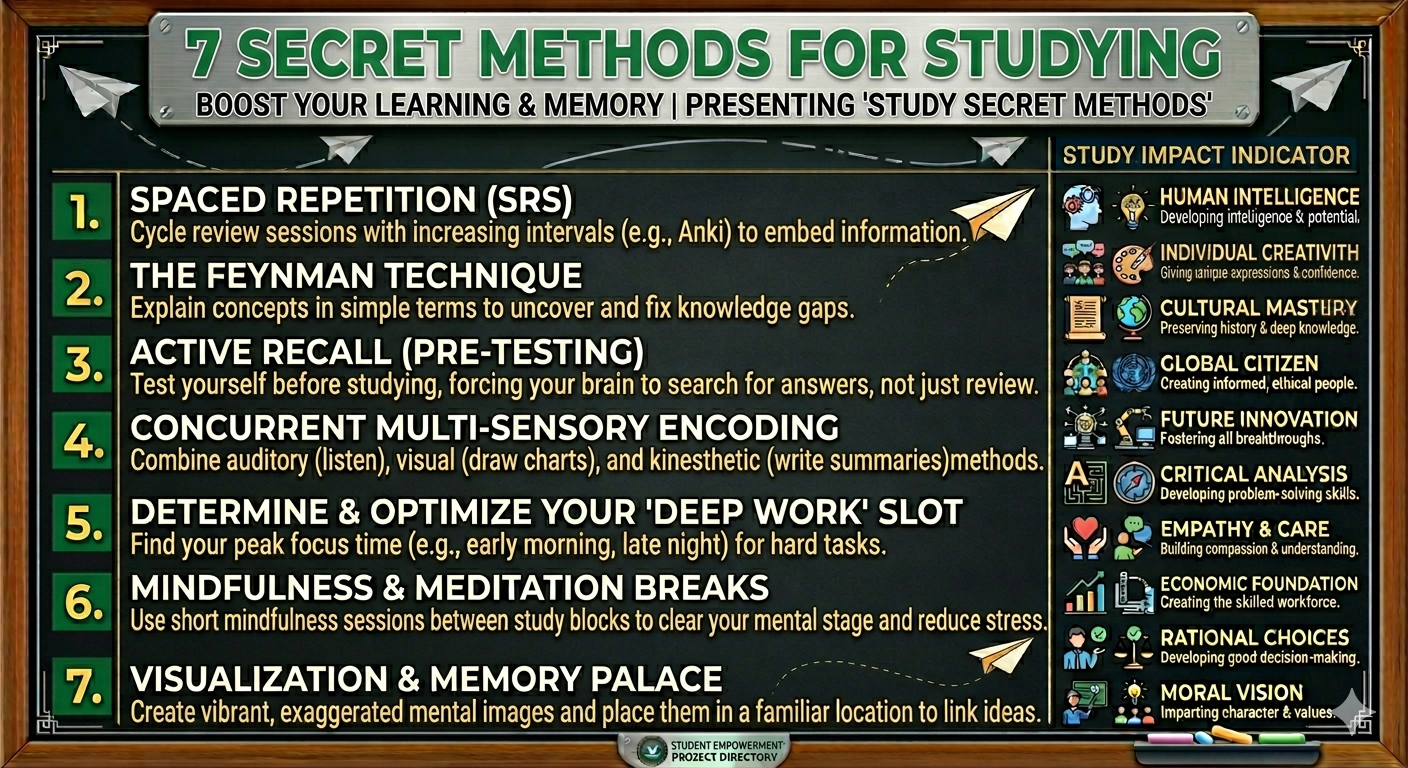
Here are 7 Secret Methods for Studying That Boost Memory & Exam Scores Fast.
Let’s be honest—most people don’t struggle because they’re not smart.
They struggle because they’re using the wrong study methods.
If you’ve ever:
- Studied for hours but forgotten everything
- Re-read notes without real progress
- Felt overwhelmed before exams
Then this guide is exactly what you need.
These 7 secret studying methods aren’t just popular—they’re rooted in proven ideas from fields like Cognitive Psychology and memory research.
Let’s dive in
1. Active Recall (The #1 Memory Hack)
Most students re-read notes. That feels productive—but it’s not effective.
Check out: Science Students vs Arts Students: Who Is Better? & Proposition & Opposition
Instead, use Active Recall.
How it works:
You force your brain to retrieve information without looking.
Example:
- Read a topic
- Close your book
- Write down everything you remember
Why it works:
Retrieval strengthens memory pathways far better than passive reading.
Think of it as a workout for your brain.
2. Spaced Repetition (Stop Cramming Forever)
Cramming = quick forgetting.
Use Spaced Repetition instead.
How it works:
Review information at increasing intervals:
- Day 1
- Day 3
- Day 7
- Day 14
Why it works:
It aligns with the Forgetting Curve, helping you retain information long-term.
This is how top students remember things for months—not hours.
See more: How to Read for 10 Hours a Day Without Getting Tired: The Ultimate Guide for Nigerian Students
3. Pomodoro Technique (Study Without Burnout)
If you struggle to focus, try the Pomodoro Technique.
How it works:
- Study for 25 minutes
- Take a 5-minute break
- Repeat
Why it works:
- Prevents mental fatigue
- Keeps your brain fresh
- Makes studying less overwhelming
Perfect for long study sessions.
4. The Feynman Technique (Learn by Teaching)
If you can’t explain it, you don’t truly understand it.
Use the Feynman Technique.
How it works:
- Pick a topic
- Explain it in simple terms (like teaching a child)
- Identify gaps in your understanding
Why it works:
It forces deep comprehension, not just memorization.
5. Interleaving (Mix Your Subjects)
Most people study one subject for hours.
Top learners use Interleaving.
How it works:
Instead of:
- Math for 3 hours
Do:
- Math → Biology → English → back to Math
Why it works:
- Improves problem-solving
- Boosts adaptability
- Strengthens long-term learning
6. Blurting Method (Dump Your Brain)
This is one of the most underrated techniques.
Read also: Public Schools Are Better Than Private Schools Debate Points (7 Winning Points)
How it works:
- Study a topic
- Close your notes
- Write EVERYTHING you remember
- Check what you missed
Why it works:
It combines:
- Active recall
- Self-testing
- Immediate feedback
It’s like testing yourself without waiting for exams.
7. Study Environment Engineering
Your environment matters more than you think.
Optimize your space:
- Remove distractions
- Use background music (instrumental)
- Keep your desk clean
You can even use apps like Forest to stay focused.
Why it works:
Your brain associates environments with behavior.
A focused space = a focused mind.
Read more: How to Study for Multiple Choice Questions: The Secret to Acing JAMB and WAEC
Bonus Tips to Study Smarter (Not Harder)
- Sleep 7–8 hours (memory consolidation happens during sleep)
- Stay hydrated
- Avoid multitasking
- Create a study schedule
Common Study Mistakes to Avoid
- Re-reading notes endlessly
- Highlighting everything
- Studying without breaks
- Last-minute cramming
These feel productive—but they don’t work.
Final Thoughts
The difference between average students and top performers isn’t intelligence—it’s strategy.
By using:
- Active recall
- Spaced repetition
- Focus techniques
You can learn faster, remember longer, and perform better.