Let’s be real—focusing on studying isn’t the problem… staying focused is.
One minute you’re reading, the next minute you’re:
- Checking your phone
- Thinking about something random
- Or staring at your notes without actually learning anything
If that sounds familiar, you’re not alone.
The good news? Focus isn’t something you’re born with—it’s something you train.
In this guide, you’ll learn practical, science-backed ways to focus on studying, retain more information, and finally make your study time count.
Why You Can’t Focus (And It’s Not Laziness)
Before fixing your focus, understand what’s working against you.
Read now: How to Use the Pomodoro Technique to Crush WAEC and JAMB (Without Burning Out)
Most focus problems come from:
- Constant distractions (especially your phone)
- Mental fatigue
- Lack of structure
- Studying passively instead of actively
Your brain naturally avoids effort. That’s why techniques from Cognitive Psychology emphasize active engagement over passive reading.
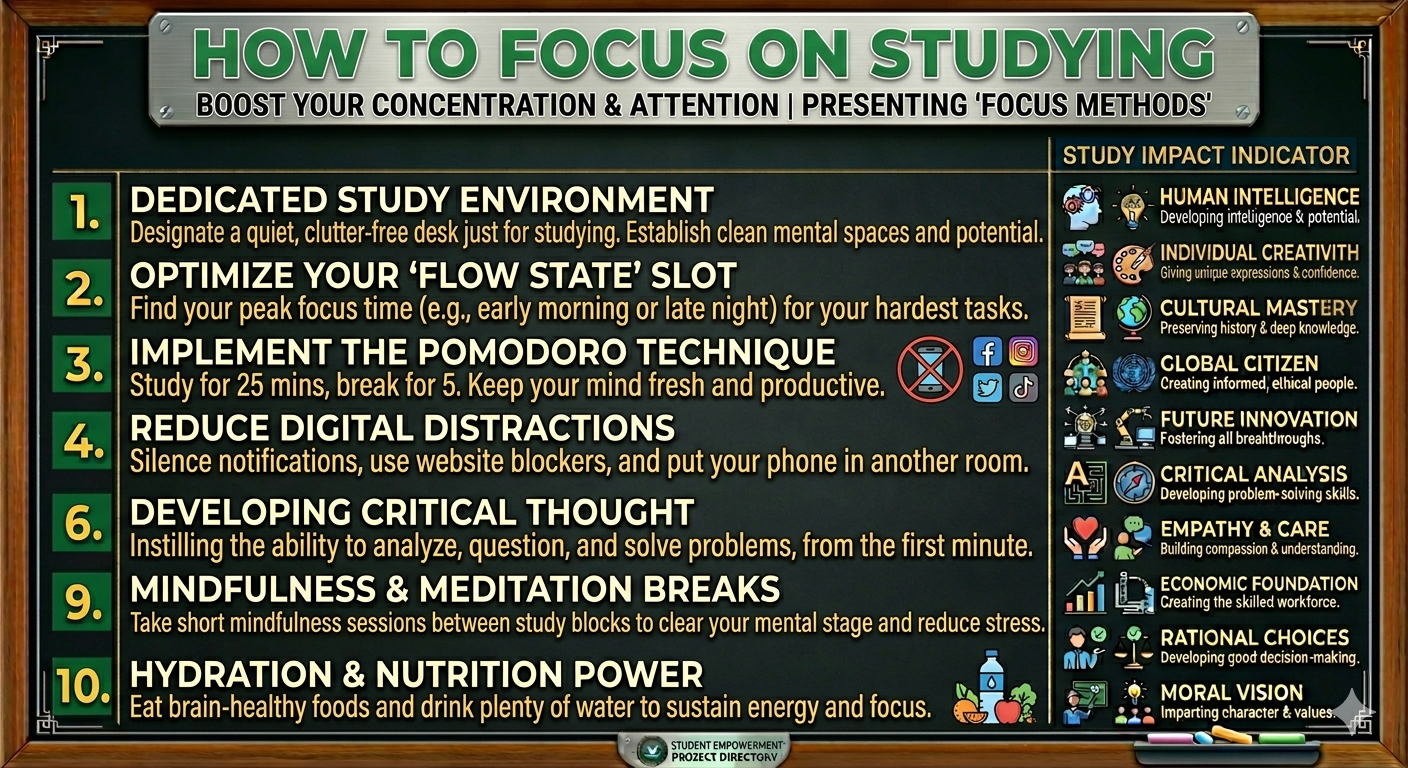
1. Use the Pomodoro Technique (Focus in Short Bursts)
One of the easiest ways to improve focus is the Pomodoro Technique.
How it works:
- Study for 25 minutes
- Take a 5-minute break
- Repeat 4 times, then take a longer break
Why it works:
- Reduces burnout
- Makes studying feel manageable
- Keeps your brain fresh
Instead of “studying for hours,” you focus on just 25 minutes at a time.
2. Eliminate Distractions (Your Phone Is the Enemy)
Let’s be honest—your biggest distraction is your phone.
What to do:
- Put your phone in another room
- Turn off notifications
- Use focus apps like Forest
Why it works:
Every notification breaks your concentration and resets your focus.
Deep focus requires zero interruptions.
3. Use Active Recall Instead of Re-Reading
Re-reading feels productive—but it’s not effective.
Switch to Active Recall.
How:
- Study a topic
- Close your notes
- Try to recall everything from memory
Why it works:
It forces your brain to work harder, which improves retention.
Check out: How to Use the Pomodoro Technique to Crush WAEC and JAMB (Without Burning Out)
4. Study at Your Peak Energy Time
Not everyone focuses best at the same time.
Find your peak:
- Morning person? Study early
- Night owl? Study later
Why it works:
Focus improves when your brain is naturally alert.
Don’t fight your body—work with it.
5. Create a “Focus Environment”
Your environment shapes your behavior.
Optimize your space:
- Clean desk
- Good lighting
- Comfortable chair
- Minimal noise
Optional:
- Instrumental music or white noise
Your brain starts associating that space with deep work.
6. Write, Don’t Just Read
Reading alone = passive learning.
Do this instead:
- Take notes
- Summarize concepts
- Draw diagrams
Writing keeps your brain engaged and improves understanding.
See also: Parents Are NOT Solely to Blame for the Misconduct of Their Children
7. Use the Blurting Method
This is a powerful focus + memory hack.
How:
- Study a topic
- Close your notes
- Write everything you remember
- Check and fill gaps
It forces concentration and reveals weak areas instantly.
8. Break Big Tasks into Small Ones
“Study Biology” is too vague.
Instead:
- Study chapter 1 summary
- Review diagrams
- Practice 5 questions
Why it works:
Small tasks feel easier to start and finish.
Clarity increases focus.
9. Take Care of Your Brain
Focus isn’t just mental—it’s physical too.
Essentials:
- Drink water
- Eat properly
- Sleep 7–8 hours
Sleep is especially important for memory consolidation.
A tired brain cannot focus.
See more: Education Is a Scam vs Education Is the Key: A Balanced Debate for Today’s World
10. Create a Study Plan
Random studying leads to poor focus.
What to do:
- Set daily study goals
- Allocate time blocks
- Track progress
A clear plan removes decision fatigue.
11. Avoid Multitasking
Multitasking destroys focus.
Example:
- Studying + texting = poor retention
Focus on one task at a time for better results.
12. Train Your Attention Span
Focus is like a muscle—you build it over time.
Start with:
- 20 minutes of deep work
- Gradually increase to 60–90 minutes
The more you practice, the easier it gets.
13. Reward Yourself After Studying
Give your brain something to look forward to.
Read now: Farmer vs Doctor: 10 Compelling Reasons Why the Doctor Is More Important
Examples:
- Watch a show
- Eat a snack
- Scroll social media (after studying)
Rewards reinforce good habits.
Common Mistakes That Kill Focus
Avoid these:
- Studying with your phone nearby
- Re-reading without testing yourself
- Skipping breaks
- Overloading your schedule
These silently reduce productivity.
Final Thoughts
Learning how to focus on studying isn’t about forcing yourself—it’s about using the right systems.
When you:
- Remove distractions
- Use active techniques
- Study with structure
You’ll notice a huge difference in your performance.