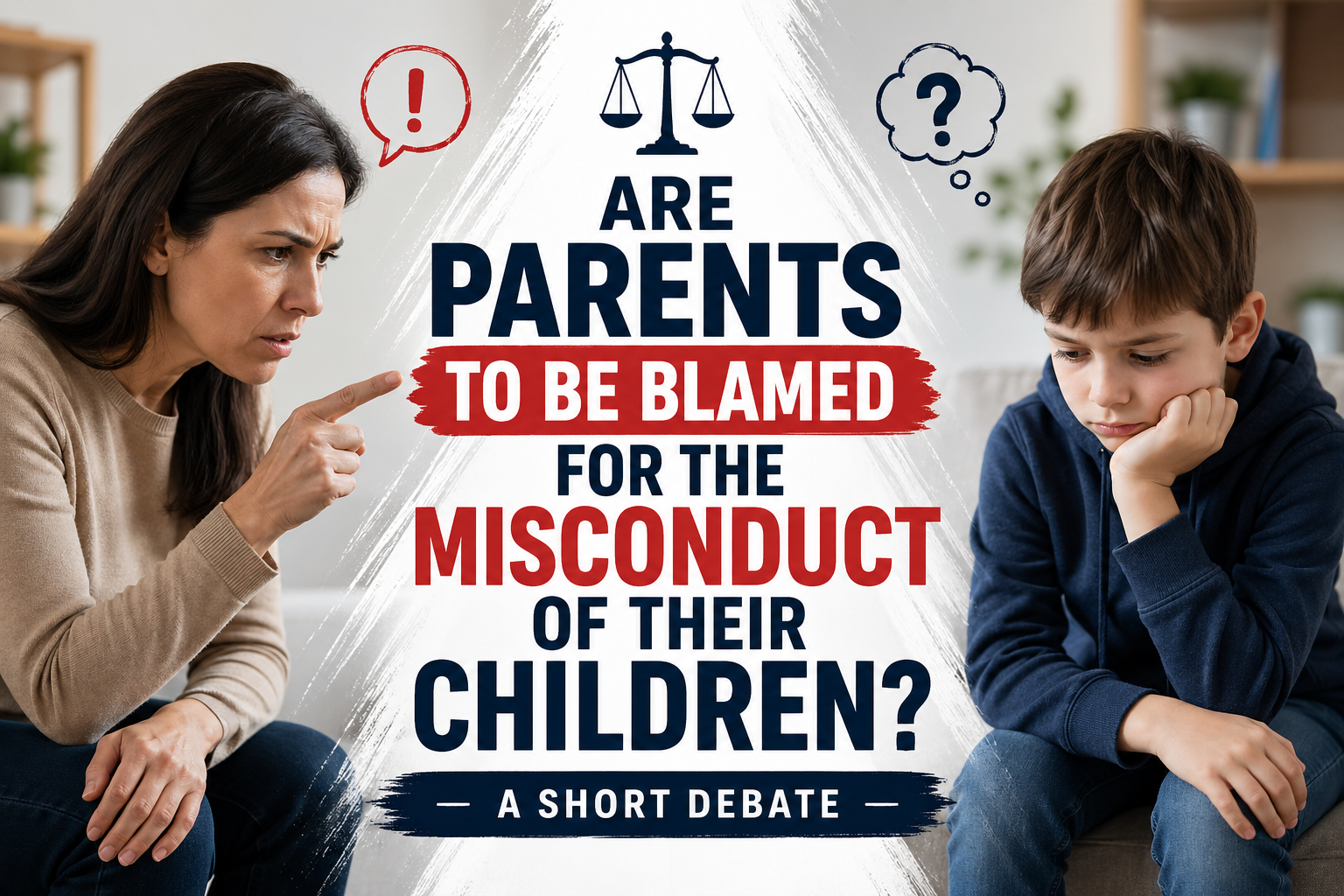
Here’s a short debate on parents are to be blamed for the misconduct of their children
When a child misbehaves—whether it’s lying, bullying, or breaking rules—the first question people often ask is: “Where are the parents?” It’s a natural reaction. After all, parents are a child’s first teachers, role models, and authority figures. But is it fair to hold them entirely responsible for every act of misconduct?
This topic sparks strong opinions in classrooms, homes, and public discourse. Some argue that parents shape a child’s values and behavior from the start, making them largely accountable. Others believe that factors like peer influence, social media, school environment, and individual personality play equally powerful roles.
In this short debate, we’ll explore both sides—clearly, thoughtfully, and without oversimplifying a complex issue.
Understanding Children’s Misconduct
Before assigning blame, it’s important to understand what we mean by “misconduct.”
See now: JAMB 2026 Novel Summary: The Lekki Headmaster by Kabir Alabi Garba (Complete Guide)
Children’s misconduct can include:
- Disobedience at home or school
- Bullying or aggressive behavior
- Dishonesty or stealing
- Academic negligence
- Risky or inappropriate actions
These behaviors don’t appear out of nowhere. They develop over time, influenced by environment, upbringing, and personal choices.
Argument For: Parents Are to Blame
Those who support this view believe that parents play the primary role in shaping a child’s behavior. Here’s why.
1. Parents Are the First Role Models
Children learn by observing. If a child grows up seeing dishonesty, aggression, or disrespect at home, they are more likely to mirror those behaviors.
A parent who handles conflict with anger may unknowingly teach a child that aggression is acceptable. On the other hand, calm and respectful communication models emotional control.
Simply put, children often become what they consistently see.
2. Early Childhood Training Matters
The foundation of behavior is built in early childhood. This includes:
- Discipline
- Moral values
- Respect for authority
- Emotional regulation
If parents fail to instill these early on, children may struggle with boundaries later in life.
For example, a child who is never corrected for lying may grow into a teenager who sees dishonesty as normal.
Check out: How to Use the Feynman Technique to Understand Difficult Topics (Stop Cramming, Start Passing)
3. Lack of Supervision Leads to Misconduct
In many cases, misconduct stems from lack of parental involvement.
When parents are absent—physically or emotionally—children may:
- Seek validation from the wrong sources
- Engage in risky behavior
- Feel neglected or misunderstood
Active parenting doesn’t mean control—it means guidance, awareness, and presence.
4. Discipline and Consequences Start at Home
Children need to understand that actions have consequences.
If parents:
- Ignore bad behavior
- Excuse misconduct
- Avoid setting boundaries
…children may grow up believing they can act without accountability.
Consistent discipline, when done correctly, teaches responsibility and self-control.
5. Values Are Taught, Not Inherited
Respect, honesty, empathy—these aren’t automatic traits. They are taught.
Parents who actively teach and reinforce these values are more likely to raise well-behaved children. When these lessons are absent, misconduct becomes more likely.
Argument Against: Parents Are Not Solely to Blame
While parents play a major role, blaming them entirely ignores other powerful influences in a child’s life.
Read more: How to Create Flashcards for Quick Revision: The Ultimate Guide for Nigerian Students
1. Peer Pressure Is Real
As children grow, especially during adolescence, peers begin to influence behavior more than parents.
A well-raised child may still:
- Join negative friend groups
- Engage in risky behavior to “fit in”
- Adopt attitudes from peers
Peer pressure can override even strong parental guidance.
2. The Impact of Social Media and Technology
Today’s children are exposed to content from all over the world—often without filters.
Social media can:
- Normalize inappropriate behavior
- Promote unrealistic lifestyles
- Influence attitudes and decisions
Even the most attentive parents can’t control everything a child consumes online.
3. School and Environment Matter
Children spend a large part of their day outside the home.
Factors like:
- School culture
- Teacher influence
- Neighborhood environment
…can significantly shape behavior.
A child in a negative environment may adopt behaviors that conflict with their upbringing.
4. Individual Personality and Choices
Every child is different.
See also: How to Handle Panic Attacks in the Exam Hall: A Survival Guide for Nigerian Students
Some are naturally more:
- Rebellious
- Curious
- Independent
Even within the same household, siblings can behave very differently.
At some point, personal responsibility comes into play. Children, especially older ones, make choices independent of their parents.
5. External Stress and Mental Health
Misconduct can sometimes be a sign of deeper issues such as:
- Anxiety
- Depression
- Trauma
- Low self-esteem
In such cases, behavior isn’t simply a result of parenting—it may require professional support.
A Balanced Perspective
So, are parents to blame for the misconduct of their children?
The honest answer is: partly, but not entirely.
Parents lay the foundation. They influence:
- Values
- Discipline
- Early behavior patterns
But as children grow, other factors—peers, environment, media, and personal choices—begin to shape behavior as well.
Blaming parents alone oversimplifies a complex issue. At the same time, removing responsibility from parents entirely ignores their critical role.
The truth lies somewhere in between.
Key Takeaways for Debate
If you’re preparing for a debate, here are strong points you can use:
Points Supporting the Motion:
- Parents are the first and most influential teachers
- Early upbringing shapes long-term behavior
- Lack of discipline and supervision leads to misconduct
- Children imitate parental behavior
Points Opposing the Motion:
Read now: Pen is mightier than the sword debate points for secondary school
- Peer pressure heavily influences behavior
- Social media exposure is beyond full parental control
- Environment and schooling play major roles
- Children have individual personalities and make independent choices
Conclusion
The idea that parents are solely to blame for their children’s misconduct is appealing—but incomplete.
Yes, parents play a foundational role. They guide, teach, and influence a child’s early development. But they are not the only factor.
Children grow in a world filled with influences—some positive, some negative. As they mature, they begin to make their own choices, sometimes in ways that even the best parenting cannot fully prevent.
In the end, responsibility is shared.
A more productive approach isn’t to assign blame—but to focus on guidance, support, and understanding. Because raising well-behaved children isn’t just a parental task—it’s a collective effort involving families, schools, communities, and society as a whole.