When people hear the topic “farmer is better than teacher,” the reaction is usually predictable.
Some laugh. Others hesitate. A few immediately disagree.
But here’s the twist most people don’t expect:
In today’s world, farming isn’t just about hoes and cutlasses anymore. It’s a multi-billion-dollar industry tied to global food supply, agribusiness, exports, and even technology. In fact, modern farmers can earn incomes that rival—or even exceed—many traditional professions.
So the real question isn’t emotional. It’s practical.
See now:How to Use the Cornell Method to Take Better Lecture Notes (A Guide for Nigerian Students)
Who contributes more to survival, economy, and sustainability—farmers or teachers?
Let’s break it down with 10 powerful debate points you can confidently use in school, competitions, or essays.
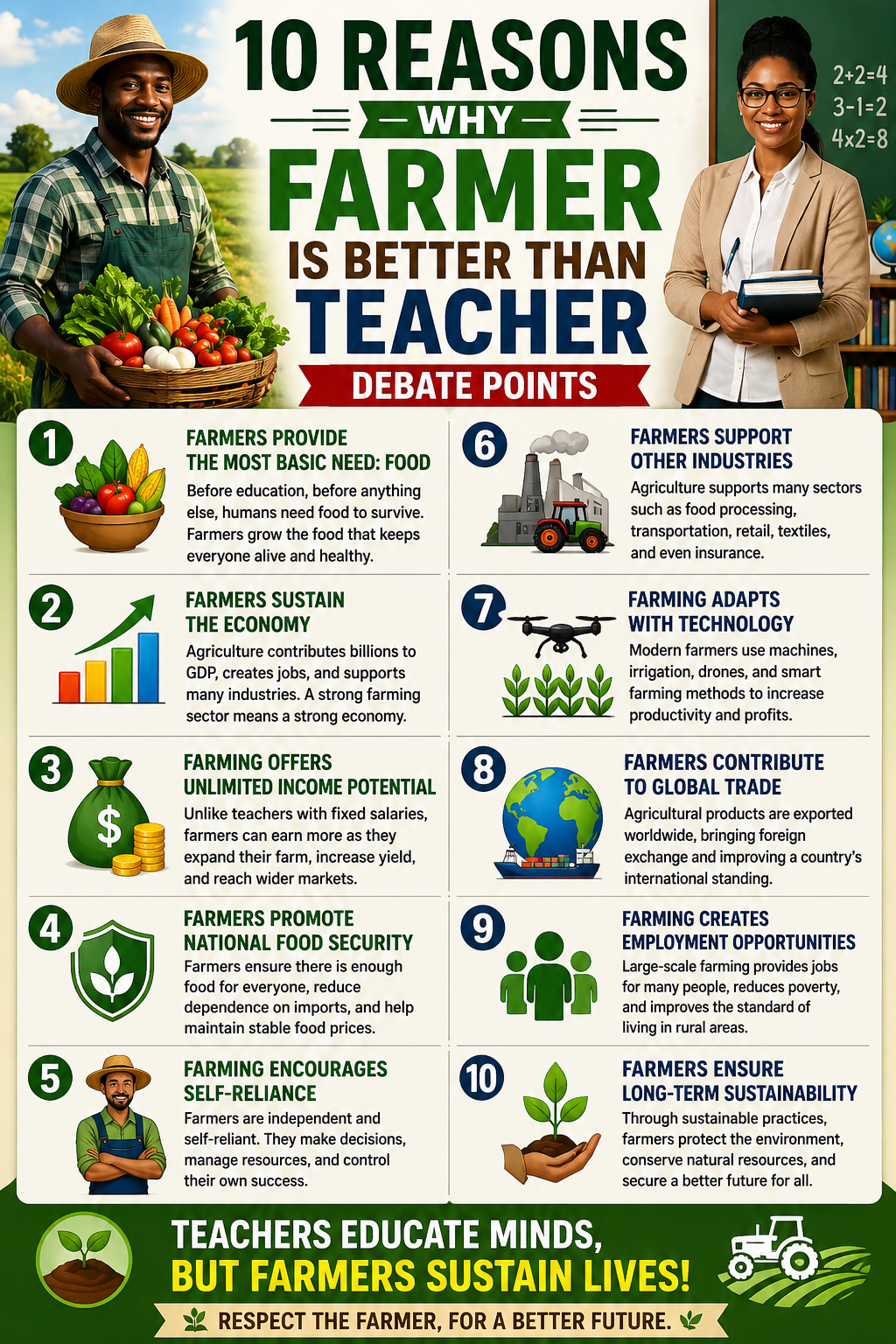
1. Farmers Provide the Most Basic Human Need: Food
Before education, before careers, before anything else—humans need food to survive.
Farmers are responsible for producing:
- Rice
- Vegetables
- Fruits
- Livestock
Without them, society literally stops functioning.
A teacher can educate minds, yes—but without food, there would be no students in classrooms.
2. Farmers Sustain the Economy Through Agriculture
Agriculture is one of the largest sectors in many economies, especially in countries like Nigeria.
Farmers contribute to:
- GDP growth
- Export revenue
- Job creation
In fact, large-scale farming is now linked to investment planning, agribusiness funding, and financial services, making it a high-value economic activity.
See also: How to Use the Pomodoro Technique to Smash Your WAEC and JAMB Exams
3. Farming Offers Unlimited Income Potential
Unlike fixed salaries, farming can scale.
A teacher typically earns a structured monthly wage. But a farmer?
Income depends on:
- Land size
- Crop yield
- Market demand
Successful farmers can generate six-figure annual income streams, especially with commercial farming and exports.
4. Farmers Promote National Food Security
A country that cannot feed itself is vulnerable.
Farmers help ensure:
- Food availability
- Reduced dependency on imports
- Price stability
Without strong agricultural systems, nations face inflation and shortages.
5. Farming Encourages Self-Reliance
Farmers are independent by nature.
They:
- Own their production
- Control their output
- Decide their growth
This level of independence is rare in traditional professions like teaching, where individuals often rely on institutional structures.
6. Farmers Support Other Industries
Agriculture doesn’t exist in isolation.
See more: How to Handle Panic Attacks in the Exam Hall: A Survival Guide for Nigerian Students
It supports:
- Food processing industries
- Transportation sectors
- Retail markets
Even industries tied to insurance, logistics, and financial services benefit from agricultural activity.
7. Farming Adapts With Technology
Modern farming isn’t outdated—it’s evolving.
Today’s farmers use:
- Irrigation systems
- Drones
- Data analytics
This makes agriculture one of the fastest-growing sectors tied to innovation.
8. Farmers Contribute to Global Trade
Agricultural exports generate massive revenue.
Products like:
- Cocoa
- Palm oil
- Grains
…are traded internationally, bringing foreign exchange into the economy.
9. Farming Creates Employment Opportunities
Large farms employ:
- Laborers
- Technicians
- Distributors
This means one farmer can indirectly create jobs for dozens of people.
10. Farmers Ensure Long-Term Sustainability
Farming, when done responsibly, supports environmental balance.
Through:
- Crop rotation
- Sustainable practices
- Soil management
Farmers play a key role in preserving ecosystems.
People Also Ask
Is farmer better than teacher in debate?
It depends on the angle. If the focus is survival, economy, and food security, farmers often have the stronger argument. If the focus is education and knowledge development, teachers may take the lead.
What are the advantages of being a farmer?
Farmers enjoy:
- Independence
- Scalable income
- Contribution to food supply
- Business growth opportunities
Modern farming also connects with investment planning and agribusiness financing, increasing its profitability.
Why are farmers important to society?
Farmers are essential because they provide food, support the economy, and ensure national stability. Without them, societies would struggle to function.
Check out: Education Is a Scam vs Education Is the Key: A Balanced Debate for Today’s World
Who earns more, farmer or teacher?
Traditionally, teachers have stable salaries. However, large-scale farmers can earn significantly more, especially in commercial agriculture.
What are the disadvantages of being a teacher?
Some challenges include:
- Fixed income
- Limited scalability
- High workload
That said, teaching remains one of the most respected professions globally.
Related Searches Answered
10 reasons why teacher is better than farmer
Teachers:
- Educate future leaders
- Shape society intellectually
- Promote knowledge and innovation
This makes the debate balanced depending on perspective.
Farmer vs teacher debate conclusion
A strong conclusion acknowledges both roles but emphasizes the argument you’re defending—in this case, the farmer’s contribution to survival and economy.
Debate points on agriculture importance
Read more: How to Study When You Are Feeling Depressed or Unmotivated (A Realistic Guide)
Key points include:
- Food production
- Economic impact
- Employment creation
- Global trade
Importance of farmers in Nigeria
In Nigeria, farmers:
- Drive local food production
- Reduce import dependency
- Support rural economies
Final Thoughts
At first glance, comparing farmers and teachers might seem unfair.
But debates aren’t about dismissing one role—they’re about highlighting strengths from a specific perspective.
And when you look closely, farmers stand at the very foundation of human survival.
No food, no life.
No life, no education.
That doesn’t make teachers less important—it simply shows that farmers operate at the most fundamental level of existence.