Here’s a complete post on woman education does not end in the kitchen debate points
If you’ve ever heard someone say, “A woman’s place is in the kitchen,” you already know how outdated—and limiting—that idea sounds. Yet, in many parts of the world, this belief still quietly shapes expectations about what girls should study, how far they should go in school, and what they’re “allowed” to become.
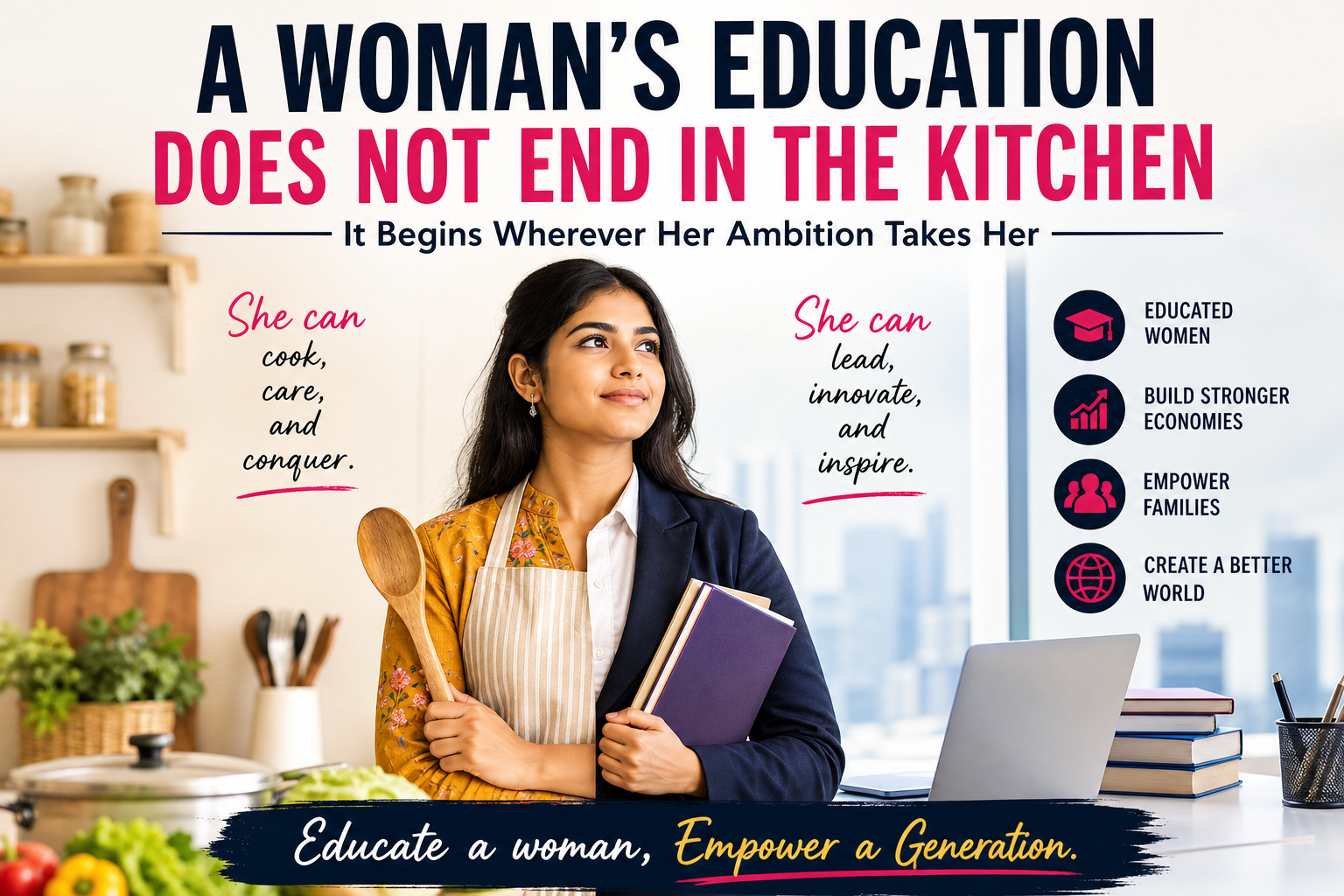
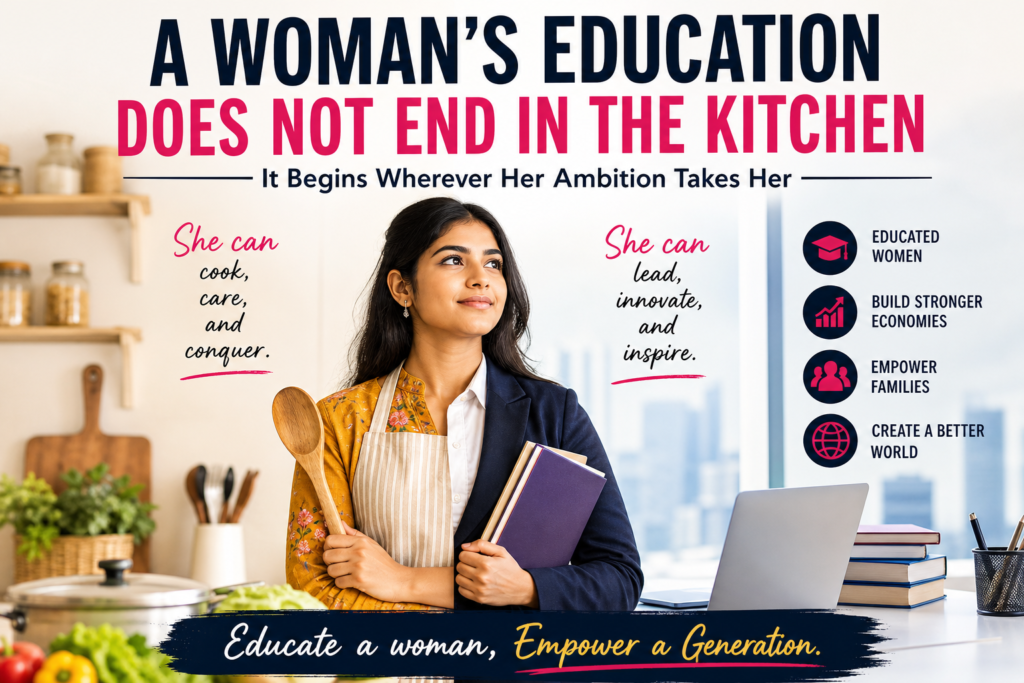
Let’s be clear: a woman’s education does not end in the kitchen, it begins wherever her ambition takes her.
This isn’t just a slogan. It’s a truth backed by history, economics, and everyday reality. In this blog post, we’ll break down strong, engaging debate points that prove why women’s education must go far beyond domestic roles—and why society benefits when it does.
Understanding the Statement
Before diving into arguments, it helps to understand what the phrase implies.
When people say “a woman’s education ends in the kitchen,” they’re suggesting that:
- Women are primarily meant for domestic roles
- Formal education for girls is unnecessary beyond basic skills
- Career ambition is secondary (or even inappropriate) for women
This perspective ignores the full potential of women as thinkers, leaders, innovators, and professionals.
Debate Point 1: Education Is a Fundamental Human Right
Education is not a privilege reserved for men—it is a basic human right for everyone, regardless of gender.
Read more: How to Handle Panic Attacks in the Exam Hall: A Survival Guide for Nigerian Students
Denying women access to full education limits their:
- Personal growth
- Economic independence
- Ability to make informed decisions
A girl deserves the same opportunity to study medicine, law, engineering, or business as any boy. Suggesting otherwise isn’t tradition—it’s restriction.
Debate Point 2: Educated Women Build Stronger Economies
When women are educated, entire economies grow.
Studies consistently show that:
- Educated women earn higher incomes
- They invest more in their families
- They contribute to national productivity
Imagine a society where half the population is undereducated. That’s not just unfair—it’s economically damaging.
Women aren’t just contributors; they are drivers of economic progress.
Debate Point 3: Education Empowers Women to Make Better Life Choices
Education gives women the power to:
- Make informed health decisions
- Plan their families
- Understand their rights
An educated woman is less likely to be trapped in harmful situations because she has the knowledge and confidence to choose differently.
This isn’t just about careers—it’s about control over one’s life.
Debate Point 4: Women Excel Beyond Domestic Roles
Let’s challenge a common myth: that women are naturally suited only for household duties.
In reality, women are:
- CEOs
- Scientists
- Engineers
- Politicians
- Entrepreneurs
From leading global companies to pioneering scientific breakthroughs, women have proven time and again that their abilities go far beyond the kitchen.
Limiting education limits potential—and the world loses out on talent.
Read more: How to Use the Cornell Method to Take Better Lecture Notes (And Stop Cramming)
Debate Point 5: Educating Women Improves Future Generations
Here’s a powerful truth:
When you educate a woman, you educate a generation.
Educated mothers are more likely to:
- Send their children to school
- Promote learning at home
- Raise confident, informed individuals
This creates a ripple effect that benefits families, communities, and entire nations.
Debate Point 6: Gender Equality Starts with Education
If we want a fair society, education must be equal.
When girls are denied advanced education:
- Gender inequality deepens
- Opportunities remain uneven
- Stereotypes continue
But when girls are encouraged to learn and grow, society moves closer to true equality.
Debate Point 7: The “Kitchen-Only” Mindset Is Outdated
The world has changed.
Today’s economy values:
- Innovation
- Critical thinking
- Digital skills
Limiting women to domestic roles ignores modern realities. It also overlooks the fact that many women successfully balance careers and home life.
The idea that education for women should stop at domestic skills simply doesn’t fit today’s world.
Debate Point 8: Women Contribute to All Sectors
From healthcare to technology, women play key roles in every industry.
See now: How to Use the Pomodoro Technique to Crush WAEC and JAMB (Without Burning Out)
Think about it:
- Who are the nurses, doctors, and researchers saving lives?
- Who are the teachers shaping young minds?
- Who are the entrepreneurs creating jobs?
Women.
Without proper education, these contributions would not be possible.
Debate Point 9: Education Builds Confidence and Independence
An educated woman is more likely to:
- Speak up for herself
- Pursue her goals
- Stand against injustice
Confidence comes from knowledge. Independence comes from opportunity.
Education provides both.
Debate Point 10: Society Progresses When Women Are Educated
No society can truly develop while holding women back.
Countries that invest in women’s education often see:
- Lower poverty rates
- Better healthcare outcomes
- Higher literacy levels
Progress isn’t possible when half the population is limited.
Counterargument (and Rebuttal)
“But women still need to manage homes, right?”
Yes—home management is important. But it’s not exclusive to women.
Modern families thrive when:
- Responsibilities are shared
- Both partners contribute
- Everyone has the freedom to pursue their goals
Education doesn’t take women away from the home—it equips them to manage life more effectively, both inside and outside it.
Read now: Pen is mightier than the sword debate points for secondary school
Real-Life Perspective
Look around you.
Women today are:
- Running businesses from home
- Working remotely in global companies
- Leading communities
- Pursuing higher education
Many of them still cook, care for families, and manage households—but that’s not all they do.
And it shouldn’t be.
Conclusion: Let Education Go Beyond Limits
The idea that a woman’s education ends in the kitchen is not just outdated—it’s harmful.
Women deserve:
- Equal opportunities
- Access to quality education
- The freedom to choose their paths
When women are educated, everyone benefits.
So the next time this debate comes up, remember this simple truth:
A woman’s education doesn’t end in the kitchen—it empowers her to shape the world.